
(7% discount is applied at checkout)
Cart is empty
Your go-to destination for cutting-edge server products
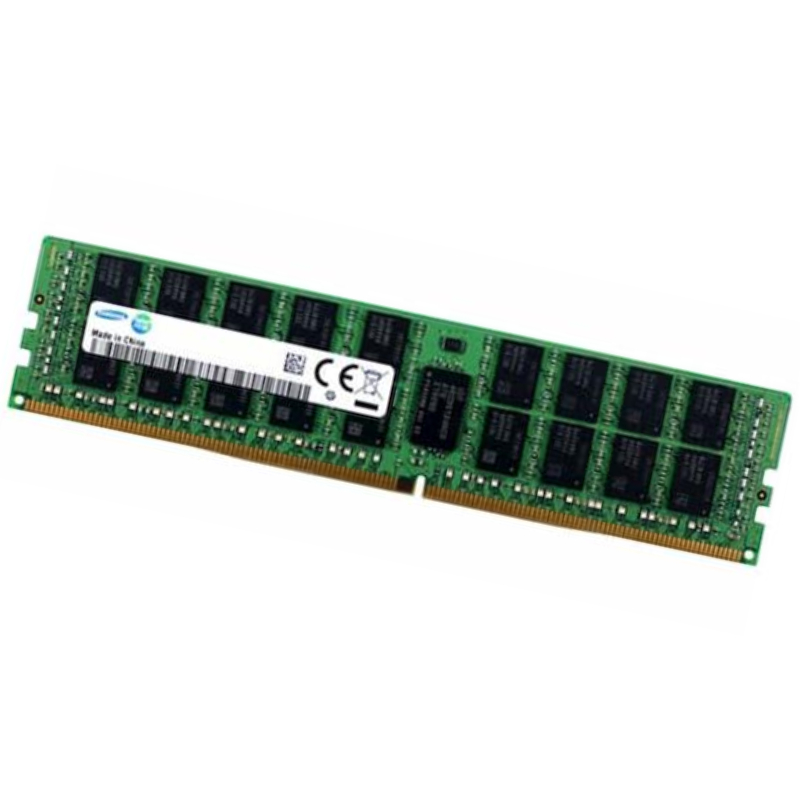
Samsung M321R4GA0PB2-CCPKC 32GB 6400MHz Pc5-51200 Cl52 ECC Registered Dual Rank X4 1.2v DDR5 Sdram 288-pin Rdimm Memory Module. New Sealed in Box (NIB) with 3 Years Warranty
The Samsung M321R4GA0PB2-CCPKC 32GB DDR5 SDRAM memory module offers high-performance capabilities, ideal for demanding applications. Designed to enhance system efficiency, this module operates with cutting-edge DDR5 technology for optimal speed and data integrity.
The landscape of server memory has evolved dramatically with the introduction of DDR5 technology, a leap forward designed to meet the escalating demands of modern data centers, cloud computing, and enterprise-level applications. At the heart of this evolution lies the Registered DIMM (RDIMM), a module type engineered for unwavering stability and maximum capacity in multi-channel configurations. The Samsung M321R4GA0PB2-CCPKC represents a pinnacle of this class, embodying the critical advancements in speed, error correction, and signal integrity that define next-generation server performance. This detailed exploration delves into the specifications and technologies that make this memory category essential for reliable enterprise operations.
Every character in this module's part number conveys specific technical information. "M32" indicates a 32GB capacity module, while "1R" denotes a single module package. "4GA" references the component organization. The "0PB2" segment often relates to the specific product revision and design. The suffix "CCPKC" is a crucial bin code, where "6400" represents the data transfer rate of 6400 Megatransfers per second (MT/s), "CL52" is the CAS Latency timing, and "1.2V" specifies the operating voltage. Understanding this nomenclature is key to identifying compatible and optimal memory for your server platform.
The physical and electrical design of this RDIMM is tailored for server environments. Its 288-pin interface is the standard for DDR5 modules but is keyed differently from desktop UDIMMs to prevent incorrect installation. The "Registered" component is a hardware register that buffers the address and command signals between the memory controller and the DRAM chips, reducing electrical load and enabling the population of more modules per channel without signal degradation. This is fundamental for servers requiring large amounts of total system memory.
The "Dual Rank, X4" designation describes the internal organization of the memory chips. A "rank" is a set of DRAM chips that work together to service a 64-bit data block (72-bit with ECC). A dual-rank module has two independent sets, allowing the memory controller to access one rank while preparing the other, improving efficiency through interleaving. The "X4" refers to the data width of the individual DRAM chips (4 bits). This organization, combined with on-DIMM Error Correction Code (ECC), is optimal for server reliability, as it allows for enhanced chipkill error correction, protecting against complete chip failures.
DDR5 memory is not merely an incremental speed boost over DDR4; it is an architectural overhaul. The Samsung 32GB 6400MHz module operates at a PC5-51200 data rate, which translates to a peak theoretical bandwidth of 51.2 GB/s per module. This immense bandwidth is critical for reducing bottlenecks in applications such as in-memory databases (like SAP HANA), high-frequency trading platforms, scientific simulations, and virtualization hosts running numerous virtual machines.
Despite the significant performance increase, the module operates at a standard 1.2V, which is lower than the typical DDR4 voltage of 1.2V for comparable speeds. This improvement in power efficiency is achieved through advanced silicon fabrication and circuit design. For large-scale data centers deploying thousands of servers, even a minor reduction in per-module power consumption translates to substantial operational cost savings and a lower thermal footprint, directly impacting cooling requirements and overall PUE (Power Usage Effectiveness).
A key innovation in DDR5 is the migration of voltage regulation from the motherboard to the memory module itself. Each RDIMM, like the Samsung M321R4GA0PB2-CCPKC, features an onboard PMIC. This allows for more precise and stable power delivery to the DRAM chips, minimizing noise and improving signal integrity—a must for achieving high data rates like 6400 MT/s reliably. The PMIC also enables better power monitoring and management capabilities at the DIMM level.
In enterprise environments, data integrity and system uptime are non-negotiable. This memory module incorporates two core technologies to ensure this: Error-Correcting Code (ECC) and a Registered Clock Driver (RCD).
ECC is a hardware-based technology that detects and corrects the most common types of data corruption in real-time. Each 64-bit data word is paired with an additional 8 bits for ECC, making it a 72-bit wide module. This allows the memory controller to not only detect single-bit and double-bit errors but also automatically correct single-bit errors without any performance penalty or operating system involvement. This prevents silent data corruption, system crashes, and application faults that could result from cosmic rays or electrical interference.
Reliability, Availability, and Serviceability (RAS) are enhanced by the underlying X4 chip architecture. In the event of a failure in a single DRAM chip (which is 4 bits wide), the ECC syndrome, using data from the other chips on the same rank, can reconstruct the lost data. This "Chipkill" level protection is analogous to a RAID-like functionality at the DIMM level and is a standard expectation for Tier-1 server memory.
The RCD is the component that makes an RDIMM "Registered." It acts as a command and address buffer, stabilizing these critical signals before they reach the DRAM chips. This buffering reduces the capacitive load on the server's memory controller, allowing a single channel to support a higher number of DIMMs—often up to 2 DIMMs per channel (2DPC) at high speeds like 6400MT/s. This is essential for scaling total system memory capacity in multi-socket servers designed for large-scale database and virtualized workloads.
The Samsung M321R4GA0PB2-CCPKC is designed for compatibility with the latest server platforms from major OEMs like Dell (PowerEdge), HPE (ProLiant), Lenovo (ThinkSystem), and Cisco (UCS), as well as with leading motherboard manufacturers for white-box servers. These platforms are built around Intel Xeon Scalable Processors (Emerald Rapids, Sapphire Rapids) and AMD EPYC 9004 Series (Genoa) CPUs, which feature memory controllers specifically architected for high-speed DDR5 RDIMMs.
Server CPUs utilize multi-channel memory architectures (e.g., 8-channel on Intel, 12-channel on AMD) to massively increase aggregate memory bandwidth. When populating a system, modules must be installed in matched sets per channel to enable this mode. A bank of eight 32GB 6400MHz RDIMMs, for example, can deliver over 400 GB/s of theoretical bandwidth to the CPU, ensuring that processors with dozens of cores are never starved for data.
The combination of high density (32GB), high speed (6400MHz), and robust reliability features makes this memory category ideal for specific demanding computational workloads.
Platforms like SAP HANA, Oracle Exadata, and various NoSQL databases keep entire datasets in RAM to eliminate storage latency. The high bandwidth of DDR5-6400 directly accelerates query performance, while the large 32GB per-module density allows for massive in-memory datasets. ECC protection is absolutely critical here, as a single uncorrected memory error could corrupt a database.
Scientific computing, financial modeling, and the training phases of machine learning involve iterative calculations on vast matrices. These workloads are often memory-bandwidth-bound. The bandwidth provided by modules like this DDR5-6400 RDIMM ensures that powerful multi-core CPUs and attached accelerators (GPUs) are fed data as quickly as possible, reducing total computation time and improving resource utilization in cluster environments.
Modern hypervisors (VMware vSphere, Microsoft Hyper-V, KVM) allow for the consolidation of dozens of virtual machines on a single physical host. Each VM requires dedicated memory space. The high density of 32GB modules allows for greater VM density per server, while the RAS features maintain stability across mixed workloads. The registered buffer architecture is key to supporting the large number of DIMMs required for such high total memory capacities (often 1TB or more per server).


 Contact Us
 Information
 Catalog
 Solid State Drives (SSD)
 Network Switches
 Hard Disk Drives
 HBA & Controllers
 PC & Servers
 PC & Server Memory
 CPU & Processors
 Network Routers
 Power Supplies
 Tape Drives & Libraries
 Network Devices
 Computer & Network Cables