
(7% discount is applied at checkout)
Cart is empty
Your go-to destination for cutting-edge server products
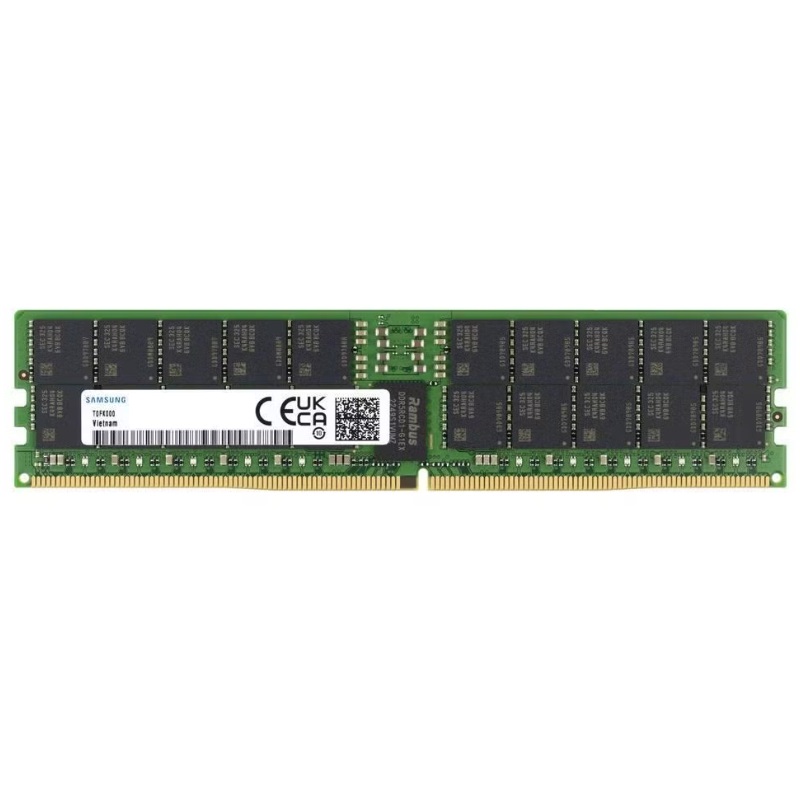
Samsung M321R8GA0BB0-CQKRH 64GB DDR5 4800MBPS PC5-38400 Dual Rank ECC Registered 1.1v Cl40 Sdram 288-pin Rdimm Memory. New Sealed in Box (NIB) with 3 Years Warranty
The Samsung M321R8GA0BB0-CQKRH 64GB DDR5 4800MBPS PC5-38400 Dual Rank ECC Registered 1.1v Cl40 SDRAM 288-pin RDIMM Memory is a high-performance, enterprise-grade memory module designed for demanding computing environments. It offers advanced memory technology that enhances server performance, reliability, and efficiency, making it an ideal choice for data centers, workstations, and high-performance computing systems. This memory module combines the latest DDR5 technology with the security and error correction capabilities of ECC to deliver superior stability and fast data transfer speeds.
Product Details
Ideal Deployment Scenarios
The Samsung M321R8GA0BB0-CQKRH represents a pinnacle of reliability and performance in the realm of enterprise and high-stakes computing. This specific 64GB DDR5 module is not your standard desktop memory; it is a meticulously engineered component designed for systems where data integrity, continuous uptime, and massive data throughput are non-negotiable. As a DDR5 ECC Registered RDIMM (Redundant Dual In-line Memory Module), it is the lifeblood of servers, data center racks, high-performance workstations, and critical computational infrastructure. Its specifications—4800MT/s, dual-rank, CL40, and a low operating voltage of 1.1V—speak to a harmonious balance of speed, capacity, stability, and power efficiency, addressing the complex needs of modern IT landscapes.
Operating at a bus speed of 4800MBPS (DDR5-4800 / PC5-38400), this module offers a significant leap in throughput over DDR4 technology. The increased data rate allows faster communication between the processor and memory, which directly translates into reduced latency for memory-intensive tasks. Featuring a CAS latency of CL40, this DDR5 RDIMM strikes a practical balance between speed and reliability. While enterprise memory prioritizes stability over ultra-low latency, the optimized timing profile ensures consistent performance under sustained workloads.
The leap from DDR4 to DDR5 is architectural. While the 4800 Megatransfers per second (MT/s) data rate offers a significant bandwidth increase over standard DDR4, the innovations run deeper. DDR5 introduces a paradigm shift with its dual 32-bit sub-channels per module. This effectively allows the memory controller to handle two independent 32-bit data pathways simultaneously, improving efficiency for smaller, more concurrent data requests—a common pattern in server workloads. The result is not just faster peak bandwidth but smarter, more granular data handling.
With a substantial 64GB capacity in a single module, this DDR5 memory is optimized for applications that require large memory pools. Virtualization platforms, in-memory databases, cloud infrastructure, and analytics workloads benefit from the ability to handle higher data volumes without compromising responsiveness.
Power Management Integrated Circuit (PMIC)
A cornerstone of DDR5's efficiency is the relocation of power regulation from the motherboard to the memory module itself via an integrated PMIC. This provides superior voltage control, reduces signal noise, and enhances signal integrity. The PMIC is a key enabler for the module's low 1.1V operating voltage, which directly translates to reduced power consumption and heat generation at scale—a critical factor for data centers operating thousands of modules, where even marginal wattage savings per DIMM amount to substantial operational cost reductions and a lower carbon footprint.
In mission-critical applications, a single-bit memory error can cause system crashes, data corruption, or silent computational errors. ECC memory, like this Samsung module, includes extra bits to detect and automatically correct single-bit errors on the fly. It can also detect (though not correct) multi-bit errors, alerting the system to a serious issue. This continuous memory scrubbing is invisible to the operating system but is fundamental for maintaining data integrity in financial modeling, scientific research, database transactions, and virtualization hosts.
A Registered DIMM incorporates a register (or buffer) on the module that sits between the memory controller and the DRAM chips. This register buffers the command, address, and clock signals, reducing the electrical load on the memory controller. The primary benefit is that the controller can drive more memory modules without signal degradation. This allows servers to support much higher total memory capacities (often into the multi-terabyte range) and maintain stability with heavily populated memory channels. The trade-off is a tiny, consistent latency penalty (the CL40 timing), which is vastly outweighed by the gains in capacity and system stability for target applications.
The module's speed of 4800MT/s (MegaTransfers per second) defines its peak data transfer rate. In terms of bandwidth, a single module provides up to 38.4 GB/s (4800 MT/s * 8 bytes/transfer). However, raw speed is only one part of the performance equation. CAS Latency (CL40) measures the delay, in clock cycles, between the memory controller requesting data and the first piece of data being available. A higher CAS latency at a given speed can indicate more clock cycles of delay. However, because DDR5 clocks are faster (shorter clock cycles), absolute latency in nanoseconds is a more meaningful comparison. The combination of 4800MT/s and CL40 in this Samsung module is tuned for optimal balance in server environments, prioritizing massive throughput and rock-solid stability over the ultra-low latency sought in gaming DRAM.
The designation PC5-38400 is the module's classification based on its peak bandwidth. "PC5" indicates it is a DDR5 module. The number "38400" refers to its theoretical maximum bandwidth in megabytes per second (MB/s). This is calculated as (4800 MT/s * 8 bytes) = 38,400 MB/s. This labeling provides a quick, standardized way to identify the module's performance tier within the DDR5 ecosystem.
The Samsung M321R8GA0BB0-CQKRH utilizes the standard 288-pin RDIMM form factor. It is physically and electrically incompatible with DDR4 (which uses a 288-pin design but with a different key notch position) and desktop UDIMMs. This module is exclusively designed for server and workstation motherboards that feature DDR5 memory slots supporting the Registered (RDIMM) and ECC protocol. It is crucial to verify compatibility with specific system vendor qualification lists (e.g., Dell, HPE, Lenovo, Supermicro) or motherboard QVLs before integration.
This memory is the default choice for modern data center servers. Its reliability and capacity enable: Virtualization Hosts (VMware, Hyper-V, KVM): Running dozens of virtual machines requires massive, error-resistant memory pools. Database Servers (SQL, Oracle, NoSQL): In-memory databases and large query caches depend on high-capacity, stable RAM for performance and transactional integrity. Cloud Infrastructure and Storage Controllers: Foundational hardware for public/private clouds and storage arrays (like SAN/NAS) where caching and metadata operations are memory-heavy.
Samsung is a tier-one manufacturer of DRAM chips, renowned for its rigorous quality control and cutting-edge semiconductor processes. Choosing a first-party Samsung module ensures: Component Integrity: The use of Samsung's own DRAM chips, PCB, and firmware ensures optimal compatibility and performance. Thermal Management: High-quality components and design contribute to stable thermal performance under sustained load. Long-Term Reliability and Support: Samsung modules are built to exacting standards for mean time between failures (MTBF), offering peace of mind for long-term deployments.
Always consult your system or motherboard manufacturer's documentation. While the Samsung M321R8GA0BB0-CQKRH adheres to industry standards, server OEMs often have specific firmware requirements or validated part lists. Using qualified memory ensures full performance, compatibility with system management features (like IPMI/iDRAC/iLO), and retains warranty coverage. This Samsung DDR5 RDIMM is designed for compatibility with servers and workstations that support DDR5 registered ECC memory. It is well-suited for enterprise IT infrastructures, high-performance computing clusters, and professional-grade systems that demand dependable memory performance.


 Contact Us
 Information
 Catalog
 Solid State Drives (SSD)
 Network Switches
 Hard Disk Drives
 HBA & Controllers
 PC & Servers
 PC & Server Memory
 CPU & Processors
 Network Routers
 Power Supplies
 Tape Drives & Libraries
 Network Devices
 Computer & Network Cables