(7% discount is applied at checkout)
Cart is empty
Your go-to destination for cutting-edge server products
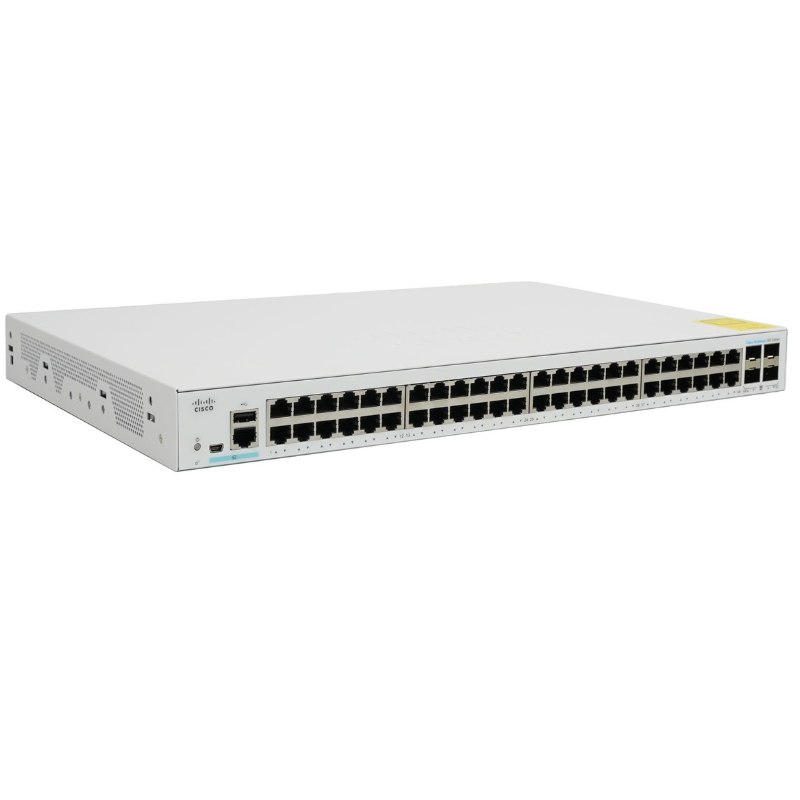


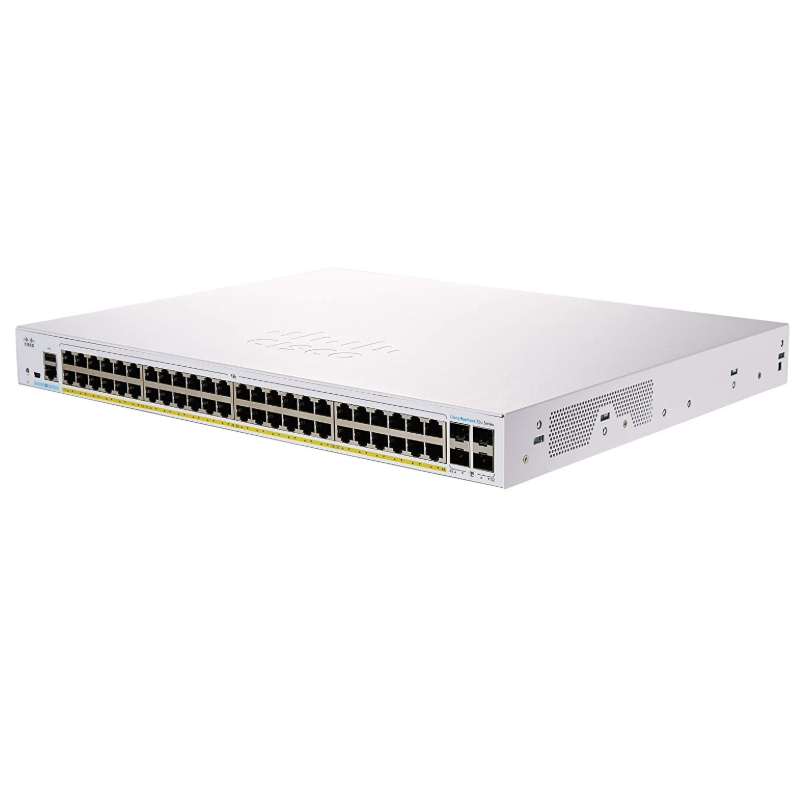
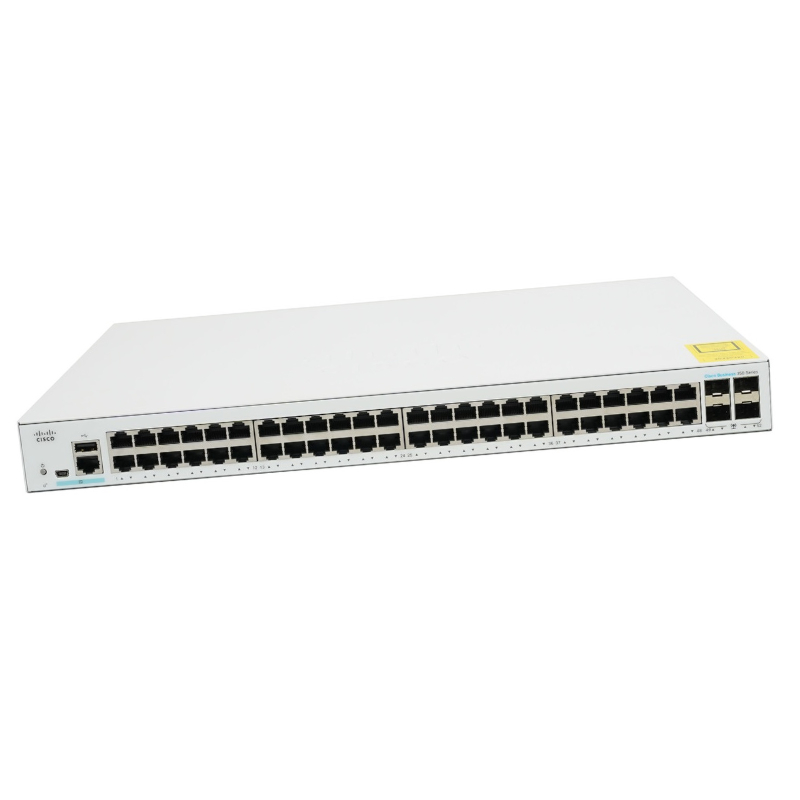
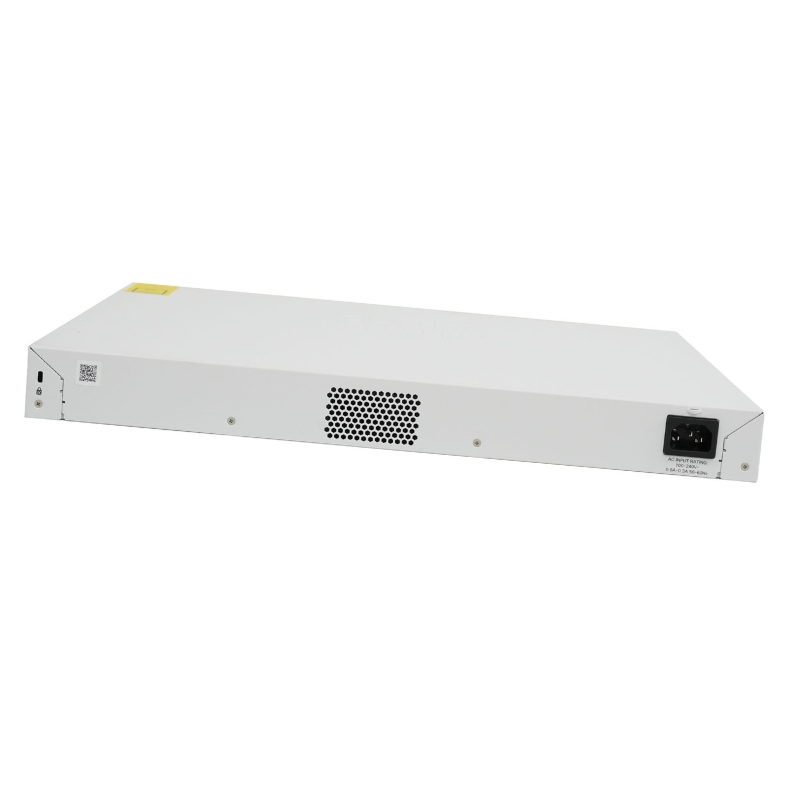
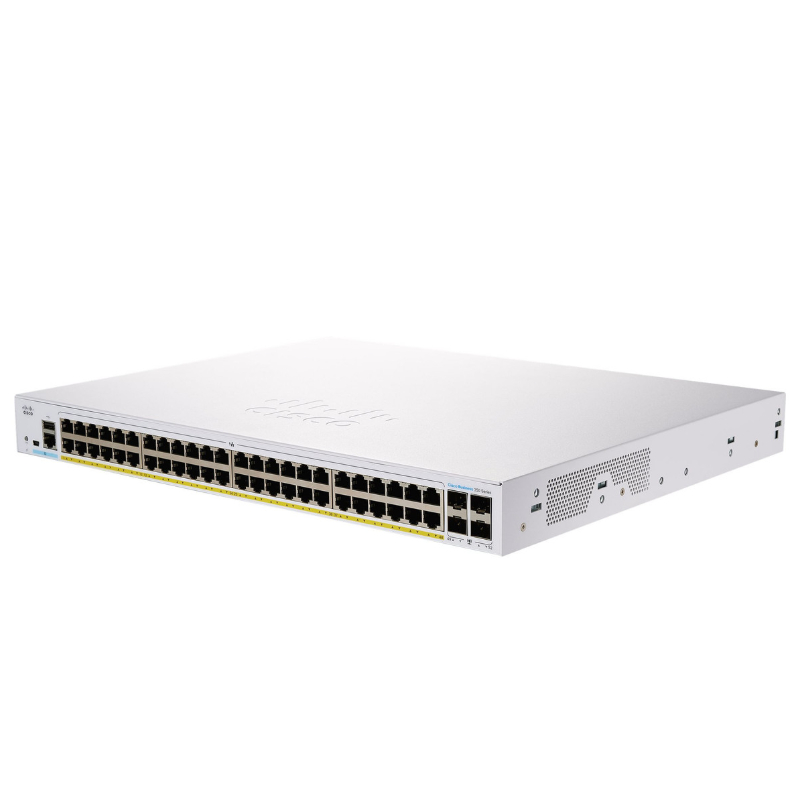
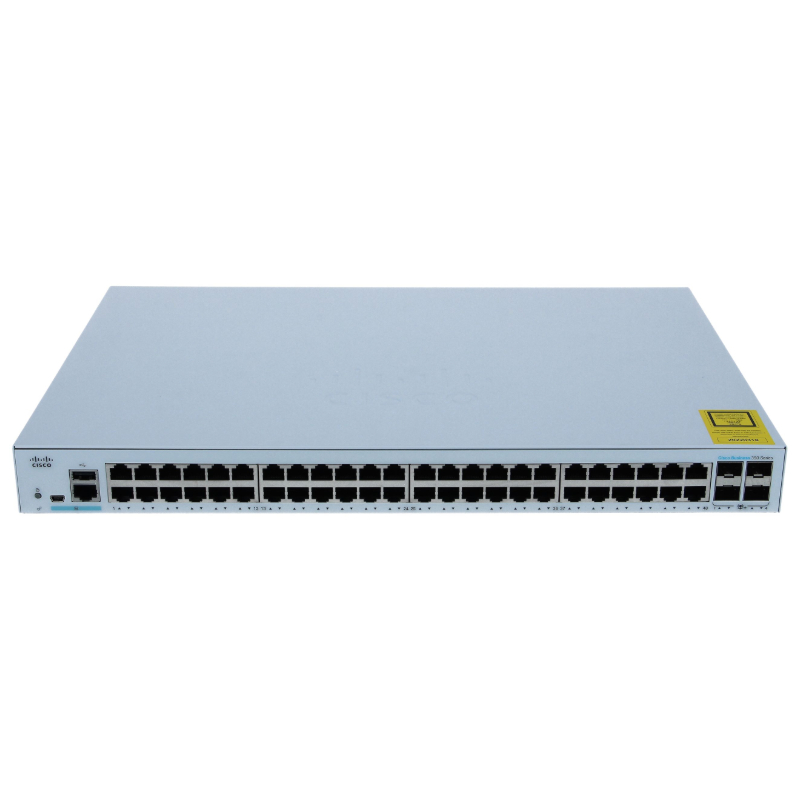
Cisco CBS350-48T-4X-NA 350 CBS350-48T-4X 48 Ports Manageable 2 Layer Ethernet Switch. Excellent Refurbished with 1 year replacement warranty
| SKU/MPN | Warranty | Price | Condition | You save |
|---|---|---|---|---|
| CBS350-48T-4X-NA | 1 Year Warranty | $670.00 | Excellent Refurbished | You save: $234.50 (26%) |
| CBS350-48T-4X-NA | 1 Year Warranty | $1,285.00 | Factory-Sealed New Retail in Original Box (FSB) | You save: $449.75 (26%) |
The Cisco CBS350-48T-4X-NA is a high-efficiency, Layer 3 managed Ethernet switch engineered for businesses seeking stable performance, broad connectivity options, and advanced network control. Designed for rack-mount setups, it integrates robust hardware with enterprise-grade security and flexible management capabilities.
This switch supports a wide array of dynamic and static routing protocols to streamline data distribution across large networks:
The device adheres to essential IEEE networking standards, including:
The Cisco CBS350-48T-4X-NA 350 CBS350-48T-4X 48 Ports Manageable 2 Layer Ethernet Switch represents a complete category of reliable, high-density Layer 2 switching that is designed for modern small and medium business networks, branch offices, campus edge deployments, and converged application environments. This category description explores the technical capabilities, deployment patterns, management and security features, cabling and physical considerations, performance expectations, and buyer guidance that make the CBS350-48T-4X-NA a practical and search-optimized target for organizations looking to balance cost, control, and growth.
At the heart of the Cisco CBS350-48T-4X-NA category is the need to deliver predictable switching for networks that require a full complement of access ports, flexible uplink capacity, and advanced Layer 2 functionality without the overhead of enterprise-class Layer 3 routing. Typical deployment scenarios include the network edge for multi-floor offices, wiring closets supporting dozens of users and wired devices, server access for small virtualization hosts and NAS storage, VoIP phone farms, and wireless access point aggregation points where aggregated traffic flows to a distribution layer. The inclusion of four high-capacity uplink interfaces allows the CBS350-48T-4X family to accommodate converged traffic — data, voice, and low-latency storage — and to provide future headroom for link aggregation and fiber interconnect.
This switch category emphasizes high port density, featuring forty-eight Gigabit Ethernet copper access ports alongside four high-speed uplink ports. The physical layout is optimized to maximize horizontal cabling efficiency in standard rack or wall-mount installations while keeping the table space required for patch panels and cable management minimal. The dense access port count enables centralized device connectivity for offices that prefer to consolidate endpoints to a single switch rather than distribute multiple smaller switches across a floor. The four uplinks typically use SFP+ or 10 Gigabit-capable interfaces and are intended to carry aggregated upstream traffic, provide redundancy to distribution switches, or connect directly to storage aggregation or high-performance servers.
The CBS350-48T-4X-NA family is commonly offered in compact rack-mountable enclosures suited for 19-inch racks and shallow cabinets. For network designers, this means predictable rack space planning, consistent airflow requirements, and straightforward cable management. Power provisioning should be planned with attention to redundancy and the cumulative draw of all connected devices. Although some models in the broader product line support PoE for powering devices such as IP phones and access points, the specific CBS350-48T-4X-NA designation focuses on port density and uplink capacity; buyers should confirm PoE requirements separately when selecting a model.
The CBS350-48T-4X-NA sits squarely in the managed Layer 2 category, which means it provides a robust set of switching protocols and features that allow network administrators to segment, prioritize, and protect traffic at the access layer. Industry-standard Layer 2 capabilities included in this class of switch typically include support for 802.1Q VLANs for logical segmentation, Quality of Service (QoS) to prioritize latency-sensitive flows, Link Aggregation Control Protocol (LACP) for increased throughput and redundancy, Spanning Tree Protocol (STP) variations for loop avoidance, and IGMP snooping to optimize multicast distribution. These features ensure the switch can deliver traffic deterministically across mixed workloads while integrating smoothly with existing network topologies.
VLAN implementation in the CBS350-48T-4X-NA category enables administrators to isolate user groups, separate guest access from corporate resources, and create security zones for IoT and operational technology devices. Quality of Service mechanisms are equally important; in environments that run VoIP phones, video conferencing, or real-time application workloads, the ability to classify and prioritize packets at the access layer reduces jitter and improves overall user experience. The combination of VLANs and QoS provides a foundation for predictable performance and secure separation without requiring complex routing at the access switch.
Efficient handling of multicast traffic through IGMP snooping is a key requirement when streaming content or deploying unified communications across the network. The CBS350-48T-4X family’s Layer 2 intelligence allows multicast group membership to be tracked and multicast streams to be forwarded only where needed. Broadcast containment features and storm control help preserve switching capacity and prevent a misbehaving endpoint from degrading performance for all connected devices.
Security at the access layer is critical because this is where users and endpoints connect. The CBS350-48T-4X-NA category supports essential edge security features designed to minimize unauthorized access and contain threats close to their source. Common protections include port-based access control, dynamic host configuration protections, and features that mitigate address spoofing. Administrators can use Access Control Lists (ACLs) to restrict which endpoints may communicate across specific VLANs and employ tools to detect and respond to anomalies in link behavior.
In environments that require strict user authentication, edge switches can integrate with 802.1X authentication systems to enforce user or device identity before granting network access. This is particularly important in locations that host sensitive systems or regulatory data. Where 802.1X is not implemented, MAC-based access control and static port assignments provide simpler, though less flexible, alternatives to limit access based on device identifiers.
Features such as storm control, DHCP snooping, and IP source guard reduce the risk that compromised or misconfigured endpoints will cause network-wide disruptions. Rate-limiting at the port level, combined with monitored alerts for unusual activity, helps isolate suspicious devices and prevents a single point of failure from cascading into a larger outage.
Buyers selecting a CBS350-48T-4X-NA switch should evaluate throughput and low-latency behavior under realistic loads. With forty-eight Gigabit access ports, typical aggregated throughput across the uplinks can reach very high levels when ports are utilized concurrently. The presence of four high-capacity uplinks enables administrators to plan link aggregation groups that distribute traffic evenly and maintain low contention. Performance is further influenced by QoS settings, the presence of multicast traffic, and the extent to which features like ACL processing or deep packet inspection are engaged.
Understanding backplane capacity and forwarding rates helps align switch selection with the expected traffic profile. A device in this class is built to switch line-rate traffic across all access ports when operating at 1 Gbps per port, but practical throughput will depend on whether traffic patterns are local between access ports or destined off-switch through the uplinks. For environments with heavy east-west server traffic or storage traffic, ensuring sufficient uplink bandwidth and considering additional aggregation options is essential to maintain consistent performance.
A pragmatic benefit of the CBS350-48T-4X-NA category is its compatibility with industry-standard protocols and interfaces. It supports common Ethernet features that allow smooth interoperability with distribution and core switches from various vendors. When integrating into multi-vendor environments, administrators should pay attention to consistent configurations for VLAN trunking, link aggregation, Spanning Tree timers, and QoS markings to avoid traffic disruption. Using industry-standard SFP or SFP+ modules for uplinks provides flexibility in selecting fiber transceivers that match fiber plant and distance requirements.
While stacking hardware can simplify management and create a single logical switch across multiple units, many deployments use uplink aggregation and centralized distribution to achieve similar outcomes without proprietary stacking hardware. For organizations that expect growth, designing a modular architecture where additional CBS350 switches are added as more access ports are needed allows predictable scaling. Linking new switches via high-speed uplinks and configuring LACP groups for redundancy keeps the network resilient as device counts increase.
Proper cabling is fundamental to achieving the performance the CBS350-48T-4X-NA family promises. For copper access ports, category-rated twisted pair cabling installed to industry standards ensures Gigabit performance and long-term reliability. For uplinks that use 10 Gigabit interfaces, multimode or single-mode fiber must be selected based on distance, transceiver compatibility, and future growth plans. Thoughtful cable management, labeling, and patch panel organization not only improve mean time to repair but also provide a professional look and predictable airflow for thermal management in rack environments.
Power planning should take into account peak loads during power cycles and the potential need for redundancy. In installations where continuous availability is required, redundant power sources, UPS integration, and consideration of power distribution within the rack contribute to uptime objectives. If a PoE-capable model is required, the designer must account for the total PoE budget and how power draws will change when devices reboot, during firmware updates, or when additional endpoints are added.


 Contact Us
 Information
 Catalog
 Solid State Drives (SSD)
 Network Switches
 Hard Disk Drives
 HBA & Controllers
 PC & Servers
 PC & Server Memory
 CPU & Processors
 Network Routers
 Power Supplies
 Tape Drives & Libraries
 Network Devices
 Computer & Network Cables