
(7% discount is applied at checkout)
Cart is empty
Your go-to destination for cutting-edge server products
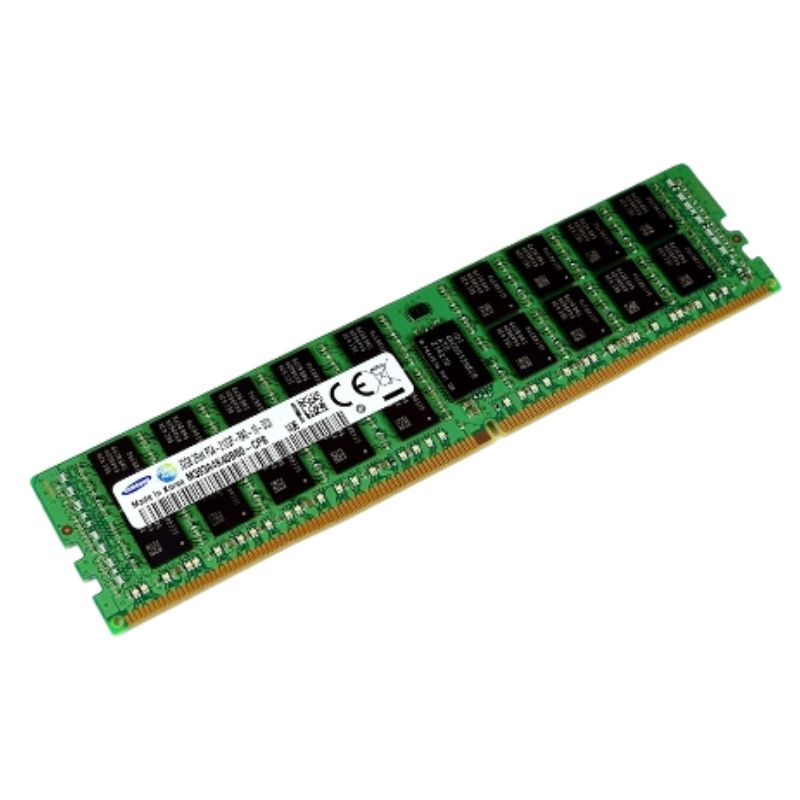
Samsung M321R4GA3EB2-CCP PC5-51200 DDR5-6400MHz 32GB ECC Ddr5 Sdram 288-pin Rdimm Memory Module. New Sealed in Box (NIB) with 3 Years Warranty
| SKU/MPN | Warranty | Price | Condition | You save |
|---|---|---|---|---|
| M321R4GA3EB2-CCP | 1 Year Warranty | $1,137.00 | New (System) Pull | You save: $397.95 (26%) |
| M321R4GA3EB2-CCP | 1 Year Warranty | $1,440.00 | New Sealed in Box (NIB) | You save: $504.00 (26%) |
The Samsung M321R4GA3EB2-CCP represents one of the most advanced memory solutions available today in the server and data center market. Classified under the PC5-51200 DDR5 ECC Registered DIMMs (RDIMMs), this memory module operates at blazing-fast DDR5-6400MHz speeds and offers 32GB of high-efficiency capacity. Designed specifically for performance-intensive workloads, this 288-pin ECC RDIMM module delivers unmatched bandwidth, improved reliability, and scalability for modern enterprise infrastructures.
The advent of DDR5 SDRAM represents a monumental leap forward in server memory technology, setting a new standard for performance, efficiency, and reliability in enterprise and data center environments. Unlike its predecessor, DDR4, DDR5 architecture introduces a paradigm shift with its on-die ECC (Error Correction Code), higher base speeds, dual 32-bit subchannels per module, and a significantly improved power management system. This category of memory is engineered to meet the escalating demands of cloud computing, artificial intelligence, machine learning workloads, virtualization, and high-performance databases. The Samsung M321R4GA3EB2-CCP 32GB module is a quintessential example of this advanced generation, embodying the critical features that make DDR5 the backbone of next-generation server infrastructure.
DDR5 memory modules are not merely an incremental upgrade; they are a complete re-engineering of the memory subsystem. A fundamental change is the shift of the power management IC (PMIC) from the motherboard to the memory module itself. This relocation allows for finer-grained voltage control, improved signal integrity, and enhanced power delivery efficiency, which is crucial for stability at high data rates. Furthermore, the burst length is doubled to BL16, and bank groups are increased, allowing for greater parallelism and higher effective bandwidth. These architectural enhancements collectively reduce latency bottlenecks and increase overall system throughput, enabling servers to process more data simultaneously with greater precision.
The designation "PC5-51200" is a critical specification that defines the module's theoretical peak transfer rate. PC5 refers to the DDR5 standard, while 51200 indicates a bandwidth of 51200 MB/s per module. This is calculated from the I/O clock speed of 6400 Megatransfers per second (MT/s), with each transfer moving 8 bytes of data (6400 x 8 = 51200 MB/s). This staggering bandwidth, a substantial increase over DDR4's common PC4-25600 (3200 MT/s), directly translates to faster data access for CPUs, reducing wait states and accelerating computation across all cores. This makes modules like the Samsung M321R4GA3EB2-CCP ideal for memory-intensive applications where data throughput is a limiting factor.
The 6400 Mbps (more accurately, 6400 MT/s) data rate signifies the number of operations the memory module can perform per second on its I/O bus. In a server context, this high speed ensures that multi-core processors, such as Intel Xeon Scalable or AMD EPYC CPUs, are consistently fed with data, preventing core starvation and maximizing utilization. The increase in data rate is achieved through advanced signaling techniques and improved manufacturing processes, allowing for reliable operation at higher frequencies while maintaining strict signal integrity requirements essential for server stability.
This specific Samsung module is a meticulously engineered component designed for professional server deployment. Its part number, M321R4GA3EB2-CCP, encodes its specifications: a 32GB capacity, part of the DDR5 Registered (RDIMM) family. Each specification plays a vital role in determining compatibility, performance, and suitability for particular server workloads.
The 32GB capacity per module offers an optimal balance between density and cost for many mainstream server configurations. The "(1x32GB)" denotes a single module providing 32 gigabytes of memory. The "Dual Rank" configuration indicates that the module's memory chips are organized into two independent sets (ranks) that can be accessed separately. While not doubling the physical channels, dual ranking improves memory controller efficiency by allowing interleaved accesses between ranks, effectively hiding precharge and activation delays, thus boosting overall performance compared to a single-rank module of the same capacity. The "x8" refers to the physical organization of the DRAM chips, meaning each chip has an 8-bit data interface. x8 configuration is standard for server-grade memory as it provides an optimal balance of reliability, capacity, and support for advanced error correction.
This module incorporates two cornerstone server memory technologies: ECC (Error-Correcting Code) and a Registered (Buffered) design. ECC is non-negotiable in mission-critical systems. It detects and corrects single-bit memory errors on-the-fly and detects multi-bit errors, preventing silent data corruption that could lead to application crashes, data loss, or computational inaccuracies. The "Registered" aspect, signified by "RDIMM" (Registered Dual In-Line Memory Module), incorporates a register (or buffer) on the module that sits between the memory controller and the DRAM chips. This register buffers the command and address signals, reducing the electrical load on the memory controller. This allows a system to support a much greater number of memory modules per channel (increasing maximum total system memory) while maintaining signal integrity and stability at high speeds, which is paramount in multi-socket servers populated with numerous DIMMs.
DDR5 operates at a lower voltage than DDR4, with this module running at a standard 1.1 volts. This reduction in voltage is a key contributor to improved power efficiency, lowering the total power consumption of the server's memory subsystem—a critical factor for large-scale data center operational costs (OPEX) and thermal management. The CAS Latency (CL) of 52, often expressed as CL52, is the number of clock cycles between a read command and the moment data is available. While this number is higher in absolute terms compared to DDR4 (e.g., CL22), it is relative to the much faster clock cycle of DDR5. When calculating actual latency in nanoseconds (ns), the formula is (CL / Clock Speed in MHz) * 2000. For this 6400 MT/s module (3200 MHz clock), the approximate latency is (52 / 3200) * 2000 = 32.5 nanoseconds, which is competitive with or better than many DDR4 modules, offering a superior combination of high bandwidth and responsive latency.
The physical interface is defined by the 288-pin edge connector. It is imperative to note that DDR5 modules are not backward compatible with DDR4 slots due to a different pin count, key notch position, and electrical requirements. The "RDIMM" designation confirms this is a Registered module, meaning it is exclusively compatible with server platforms (Intel and AMD) that support Registered memory. It will not work in consumer desktop platforms that only accept Unbuffered (UDIMM) memory. Verifying motherboard and CPU compatibility lists is essential before integration.
Samsung DDR5 RDIMMs like the M321R4GA3EB2-CCP are purpose-built for demanding, 24/7 enterprise environments. Their combination of high bandwidth, large capacity, and robust reliability features makes them ideal for specific compute-intensive and data-sensitive workloads.
In virtualized server environments, physical memory is a shared resource among multiple virtual machines (VMs). High memory bandwidth and large per-module capacity directly increase VM density—the number of VMs a single host can support efficiently—and improve the performance of each VM by reducing I/O contention. The ECC functionality is critical here to maintain the integrity of data belonging to different tenants or services hosted on the same physical hardware.
Databases like SAP HANA, Oracle Database In-Memory, and various real-time analytics platforms reside largely or entirely in RAM to achieve ultra-low query response times. For these applications, the total memory bandwidth provided by multiple channels of high-speed DDR5 RDIMMs is often the primary performance bottleneck. The 51200 MB/s per module bandwidth of this Samsung DIMM accelerates data ingestion, processing, and retrieval, enabling faster business intelligence and real-time decision-making.
HPC clusters solving complex simulations in fields like computational fluid dynamics, genomic sequencing, and climate research require immense and consistent memory bandwidth to feed thousands of compute cores. The stability offered by ECC and the registered design, combined with the raw throughput of DDR5, ensures that lengthy, critical calculations are completed accurately and without interruption due to memory errors.
Server memory modules are expected to operate flawlessly for years in challenging conditions with constant thermal cycling. Samsung's modules are designed with high-quality, multi-layer PCBs with optimized trace routing for signal integrity. They undergo extended reliability testing, including high-temperature operating life (HTOL) tests, to validate long-term stability. This results in a lower annualized failure rate (AFR), minimizing downtime and maintenance costs in data center deployments.


 Contact Us
 Information
 Catalog
 Solid State Drives (SSD)
 Network Switches
 Hard Disk Drives
 HBA & Controllers
 PC & Servers
 PC & Server Memory
 CPU & Processors
 Network Routers
 Power Supplies
 Tape Drives & Libraries
 Network Devices
 Computer & Network Cables