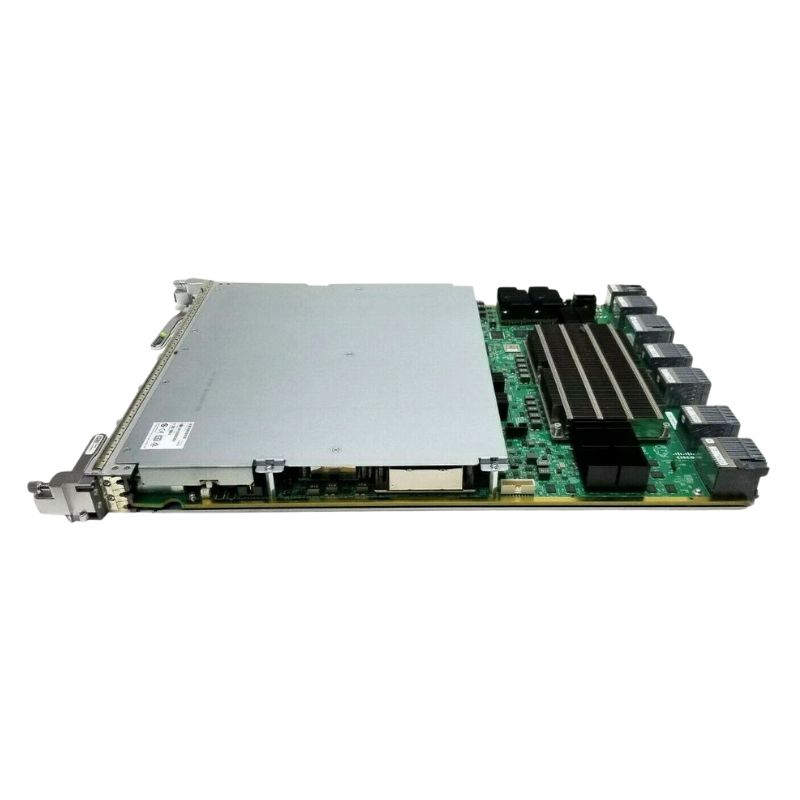
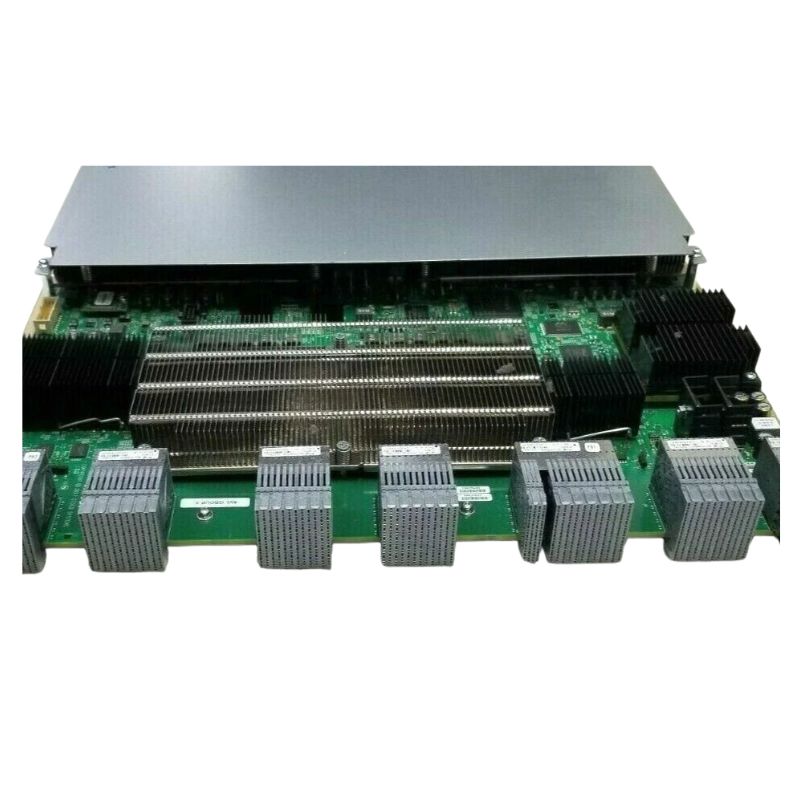
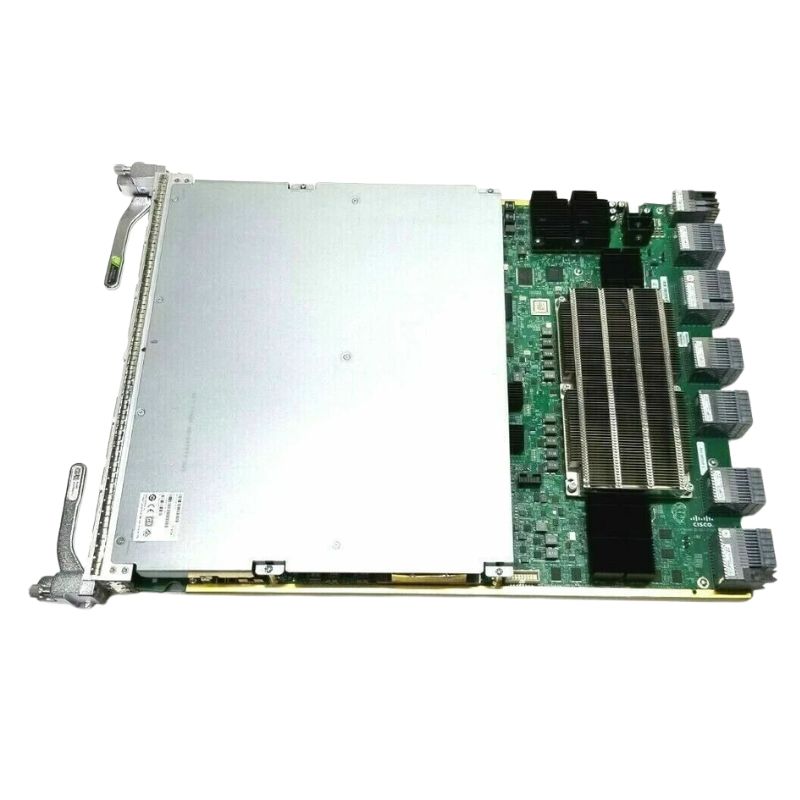
Cisco N77-F430CQ-36 30-Port 100G QSFP28 Line Card
The Cisco N77-F430CQ-36 is a high-density, low-latency 100-Gigabit Ethernet line card engineered for the Cisco Nexus 7700 chassis. Built for modern spine-and-leaf fabrics and scale-out data center designs, it delivers resilient throughput, flexible optics, and fabric-wide automation to keep mission-critical applications responsive under peak demand.
At-a-Glance Highlights
- Manufacturer: Cisco
- Part Number / SKU: N77-F430CQ-36
- Product Type: Switch Line Card
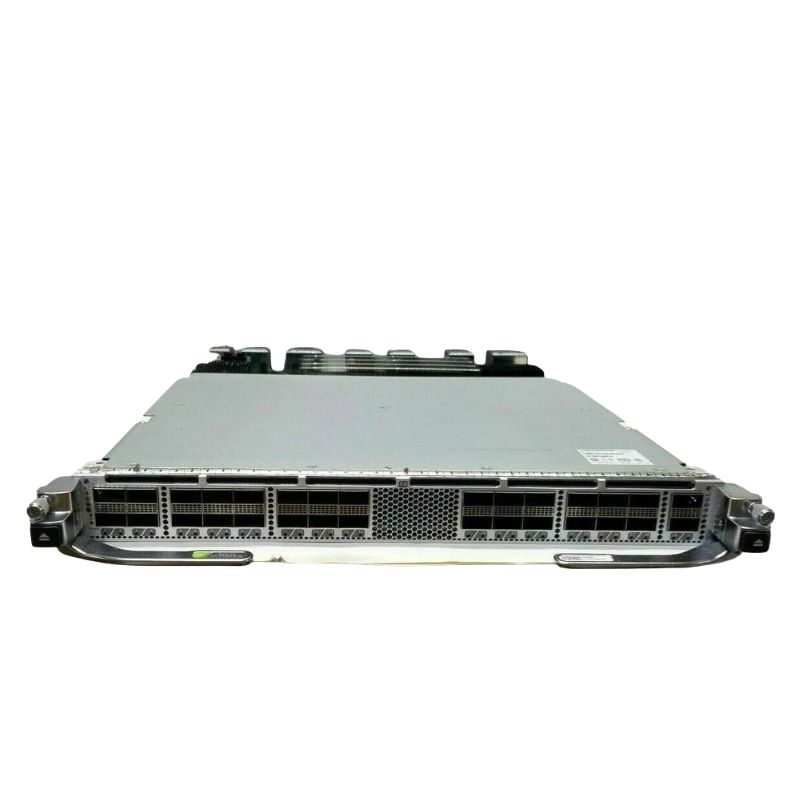
- Port Density: 30 × 100-Gigabit Ethernet
- Transceiver Form Factor: QSFP28
- Per-Port Performance: up to 100 Gbps
- Platform Compatibility: Nexus 7700 F4-series
- Use Cases: spine aggregation, 100G server/leaf uplinks, data center interconnect, high-performance storage fabrics
Why Choose the N77-F430CQ-36 for Nexus 7700
- Dense 100G in a Single Slot: Consolidate high-bandwidth links and simplify cabling with 30 native QSFP28 ports.
- Fabric-Ready for Scale: Designed for the F4-series architecture to expand non-blocking capacity across the Nexus 7700 fabric.
- Operational Consistency: Aligns with NX-OS features for automation, segmentation, and visibility across the switching estate.
- Lifecycle Efficiency: Standardized 100G optics, DACs, and AOCs help reduce TCO and streamline spares.
Technical Overview
Interface & Media Options
- Port Type: 100-Gigabit Ethernet via QSFP28 cages
- Media Support: QSFP28 SR/LR/ER/DR/FR (as supported), copper DACs, and active optical cables
- Breakout Flexibility: Supports common breakout modes (platform-supported) for migration paths and incremental upgrades
Performance & Throughput
- Per-Port Speed: 100 Gbps line-rate forwarding
- Traffic Profiles: Designed for east-west application flows, storage replication, and bursty workloads
- Fabric Integration: Optimized for Nexus 7700 F4-series fabric modules to maintain predictable latency
Data Center Features
- Virtualization: Network overlays and multi-tenant segmentation (platform features as enabled by NX-OS)
- Automation: API-driven operations, programmability, and templated provisioning for rapid turn-ups
- Visibility: Telemetry and analytics hooks to expose flow-level insights and capacity trends
Platform Fit & Design Considerations
Designed for Nexus 7700 F4-Series
- Seamless Chassis Integration: Fits Nexus 7700 slots and leverages F4 fabric resources for high availability.
- Operational Alignment: Consistent NX-OS feature set and CLI/automation models across the portfolio.
- Investment Protection: 100G today with options to adapt optics and breakout as your fabric evolves.
Spine, Leaf, and Core Roles
- Spine Aggregation: Terminate numerous 100G leaf uplinks with deterministic performance.
- DCI & Core Uplinks: High-capacity, low-jitter links between pods, sites, and core domains.
- Storage Fabrics: Consistent throughput for IP-based storage, backup, and replication traffic.
Reliability & Operations
High Availability
- Fabric Redundancy: Works with redundant supervisors and fabric modules in Nexus 7700 chassis for 24×7 uptime.
- Failover Behavior: Designed for fast convergence and link resiliency to minimize interruption.
Monitoring & Telemetry
- Real-Time Insights: Stream counters and events to your observability stack for proactive capacity planning.
- Troubleshooting: Flow-aware visibility helps isolate hotspots and asymmetric paths quickly.
Security & Segmentation
- Policy Controls: Enforce segmentation and traffic governance in multi-tenant environments.
- Standards Alignment: Features to support secure, compliant designs across regulated industries.
Cabling, Optics, and Migration
Optics Flexibility
- Short-Reach & Long-Reach: Choose QSFP28 SR for in-row density or LR/ER (as supported) for longer runs.
- Cost Control: Mix optics, DACs, and AOCs to meet distance needs without over-spending.
Migration Paths
- Stepwise Upgrades: Start with 100G uplinks and introduce breakout where platform support and design need align.
- Future-Ready: Maintain consistent 100G lanes while evolving leaf/server edge capabilities.
Deployment Scenarios
Cloud & Enterprise Data Centers
- High-Density Spine: Simplify cable plants while scaling bandwidth for microservices and container platforms.
- AI/ML & HPC: Support bandwidth-intensive east-west flows and parallel workloads.
Service Providers & Large Campuses
- Core Aggregation: Efficiently aggregate 100G links across large domains.
- Multi-Tenant Pods: Isolate tenants with consistent policies and deterministic throughput.
Specs Summary
Core Specifications
- Model: Cisco N77-F430CQ-36
- Type: Switch Line Card for Nexus 7700
- Series: F4-Series
- Ports: 30 × QSFP28 100G
- Per-Port Rate: 100 Gbps
- Designed For: Cisco Nexus 7700 chassis (F4-series fabric)
Environmental & Power (Overview)
- Cooling: Chassis-integrated airflow; observe Nexus 7700 guidelines for slot population and thermal planning.
- Power: Follows Nexus 7700 power budgeting—verify power supplies for intended population.
Ordering & Lifecycle Tips
Pre-Deployment Checklist
- Compatibility: Confirm Nexus 7700 supervisor, fabric module, and NX-OS release support for F4-series.
- Optics Plan: Select QSFP28 modules (SR/LR/ER/DR/FR as applicable) and cable lengths per link budget.
- Redundancy: Validate fabric/module redundancy targets to meet SLA.
Spares & Accessories
- Optical Inventory: Keep a mix of QSFP28 optics and DAC/AOC spares for rapid replacement.
- Labeling & Documentation: Maintain port maps and coding to accelerate troubleshooting.
Cisco N77-F430CQ-36 QSFP28 Switch Line Card
The Cisco N77-F430CQ-36 is a high-performance F4-Series line card engineered for the Cisco Nexus 7700 chassis family, designed to deliver dense 100-Gigabit Ethernet aggregation, spine capacity for leaf-spine fabrics, and future-proof scalability in data center, campus core, and service-provider environments. Within this category, buyers look for deterministic latency, ultra-high port density, programmable telemetry, and the operational simplicity that comes from proven NX-OS software. The F4-Series platform focuses on efficient forwarding, hardware-based features for VXLAN/EVPN fabrics, and investment protection across 10/25/40/50/100-GbE migrations. This description unpacks the capabilities, benefits, design options, and lifecycle considerations of the N77-F430CQ-36 to help architects, operators, and procurement teams select, deploy, and optimize the line card in modern multi-tenant and cloud-scale networks.
Positioning in the Nexus 7700 Portfolio
The line card sits in the high-capacity tier of the Nexus 7700 ecosystem, providing 100-GbE connectivity with flexible breakouts to lower speeds for mixed environments. Positioned as a core building block for large fabrics, it highlights:
- High-density 100-GbE: A compact form factor supporting numerous QSFP28 interfaces for spine/aggregation roles.
- Fabric scalability: Optimized for multi-slot, high-bandwidth fabric modules in the 7700 chassis.
- Operational consistency: Unified policy, telemetry, and automation with NX-OS and NX-API.
- Investment protection: Smooth migration from 10/40-GbE to 25/50/100-GbE with hardware-assisted encapsulations.
Typical Use Cases and Design Drivers
Customers choose the N77-F430CQ-36 to satisfy demanding throughput targets while retaining architectural flexibility:
- Spine/aggregation in leaf-spine fabrics: Core connectivity for thousands of 10/25/50-GbE leaf ports via 100-GbE uplinks.
- Enterprise data-center core: Inter-pod and inter-fabric connectivity with predictable latency and strong QoS.
- Cloud and hosting providers: Tenant isolation at scale using VXLAN EVPN, plus easy service insertion.
- Campus distribution to core: 100-GbE rings or mesh cores with MACsec options for encrypted backbones.
- Storage and HPC backbones: Line-rate performance for RoCEv2, IP-SAN, and high-throughput workloads.
Hardware Architecture and Form Factor
The N77-F430CQ-36 is an F4-series line card designed for the modular Cisco Nexus 7700 chassis. It relies on a high-bandwidth fabric interface that leverages the chassis’s mid-plane fabric modules for distributive, non-blocking scalability. Each QSFP28 port supports 100-GbE operation with hardware pipelines tuned for deterministic forwarding even under heavy east-west traffic typical in leaf-spine designs. High-efficiency heat sinks and intelligently managed airflow maintain thermal headroom for sustained performance in high ambient and high-density deployments.
Port Technology and QSFP28 Optics
Each front-panel interface uses QSFP28 for 100-GbE connectivity, allowing the use of a broad optical and DAC portfolio:
- Direct Attach Cables (DAC): Cost-effective short-reach connectivity within the same rack or adjacent racks.
- Active Optical Cables (AOC): Simplified cabling for moderate distances without the need for discrete optics.
- SR4/MMF and DR/FR/LR Single-Mode: Multimode SR4 for short-reach data-center links; DR/FR/LR single-mode for inter-row and building-scale links.
- Breakout support: Flexible fan-out for 4×25-GbE or 4×10-GbE where supported, enabling gradual migrations.
Forwarding Performance and Buffering
The line card’s forwarding ASICs are tuned to maintain line-rate performance across small and large packets, with QoS profiles that mitigate microbursts and provide isolation for latency-sensitive flows like storage or voice. Intelligent buffering and queueing help absorb transient congestion without sacrificing fairness across tenants or overlay segments. Hardware offloads for encapsulation, policy enforcement, and ACL matching lower CPU impact and enable deterministic performance even during scale events.
Latency Considerations
In spine roles, latency is a design-critical metric. The N77-F430CQ-36 offers low and predictable forwarding latency, minimizing hop-wise accumulation across the fabric. Paired with leaf switches using 25/50-GbE uplinks, the design delivers consistent end-to-end application performance for microservices, distributed databases, and real-time media.
Software Features with NX-OS
Powered by Cisco NX-OS, the line card inherits a mature operating environment emphasizing modularity, process isolation, and programmability.
Overlay Networking and Virtualization
- VXLAN Data Plane: Hardware offload for VXLAN encapsulation/decapsulation supports scalable multi-tenant overlays.
- EVPN Control Plane: BGP EVPN brings flexible host route learning, optimized MAC/IP mobility, and distributed anycast gateways.
- Multi-VRF and Tenant Isolation: Policy-driven segmentation with route leaking options for shared services.
- Gateway Placement: Support for L2 and L3 gateway functions with anycast gateway models for east-west traffic optimization.
Routing Protocol Capabilities
The N77-F430CQ-36 supports common enterprise and service-provider routing stacks with hardware acceleration for FIB lookups:
- BGP (including EVPN address families): Scales to large route tables with policy-based path selection.
- OSPF/IS-IS: For fast convergence in campus core or data-center underlay designs.
- Static and Policy-Based Routing: Deterministic forwarding for special traffic classes.
- uRPF and Prefix-Lists: Security-minded edge or inter-domain peering configurations.
Quality of Service (QoS)
QoS controls are essential where mixed application loads coexist. The line card offers granular classification (CoS/DSCP), hierarchical scheduling, and queue-level policies for shaping, policing, and priority handling. With hardware-assisted QoS and deep buffers, the platform helps protect interactive or storage traffic from elephant flows, maintaining service-level objectives during bursts and failovers.
Security, ACLs, and Encryption Options
- TCAM-based ACLs: Scalable Layer-2 to Layer-4 filtering with hit counts and logging for audits.
- Control-Plane Policing (CoPP): Safeguards the supervisor and control plane from DDoS or malformed traffic.
- MACsec (where supported by optics/ports): Link-layer encryption for campus core or data-center interconnects.
- First-Hop Security features: Guard against common L2 threats in segmented environments.
Automation, Telemetry, and Operations
Day-0, Day-1, and Day-2 operations benefit from mature automation and telemetry within NX-OS and Nexus 7700 systems.
Programmability and APIs
- NX-API and REST: Programmatic access to configuration and operational data for integration with custom tooling.
- Python and On-Box Scripting: Execute scripts for repeatable changes, compliance checks, and automated rollbacks.
- Ansible and Terraform: Infrastructure-as-Code workflows for standardized templates and versioned deployments.
Streaming Telemetry and Visibility
Streaming telemetry enables high-frequency metrics export to external collectors for capacity planning and anomaly detection. Operators can ingest interface counters, flow statistics, buffer occupancy, and QoS queue metrics to build proactive SLO dashboards. Coupled with ERSPAN and hardware-assisted sampling, the N77-F430CQ-36 simplifies traffic engineering and root-cause analysis.
High Availability and In-Service Operations
- Stateful Process Restart: NX-OS process modularity reduces the blast radius of faults.
- ISSU/Graceful Restart: Upgrade paths designed to keep control and data planes stable with minimal disruption.
- Redundant Fabric and Power: Chassis-level resiliency ensures continued forwarding during component failures.
Design and Deployment Guidance
Because the N77-F430CQ-36 targets core and aggregation roles, design best practices emphasize deterministic performance, graceful scaling, and operational simplicity.
Leaf-Spine Architectures
Deploy the line card as a spine aggregation layer receiving 100-GbE uplinks from leaf switches. EVPN/VXLAN overlays deliver L2 adjacency and L3 segmentation without large L2 domains. Align ECMP widths and BGP policy to avoid path polarization and to ensure consistent hashing across spine paths.
Underlay Considerations
- IP-Clos Underlay: Choose IS-IS or OSPF for quick convergence; BFD for rapid failure detection.
- ECMP and Load Balancing: Validate hashing algorithms for your mix of flows (e.g., 5-tuple vs. 3-tuple hashing).
- MTU Strategy: Set a uniform jumbo MTU to reduce fragmentation and improve overlay efficiency.
Overlay Considerations
- Route-Type Planning: Use Type-2 EVPN routes for host mobility and Type-5 routes for scalable L3 reachability.
- Anycast Gateway: Provide distributed L3 default gateways at the leaf for low-latency east-west traffic.
- Multitenancy: Map VRFs to VNIs consistently; reserve ID ranges for future growth.
Campus Core and WAN Edge Aggregation
In campus designs, the N77-F430CQ-36 consolidates high-bandwidth distribution links into a secure, policy-rich core. MACsec links can encrypt traffic between buildings, and QoS policies prioritize voice/video across the backbone. Integration with firewalls and SD-WAN edges is facilitated by clean L3 segmentation and flexible route leaking.
Storage, HPC, and Low-Latency Applications
For RoCEv2 and other storage workloads, apply priority flow control (PFC) where required and ensure lossless queues are configured correctly across the path. Align congestion notification settings and ECN marks with application requirements. Validate buffer profiles under worst-case microburst conditions and failover events.
Migration and Scalability Planning
The N77-F430CQ-36 supports staged migrations from legacy speeds to 100-GbE without forklift upgrades.
Breakout-Driven Transitions
- 4×25-GbE or 4×10-GbE: Use fan-out cables to segment a 100-GbE port into multiple downlinks, facilitating gradual upgrades.
- 50-GbE Pairing: Where supported, use two-lane options to standardize around modern NICs.
- Optics Portfolio: Select optics that match your reach, fiber type, and power budget to avoid over-engineering.
Capacity Modeling
Develop a capacity roadmap that accounts for traffic growth, overlay control-plane scale, and multi-tenant expansion. Plan spare ports for burst projects and DR capacity. Use historical telemetry to identify peak/95th percentile usage, then size ECMP widths and buffer headroom accordingly.
Fabric Growth and Slot Planning
For large chassis deployments, distribute N77-F430CQ-36 line cards across slots to balance fabric-module bandwidth and airflow. Confirm fabric module compatibility and count to sustain line-rate throughput across all populated ports. Align supervisor versions and system bundles to maintain feature parity during incremental growth.
Reliability, Testing, and Validation
High-stakes cores demand rigorous validation prior to production. Build lab or pre-production environments that mirror optics, cable plant, and software versions expected in production.
Test Plan Essentials
- Port-Turnup Scripts: Automate consistency checks: interface speed, MTU, LLDP, and description standards.
- Failure and Convergence: Verify path failover timing with BFD, routing reconvergence, and ECMP re-hash events.
- QoS and Buffer Behavior: Use traffic generators to simulate elephant flows and microbursts across multiple queues.
- Overlay Scale: Validate EVPN route counts, MAC/IP table usage, and route-type filtering.
Optics and Cabling Hygiene
Clean fiber and certified cabling reduce intermittent errors. Track light levels, connector loss budgets, and maintain spare optics. For DAC/AOC, respect bend radius and maximum length to avoid CRC errors under load. Document each port’s media and destination to accelerate troubleshooting.
Security and Compliance Framework
As a core switching element, the line card participates in a broader security posture. Align controls with corporate and regulatory frameworks.
Segmentation Strategy
- VRF/VNI Isolation: Separate tenants and environments; block lateral movement via EVPN policy.
- ACL Baselines: Implement default-deny with explicit allow lists, logging critical hits.
- uRPF: Drop spoofed traffic at aggregation points to control attack surfaces.
Encryption and Key Management
Evaluate MACsec or higher-layer encryption for sensitive traffic. Coordinate key rotation and cipher suites with endpoint capabilities. For inter-DC links, consider transport-level encryption combined with route filtering and strict underlay policies.
Auditing and Change Control
Use configuration archives, signed change reviews, and automated pre-checks to minimize risk. Streaming telemetry provides immutable time-series data suitable for compliance playbacks during audits and incident post-mortems.
Operations, Monitoring, and Troubleshooting
Well-instrumented operations convert reactive firefighting into proactive reliability engineering.
Baseline Dashboards
- Interface Health: Error counters, CRCs, discards, temperature, and optical power levels.
- Control Plane: BGP/OSPF adjacency states, route churn metrics, and CPU utilization.
- Overlay Health: EVPN route counts, MAC/IP mobility events, and VTEP reachability.
- QoS: Queue depths, buffer occupancy, PFC pause frames, and ECN marks.
Common Troubleshooting Patterns
- Link Flaps: Inspect optics seating, DOM readings, and cable integrity; enforce consistent autoneg/speed settings.
- Asymmetric Traffic: Review ECMP hashing, flow pinning, and ACL side effects.
- Packet Loss Under Burst: Tune QoS buffer profiles and verify PFC alignment end-to-end.
- Overlay Reachability: Validate VNI mappings, route-target policies, and MTU for VXLAN encapsulation.
Change Windows and Rollbacks
Automate pre-change snapshots and post-change comparisons. Use staged rollouts, ISSU where supported, and back-out plans that reapply known-good configurations. Record every variance: interface counters, routing tables, EVPN advertisements, and QoS queue statistics before and after the change.
Capacity, Power, and Environmental Considerations
High-density 100-GbE deployments require attention to energy and thermal budgets, as well as rack-level design.
Power Budgeting
- Line Card Draw: Factor typical and maximum power consumption under full port utilization.
- PSU Redundancy: Maintain N+1 or N+N designs with headroom for transient spikes and growth.
- Optics Contribution: Long-reach single-mode optics often draw more power; calculate per-port totals accurately.
Cooling and Airflow
Respect front-to-back or back-to-front airflow policies based on chassis orientation. Provide hot-aisle/cold-aisle containment where possible. Monitor inlet temperature sensors and set alarms below thresholds to prevent thermal throttling. Keep blanking panels installed in unused slots to preserve designed airflow paths.
Rack Layout and Cable Management
Position the 7700 chassis to balance weight and access, with ladder racks or cable managers to minimize strain on QSFP28 connectors. Separate power, copper, and fiber bundles to reduce interference and simplify maintenance. Label at both ends and maintain accurate patch documentation.
Licensing, SKUs, and Accessories Overview
While licensing models can evolve, the N77-F430CQ-36 typically participates in standard NX-OS licensing for feature activation. Ensure that advanced features—overlay, security, or automation—are properly licensed at the system level. Match transceivers and cables to Cisco-approved options to guarantee support and full functionality. Keep spare QSFP28 optics and DACs in inventory to meet SLAs during failures.
Optics Selection Checklist
- Distance and Fiber Type: Pick SR for short MMF links; DR/FR/LR for SMF distances as needed.
- Breakout Cables: For 4×25-GbE or 4×10-GbE fan-outs, verify supported optics and cabling.
- DOM Monitoring: Prefer optics with digital diagnostics for continuous health visibility.
- Power and Heat: Consider higher-power optics’ thermal impact on line card cooling margins.
Comparisons and Differentiators
Within the Nexus 7700 family, the N77-F430CQ-36 emphasizes 100-GbE density and overlay scale, differentiating itself with efficient forwarding pipelines and operational consistency. Compared to lower-speed line cards, it offers a more future-proof aggregation layer. Against alternative platforms, differentiators include NX-OS maturity, EVPN/VXLAN breadth, and a comprehensive optics ecosystem that reduces integration friction in mixed-vendor environments.
When to Choose This Line Card
- High East-West Traffic: Microservices and distributed applications benefit from low-latency, high-bandwidth spines.
- Tenant Scale: Multi-tenant environments with many VRFs/VNIs and active mobility events.
- Consistent Operations: Teams invested in NX-OS tooling, scripts, and automation.
- Optics Flexibility: Environments that mix SR, DR/FR/LR, DAC, AOC, and breakout options.
Best Practices and Configuration Patterns
Standardize configurations to accelerate turnups and reduce human error. Keep templates versioned in a Git repository and test changes in a staging environment before production rollout.
EVPN/VXLAN Baselines
- Define route distinguishers and route targets systematically to avoid collisions.
- Use consistent VTEP loopback numbering and document VNI ranges for L2 and L3.
- Enable advertise-pip/host-route options according to gateway design and fabric size.
QoS Blueprint
Adopt a small number of QoS classes mapped to DSCP/CoS values that reflect organizational priorities. Validate queue depths, shaping rates, and ECN/PFC behavior with application owners. Document SLOs per class and alert when sustained drops or latency exceed thresholds.
Interoperability and Multi-Vendor Scenarios
Data centers often combine devices from different vendors. The N77-F430CQ-36, with standards-based 100-GbE and BGP EVPN, fits well in heterogeneous topologies. Validate LACP timers, LLDP interoperability, and EVPN route-type policies across vendors. Use standard transceiver types and stick to common MTUs to prevent fragmentation and PMTUD issues.
EVPN Interop Notes
- Align extended communities and route-target imports/exports.
- Confirm handling of EVPN Type-2 and Type-5 routes across domains.
- Test multi-vendor anycast gateway behavior for ARP/ND consistency.
Documentation and Governance
Strong documentation accelerates onboarding and reduces errors. Maintain as-built diagrams, cable maps, and configuration baselines specific to each N77-F430CQ-36 deployment. Embed governance into pull requests for configuration changes, require peer reviews, and link every change to a ticket with testing evidence.
KPIs and SLOs
- Availability: Target “five nines” for core services; track incident minutes and change-related impacts.
- Performance: Packet loss < 0.01% during peak; consistent latency budgets across the fabric.
- Capacity: Maintain ≥ 20% headroom in links and buffers.
- Security: Zero critical CVEs unpatched beyond policy windows; audit logs for every change.
Training and Team Enablement
Equip operations teams with hands-on labs, runbooks, and failure drills. Encourage scripting literacy (Python/Ansible) and dashboard proficiency for telemetry consumers. Establish an on-call rotation with clear escalation and a blameless post-mortem culture to continually refine processes.
Change Dry-Runs
- Practice ISSU steps in a lab mirroring the production chassis and line cards.
- Use traffic generators to simulate realistic loads during upgrades.
- Capture pre/post metrics to quantify success and detect regressions quickly.
Performance Optimization Tips
To keep the N77-F430CQ-36 operating at peak efficiency, align configuration to workload characteristics and continuously measure outcomes.
Hashing and ECMP
- Verify consistent hashing across flows and adjust fields if traffic skews occur.
- For elephant flows, enforce QoS guarantees or steer using policy-based techniques.
Microburst Management
Refine buffer profiles and prioritize latency-sensitive traffic. Use telemetry to locate hotspots and validate improvements after tuning.
Overlay Route Control
Filter unnecessary routes, summarize where appropriate, and avoid overloading control plane and TCAM resources. Regularly audit route-target policies.
Change Management and Risk Reduction
Mature processes around the N77-F430CQ-36 reduce downtime and protect business services.
Pre-Deployment Reviews
- Design and security reviews: confirm segmentation, encryption, and policy.
- Optics plan: media types, distances, and spares inventory.
- Test outcomes: pass/fail gates for performance and stability.
Maintenance Windows
- Define clear success criteria and rollback triggers.
- Stage configuration changes in small, reversible steps.
- Capture pre/post telemetry to verify impact and document improvements.
Documentation Samples and Templates
As-Built Diagram Checklist
- Chassis slot map with N77-F430CQ-36 placements and fabric modules.
- Uplink/downlink topology, ECMP widths, and VTEP loopbacks.
- Optics matrix including reach, fiber type, and DOM thresholds.
- QoS class mappings, MTU, and lossless domains.
Operations Runbook Outline
- Incident triage flowchart for link and routing issues.
- Optics replacement SOP with safety and ESD procedures.
- Upgrade/rollback scripts and verification commands.
- Contact tree and escalation timings.
Key Benefits at a Glance
- High-density 100-GbE: Consolidates aggregation layers and simplifies cabling.
- Overlay at scale: Hardware-offloaded VXLAN/EVPN for multi-tenant performance.
- Operational consistency: NX-OS tooling, APIs, and telemetry.
- Flexible migrations: Breakout options to 25/10-GbE ease transitions.
- Resilience: Chassis-level redundancy, ISSU options, and fast convergence.
Procurement and Readiness Checklist
- Confirm Nexus 7700 chassis, supervisors, and fabric modules are compatible.
- Select NX-OS release meeting feature and stability requirements.
- Finalize optics and cabling plan with spares and documented reach.
- Prepare baseline configurations and automation templates.
- Schedule lab validation and define success metrics.
Real-World Deployment Patterns
Organizations typically scale the N77-F430CQ-36 in pairs or quads at the spine to achieve both bandwidth and redundancy. Each leaf switch connects with dual 100-GbE uplinks to disjoint spines, maximizing resilience. Inter-pod links may use long-reach optics with MACsec to satisfy security requirements. As capacity grows, operators fill additional chassis slots with identical line cards to preserve homogeneity, simplifying spares and operations.
Disaster Recovery and Multi-Site
For active/active data centers, EVPN with symmetric IRB provides consistent L2/L3 services across sites. Carefully consider route filtering and bandwidth headroom on inter-site links. Use telemetry to monitor latency, jitter, and loss; apply QoS to protect replication and control-plane traffic during failovers.
Future-Ready Networking
The N77-F430CQ-36 helps bridge current 10/25/50-GbE estates into full 100-GbE backbones while keeping options open for higher speeds and new overlay features. A standards-oriented approach to routing, encapsulation, and security allows organizations to adopt new technologies incrementally—without wholesale redesigns. Combine this line card with strong automation, robust telemetry, and disciplined change management to sustain predictable performance as demand grows.





 Contact Us
 Information
 Catalog
 Solid State Drives (SSD)
 Network Switches
 Hard Disk Drives
 HBA & Controllers
 PC & Servers
 PC & Server Memory
 CPU & Processors
 Network Routers
 Power Supplies
 Tape Drives & Libraries
 Network Devices
 Computer & Network Cables