(7% discount is applied at checkout)
Cart is empty
Your go-to destination for cutting-edge server products
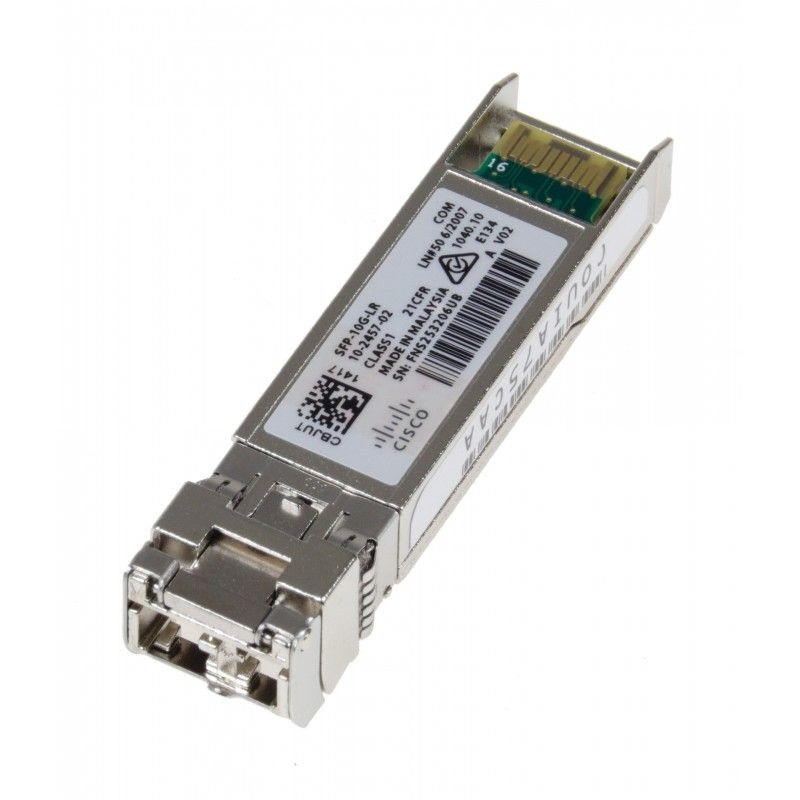


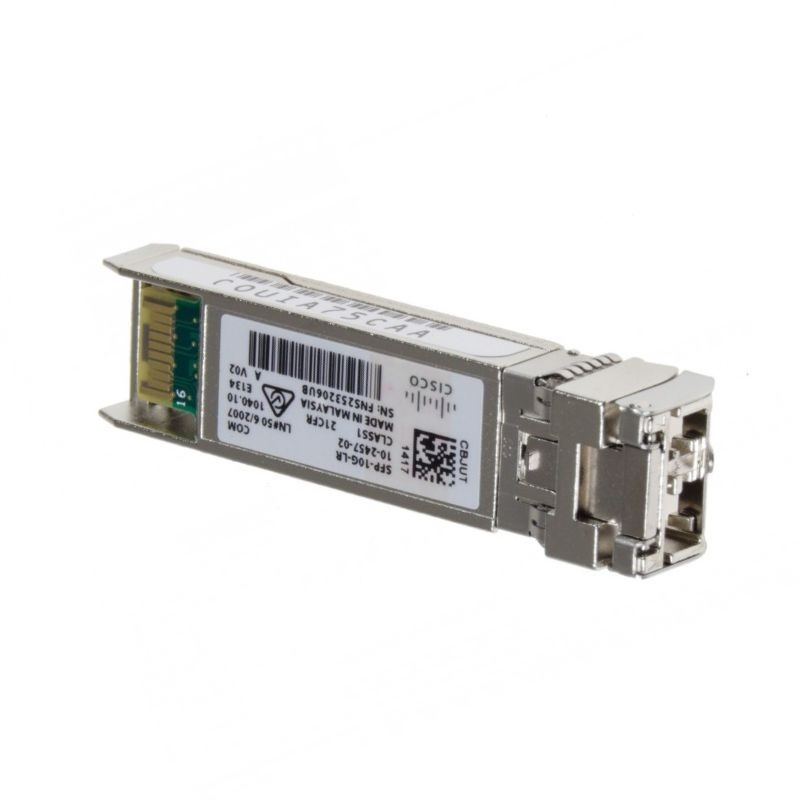
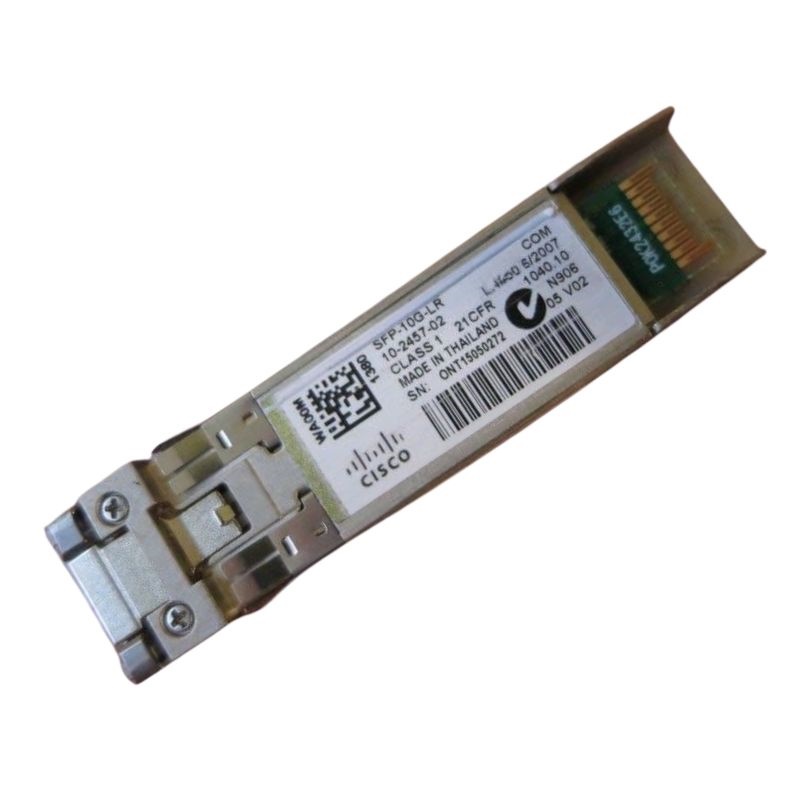
Cisco 10-2457-03 10GBASE-LR SFP+ 10 GBPS Transceiver Modules. Factory-Sealed New in Original Box (FSB) with 1 year replacement warranty
Elevate backbone links and server uplinks with a genuine Cisco SFP+ transceiver engineered for long-reach, low-latency 10 Gigabit Ethernet. This plug-in optical module pairs a standard LC/PC duplex interface with 1310 nm optics to deliver dependable 10 Gbps connectivity over single-mode fiber.
Designed for seamless operation in the following environments:
Use Cases & Deployment Ideas
The Cisco 10-2457-03 10GBASE-LR SFP+ 10 Gbps transceiver module category centers on hot-swappable optical interfaces designed for long-reach 10 Gigabit Ethernet over single-mode fiber (SMF). In this category you will find modules engineered for the 10GBASE-LR optical specification with typical operation at 1310 nm wavelength, duplex LC connectors, and support for Digital Diagnostics Monitoring (DDM/DOM). These modules target campus backbones, aggregation layers, data center leaf-spine links, metro access, and enterprise WAN edge connections that require up to long-reach connectivity within the bounds of LR optics. Products in this category are designed to fit SFP+ slots on compatible Cisco switching, routing, and server adapter platforms and follow the SFP+ Multi-Source Agreement (MSA) form factor for streamlined deployment and interchangeability within specifications.
10GBASE-LR SFP+ occupies the “long reach over single-mode fiber” niche in the 10 GbE ecosystem. It sits between short-reach multimode options like 10GBASE-SR and very-long-reach single-mode options such as 10GBASE-ER/ZR. As such, the category is optimized for moderate distances commonly encountered across buildings, between data halls, across a campus, or from distribution to core layers. With low power consumption, compact size, and familiar LC connectors, modules in this category offer a cost-effective, power-efficient way to scale 10 GbE where multimode fiber distances are insufficient and where the higher optical budgets of ER/ZR are unnecessary.
While specific values vary by manufacturing revision and optical budget design, 10GBASE-LR SFP+ modules in the Cisco 10-2457-03-aligned category generally exhibit the following characteristics. Always verify device-level specifications for your exact part and software release.
Organizations with multiple buildings typically deploy single-mode fiber between intermediate distribution frames (IDFs) and main distribution frames (MDFs). 10GBASE-LR modules are well suited for building-to-building uplinks or MDF-to-core interconnects where cable paths exceed the comfortable range of multimode SR. With duplex LC terminations commonly used in campus SMF plants, LR optics offer a straightforward drop-in interface for 10 GbE backbone connectivity.
Leaf-to-spine designs often combine a variety of interconnects: twinax DACs for adjacent racks, AOC for mid-range rows, and single-mode optics for longer cross-row or cross-hall links. LR SFP+ optics provide a clean way to extend 10 GbE beyond the physical limits of DAC/AOC without stepping up to costlier ER/ZR optics. They blend density, manageability, and predictable performance across common data hall distances.
Service providers and carriers can leverage LR modules on customer-facing 10 GbE handoffs or for short metro aggregation spurs. When co-located equipment resides in the same facility or in nearby sites linked by SMF, LR optics meet bandwidth demands without incurring the penalties of higher-power long-haul optics.
Storage Area Networks (SANs) and IP-based replication commonly require deterministic low-latency connectivity between arrays, converged infrastructure nodes, or backup facilities within a campus. LR optics provide stable, standards-aligned transport for IP storage protocols and backup replication traffic where distances exceed multimode capabilities.
10GBASE-LR is designed for single-mode fiber. Many installed plants use OS1 or OS2 types. OS2 (low water-peak, outdoor-rated SMF) is common for modern builds and metro applications. Ensure that connector polish types are consistent and clean; LC/UPC is typical for Ethernet LR deployments. High-quality patch cords and neatly managed jumpers reduce insertion loss and maintain link reliability.
Category selection should account for end-to-end optical loss, including patch panels, splices, connectors, and any passive components. While LR optics are designed for long-reach SMF, high loss from dirty connectors or excessive patching can erode margin. Use DOM readings to validate received power and maintain a buffer above minimum sensitivity. When planning upgrades, perform an optical loss test (OLTS) and inspect/clean all LC interfaces.
Even minor contamination can cause light reflections, increased bit error rates, and intermittent flaps. Establish a “inspect-clean-inspect” process using fiber scopes and lint-free cleaning tools. Avoid touching ferrules; always replace dust caps when optics are not plugged in. This discipline is essential across the LR category because SMF tolerances are tight and LR wavelengths are sensitive to contamination.
Modules in the Cisco 10-2457-03 10GBASE-LR SFP+ category are intended for SFP+ ports on a broad range of Cisco platforms that support 10 GbE LR optics. Platform compatibility can vary by hardware revision and software release; confirm specific support on your target switch, router, or server NIC. Many environments also combine LR with SR, ER, or DAC/AOC in the same chassis. Consistent with best practice, deploy optics that match the intended fiber type and distance, and maintain an inventory of spares with comparable optical budgets.
10GBASE-LR is governed by IEEE standards for 10 GbE. Interoperability depends on compliance with those standards, clean fiber, and correct link configuration on the host platform. Select complementary optics on both ends of the link—10GBASE-LR to 10GBASE-LR—and ensure consistent wavelength and connector type. DOM telemetry can confirm signal health and detect out-of-range conditions early.
The DDM/DOM feature commonly included in this category provides live data on module temperature, supply voltage, transmit bias current, and TX/RX optical power. Operations teams use these metrics to establish baselines and alert thresholds. For example, a gradual rise in TX bias might indicate aging lasers or connector contamination; falling RX power can hint at rising insertion loss somewhere along the path. Leveraging DOM reduces mean-time-to-repair and supports proactive maintenance.
When deploying this category of SFP+ optics on Cisco platforms, administrators typically verify the interface is set to 10 Gbps, confirm that autonegotiation settings align with platform capabilities, and check that DOM is enabled (it usually is by default). Error counters such as CRCs, input errors, and laser bias warnings should be monitored; they often correlate with cabling issues rather than optic failures. Maintain clear logs of serial numbers and DOM snapshots for baseline comparisons over time.
The compact SFP+ design is inherently power-efficient. Even so, high-density line cards fully populated with LR optics can add heat to confined spaces. Ensure adequate front-to-back or back-to-front airflow per platform design, avoid blocking ventilation, and follow recommended ambient operating temperatures. Keeping dust filters clean and cable management organized promotes airflow around optics and host cages, enhancing longevity.
For each proposed link, identify the fiber type (OS1/OS2 SMF), total path length, and cumulative insertion loss. Select 10GBASE-LR optics where the distance and loss fall comfortably within LR budgets. If your path involves higher losses or longer spans, evaluate whether to re-terminate and clean connections to reduce loss or consider an alternate optic class.
To minimize downtime, maintain a spare inventory sized for your critical links—commonly 5–10% of deployed count, adjusted for site criticality and lead times. Store spares with dust caps in antistatic packaging. Document module identifiers and locations, and rotate spares occasionally to test DOM health and avoid surprises during emergency swaps.
Although SFP+ optics are hardware modules, host platform software versions can influence how DOM data is displayed, how alarms are triggered, and how optics are authenticated. Keep network operating systems current according to your change control policy and verify release notes for any updates related to optics or interface drivers. Standardizing on tested software images across sites reduces operational variance.
Use high-quality SMF patch cords with duplex LC connectors appropriate for the polish type (typically UPC). Keep bend radius within specification. Route patch cords along cable guides to prevent strain on the SFP+ cage. Label both ends for clarity, reflecting switch/port IDs and destination. Good documentation accelerates troubleshooting and reduces accidental disconnects.
High ambient temperatures, restricted airflow, or dust buildup can push optics out of comfortable ranges. Ensure fans and filters are clean and oriented correctly. Verify that cable bundles do not obstruct vents. In environments subject to vibration, use proper cable management and ensure cage retention is intact to prevent micro-movements that could cause transient errors.
Optical transceivers are small, valuable, and widely sourced. To ensure reliability, procure modules through trusted channels and document chain of custody. Record serial numbers and deployment locations. In regulated environments, maintain auditable records for device provenance, firmware versions where applicable, and end-of-life dispositions.
Target optical budgets with a comfortable margin to account for temperature variance, connector aging, and minor plant changes. Avoid running links at the edge of the receive sensitivity range. If DOM shows RX power hovering just above the minimum, investigate ways to reduce loss or consider an optic with a higher budget if the path cannot be improved.
At 10 Gbps, deterministic performance depends as much on buffer configuration and queueing policies as it does on the optical layer. Confirm that interface buffers and QoS profiles match application needs. Use synthetic tests to confirm lossless behavior for storage traffic or low-jitter profiles for voice/video traversing the same links. Optics in this category are capable of line-rate performance; any bottlenecks usually arise from configuration, congestion, or cabling faults.
For mission-critical links, deploy at least two LR paths via diverse conduits and termination points. Use protocols like ECMP, LACP, or routing adjacencies that converge quickly on failures. Document the optical path for each redundant leg so field teams know which physical plant corresponds to each logical link, simplifying incident response.
If your path length exceeds multimode limits or if your campus standardizes on single-mode for simplicity and future-proofing, LR optics are typically the more economical and operationally clean solution. They avoid the need for mode-conditioning or complex multimode design constraints at higher speeds.
For repeatable deployments, define a standard LR bill of materials (BOM) that includes the optic model, SMF patch cords, LC couplers, cleaning kits, labels, and spare quantities. Use consistent part numbers across projects to streamline logistics, minimize support questions, and simplify warranty management.
Provide clients with as-built diagrams highlighting each 10GBASE-LR link, port IDs, cable labels, and DOM baseline values captured at handover. Include a simple runbook for cleaning procedures and a troubleshooting decision tree. Well-documented LR deployments minimize escalations and build customer confidence.
Define SLOs for optical power margins, link error rates, and mean-time-to-repair. DOM-driven monitoring can back these objectives with measurable metrics. Clear SLOs align expectations and guide capacity planning as networks grow.
As density increases, low-power optics help reduce cooling loads and overall energy consumption. LR SFP+ modules are inherently efficient, supporting sustainability goals while maintaining high-performance 10 GbE links. Combined with smart airflow management and right-sized power distribution, they contribute to greener network designs.
Optical modules and fiber accessories should be disposed of through e-waste programs that handle electronics responsibly. Maintain records of module serials and decommission dates for auditing and to track failure patterns over time.
Maintain a centralized record of module serials, deployment locations, and DOM baselines. Include warranty terms and procurement dates. When modules are moved, update records immediately. Accurate asset data speeds RMA processes and enables analytics that reveal failure patterns tied to specific environments or cabling methods.
After any change—adding a link, replacing an optic, or rerouting cables—capture new DOM snapshots and run throughput or loss tests if feasible. Compare against historical data to confirm performance. Attach these results to the change ticket for traceability.
As networks migrate to 25G, 40G, or 100G, many organizations maintain a tier of 10 GbE links for access or legacy systems. LR modules remain vital for these layers, especially where single-mode plants are well established. When planning migrations, confirm the optical roadmap for each layer and ensure that cabling pathways support future pluggable types without extensive rework.
Stagger upgrades to preserve service continuity. For example, move non-critical links first, validate performance, then schedule critical LR paths with maintenance windows and rollback plans. Keep spare modules on hand during migrations in case any existing optics show marginal DOM readings when moved.
Before field installation, stage optics in a lab environment. Validate link-up, DOM reporting, and interface counters on the same platform type used in production. This step catches compatibility issues early and gives teams familiarity with expected DOM ranges, which speeds field troubleshooting.
For large deployments, soak test a sample set under traffic for 24–72 hours. Monitor temperature and error counters. A clean test provides confidence; anomalies drive proactive remediation, such as replacing marginal patch cords or cleaning specific panels before rollout.
In a multi-building campus, two LR links per building—each via a different conduit—can feed a redundant distribution stack. DOM thresholds are tuned to alert at a modest loss increase, enabling cleaning during business hours before users notice performance issues. The result is high availability without costly ER optics.
When rows are spaced beyond AOC ranges, LR optics over OS2 cross-row trunks deliver predictable 10 GbE with low operational effort. Using pre-terminated panels with LC cassettes standardizes connections and simplifies MAC (moves, adds, changes).
At the provider edge, LR SFP+ modules terminate customer 10 GbE on SMF while keeping power draw minimal. DOM monitoring at the NOC allows proactive dispatch when RX power trends downward, often indicating a dirty customer patch panel long before service impact occurs.
10GBASE-LR SFP+ optics within the Cisco 10-2457-03 category deliver a pragmatic blend of performance and operational simplicity. They cover the majority of single-mode 10 GbE scenarios encountered in modern networks, providing dependable links for critical services without the complexity or expense of higher-budget optics. With disciplined fiber hygiene, thoughtful monitoring, and clear documentation, they form a robust foundation for enterprise and provider infrastructures.
Because the LR specification is widely adopted, operations teams benefit from predictable behavior and readily available expertise. Support playbooks are mature, replacement parts are easy to stock, and troubleshooting patterns are well understood. This maturity translates directly into lower operational risk and faster time-to-resolution when issues arise.
Pair SR modules with OM3/OM4/OM5 multimode fiber for short intra-room connections, top-of-rack to aggregation, and lab builds. SR offers the lowest cost per port for short distances where multimode cabling is in place.
When spans exceed LR capabilities, consider ER or ZR classes. These modules support much longer reaches on SMF at the cost of higher power and thermal outputs. Use judiciously and validate optical budgets carefully.
DAC and AOC options simplify ultra-short links without the need for patch panels or fiber cleaning, ideal for within-rack or adjacent-rack interconnects. They complement LR optics in mixed-distance environments.


 Contact Us
 Information
 Catalog
 Solid State Drives (SSD)
 Network Switches
 Hard Disk Drives
 HBA & Controllers
 PC & Servers
 PC & Server Memory
 CPU & Processors
 Network Routers
 Power Supplies
 Tape Drives & Libraries
 Network Devices
 Computer & Network Cables