(7% discount is applied at checkout)
Cart is empty
Your go-to destination for cutting-edge server products
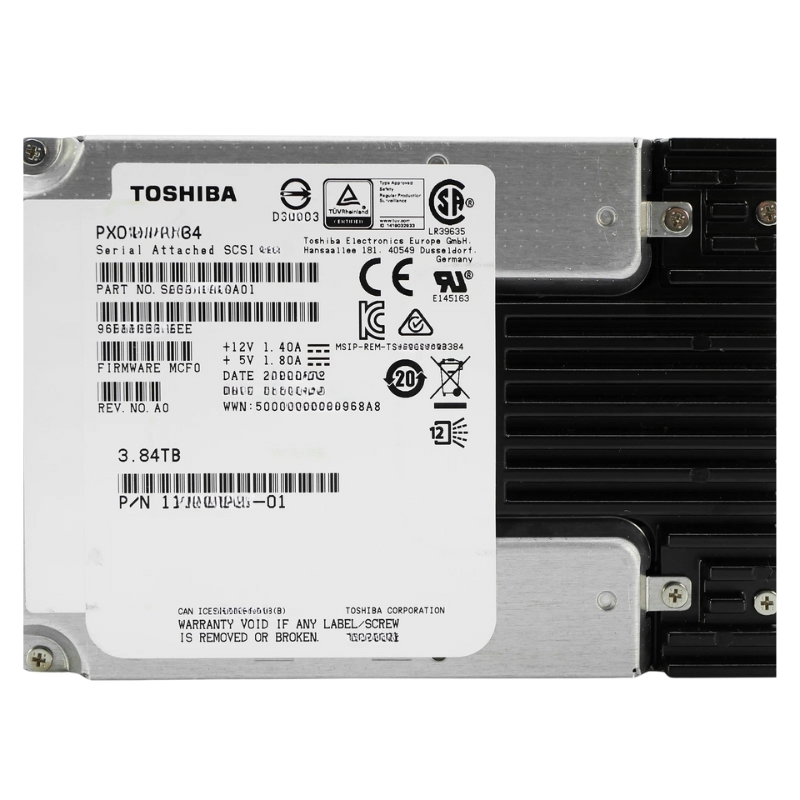


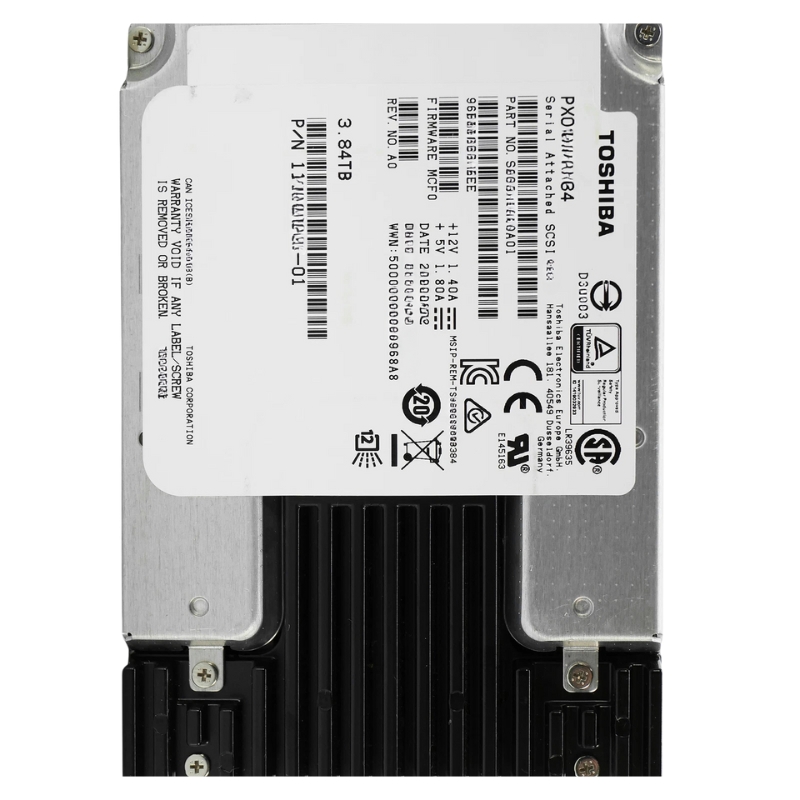
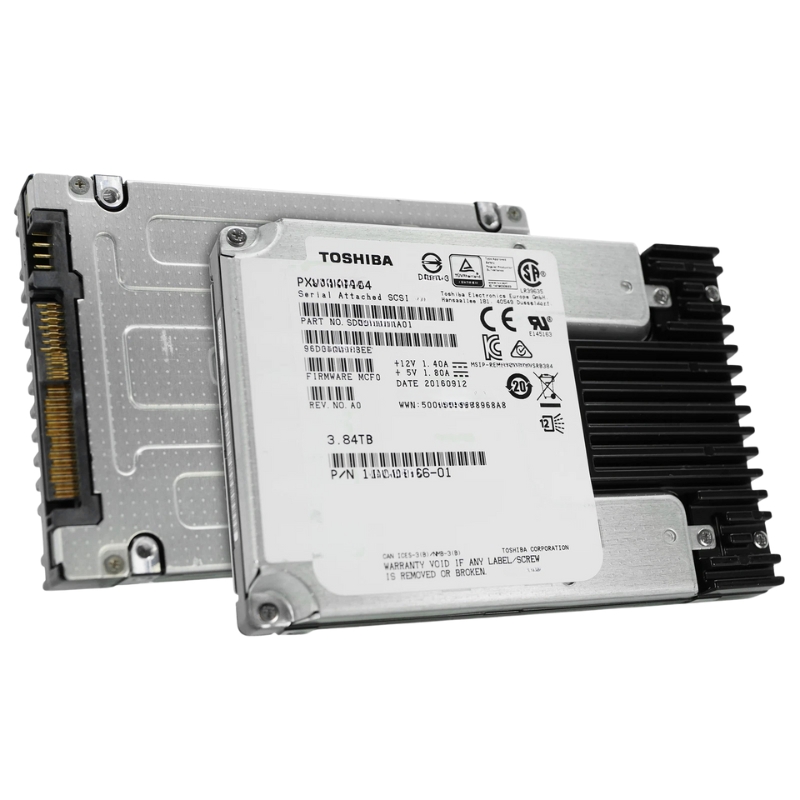
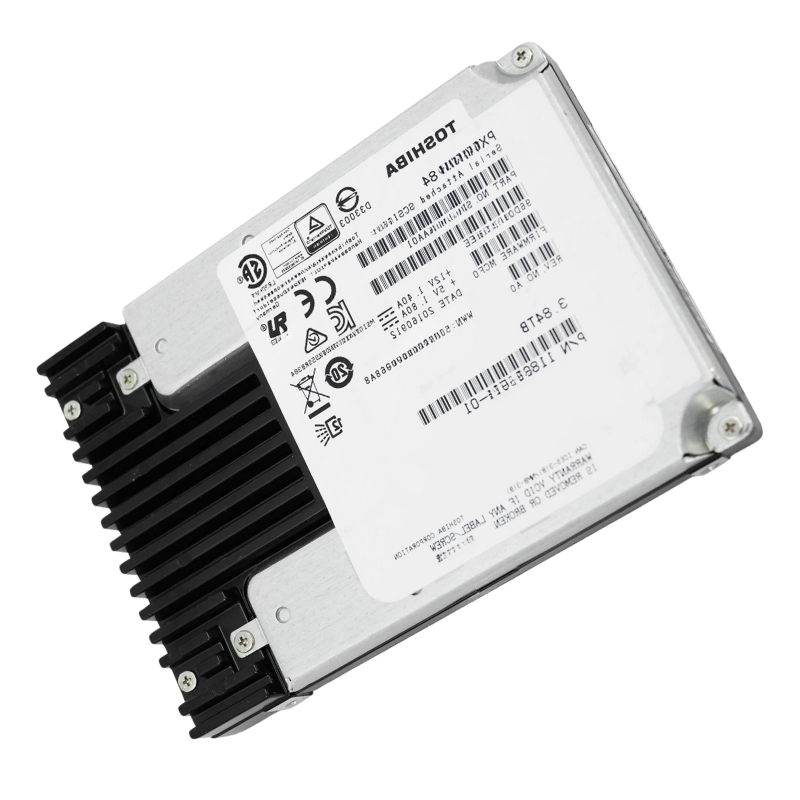
Toshiba SDFUS84DHB02T 3.84TB PM6R SAS 24GBPS 2.5Inch Read Intensive SSD. New Sealed in Box (NIB) with 3 years Warranty - Dell Version
This high-performance solid state drive, identified by part number SDFUS84DHB02T, is engineered for demanding data center applications requiring exceptional reliability and speed.
Boasting a substantial 3.84 terabytes of storage space, this unit utilizes cutting-edge BiCS FLASH™ TLC NAND technology, offering an optimal balance of density, performance, and cost-efficiency.
The drive features a robust SAS-4 (24 Gb/s) interface, ensuring maximum bandwidth and compatibility with modern server backplanes. It connects via a single SAS port and is designed for seamless integration into a hot-plug capable 2.5-inch bay.
Characterized as a read-intensive model, it offers a durability rating of 1 Drive Writes Per Day (DWPD). Its operational resilience is underscored by a Mean Time To Failure (MTTF) of 2.5 million hours.
This SSD supports the Advanced Format 512e standard, ensuring broad compatibility with existing infrastructure while optimizing data integrity and storage efficiency. Its hot-swap capability allows for drive replacement without system shutdown, maximizing server uptime.
Product Category Overview — Toshiba 3.84TB PM6R SAS 24Gbps 2.5" Read-Intensive SSD
The Toshiba SDFUS84DHB02T 3.84TB PM6R is a 2.5-inch, enterprise-class, read-intensive (RI) SAS SSD engineered for data-center tiers that prioritize high read throughput, low latency, and predictable serviceability. Built to the SAS 24Gb/s interface standard and optimized for sustained read workloads, this drive is commonly used in content delivery, metadata storage, read caching layers, archive accelerators, and other applications where read operations dominate and cost per usable terabyte matters. As part of the PM6R product family, the drive balances the reliability and manageability features expected in enterprise deployments with endurance characteristics tuned for read-heavy patterns, delivering a dependable building block for mixed storage ecosystems.
The SDFUS84DHB02T ships in the industry-standard 2.5-inch format that fits server bays and dense storage sleds. The 2.5" footprint allows higher drive counts per chassis compared with 3.5" HDD bays, enabling increased rack-level capacity and better IOPS density. When planning rack and sled layouts, verify whether your enclosure supports 7 mm or 15 mm drive profiles and the specific connector types used by the vendor to ensure mechanical and thermal compatibility.
Unlike client or NVMe devices, SAS drives use an enterprise SAS protocol set that includes robust multipath support, dual-port connectivity, and mature error handling suited to mission-critical server environments. The 24 Gbps SAS link provides headroom for concurrent random reads and multiple queueing agents, enabling predictable latency at scale. Dual-port SAS also allows high availability configurations and non-disruptive path failover, which are valuable in SAN and shared storage arrays.
The PM6R series is positioned as a Read-Intensive class, meaning the internal flash programming and overprovisioning are optimized for workloads with a high read:write ratio. That tuning delivers a favorable cost per terabyte for read-dominant workloads where frequent large sequential reads or large numbers of small random reads are the norm. RI drives typically have lower drive writes per day (DWPD) guarantees than mixed-use or write-intensive counterparts, so they yield the best value where write amplification and heavy sustained writes are uncommon.
The SDFUS84DHB02T is engineered to deliver high sustained read throughput for both large sequential transfers and small random reads. These characteristics make it well suited for caching, indexing, and streaming layers where application performance depends on fast and consistent read access. For workloads such as metadata lookups, content serving, or VM image libraries, read IOPS and deterministic latency are typically more critical than peak sequential write numbers.
Although able to accept writes, RI drives are not primarily designed for continuous heavy write workloads. Sustained write bursts will be tolerated, but frequent, long-duration writes will accelerate wear and can lead to performance throttling as internal maintenance tasks run. For write-sensitive applications, consider a mixed-use or write-intensive alternative. When RI drives are used for write-heavy bursts in tiered designs, combine them with a write buffer tier (e.g., higher endurance SSDs or NVM) to absorb writes and protect the RI layer.
Predictable latency under concurrent load is a hallmark of enterprise SAS SSDs. The drive’s firmware and SAS protocol cooperate to maintain consistent command servicing and error recovery behavior. For latency-sensitive applications, enforce I/O queue controls, NUMA-aware placement, and multipath tuning to prevent host-side bottlenecks from obscuring drive QoS characteristics.
Dual-port SAS provides two independent SAS paths into the drive, enabling multipath failover and non-disruptive maintenance within SAN environments. This capability is essential for shared storage, clustered filesystems, and high-availability designs where uninterrupted access is required during link or controller maintenance.
Enterprise SSDs implement end-to-end data integrity checks, advanced ECC, and internal mechanisms to detect and correct media errors before they reach the host. These protections reduce the risk of silent data corruption and allow storage stacks to rely on the drive for verified data at rest and in transit across the media channels.
Some enterprise drives include power-loss protection features that guard in-flight data during sudden power events. These protections can range from firmware safeguards to supercapacitor-backed flushes that ensure critical metadata is persisted. Verify the exact power-loss protection features for your model and account for any required host power sequencing or connector dependencies specified by the vendor.
SAS drives expose vendor and industry standard telemetry for SMART attributes, error logs, and usage counters. Monitoring these signals enables predictive maintenance workflows and fleet health dashboards. Key attributes to track include media wear indicators, corrected/uncorrected error counts, temperature, and power cycles. Integrate SAS telemetry into your existing monitoring and automation frameworks to trigger proactive replacements and capacity planning.
Enterprise SSD firmware is often updated to address interoperability, performance, and stability across a wide range of platforms. Establish a controlled firmware update process: test new firmware in a staging environment that replicates production loads, validate rollback procedures, and schedule updates during maintenance windows. Many vendors offer firmware validation programs and release notes that describe fixes and behavior changes — rely on those documents during procurement and operations.
The SDFUS84DHB02T is an excellent candidate for read caches and hot tiers in hybrid storage stacks. In these roles it acts as a high-speed layer in front of larger, slower capacity tiers (like HDDs or object stores), absorbing repeated reads and dramatically improving response times for popular content or metadata. Caching algorithms that favor reads benefit from the drive’s quick access times and steady read throughput.
Indexes and metadata repositories that serve frequent read requests with occasional writes gain from RI SSD characteristics. File system metadata, search indexes, and object store indices are common targets, where small random reads and a need for low latency govern performance more than write endurance.
When many virtual machines or containers boot from a shared image repository, the storage tier that hosts those images must deliver high random read IOPS and low latency. A 3.84TB read-intensive SAS SSD can store many compact images or heavily accessed container layers, reducing boot storms and improving scaling during fleet expansions.
Ensure your storage controllers, HBAs, and backplane electronics support SAS 24Gb/s links and any specific connector mappings used by the drive vendor. While SAS is backward compatible in many cases, using the correct generation and cabling ensures you realize expected throughput and multipath features. Confirm the dual-port mapping and cable routing for redundancy and performance.
High-density deployments must account for thermal headroom. Even drives optimized for reads will generate heat under sustained activity. Verify that rack airflow, sled design, and onboard heat spreaders meet vendor recommendations and that system firmware can monitor and react to elevated temperatures to protect performance and longevity.
When deploying the SDFUS84DHB02T in arrays or RAID groups, adjust rebuild policies and spare pool sizes to suit the RW profile and desired recovery windows. Because rebuilds can initiate significant write loads, ensure the array has capacity to absorb rebuild operations without overtaxing RI devices — in many architectures, pairing RI drives with a higher-endurance journal or using erasure coding that minimizes write amplification will improve overall resilience.
Account for vendor overprovisioning and reserve space for system overhead when calculating usable capacity. Overprovisioning helps the controller manage wear and background tasks without impacting user-visible performance. Plan usable TB capacity with RAID/replication overhead in mind to avoid mid-lifecycle surprises.
Implement continuous monitoring of SMART attributes and vendor telemetry to detect trends in media wear or rising error counts. Automated alerts can help teams replace drives before they fail, lowering the risk of rebuild storms and data availability impacts. Maintain an inventory of spare units and an RMA plan tailored to your availability targets.
Tune host I/O stacks for predictable latency: enable multipath and proper queue depth settings, align filesystems to expected I/O sizes, and consider bypass strategies like direct NVMe access where applicable in mixed environments. Although SAS is block-based, many principles of I/O alignment and queue tuning still apply to guarantee consistent performance under concurrent workloads.
If the drive and system architecture support it, consider drive-level encryption for multi-tenant or regulated environments. Hardware encryption paired with key management systems protects data at rest and simplifies decommissioning. Confirm support for industry standards and key management integrations before relying on encryption for compliance obligations.
Proper end-of-life procedures are essential. Use manufacturer-provided secure erase tools or validated cryptographic zeroization to ensure data cannot be recovered when drives leave service. For high-security contexts, combine secure erase with physical destruction policies as required by regulation.
Selecting the right endurance class requires mapping workload characteristics to drive capabilities:
The Toshiba 3.84TB PM6R RI device is a cost-efficient choice when reads greatly outnumber writes; however, for heavy write workloads choose MU or WI products to ensure predictable media life and lower replacement churn.
Prefer SAS RI Drives Over NVMe Alternatives
SAS RI drives remain attractive where existing SAN or SAS infrastructure is already deployed, where dual-port connectivity and SAN features are required, or where the operational model relies on SAS manageability. NVMe drives offer higher raw bandwidth and lower protocol overhead, but SAS provides mature multipath, proven enterprise support, and simpler shared storage integration in many legacy arrays. Evaluate the broader storage architecture, management tooling, and availability SLAs when comparing SAS RI and NVMe options.
Calculate cost per usable TB after factoring in RAID overhead, overprovisioning, and redundancy. RI devices often provide a lower purchase price per TB but may require complementary tiers for write buffering or durability under write bursts. Include power, cooling, and service contracts when modeling TCO because operational expenses often dominate over time.
Before buying, validate these items:
Acceptance & Burn-In Testing
Upon receiving drives, perform acceptance testing that simulates expected production patterns: run read-heavy workloads, monitor SMART telemetry for abnormal behavior, validate multipath failover, test secure erase procedures, and confirm firmware versions. A short burn-in period helps catch early failures and verifies that drives behave within expected thermal and performance envelopes.


 Contact Us
 Information
 Catalog
 Solid State Drives (SSD)
 Network Switches
 Hard Disk Drives
 HBA & Controllers
 PC & Servers
 PC & Server Memory
 CPU & Processors
 Network Routers
 Power Supplies
 Tape Drives & Libraries
 Network Devices
 Computer & Network Cables