(7% discount is applied at checkout)
Cart is empty
Your go-to destination for cutting-edge server products
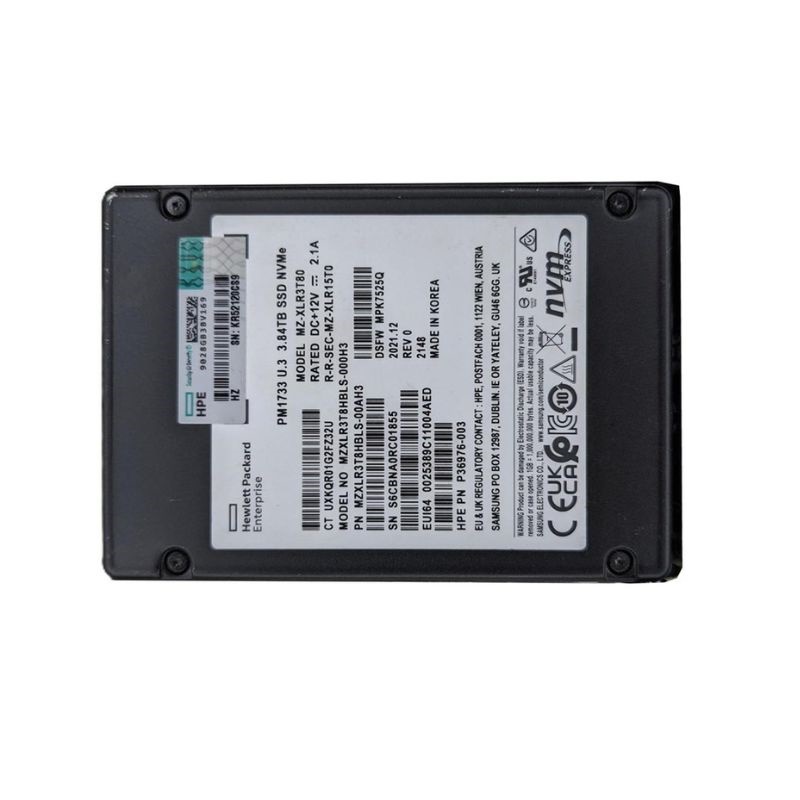


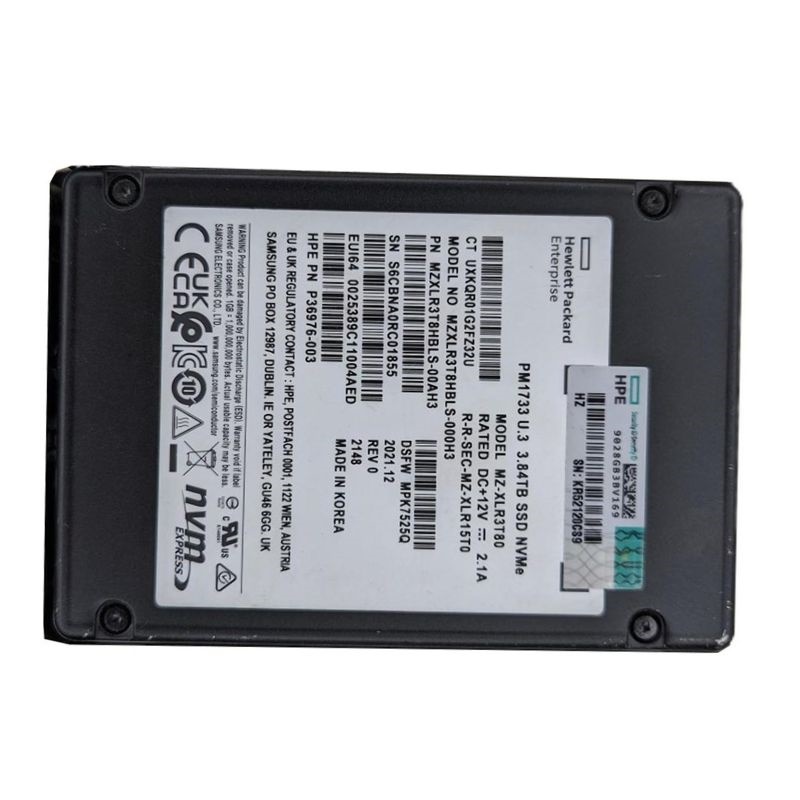
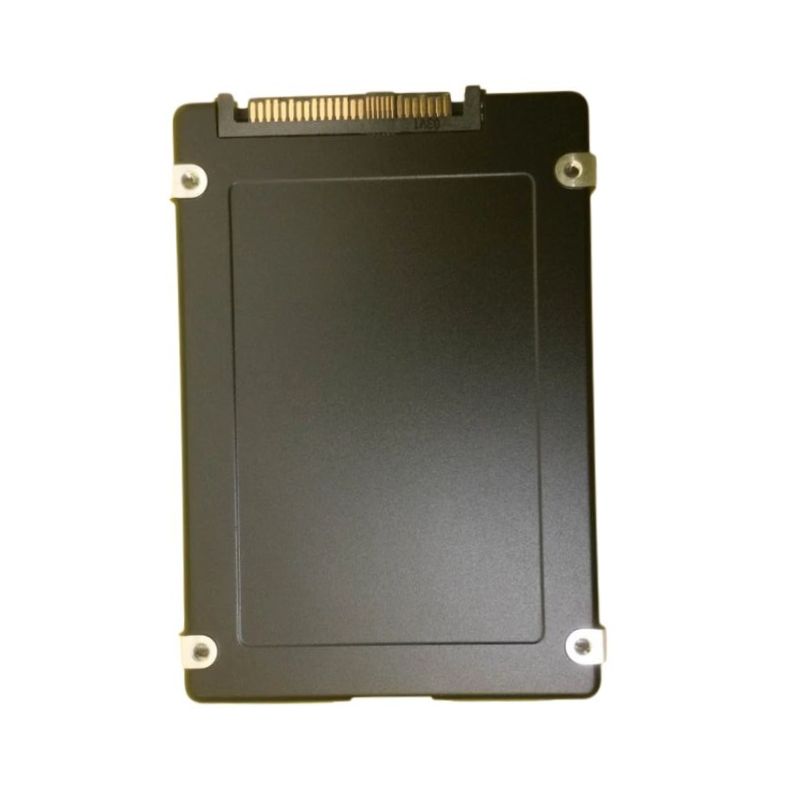
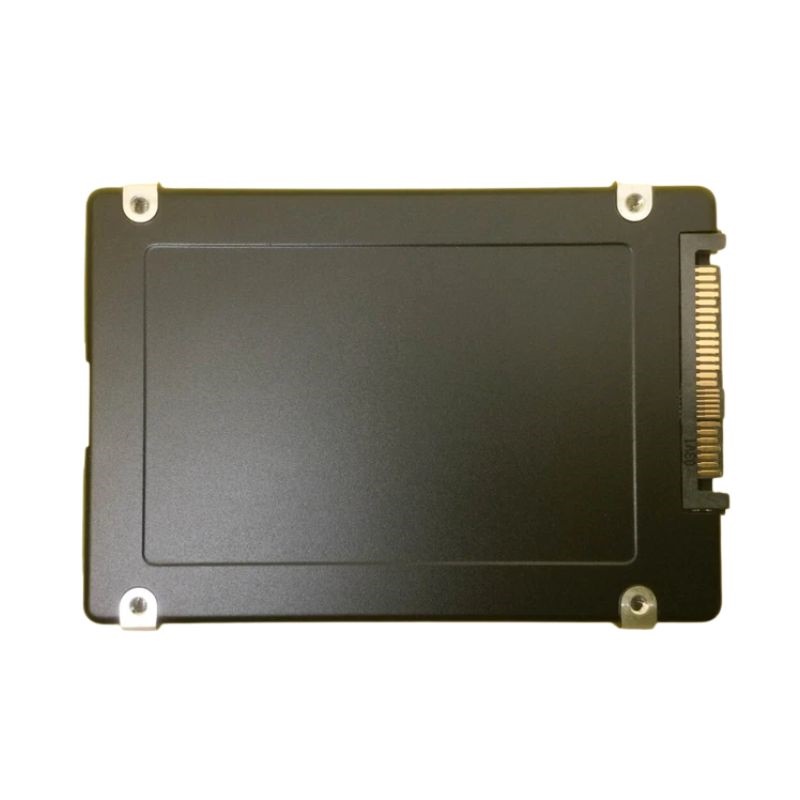
Samsung MZXLR3T8HBLS-00AH3 3.84 TB PCI-E PM1733 NVMe Internal Solid State Drive. Excellent Refurbished with 1 year replacement warranty -HPE Version
The Samsung PM1733 MZXLR3T8HBLS-00AH3 is a high-performance enterprise-grade solid-state drive engineered for demanding workloads. Offering excellent speed, endurance, and efficiency, it delivers uncompromising data storage solutions for businesses and data centers requiring reliability and scalability.
This drive is meticulously crafted to support enterprise workloads where speed, durability, and seamless integration are paramount.
Optimized for intensive workloads, the Samsung PM1733 drive guarantees high-speed processing and stable endurance levels. Built with PCIe Gen4 support, it significantly enhances data throughput.
By incorporating Samsung’s V-NAND architecture, this SSD ensures lower latency, high endurance, and maximum throughput. PCIe 4.0 compatibility further enhances system-level responsiveness, making it a preferred choice for enterprise servers and storage arrays.
The drive is best suited for:
Compact yet sturdy, the Samsung PM1733 SSD integrates into 2.5-inch slots, ensuring easy deployment within rack systems while offering advanced protection for sustained usage.
The drive is designed with reduced power consumption in mind, allowing enterprises to maintain performance without excessive energy use, lowering operational costs over time.
The Samsung MZXLR3T8HBLS-00AH3 belongs to the PM1733 family of enterprise-grade NVMe solid-state drives engineered for consistently low latency, high throughput, and robust data protection in modern data centers. Built on Samsung V-NAND and optimized for the PCI-Express 4.0 x4 interface, this 3.84 TB U.2/U.3-ready class device is designed to accelerate database platforms, virtualization clusters, AI/ML pipelines, real-time analytics, and large-scale content delivery while meeting stringent uptime and durability requirements. With a focus on predictable QoS under concurrent workloads, the PM1733 architecture emphasizes end-to-end data integrity, power-loss protection, and advanced NVMe features that streamline fleet management and multi-tenant operations.
Whether you are planning a fresh deployment in a PCIe Gen4-capable server or upgrading legacy infrastructure to meet higher service-level objectives, the MZXLR3T8HBLS-00AH3 offers a compelling blend of performance per watt, TCO advantages, and enterprise security. The drive aligns with common hyperscale and private cloud standards, integrates with popular host NVMe drivers, and supports monitoring hooks that simplify observability within infrastructure-as-code workflows.
PCI-Express 4.0 doubles the per-lane bandwidth of Gen3, meaning a x4 link provides significantly higher headroom for sustained reads, mixed-write activity, metadata operations, and background tasks like garbage collection or wear leveling. On the PM1733 platform, this translates into reduced queuing delays, better tail latency, and more stable throughput under heavy I/O concurrency compared to comparable Gen3 designs. The MZXLR3T8HBLS-00AH3 leverages controller optimizations and V-NAND parallelism to serve both sequential and random I/O patterns common in enterprise applications.
Samsung’s V-NAND technology stacks memory cells vertically to increase density while minimizing cell-to-cell interference. In enterprise drives like the PM1733 series, this architecture supports sustained write performance, robust endurance ratings appropriate for 24/7 duty cycles, and tight latency distributions that help meet SLOs. The result is fewer performance regressions during peak hours and more predictable job completion times for latency-sensitive applications.
The MZXLR3T8HBLS-00AH3 integrates enterprise-grade protection mechanisms, including:
The 2.5-inch U.2/U.3 form factor fits standard server hot-swap bays. Many Gen4 backplanes in current dual-socket and single-socket platforms support NVMe devices like the Samsung MZXLR3T8HBLS-00AH3 without add-in cards, simplifying cable management and enabling dense storage nodes. For operators transitioning from SAS/SATA, U.3-capable bays can streamline mixed media configurations, while maintaining serviceability.
Commonly used NVMe capabilities on the PM1733 platform include namespaces for multi-tenant isolation, firmware activation without host reboots (vendor/OS support dependent), and standardized SMART attributes. Many operating systems offer native NVMe drivers that expose these features via CLI tools and automation frameworks, making it straightforward to integrate the MZXLR3T8HBLS-00AH3 into existing provisioning pipelines.
For workloads emphasizing rapid content retrieval—such as microservices serving static assets, media libraries, or inference models—the PCIe 4.0 bandwidth and NVMe parallelism of the PM1733 reduce fetch times and improve cache warm-up durations. Operators can expect strong sequential read behavior and solid random read latency, enabling higher QPS before scaling out nodes.
Transactional databases, distributed SQL engines, and virtualized environments generate interleaved read/write patterns with variable block sizes. The MZXLR3T8HBLS-00AH3 is tuned to handle these mixed operations with predictable latency, mitigating noisy neighbor effects and helping sustain performance during checkpoints, compactions, or snapshot operations. In multi-tenant hypervisors, this consistency translates into smoother VM performance and fewer outliers during peak contention.
Compilations, artifact packaging, and container image layering benefit from low-latency storage. The PM1733’s responsiveness shortens build times, accelerates test suites, and improves developer feedback loops. When paired with high-core CPUs and sufficient memory, the drive allows CI runners to execute more jobs concurrently without saturating storage queues.
In edge scenarios where footprint, power budgets, and environmental constraints matter, the efficiency of a PCIe Gen4 x4 NVMe device like the Samsung MZXLR3T8HBLS-00AH3 enables higher performance per watt and straightforward serviceability. PLP and data integrity features are especially relevant in locations susceptible to power anomalies.
Enterprise deployments frequently require encryption capabilities, secure erase workflows, and compliance-aligned sanitization methods. The PM1733 platform supports standards-driven approaches to help administrators protect data at rest and decommission drives safely. These controls, combined with namespace isolation and access management at the host layer, form a defense-in-depth model appropriate for regulated industries.
Granular telemetry helps satisfy audit requirements and anticipate issues before they affect SLAs. With NVMe SMART logs and vendor-specific counters, the MZXLR3T8HBLS-00AH3 integrates into observability stacks, enabling anomaly detection, trend analysis for endurance consumption, and alerting for temperature thresholds or media wear indicators.
Before deploying the Samsung PM1733 MZXLR3T8HBLS-00AH3 broadly, validate server BIOS/UEFI versions, NVMe driver stacks, and backplane firmware. Ensure your chassis supports PCIe 4.0 signal integrity on the target bays, and confirm front-panel cooling airflow aligns with the drive’s thermal envelope. For mixed media environments, map bay assignments to avoid thermal hotspots and to maintain easy physical access for service rotations.
Use modern partitioning schemes that default to 4K alignment to optimize write amplification and latency. Filesystem choices should reflect workload characteristics: log-structured or copy-on-write filesystems can simplify snapshots and integrity, while journaling filesystems may be preferred for deterministic recovery and well-understood admin tooling. For latency-critical databases, consult vendor guidance on I/O scheduler tweaks, queue depths, and write-barrier semantics.
NVMe namespaces allow logical segmentation within a single physical drive. On hosts that service multiple tenants or microservices, namespaces can isolate performance domains and simplify lifecycle management (resize, provision, retire). The MZXLR3T8HBLS-00AH3 supports namespace operations consistent with the PM1733 feature set, enabling flexible carve-ups that align to capacity planning and internal chargeback models.
Treat drive firmware like any production dependency. Maintain a staging environment to certify updates, record baselines, and roll out upgrades in waves using maintenance windows. Where supported, leverage non-disruptive activation paths to minimize downtime. Capture SMART deltas pre- and post-upgrade to verify expected behavior and to document compliance.
NVMe exploits parallel queues to drive high throughput. Benchmark realistic queue depths for your workload rather than defaulting to synthetic maxima. For latency-sensitive services, prioritize shorter queues with more threads bound to CPU cores that minimize NUMA crossings. On virtualization hosts, balance guest-level queues with host-level arbitration to avoid oversubscription that inflates tail latencies.
Experiment with I/O sizes that align to application access patterns. Some databases benefit from direct I/O to reduce double-caching, while others prefer buffered I/O to coalesce small writes. Monitor write amplification and garbage collection behavior when adjusting parameters, and ensure changes are validated under peak traffic, not just idle testing windows.
Even with intelligent throttling, thermal headroom drives consistency. Verify front-to-back airflow, ensure intake filters are clean, and position the MZXLR3T8HBLS-00AH3 in bays with adequate cooling. Use system telemetry to track temperature trends over weeks to capture seasonal or environmental shifts that may affect performance.
Pooling multiple Samsung PM1733 drives can deliver both performance scaling and redundancy. Establish per-node capacity thresholds that leave space for snapshots, compaction bursts, and maintenance operations. Avoid running devices at sustained near-full utilization, which can elevate write amplification and exacerbate tail latency outliers.
Track SMART wear indicators and lifetime bytes written. Correlate these metrics with application release cycles and traffic patterns to forecast replacement windows. With the MZXLR3T8HBLS-00AH3, consistent telemetry helps predict when to rotate hardware before it impacts reliability, allowing you to maintain high availability and meet compliance targets for hardware refresh.
Hypervisors and container orchestration stacks can leverage NVMe datapaths for low-overhead access. Expose the Samsung PM1733 capacity via thin-provisioned volumes, storage classes, or VM disks, and map QoS policies that reflect workload priorities. For Kubernetes, monitor persistent volume claims, set appropriate requests/limits, and consider node-local caching for read-heavy microservices where applicable.
Relational engines, NoSQL stores, and streaming frameworks depend on predictable storage latency. When deploying on the MZXLR3T8HBLS-00AH3, align commit logs or write-ahead logs to dedicated namespaces or volumes to reduce interference with random read workloads. For distributed systems, stress-test recovery paths—like rebalancing or replica rebuilds—since these can be more demanding than steady-state operations.
Moving from SATA or SAS to NVMe on PCIe 4.0 delivers major improvements in latency, throughput, and CPU efficiency. The queue model in NVMe reduces controller overhead, and the x4 link capacity enables more parallelism. The Samsung PM1733 MZXLR3T8HBLS-00AH3 thus allows consolidation: fewer drives can often service the same workload, reducing chassis count, cabling, and power draw.
Within PCIe Gen4 ecosystems, the PM1733 series stands out for its blend of enterprise reliability features and consistent QoS. While peak synthetic numbers can be similar across vendors, sustained behavior under multitenant contention and during background tasks is where enterprise firmware maturity shows its value. The MZXLR3T8HBLS-00AH3 is tuned for these realities, offering dependable service across a wide range of I/O mixes.
Leverage native NVMe tools to query SMART data, manipulate namespaces, and manage firmware. Feed metrics into monitoring stacks to visualize trends, establish alert thresholds, and forecast capacity and endurance. The goal is to normalize device behavior at fleet scale so outliers are easy to detect and remediate.
Create clear runbooks for common operational tasks—drive replacement, firmware rollbacks, namespace resizing, and secure erase. Incorporate pre-checks (temperature, media errors) and post-checks (performance baselines) so changes are consistent and auditable. Align these runbooks with your incident response practices to reduce MTTR when anomalies occur.
The transition to PCIe Gen4 can raise concerns about power budgets, but efficient controllers and V-NAND help the PM1733 maintain competitive performance per watt. In practice, the MZXLR3T8HBLS-00AH3 often enables node consolidation that reduces overall rack power, especially when replacing arrays of lower-bandwidth devices.
Maintain recommended inlet temperatures for front-loaded bays. Use chassis fan profiles that adapt to drive temperature sensors. In high-density nodes, stagger heavy write jobs across time windows or distribute them across multiple drives to keep thermal peaks manageable and preserve steady-state performance.
Standardization simplifies spares management and automation. The Samsung PM1733 MZXLR3T8HBLS-00AH3, with its 3.84 TB capacity point, is a practical baseline for mixed read/write environments, enabling balanced pools that can service OLTP, analytics, and CI pipelines without constant retuning. For read-heavy caching layers, pair with additional devices as needed to scale capacity independently from compute.
Refresh planning should weigh endurance consumption, warranty windows, and upcoming platform upgrades (e.g., newer CPUs, faster interconnects). Because the PM1733 on PCIe 4.0 delivers robust performance today, many operators choose to amortize deployments across multiple platform generations, then migrate at opportune maintenance windows with well-documented data movement procedures.
Enterprise workloads rarely operate in ideal, single-tenant conditions. The MZXLR3T8HBLS-00AH3 is built for the messy reality of concurrent tenants, background tasks, and variable I/O patterns—delivering stable latency and throughput so application teams can trust their SLOs.
From PLP to end-to-end data path protection and detailed telemetry, the PM1733 platform is engineered to prevent, detect, and recover from issues. In hot-swap server bays, service rotations are quick, documentation is straightforward, and downtime is minimized.
By consolidating workloads and reducing the number of devices needed to hit performance targets, the PM1733 can lower power, cooling, and licensing footprints. Automation-friendly telemetry and NVMe tooling trim operational overhead while improving visibility.
The Samsung PM1733 MZXLR3T8HBLS-00AH3 3.84 TB NVMe SSD represents a dependable, scalable storage building block for data centers moving to PCIe Gen4. It pairs V-NAND performance with enterprise-grade protections, integrates smoothly with modern orchestration, and offers the predictability required for mission-critical services. Across databases, virtualization, analytics, and CI workloads, this drive’s combination of throughput, latency consistency, and operational telemetry makes it a strong choice for organizations standardizing on NVMe in high-density servers.
Use multiple MZXLR3T8HBLS-00AH3 devices in RAID or as independent volumes per shard/replica. Allocate separate namespaces for logs and data to reduce interference, and tune queue depths to meet p99 latency targets.
Leverage the PM1733’s strong read characteristics to back CDN nodes or edge application caches. Combine with efficient HTTP stacks and TLS offload to push more content with fewer servers and lower latency to end users.
Pair the drive with high-memory nodes to accelerate ingestion and query phases. Monitor compaction and spill activity; the bandwidth afforded by PCIe 4.0 x4 helps sustain performance during these intensive operations.
Samsung MZXLR3T8HBLS-00AH3, PM1733 3.84 TB, PCIe 4.0 x4 NVMe enterprise SSD, V-NAND data center storage, U.2/U.3 NVMe drive, power loss protection, end-to-end data protection, consistent QoS, low latency NVMe, enterprise-grade SSD for databases, virtualization storage, analytics acceleration, NVMe namespaces, firmware management, SMART telemetry, predictable performance, data integrity, server backplane NVMe, hot-swap NVMe, performance per watt.


 Contact Us
 Information
 Catalog
 Solid State Drives (SSD)
 Network Switches
 Hard Disk Drives
 HBA & Controllers
 PC & Servers
 PC & Server Memory
 CPU & Processors
 Network Routers
 Power Supplies
 Tape Drives & Libraries
 Network Devices
 Computer & Network Cables