(7% discount is applied at checkout)
Cart is empty
Your go-to destination for cutting-edge server products
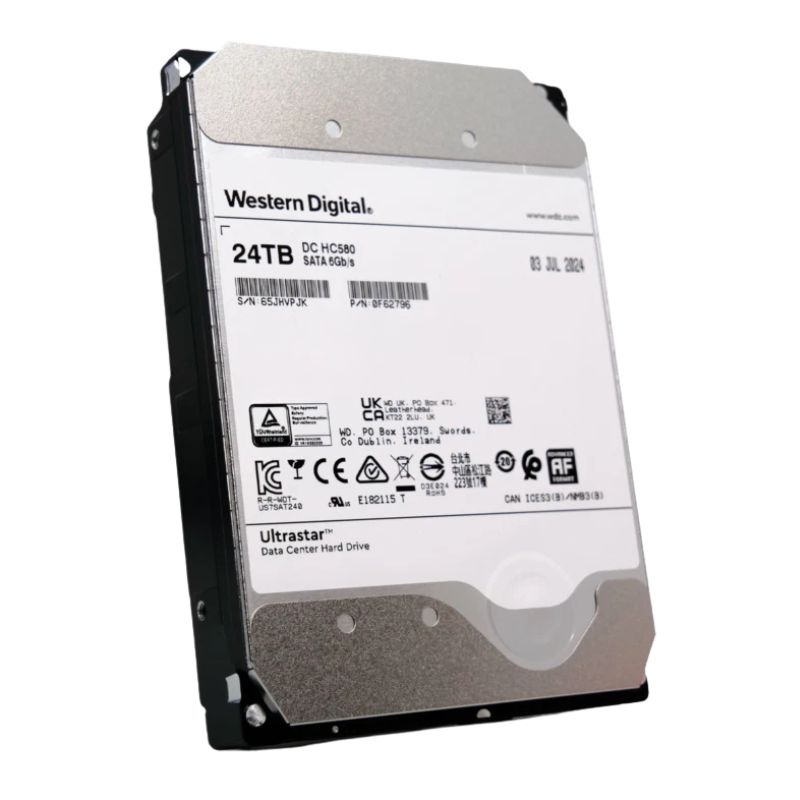


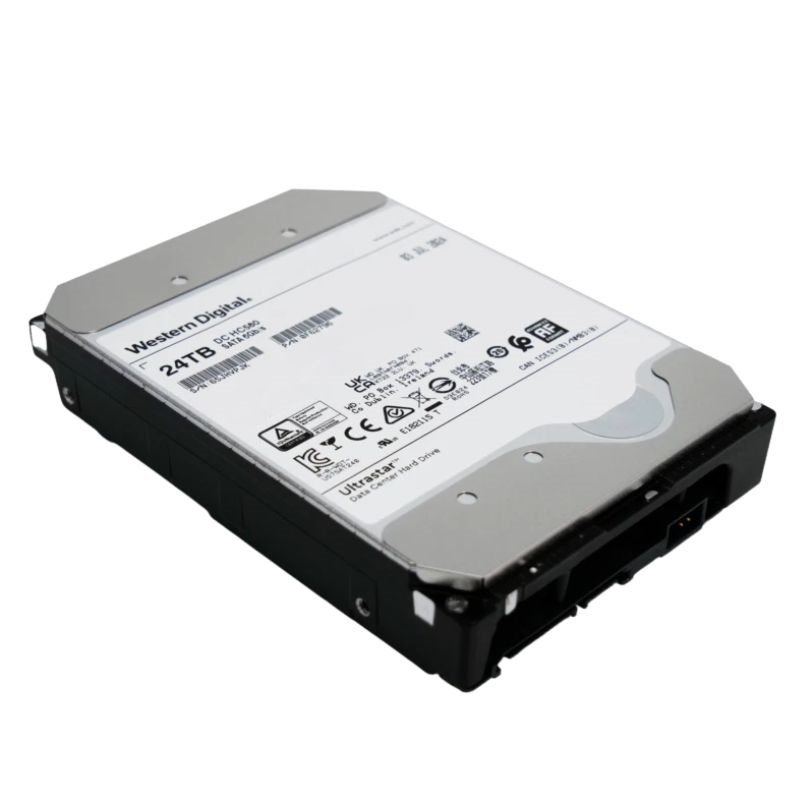
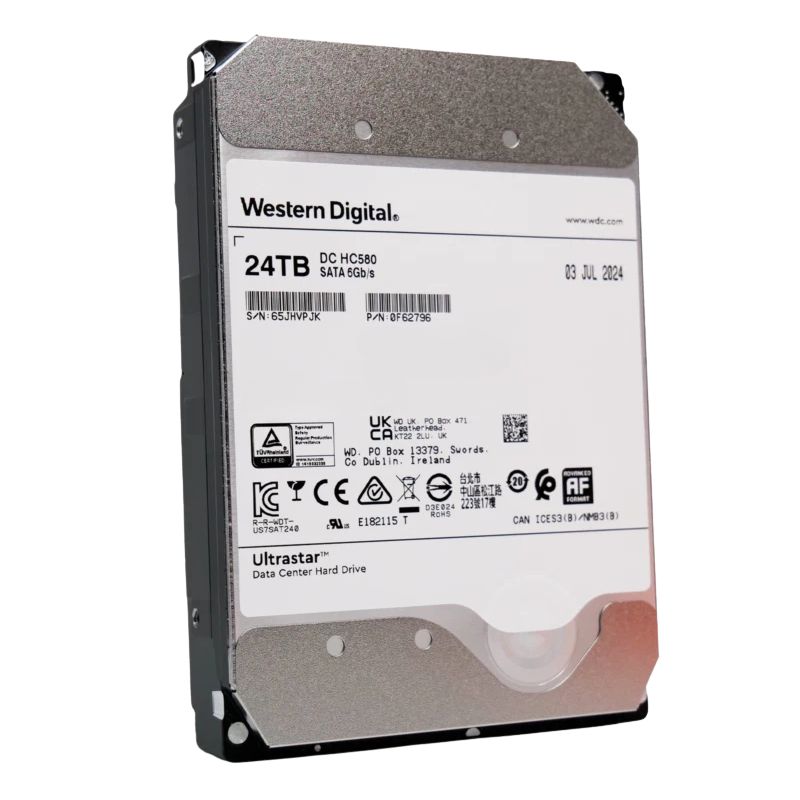
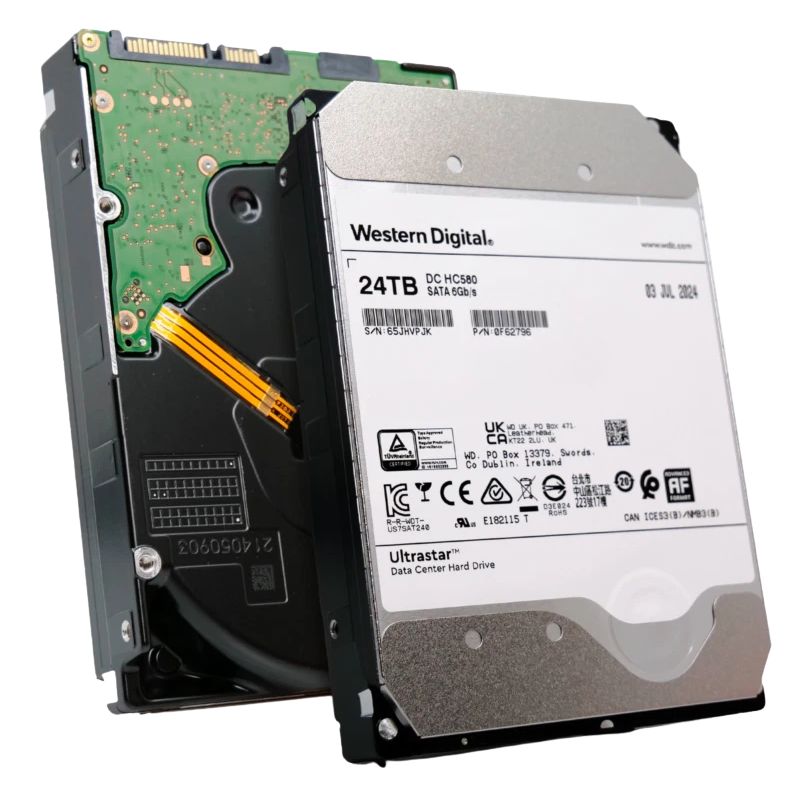
Western Digital WUH722424ALE600 Ultrastar DC Hc580 24TB 7.2K RPM SATA 6GBPS 512MB Buffer 512e 3.5 Inch Hard Disk Drive. New Sealed in Box (NIB) with 3 Year Warranty - Dell Version
The Western Digital WUH722424ALE600 Ultrastar DC Hc580 is a high-capacity enterprise-grade hard disk drive engineered for modern data center demands. Designed for reliability, performance, and scalability, this 24TB drive delivers consistent results in both cloud and on-premise environments.
This high-performance HDD is optimized for large-scale storage and complex computing environments, including:
The Ultrastar DC Hc580 series integrates seamlessly into modern enterprise storage systems, delivering high-density storage solutions without compromising performance. Its combination of high capacity, reliability, and optimized energy efficiency makes it an excellent choice for mission-critical workloads.
Designed for distributed file systems and large-scale analytics, the WUH722424ALE600 provides consistent IOPS and throughput, enabling real-time processing of massive datasets. This makes it ideal for:
With a 3.5-inch form factor and advanced CMR technology, this HDD maximizes storage density in racks, reducing the physical footprint while maintaining high availability. Key benefits include:
The Ultrastar DC Hc580 24TB HDD incorporates baseline encryption and robust security features to protect sensitive data. Combined with its 2.5 million hours MTBF, it offers peace of mind for data center administrators managing mission-critical storage infrastructure.
The Western Digital WUH722424ALE600 Ultrastar DC HC580 24TB hard disk drive represents a purpose-built storage platform for large-scale data environments. Designed to deliver high areal density, predictable performance, and enterprise-class reliability, this 3.5-inch SATA 6Gb/s drive pairs 7,200 RPM rotational speed with a sizable 512MB cache and 24 terabytes of raw capacity to address the needs of cloud service providers, hyperscale operators, archival systems, and mission-critical on-premises arrays. The drive’s inclusion of 512e sector emulation and Western Digital’s OptiNAND technology positions it as a modern HDD that blends legacy compatibility with next-generation media management enhancements. The result is a device that balances raw capacity economics with the operational requirements of heavy-duty server and storage environments.
At 24 terabytes of formatted capacity, the Ultrastar DC HC580 enables significant consolidation of storage racks and boxes. High-capacity drives reduce the number of spindles required to reach a target usable capacity, which in turn lowers per-terabyte amortized costs for power, cooling, and chassis hardware. For environments optimizing rack density and power efficiency, 24TB drives allow architects to provision large pools for cold, warm, or mixed workload tiers while keeping footprint and operational overhead in check.
The 7,200 revolutions-per-minute rating targets the sweet-spot between sequential throughput and random I/O latency for enterprise mechanical media. While not as low-latency as an SSD, a 7.2K HDD delivers dependable sequential bandwidth for large file transfers, backup streams, and write-heavy archival workloads. For random small-block workloads, performance will remain limited by seek and rotational latency compared to flash storage; therefore this drive is most effective when used in architectures that absorb HDD characteristics—such as RAID arrays, object stores, and hierarchical storage tiers that pair HDDs with SSD caching layers.
The SATA 6Gb/s interface ensures wide interoperability across server platforms, storage enclosures, and many legacy systems. SATA remains a common enterprise interface for bulk storage and capacity-tier disks because it is simple to integrate and well supported by host bus adapters and RAID controllers. For organizations migrating from older SATA HDDs, the Ultrastar DC HC580 typically plugs into existing backplanes and enclosures with minimal changes while delivering a large jump in capacity per drive.
A large 512MB DRAM buffer improves transient throughput and helps maintain sustained transfer rates during bursty operations and metadata-heavy activities. The on-drive cache smooths command latencies seen by the host and can absorb short spikes in workload without immediate impact to the spindle’s sequential flow. From a practical perspective, the buffer helps when multiple small transfers occur in quick succession, reducing the visible performance variance to the server.
The drive’s 512e (512-byte emulation) logical sector format offers compatibility with operating systems, firmware, and enterprise applications that expect traditional 512-byte sectors while the physical media may use larger physical sectors internally. 512e helps avoid the compatibility issues associated with Advanced Format drives that expose native 4K sectors directly to hosts, making these drives easier to adopt in heterogeneous data centers with varied software stacks and management tools.
OptiNAND is a proprietary Western Digital innovation that embeds a flash-based persistent storage element within the HDD platform to preserve crucial drive metadata independently of platter state. By committing metadata snapshots to embedded NAND at regular intervals, drives equipped with OptiNAND achieve faster recovery after power interruptions and improved consistency for internal drive journaling. This preservation of metadata reduces the window of vulnerability following an unexpected power loss and supports faster rebuilds and reseeding operations in enterprise arrays. For administrators designing for high availability and rapid recovery, OptiNAND-enabled drives offer tangible operational benefits.
Enterprise data center disks are engineered for continuous operation under substantial mechanical and thermal stress. The Ultrastar DC HC580 family is intended for always-on environments where drives run across long duty cycles and high utilization. That engineering focus is reflected in features that mitigate vibration, maintain thermal stability, and manage intensive write/read cycles. When deploying at scale, these attributes preserve service continuity and reduce the frequency of drive replacements due to environmental stresses found in dense chassis and high-IO racks.
Manufacturers publish MTBF and workload ratings to give planners a baseline expectation for longevity and usage envelope. Enterprise HDDs typically target higher MTBF intervals and workload ratings compared with consumer drives, reflecting the heavier, 24/7 write and rebuild duties required. While raw MTBF numbers should be considered with practical understanding—real-world failure rates depend on many factors including operating temperature, vibration, and workload profile—choosing drives with enterprise-grade ratings helps enterprises model replacement schedules and warranty exposure as part of their total cost of ownership calculations.
Power draw and thermal dissipation are crucial considerations for any large deployment. High-capacity drives consume more energy during sustained transfer and spin-up phases; they also produce heat that must be removed by rack cooling systems. When planning a server or enclosure layout that uses multiple Ultrastar DC HC580 drives, account for peak power during array spin-up and for steady-state thermal load at full utilization. Integrating proper airflow paths and monitoring inlet temperatures will prolong drive life and prevent thermal throttling or premature failures.
Object stores benefit from high-capacity, economical storage media that convert spindle count into usable petabytes with minimal overhead. The Ultrastar DC HC580’s 24TB capacity allows hyperscale operators to expand object repositories more cost-effectively without dramatically increasing rack footprint. When used alongside erasure coding strategies and multi-node replication, these drives provide a sensible balance between capacity, rebuild time, and resilient data durability for cold or warm object layers.
Backup and long-term archival systems prioritize capacity and data integrity over low-latency access. The Ultrastar DC HC580 is well suited to disk-based backup repositories, deduplication pools, and nearline archive tiers where large sequential writes and infrequent restores are the norm. OptiNAND’s metadata protection also adds value in archive contexts by reducing the risk of metadata loss and simplifying recovery processes during restore operations.
In software-defined storage (SDS) deployments, combining many high-capacity HDDs under a distributed filesystem can deliver massive, cost-effective logical volumes. Using the Ultrastar DC HC580 with SDS solutions yields lower per-node costs for raw capacity and allows operators to tune redundancy and performance across tiers—for example, pairing the drives with SSDs for caching hot data while relegating cold content to the HDD pool.
Network-attached storage with nearline provisioning benefits from drives that are both affordable and dependable. The Ultrastar DC HC580 can function as the foundation for high-capacity NAS shelves where sequential throughput is crucial and many clients access large media or scientific datasets. When mixed with flash-based metadata volumes, they provide a balanced architecture that serves a diverse workload mix while managing cost per TB.
Large-capacity drives change the calculus for RAID selection because rebuilds after a failed drive take longer and touch more data. Administrators must weigh traditional RAID levels (RAID 6 is common for higher fault tolerance) against modern erasure coding schemes that reduce reconstruction overhead and improve resiliency. In very large arrays, consider multi-parity configurations or erasure coding that tolerates multiple concurrent failures while minimizing the rebuild impact on the remaining drives.
Enterprise HDDs expose SMART attributes and vendor-specific telemetry that are vital for predictive maintenance. Regularly harvesting SMART data and integrating it into a monitoring framework enables early detection of anomalies like increasing reallocated sectors, read error rates, or mechanical performance degradation. Proactive replacement strategies driven by telemetry reduce the risk of unexpected failures and help manage procurement cycles for spare drives.
Before deploying any large fleet, perform compatibility tests with server motherboards, RAID controllers, and enclosure firmwares. Drive firmware can influence interoperability and behavior—especially under power-loss conditions or with specific caching and NCQ behaviors. Maintain a firmware update policy that balances the need for improved stability and security against the risks of in-field firmware changes. Test firmware updates in a staging environment prior to widescale rollouts.
Maximizing the value of HDDs requires intelligent data placement. Use automated tiering where hot, latency-sensitive data is held on flash and cold or capacity-bound data is stored on Ultrastar drives. Hybrid arrays that combine SSD flash for the metadata and lookup layers with OptiNAND-enabled HDDs for bulk data deliver both responsiveness and economy. For analytics or large-scale content delivery, consider partitioning workloads to match the strengths of each media type.
Compared with earlier-generation enterprise HDDs, the Ultrastar DC HC580 generally offers higher areal density and larger cache size, which translates to improved per-disk throughput and more efficient rebuild behavior. When evaluating alternatives from other manufacturers, focus on real-world metrics: sustained sequential throughput, average latency under mixed loads, reliability statistics, and the vendor’s support ecosystem. Be mindful that some competing models trade off certain features—like energy consumption or vibration tolerance—in favor of marginally higher capacity.
TCO analysis should include acquisition cost, power consumption, expected failure rates, warranty coverage, cooling needs, and spare inventory. High-capacity drives can lower per-TB acquisition cost but may increase rebuild time overhead and risk during recovery. Model TCO across realistic failure scenarios and include manpower and replacement Drive logistics. Also, factor in the savings from reduced rack and chassis hardware when fewer disks deliver equivalent capacity to lower-capacity alternatives.
When acquiring drives in bulk for enterprise environments, verify sample compatibility, check whether the vendor offers qualified firmware builds for your controller hardware, confirm the warranty and RMA terms, and request any extended support SLAs if available. Additionally, negotiate pricing tiers based on volume and consider including spare pools to accelerate replacements. A phased trial deployment that mirrors production load patterns will uncover platform-specific behaviors before full fleet roll-out.


 Contact Us
 Information
 Catalog
 Solid State Drives (SSD)
 Network Switches
 Hard Disk Drives
 HBA & Controllers
 PC & Servers
 PC & Server Memory
 CPU & Processors
 Network Routers
 Power Supplies
 Tape Drives & Libraries
 Network Devices
 Computer & Network Cables