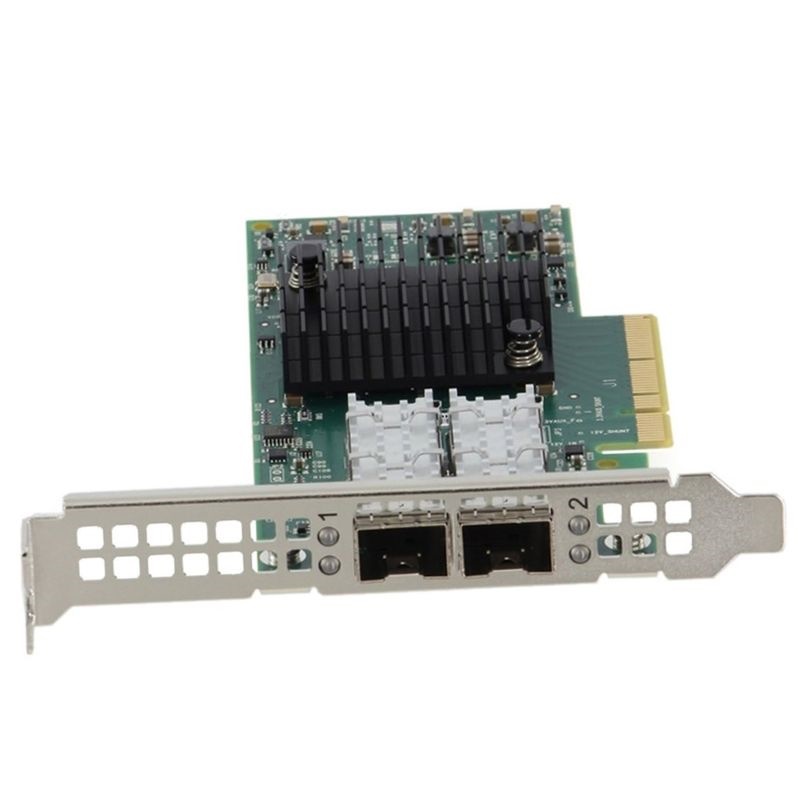
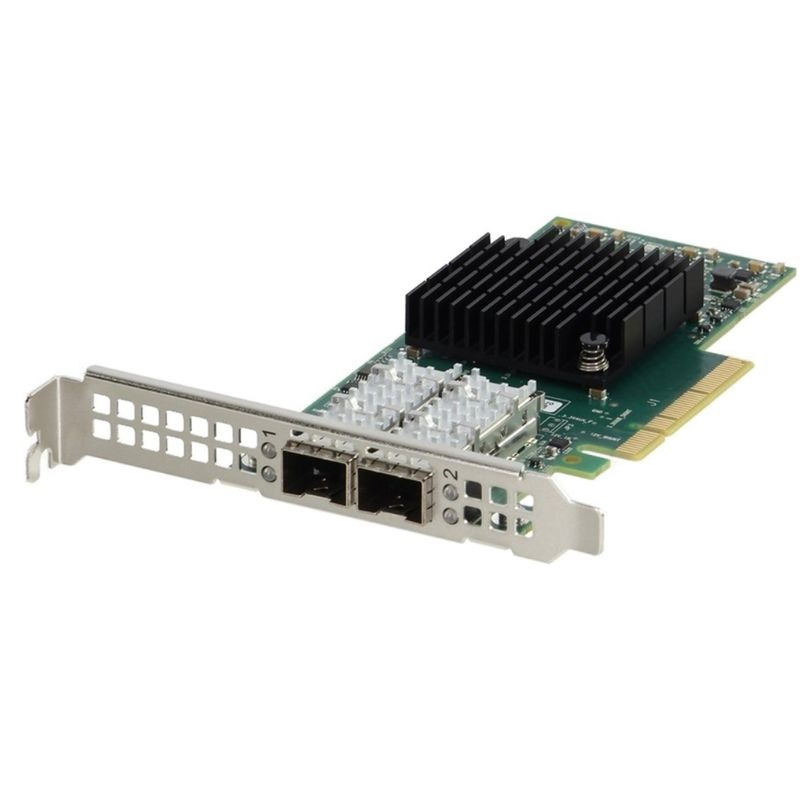
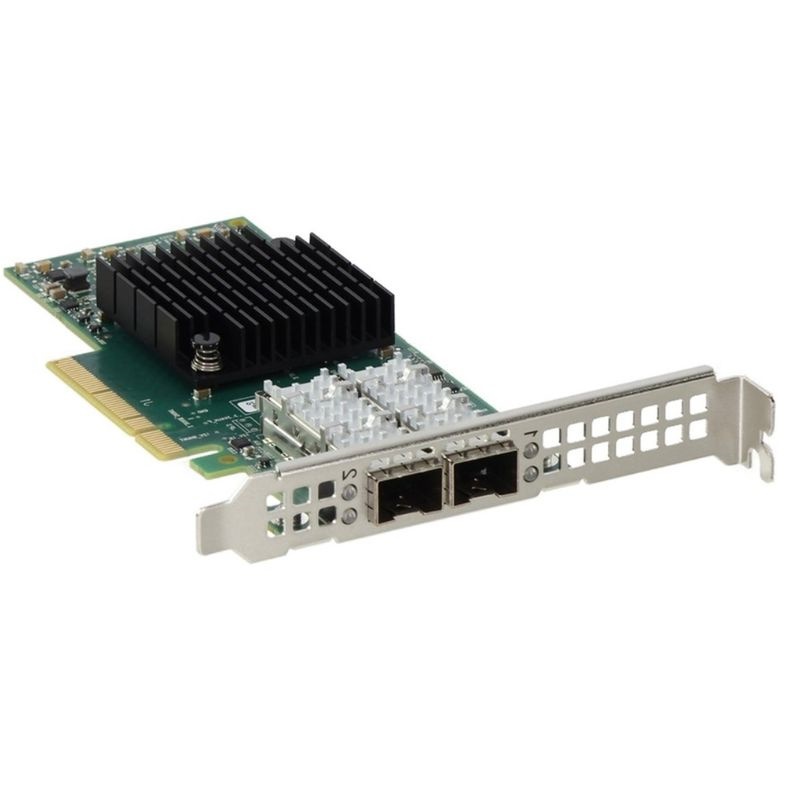
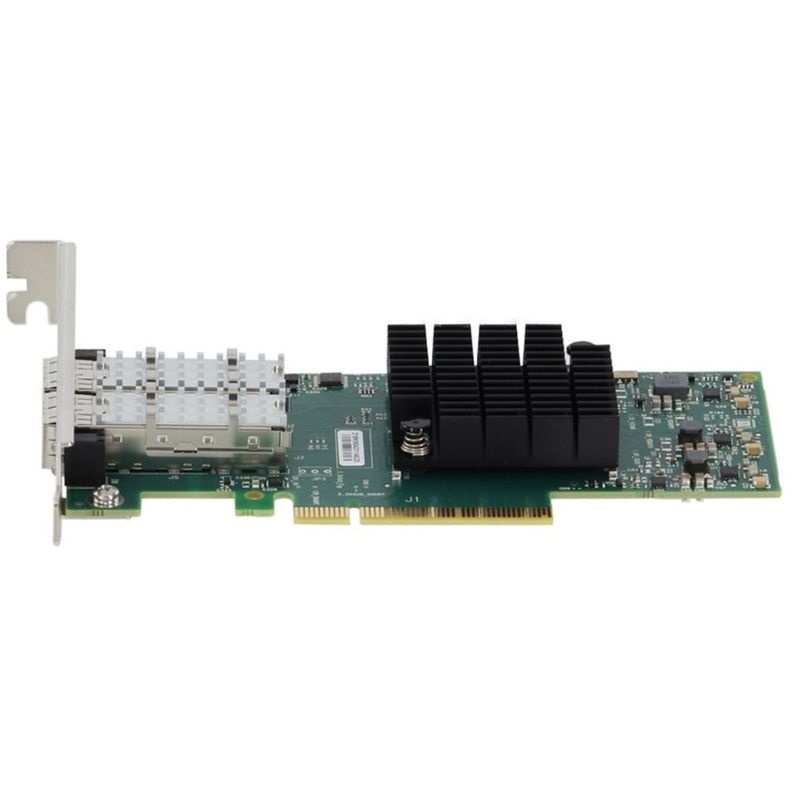
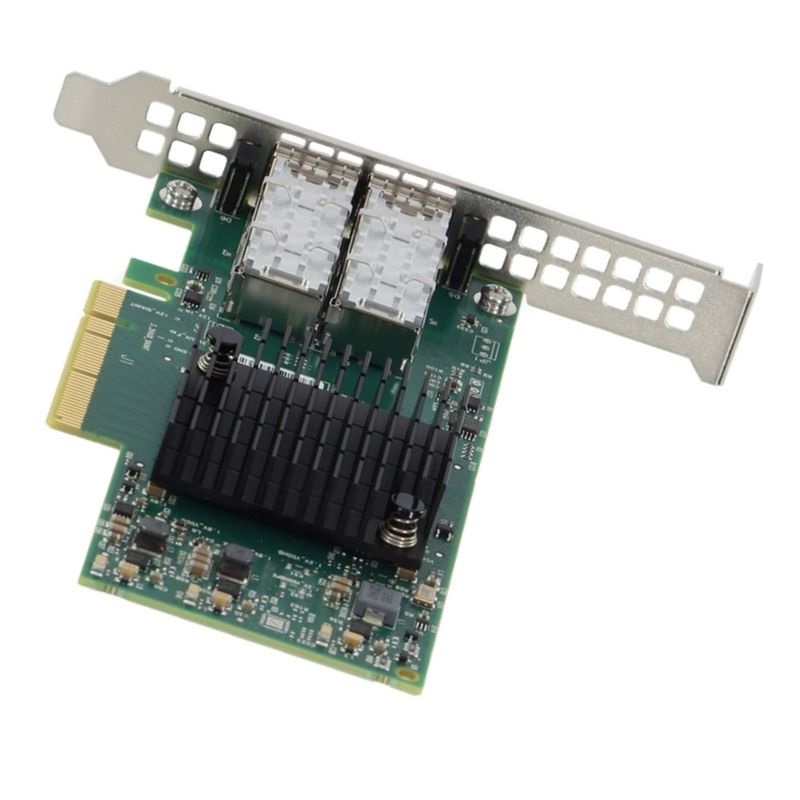
540-BDIU Dell Dual Port Mellanox ConnectX-4 Lx CX4121C 25GbE SFP28 PCI-E Adapter
- — Free Ground Shipping
- — Min. 6-month Replacement Warranty
- — Genuine/Authentic Products
- — Easy Return and Exchange
- — Different Payment Methods
- — Best Price
- — We Guarantee Price Matching
- — Tax-Exempt Facilities
- — 24/7 Live Chat, Phone Support
- — Visa, MasterCard, Discover, and Amex
- — JCB, Diners Club, UnionPay
- — PayPal, ACH/Bank Transfer (11% Off)
- — Apple Pay, Amazon Pay, Google Pay
- — Buy Now, Pay Later - Affirm, Afterpay
- — GOV/EDU/Institutions PO's Accepted
- — Invoices
- — Deliver Anywhere
- — Express Delivery in the USA and Worldwide
- — Ship to -APO -FPO
- — For USA - Free Ground Shipping
- — Worldwide - from $30
Dell 540-BDIU Dual Port 25GbE SFP28 PCI-E Adapter
The Dell 540-BDIU Mellanox ConnectX-4 Lx CX4121C is a high-performance dual-port 25 Gigabit Ethernet (25GbE) SFP28 PCIe adapter, designed to deliver exceptional speed, efficiency, and network scalability for modern enterprise data centers. Offering advanced connectivity, this adapter is a robust solution for workloads that demand low latency, high throughput, and seamless integration with Dell PowerEdge servers.
Key Information
- Manufacturer: Dell
- Part Number: 540-BDIU
- Product Type: SFP28 PCI-E Adapter
Key Capabilities of the Mellanox ConnectX-4 Lx Adapter
- Dual 25GbE ports with SFP28 connectivity
- PCI Express 3.0 x8 interface for efficient data transfer
- Enhanced support for virtualization, storage, and cloud infrastructure
- Low-latency architecture to meet demanding application requirements
- Energy-efficient design optimized for long-term data center performance
High-Performance Networking for Enterprise Environments
This adapter provides powerful networking features tailored for enterprise-class servers and cloud-ready infrastructures. By supporting dual 25GbE links, it empowers IT administrators to consolidate bandwidth, enhance throughput, and maximize application efficiency.
Scalability and Flexibility
The Mellanox ConnectX-4 Lx CX4121C delivers versatile connectivity options. Supporting SFP28 transceivers and DAC cables, it enables flexible deployment scenarios. Its ability to scale with business growth ensures that your network is always ready for tomorrow’s requirements.
Reliability and Server Integration
Engineered for Dell PowerEdge servers, the adapter undergoes rigorous testing for compatibility and stability. This ensures that your server environment benefits from maximum uptime, seamless operation, and reduced system downtime.
Technical Specifications
- Product Code: 540-BDIU
- Controller: Mellanox ConnectX-4 Lx CX4121C
- Port Configuration: Dual 25GbE SFP28
- Interface: PCIe 3.0 x8
- Form Factor: Low-profile and full-height bracket options
- Supported Platforms: Dell PowerEdge rack and tower servers
Advanced Networking Features
In addition to raw speed, the adapter includes cutting-edge features for performance optimization:
- Remote Direct Memory Access (RDMA) for ultra-low latency
- VXLAN and NVGRE offloads for enhanced virtualization
- Overlay network support for next-generation data centers
- Dynamic scalability for virtualized and software-defined environments
Virtualization-Optimized
The adapter is designed with VMware, Microsoft Hyper-V, and KVM environments in mind, delivering hardware offloads that reduce CPU utilization and improve virtual machine density. Businesses can run more workloads on fewer physical servers while maintaining top-tier performance.
Benefits of Deploying the Dell 540-BDIU Adapter
- Boosts application performance with low-latency data delivery
- Reduces operational costs with efficient energy consumption
- Provides consistent network throughput for demanding workloads
- Improves IT agility by supporting modern virtualization technologies
- Ensures strong return on investment through reliable Dell engineering
Target Use Cases
- High-performance computing clusters
- Enterprise virtualization and VDI environments
- Cloud data centers with multi-tenant workloads
- Storage and backup networking
- AI/ML and big data analytics platforms
Dell 540-BDIU Mellanox ConnectX-4 Lx CX4121C
By integrating dual 25GbE performance, advanced offload capabilities, and strong compatibility with Dell’s server portfolio, this adapter ensures that enterprises can stay ahead of today’s digital transformation needs. It enhances network reliability, workload performance, and operational efficiency, making it a top choice for businesses investing in next-generation IT infrastructure.
Highlights
- Enterprise-grade dual-port 25GbE PCIe adapter
- Future-ready design with robust scalability
- Energy-efficient, cost-optimized performance
- Certified for Dell PowerEdge servers
- Ideal for virtualization, storage, and cloud computing
Overview of Dell 540-BDIU 2 Ports 25GbE SFP28 PCI-E Adapter
The Dell 540-BDIU dual-port adapter built on Mellanox ConnectX-4 silicon delivers two 25-gigabit Ethernet (25GbE) SFP28 interfaces on a PCI Express expansion card designed for modern Dell PowerEdge servers and compatible x86 platforms. This category focuses on product attributes, deployment scenarios, compatibility guidelines, performance tuning tips, and procurement considerations for organizations standardizing on high-speed Ethernet networking for virtualization, cloud, hyper-converged, database, and storage workloads. Readers will find practical details on optical and copper transceiver options, driver and firmware alignment, link configuration, congestion control, and real-world integration patterns in data centers both greenfield and brownfield.
Key Capabilities at a Glance
- Dual SFP28 25GbE ports supporting 25G, 10G, and (with appropriate breakout) 2x10G modes when aligned with switch features.
- Mellanox ConnectX-4 controller renowned for low latency, high throughput, and robust offloads for modern stacks.
- PCI Express interface offering sufficient lanes to sustain line-rate performance across both ports under mixed packet sizes.
- Advanced networking offloads such as RSS, TSO, LRO, checksum offload, VLAN tagging, VXLAN/NVGRE offloads, and RoCE v2 support in appropriate OS stacks.
- Enterprise manageability with firmware tools, ethtool controls, and out-of-the-box integration in leading Linux distributions and virtualization platforms.
- Energy-efficient design aligned with data center density targets and consistent airflow practices found in Dell servers.
Understanding the 25GbE Advantage with SFP28
Twenty-five-gigabit Ethernet provides a strong price-performance step beyond 10GbE while maintaining familiar optical and copper cabling options. The SFP28 form factor uses one electrical lane at 25 Gbit/s, simplifying design and improving efficiency compared to older multi-lane approaches. For buyers evaluating the Dell 540-BDIU category, the combination of dual SFP28 ports and PCIe bandwidth increases aggregate throughput while preserving flexibility for link aggregation, redundancy, or network separation between storage, vMotion/live-migration, and front-end traffic.
25GbE Over 10GbE in Modern Racks
- Higher per-port throughput reduces the number of NICs and switch ports required, lowering power, cabling, and management overhead.
- Lower latency under load comes from improved silicon pipelines and tighter link-level flow control options in modern switch ecosystems.
- Straightforward migration via multi-speed optics and DACs that can negotiate down to 10G where necessary, protecting gradual upgrade paths.
SFP28 Connectivity Options
- Passive DAC (Direct-Attach Copper) for short runs within the rack; typically the lowest cost and power, ideal for top-of-rack (ToR) deployments.
- Active DAC for slightly longer reaches where signal conditioning is helpful but fiber is not required.
- SR Optics (Short-Reach) using multimode fiber (MMF) for distances common across a row or small data hall zones.
- LR Optics (Long-Reach) using single-mode fiber (SMF) for inter-row or intermediate distribution frame (IDF) connectivity.
Breakout and Multi-Speed Notes
While SFP28 modules are specified for 25G signaling, many switch platforms allow 25G ports to operate at 10G, and some offer breakout modes via QSFP uplinks (e.g., 100G QSFP28 split to 4×25G SFP28). Planning should confirm switch line card features, cable inventory, and optical budgets to ensure seamless interoperability when connecting the 540-BDIU to existing infrastructure.
Form Factor, Slot Planning, and Airflow Considerations
Proper placement of network adapters affects thermals and serviceability. The 540-BDIU typically ships in a low-profile or full-height bracket option and may be available in OCP form factors for certain chassis. In conventional PCIe slots, confirm lane availability (x8 preferred for sustained throughput) and adjacency to high-TDP devices such as GPUs or NVMe drive risers. Alignment with front-to-back airflow patterns in Dell PowerEdge servers helps maintain stable operating temperatures under sustained 25G traffic.
Recommended Slot Allocation
- Prioritize x8 or x16 electrical slots with dedicated PCIe lanes from the CPU for the adapter to avoid bandwidth contention.
- Separate storage and network cards across CPU sockets in dual-socket systems to balance interrupt handling and NUMA locality.
- Use adjacent blank brackets when available for thermal headroom in dense configurations.
Bracket and Cable Management Tips
- Choose low-profile bracket for compact chassis; full-height for tower and roomy rack servers.
- Route DAC/fiber jumpers with broad bends, respecting minimum bend radius and avoiding strain on SFP cages.
- Label both ends of each link with port IDs and server asset tags to speed up maintenance and minimize errors during swaps.
Offloads and Acceleration Features
The Mellanox ConnectX-4 controller powering the Dell 540-BDIU provides an extensive set of offloads that reduce CPU overhead and improve determinism. These capabilities are crucial in multi-tenant virtualization, containerized microservices, and NVMe/TCP or iSCSI storage fabrics where CPU cycles are at a premium.
Packet Processing and Virtualization Offloads
- Checksum offload for IPv4/IPv6, TCP, and UDP, lowering per-packet compute load.
- Large Send/Receive Offload (TSO/LRO) to optimize throughput with large payloads while maintaining low pps overhead.
- Receive Side Scaling (RSS) distributing traffic across cores; fine-tune RSS indirection tables to match vCPU or container pinning.
- VXLAN/NVGRE/Geneve offloads that preserve performance for overlay networks used by cloud platforms and SDN fabrics.
- SR-IOV (Single Root I/O Virtualization) enabling Virtual Functions (VFs) mapped directly to VMs or containers for near-native performance.
Storage and Low-Latency Enhancements
- RoCE v2 readiness in appropriate OS stacks, providing RDMA semantics over routable UDP/IP for clustered storage and HPC patterns.
- Dynamic interrupt moderation balancing latency and throughput under fluctuating packet rates.
- QoS markings and PFC (Priority Flow Control) alignment in data center bridging scenarios when low-loss operation is required.
Choosing Offloads by Workload Type
For microservice-heavy clusters where packet sizes are small and latency matters, moderate interrupt coalescing and RSS tuning deliver consistent tail-latency. For bulk-transfer workloads like backups or data lake movement, enable aggressive TSO/LRO and consider jumbo frames (e.g., MTU 9000) end-to-end. In mixed environments, test with representative traffic before globalizing a policy.
Operating System and Hypervisor Ecosystem
The Dell 540-BDIU family integrates with mainstream enterprise platforms. Driver naming conventions may reflect Mellanox’s upstream drivers within the chosen OS. Always align driver and firmware versions for stability, and validate that kernel modules are loaded with the intended features enabled.
Linux Distributions
- RHEL and derivatives: Package streams typically include Mellanox drivers compatible with ConnectX-4; verify module options and DCB/PFC tools within the distribution.
- Ubuntu LTS: Newer kernels expose recent offloads and ethtool capabilities; confirm predictable network interface naming to maintain automation consistency.
- SUSE Linux Enterprise: Common in SAP and HPC footprints; ensure SR-IOV and NUMA tuning in tandem with CPU affinity for database instances.
Hypervisors and Cloud Stacks
- VMware vSphere: Map Physical Functions (PFs) to distributed switches and carve VFs for high-performance VMs; align with vDS features and NIOC where applicable.
- Microsoft Hyper-V: Use SET (Switch Embedded Teaming) with two 25G ports for resiliency and bandwidth pooling.
- KVM/Proxmox/OpenStack: Combine SR-IOV with Neutron or OVS-DPDK where latency and throughput targets are stringent.
Container Orchestration
In Kubernetes, the 540-BDIU can support high-throughput CNI plugins and service meshes. For data-plane acceleration, consider SR-IOV CNI for pinning VFs directly into Pods handling storage, packet capture, or telco edge workloads. Establish network policies and QoS classes that map to the switch fabric’s traffic classes.
Compatibility and Server Integration
In Dell PowerEdge servers, ensure the adapter’s firmware baseline aligns with the platform’s lifecycle controller recommendations. Typical compatible families include mainstream dual-socket rack servers used for virtualization, databases, VDI, and HCI. Verify power and thermal budgets in configuration guides when mixing the 540-BDIU with GPUs, NVMe expanders, or FPGA accelerators.
Common Integration Patterns
- Two-port redundancy: Each SFP28 port home-runs to separate ToR switches, enabling multipath availability and maintenance without downtime.
- Network separation: One port dedicated to storage/IPMI/cluster interconnect; the other for client and application traffic.
- Link aggregation: LACP or static port-channeling for pooled bandwidth and simplified L3 overlay designs.
Performance Tuning and Best Practices
Out-of-the-box settings deliver strong results, but tuning can unlock additional throughput and consistency. Below are broadly applicable recommendations; always test in a staging environment that mirrors production traffic patterns.
Baseline Network Settings
- MTU Strategy: Choose 1500 for broad compatibility or 9000 for controlled domains end-to-end. If enabling jumbo frames, verify every hop—server, switch, router—matches the MTU.
- Interrupt Coalescing: Start with vendor defaults, then measure 99th percentile latency and packets per second before narrowing or widening coalescing intervals.
- RSS and CPU Affinity: Align the RSS queue count with available cores and pin high-throughput services to local NUMA nodes to minimize cross-socket memory traffic.
Overlay Networking and Offloads
Overlay networks introduce encapsulation overhead. Enable VXLAN offloads to reduce CPU usage and retain wire-speed performance. Monitor encapsulated MTU and avoid fragmentation by tuning the underlay MTU higher than the overlay’s payload expectations.
Security and Segmentation Approaches
The 540-BDIU supports common Layer 2 and Layer 3 controls that underpin micro-segmentation and zero-trust strategies. Combine NIC capabilities with switch ACLs, host firewalls, and orchestration policies to enforce least-privilege network access.
VLAN and Overlay Segmentation
- 802.1Q VLANs for classic segmentation between management, storage, and application tiers.
- VXLAN overlays to stretch logical networks across racks and sites without complex L2 extension.
- QoS markings to prioritize latency-sensitive flows such as cluster heartbeats or storage acknowledgments.
Secure Firmware and Supply Chain Considerations
Use signed firmware packages from trusted sources and align update windows with maintenance schedules. Maintain a configuration management database (CMDB) with firmware levels to correlate performance or stability changes after upgrades. For environments with strict compliance, document part numbers, lot codes, and chain of custody for optics and cables as well as the adapter itself.
Access Controls and Monitoring
- Role-based administration in hypervisors and automation stacks to prevent configuration drift.
- Syslog and NetFlow/IPFIX exports from switches to track flows involving 25G server links.
- Host IDS/IPS aligned with kernel offloads to avoid unintended performance regression.
Use Cases Across Industries
Dual-port 25GbE adapters such as the Dell 540-BDIU fit naturally into diverse workloads where bandwidth, latency, and reliability drive outcomes. Below are common scenarios demonstrating how the adapter integrates with application stacks and platform choices.
Virtualization and Private Cloud
Consolidate hosts by providing each hypervisor with 50 Gbps aggregate bandwidth and the flexibility to segment traffic by function. Map each SFP28 port to a separate ToR pair for redundancy; use LACP or active/standby uplinks on the vSwitch for resilience. SR-IOV can be delegated to performance-sensitive VMs such as firewalls, databases, or analytics engines that benefit from near-bare-metal packet paths.
Hyper-Converged Infrastructure (HCI)
In HCI nodes, East-West traffic—replication, rebuilds, and cache destage—benefits from the 25G jump. With proper QoS, you can isolate storage replication from front-end client I/O while guaranteeing resources for management and cluster control planes. Many organizations standardize on 25G HCI to hit recovery time objectives without oversizing cluster counts.
Containerized Microservices
Service meshes, API gateways, and edge proxies can produce high connection rates and modest payloads. RSS tuning and small-packet optimization keep tail latency low while preserving aggregate throughput. When Pods require deterministic I/O (e.g., packet capture, telco UPF), SR-IOV VFs mapped into namespaces provide the necessary fast path.
Databases and Analytics
Databases rely on predictable storage and network latency. Pair the 540-BDIU with NVMe/TCP or iSCSI targets on dedicated VLANs and enable jumbo frames across the path. For distributed analytics engines and object storage, dual 25G links support parallel reads and writes while balancing compute and I/O budgets.
Media, Rendering, and VDI
High-bit-rate streaming, render farm coordination, and virtual desktop infrastructures produce sustained flows. Two 25G ports provide headroom for peak concurrency and enable migration windows to complete quickly. Packet pacing and QoS avoid contention with latency-sensitive interactive sessions.
Backup, Replication, and DR
Data protection windows can shrink by dedicating one 25G port to backup networks. Through L3 segmentation and traffic shaping, you can move large volumes off production fabrics without impacting front-end user experience. For DR replication, deterministic bandwidth at 25G provides a margin for surges during failover simulations.
Capacity Planning and Economics
Adopting dual-port 25GbE cards affects switch port density, cabling costs, and power envelopes. Quantifying these elements helps build a robust business case for refreshing older 10G estates.
Port Density and Uplinks
With two 25G server ports per node, a 48×25G ToR switch can outfit 24 hosts in dual-homed fashion without oversubscription. Uplink designs can aggregate to 100G or 400G spines using QSFP28/QSFP56 breakouts depending on the switching platform. For edge pods, consider dedicated 25G aggregation per application tier to isolate failure domains.
Cabling Bill of Materials
- Estimate DAC length distribution by rack elevation and ToR location; factor spares at 10–15%.
- Standardize on SR or LR optics where copper is impractical; maintain labeled patch panels and slack managers.
- Include cleaning kits, dust caps, and test optics for field diagnostics within the BOM.
Power and Cooling
While the 540-BDIU is energy-efficient for its class, aggregated per-rack consumption grows with high-density designs. Validate thermal budgets for peak traffic scenarios, and consider blanking panels plus cold-aisle containment to maintain delta-T across the chassis.
Automation and Infrastructure as Code
Automating adapter configuration reduces drift and accelerates fleet-wide rollouts. Use infrastructure-as-code tools to enforce desired states across hosts and network devices.
Desired State Elements to Automate
- MTU, VLAN membership, and link aggregation policies at host and switch layers.
- SR-IOV enablement and VF counts mapped to VM templates or Kubernetes node roles.
- QoS, ETS, and PFC parameters aligned with storage and latency-sensitive flows.
- Firmware/driver version checks with remediation steps if drift is detected.
Telemetry and Observability
Instrument interfaces with host metrics exporters to capture throughput, errors, and latency indicators. Correlate NIC telemetry with application traces to understand end-to-end performance. Explicitly monitor packet discards, FEC corrections, and congestion signals on the ToR to anticipate service degradation.
Change Management and Rollout Waves
Adopt a wave-based rollout approach: pilot on a small cluster, validate KPIs, then expand incrementally while watching telemetry. Maintain feature flags for offloads so reversions are quick if a workload exhibits regressions post-change.
Checklist for New Deployments
- Confirm PCIe slot width and placement relative to high-TDP components.
- Select DAC or optics matched to required distances and switch policies.
- Align firmware and driver versions; record baselines in the CMDB.
- Decide MTU strategy and validate end-to-end consistency.
- Enable necessary offloads; disable those that conflict with monitoring or security tooling.
- Map VLANs, LACP groups, and QoS classes to application tiers.
- Run performance and failover tests before admitting production traffic.
Sustainability and Efficiency
Consolidating bandwidth onto dual 25G links cuts the number of NICs, switch ports, and cables compared to scaling out multiple 10G connections. Fewer components reduce embodied carbon and ongoing power. Combine this with right-sized optics (DAC in-rack, SR cross-row) to minimize both cost and energy footprint while meeting SLAs.
Lifecycle Extension Tactics
- Keep firmware current to benefit from bug fixes and efficiency improvements.
- Perform preventive cleaning of optics and dust filters on regular intervals.
- Track thermal trends; add blanking panels or improve containment if temps creep upward.
Decommissioning and Reuse
When nodes are retired, adapters and optics can be recertified as spares for non-production tiers. Maintain an audit trail of hours in service and any incidents to inform reuse decisions. Recycle end-of-life components responsibly through certified e-waste programs.
Documentation Snippets and Command Examples
The following generalized examples illustrate how administrators might verify and tune interfaces. Adjust for your OS and driver naming conventions.