(7% discount is applied at checkout)
Cart is empty
Your go-to destination for cutting-edge server products
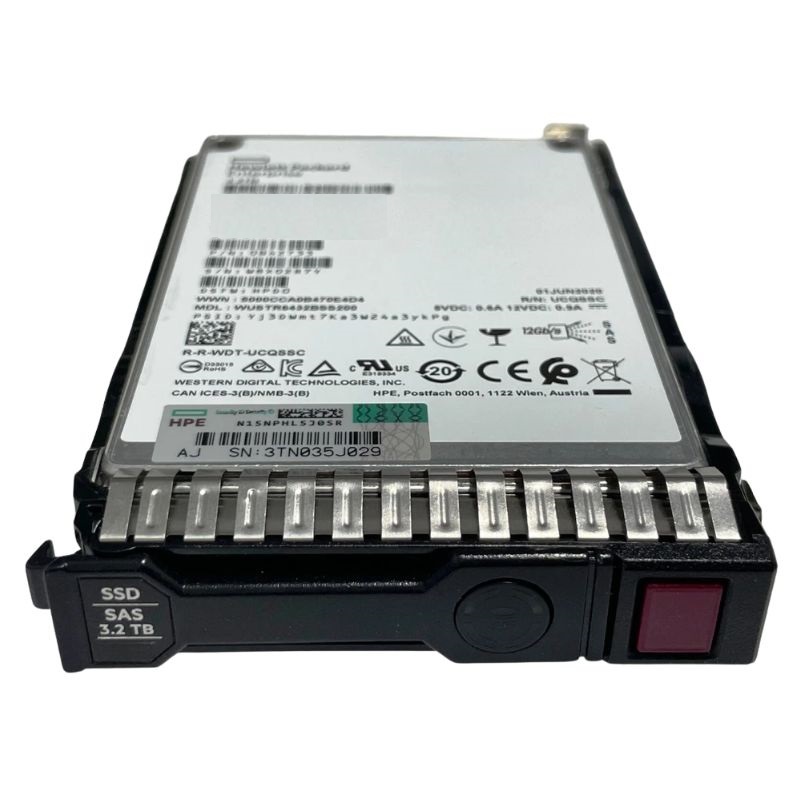


HPE 851305-001 3.2TB Multi-Level Cell SAS 12GBPS Mixed Use 2.5-Inch SFF Solid State Drive. Excellent Refurbished with 1 year replacement warranty
The HPE 851305-001 is a high-performance 2.5-inch SFF solid state drive engineered to meet the demands of enterprise data centers, cloud solutions, and high-speed computing applications. With a robust 3.2TB storage capacity, it balances efficiency, speed, and endurance, making it an excellent choice for mixed-use workloads.
The drive’s 12Gbps SAS interface ensures ultra-fast data transfer speeds while maintaining data integrity and stability in enterprise-grade applications. With MLC flash memory technology, it supports superior read/write cycles compared to traditional storage, offering both longevity and reliability.
The HPE 851305-001 3.2TB Multi-Level Cell (MLC) SAS 12Gbps Mixed Use 2.5-Inch SFF Solid State Drive represents a purpose-built enterprise storage solution designed to balance capacity, performance, endurance, and cost. Engineered for mixed-use workloads, this HPE-branded SAS SSD is optimized for data center applications where consistent latency, high throughput, and predictable IOPS are required. The 3.2TB capacity in a 2.5-inch Small Form Factor (SFF) makes it a versatile option for modern HPE ProLiant servers, storage arrays, and server SAN configurations that rely on SAS 12Gbps connectivity for backplane-level performance. This category description explores the technical attributes, real-world use cases, performance characteristics, compatibility considerations, and procurement guidance that matter to IT buyers, system integrators, and operations teams evaluating the HPE 851305-001 for enterprise deployment.
At the heart of the HPE 851305-001 is MLC NAND flash, a technology that enables a favorable cost-per-gigabyte balance while delivering strong mixed-use endurance. MLC stores more bits per cell than single level cell (SLC) but fewer than triple level cell (TLC), resulting in improved write endurance and performance consistency compared to many high-capacity consumer SSDs. Coupled with a SAS 12Gbps interface, the drive is capable of sustained, low-latency reads and writes at the scale needed by enterprise applications. The 2.5-inch SFF form factor allows high-density server and storage configurations, letting data center architects increase usable capacity without sacrificing airflow and thermal management. Important metrics such as sustained throughput, maximum sequential performance, random 4K IOPS, and sustained write endurance should be considered when matching a drive to an application profile.
The performance profile of the HPE 851305-001 centers around delivering consistent random I/O performance and low latency under mixed read/write workloads. For database servers, virtualization hosts, and mixed transaction/analytical workloads, predictable 4K random read and write IOPS are critical. SAS 12Gbps provides the transport headroom to ensure the drive can saturate sequential throughput when needed while keeping command queuing latency tight under sustained load. Enterprise SSD firmware and internal wear-leveling algorithms are tuned to maintain consistent quality of service, minimizing outliers in latency that can otherwise degrade application responsiveness. When sizing storage tiers, administrators should reference the drive’s published IOPS curves, realize that real-world performance varies by RAID level and controller caching strategy, and plan for headroom so that critical workloads never contend for limited IOPS resources.
Endurance is a primary differentiator for enterprise-class SSDs. The HPE 851305-001 is specified for mixed-use endurance, meaning it is validated to handle a balanced ratio of reads and writes typical of general-purpose enterprise workloads. Mixed-use SSDs are ideal for virtual desktop infrastructure (VDI), mid-tier databases, email servers, and general-purpose file and block storage where the write intensity fluctuates. By selecting an MLC-based mixed-use drive, organizations obtain a pragmatic compromise between the higher endurance of SLC-class drives and the higher capacities and lower costs of TLC or QLC options. IT teams should calculate expected drive writes per day (DWPD) for their use case and factor in RAID rebuild scenarios and background maintenance operations when determining the required endurance level per drive.
Thermal management and power consumption are essential in dense server environments. The 2.5-inch SFF format of the HPE 851305-001 supports efficient air cooling and enables placement in multi-drive enclosures where thermal design of the chassis is a major consideration. Drives under heavy sustained write workloads can generate additional heat, and system integrators should ensure adequate airflow, proper drive caddy seating, and firmware-based power management features are configured. Power draw at idle and under load affects overall data center PUE (Power Usage Effectiveness) and may influence decisions when scaling out thousands of drives. HPE drives often include power management modes that can be leveraged by compatible controllers to reduce consumption during low utilization periods without impacting responsiveness for active workloads.
The HPE 851305-001 is commonly carried as an HPE-qualified spare and is intended to be compatible with a wide range of HPE ProLiant servers, HPE storage enclosures, and supported RAID or HBA controllers that accept SAS 12Gbps 2.5-inch SFF drives. Using an HPE-authorized drive helps ensure firmware compatibility, predictable behavior during RAID rebuilds, and alignment with HPE’s support matrix. For administrators, verifying firmware compatibility against specific server and controller models is a recommended step prior to purchase. HPE’s compatibility matrices and support documentation outline validated pairings and firmware bundles that help avoid surprises in interoperability. When replacing failed drives or expanding storage pools in production, matching HPE part numbers and firmware revisions can reduce the risk of degraded performance or controller-level incompatibilities.
Enterprise-class SSDs often implement advanced firmware features for health monitoring, error correction, and performance optimization. The HPE 851305-001 includes SMART attributes and vendor-specific health indicators that allow proactive monitoring of drive health and predictive failure analysis. Many HPE systems expose these attributes through system management tools, allowing administrators to schedule replacement before failures occur. Firmware updates released by HPE may include performance enhancements, improved garbage collection behavior, and mitigations for specific edge-case workloads. It is best practice to review firmware release notes and apply validated updates in a test environment before rolling them into production, especially when drive firmware interacts closely with RAID controllers and host adapters.
The mixed-use nature of the HPE 851305-001 makes it well-suited for a spectrum of enterprise workloads. Virtualization hosts running multiple VMs with diverse IO patterns benefit from the drive’s balanced performance and endurance. Transactional databases that combine read-heavy queries with periodic writes can rely on consistent latency. Email and collaboration platforms require both capacity and predictable response times, which this drive supports when deployed in the appropriate RAID configuration. Mid-tier analytics, application servers, and caching layers also map well, especially where a combination of capacity and robustness is needed without the expense of highest-end endurance drives. For tiered storage architectures, the HPE 851305-001 can act as a middle tier providing improved performance over SATA HDD arrays while remaining more cost-effective than extreme endurance NVMe tiers.
Integrating the HPE 851305-001 into RAID arrays requires careful consideration of RAID level, rebuild impact, and controller cache policies. RAID choices like RAID 10 deliver superior rebuild performance and I/O resilience at the cost of capacity, while RAID 6 offers a balance between capacity efficiency and dual-failure protection for larger arrays. During a rebuild, SSDs can exhibit elevated write amplification and sustained high throughput, increasing the likelihood of encountering latent sector errors if not properly protected. HPE controllers often include features that throttle rebuilds or prioritize foreground IO; administrators should tune these settings to balance rebuild speed and application performance. Additionally, ensuring a consistent drive model and firmware across array members reduces unpredictability during rebuilds and helps maintain steady performance.


 Contact Us
 Information
 Catalog
 Solid State Drives (SSD)
 Network Switches
 Hard Disk Drives
 HBA & Controllers
 PC & Servers
 PC & Server Memory
 CPU & Processors
 Network Routers
 Power Supplies
 Tape Drives & Libraries
 Network Devices
 Computer & Network Cables