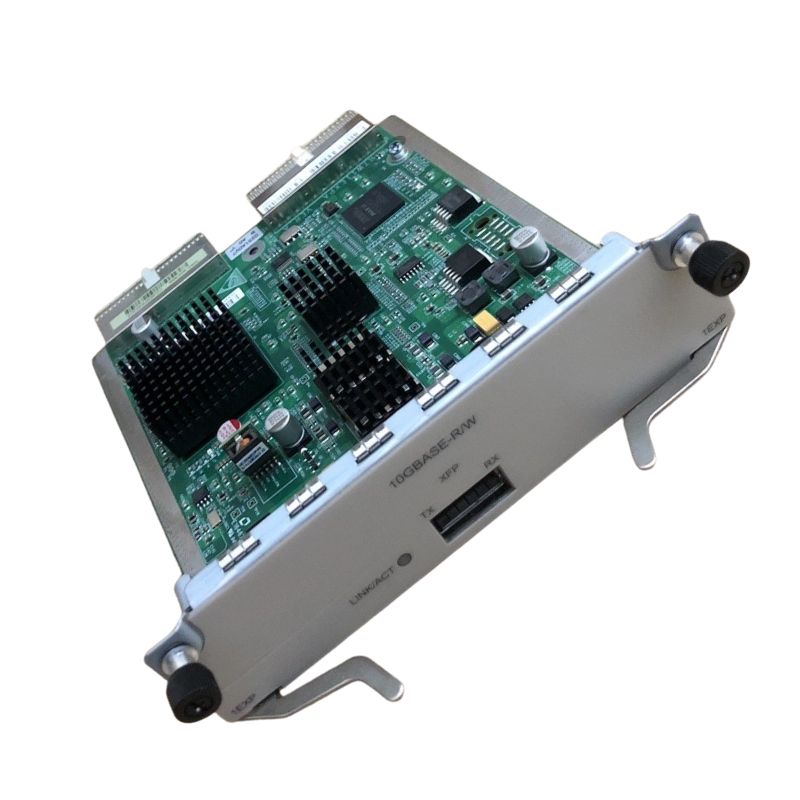
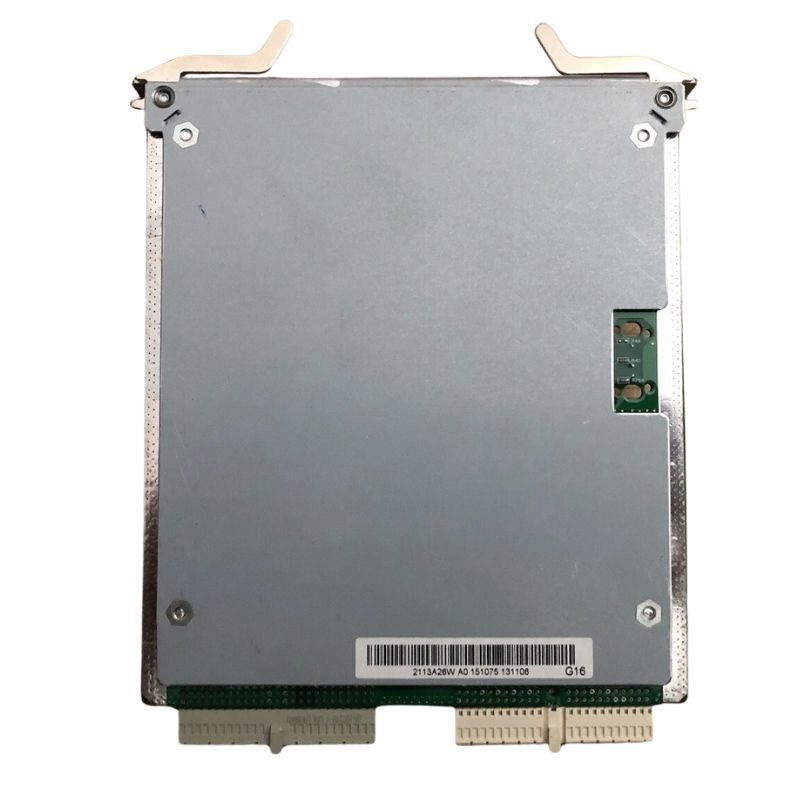
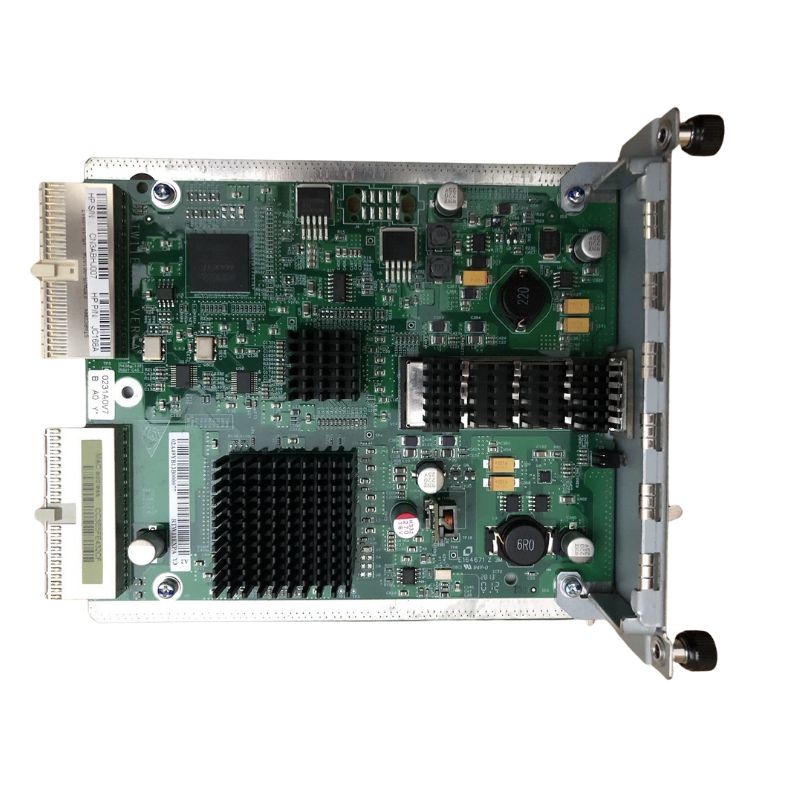
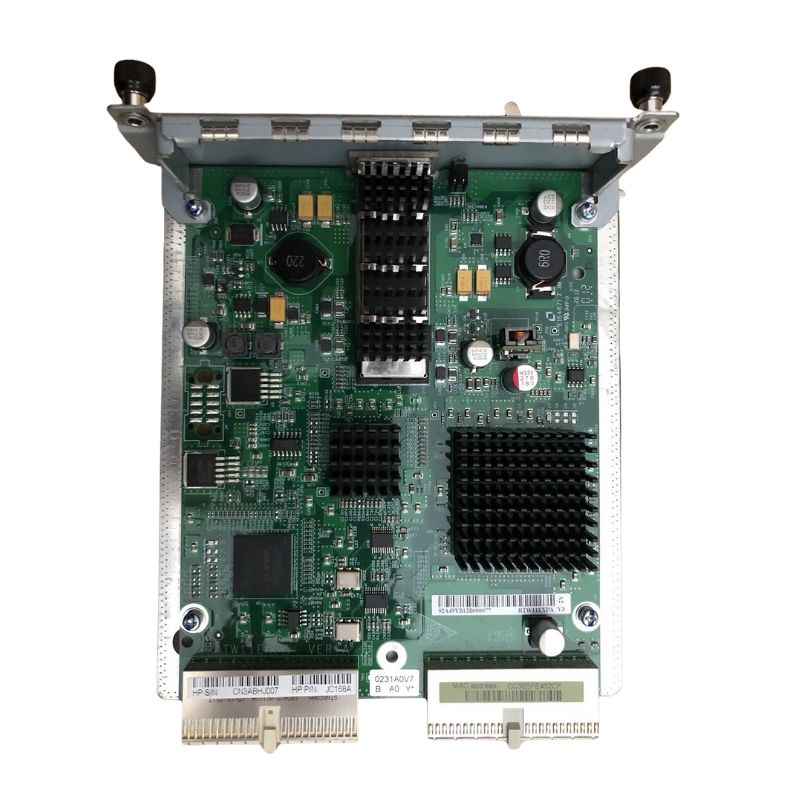
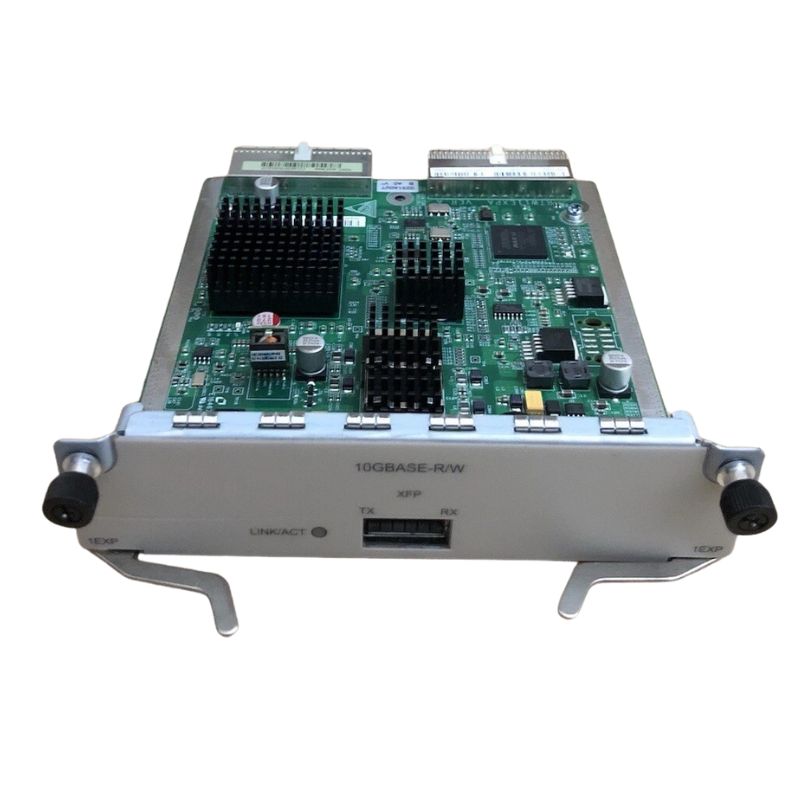
The JC168A is an HPE high-performance 1-port 10GBase-X XFP Host Interface Module (HIM) engineered for FlexNetwork 6600 series switches and routers. Built for demanding data-center and campus backbone links, this compact optical module provides reliable 10 Gigabit Ethernet connectivity over fiber for aggregation, core and high-speed uplink applications.
Key Features & Highlights
- Single 10GBase-X port: native 10 Gbps throughput for uplinks and long-reach links.
- Optical fiber support: compatible with standard fiber transceivers and single-mode multimode deployments depending on SFP/XFP optics used.
- Seamless HPE integration: designed for HPE FlexNetwork 6600 chassis for plug-and-play installation and firmware compatibility.
- Low latency & high reliability: suitable for virtualization, storage traffic and high-performance network fabrics.
Technical Specifications
General
- Manufacturer Part Number: JC168A
- Brand: HPE (Hewlett Packard Enterprise)
- Product Type: XFP Host Interface Module (HIM)
- Intended Chassis: FlexNetwork 6600 series
Interfaces & Connectivity
- Port count: 1 x 10GBase-X network port
- Interface standard: 10 Gigabit Ethernet (10GBase-X)
- Media: Optical fiber (requires compatible XFP optics)
Performance & Use Cases
- Target applications: data networking, carrier aggregation, core/aggregation uplinks
- Throughput: full wire-speed 10 Gbps
- Latency profile: optimized for low-latency transport of east-west and north-south traffic
Benefits & Business Value
Deploying the JC168A XFP HIM delivers tangible benefits for network operators and enterprise IT teams:
- Future-proof bandwidth: upgrade legacy 1G or 2.5G links to 10G without replacing the entire chassis.
- Reduced downtime: certified compatibility with HPE FlexNetwork systems minimizes integration issues and speeds rollouts.
- Efficient port consolidation: a single 10G port can replace multiple lower-speed links, simplifying topology and reducing cabling complexity.
- Flexible optics choices: pair with single-mode or multi-mode XFP optics to match distance and fiber plant requirements.
Deployment Scenarios & Examples
Campus backbone
Use the JC168A to connect distribution switches to the core fabric where 10 Gbps aggregation links are needed for heavy user traffic and multicast workloads.
Data center top-of-rack uplink
Ideal as a high-speed uplink from top-of-rack switches into aggregation layers or spine switches — especially where low latency and jitter control are critical for virtualization and storage traffic.
Essential technical highlights
- One 10Gbps XFP interface supporting 10GBase-X connectivity for high-throughput uplinks and inter-switch links.
- Support for a broad range of XFP transceivers (multimode and singlemode), allowing reach from short-reach campus links to long-haul fiber connections.
- Hardware-accelerated forwarding to preserve low latency at line rate for demanding traffic patterns.
- Hot-pluggable and serviceable design for minimal operational disruption during field upgrades.
- Compatibility with FlexNetwork 6600-series chassis slot architecture and system management APIs.
Top benefits at a glance
- Scalability: Add 10Gb capacity as needed without rearchitecting the chassis.
- Flexibility: Works with XFP optics to suit distance and media requirements.
- Cost-efficiency: One-port module for targeted upgrades reduces CAPEX compared with full-line card replacements.
- Operational simplicity: Hot-swap capability and consistent management with existing HPE controllers simplify maintenance.
- Performance: Line-rate forwarding ensures the uplink does not become a bottleneck.
Intended deployments and use cases
JC168A modules are commonly used across a range of network zones. Typical deployments include data center top-of-rack (ToR) and end-of-row aggregation, campus core-to-distribution uplinks, metro aggregation links, and connectivity to 10Gb-capable network appliances (firewalls, WAN optimization devices, or service routers).
Common scenarios
- Campus core uplink: Connecting distribution switches to the core with a dedicated 10Gb path for bandwidth-hungry applications.
- Data center edge: Linking server aggregation switches to routers or load balancers requiring a 10Gb interface.
- Service provider peering: Small-scale peering links where a single 10G handoff suffices.
- Disaster recovery/site replication: Dedicated 10Gb links used for fast replication and backup streams between co-located sites.
Performance attributes and QoS considerations
The JC168A module leverages line-rate throughput capabilities typical of modern HIM modules, allowing enterprise and service-provider networks to maintain quality of service (QoS) profiles across the 10Gb uplink. Proper QoS mapping and traffic shaping preserve voice, video and critical application performance over aggregated links.
Optics and cabling guidance
The JC168A module accepts XFP optics, making it adaptable to both multimode and singlemode fiber. Choosing the appropriate XFP transceiver is critical to meet the distance, environment, and performance demands of each link.
Security and access control
While an interface module is primarily a physical connectivity component, securing the uplink path via policy enforcement on the FlexNetwork chassis is essential. Control plane protections, interface-level ACLs, and port security measures help prevent unauthorized access and mitigate traffic-based attacks.
Security recommendations
- Apply interface ACLs to restrict management-plane access over the 10Gb link if it connects to less-trusted networks.
- Use authenticated management (SSH, TACACS+/RADIUS) for administrative operations on devices connected via the JC168A uplink.
- Monitor for aberrant traffic patterns and enable rate-limiting for unexpected high-volume flows.
Redundancy and high-availability patterns
JC168A modules often function in pairings or within resilient topologies to preserve uptime. Redundancy best practices include multi-homing, link aggregation, and active/passive failover designs to keep application connectivity uninterrupted if a single uplink fails.
High-availability design patterns
- Link Aggregation (LAG): Combine JC168A-provided 10Gb links with other ports for aggregated bandwidth and failover.
- Multi-path routing: Use dynamic routing protocols to reroute traffic automatically in case of link failure.
- Cold-standby replacement: Keep spare JC168A modules and compatible XFP transceivers on-hand for rapid swap-out.
Comparisons and alternatives
JC168A provides a single-port 10G solution; organizations may evaluate multi-port line cards or SFP+-based modules depending on density and cost targets. For higher port density or aggregated 10G demand, larger line cards or SFP+ uplink modules could be preferable. For ultra-low latency or specialized transport, purpose-built appliances and direct-attach options might be considered.
Comparison points to evaluate
- Port density: JC168A is optimal for single 10G links; for many 10G links, choose multi-port cards.
- Optical format: XFP vs SFP+ — SFP+ offers smaller form factor optics and broad transceiver availability; confirm chassis support before selecting.
- Cost per port: Single-port modules can be cost-efficient for targeted upgrades but less so for scaling numerous links.
- Power and thermal: Review chassis power and cooling when populating with multiple HIMs or line cards.
Content marketing ideas for the JC168A category
Useful content that drives organic traffic includes configuration guides, "how to choose XFP vs SFP+" comparisons, case studies showing real-world deployments, and troubleshooting checklists. Educational content that pairs the JC168A module with common use-case architectures (campus aggregation, small data center uplinks, or metro peering) will attract both technical and procurement audiences.
Content formats to produce
- Step-by-step installation walkthroughs with clear photos or diagrams of module insertion and transceiver seating.
- Short explainer videos comparing optics types and reach (SR vs LR vs ER).
- Downloadable checklists for pre-deployment testing and fiber cleanliness verification.
- Interactive compatibility tables that allow users to filter by chassis and firmware version.
Deployment highlights
- Reduced uplink contention by adding dedicated 10Gb links for storage replication traffic.
- Simplified wiring topology by using single-mode LR optics for campus backbone consolidation.
- Lowered total cost of ownership by selectively upgrading only required aggregation points with JC168A modules rather than full chassis line cards.
Key buyer indicators
- Plans to deploy 10Gb-capable servers, storage arrays, or appliances.
- Desire to aggregate multiple 1Gb links into fewer 10Gb uplinks to reduce management complexity.
- Requirement for low-latency, high-bandwidth interconnects for virtualization or VDI workloads.





 Contact Us
 Information
 Catalog
 Solid State Drives (SSD)
 Network Switches
 Hard Disk Drives
 HBA & Controllers
 PC & Servers
 PC & Server Memory
 CPU & Processors
 Network Routers
 Power Supplies
 Tape Drives & Libraries
 Network Devices
 Computer & Network Cables