(7% discount is applied at checkout)
Cart is empty
Your go-to destination for cutting-edge server products
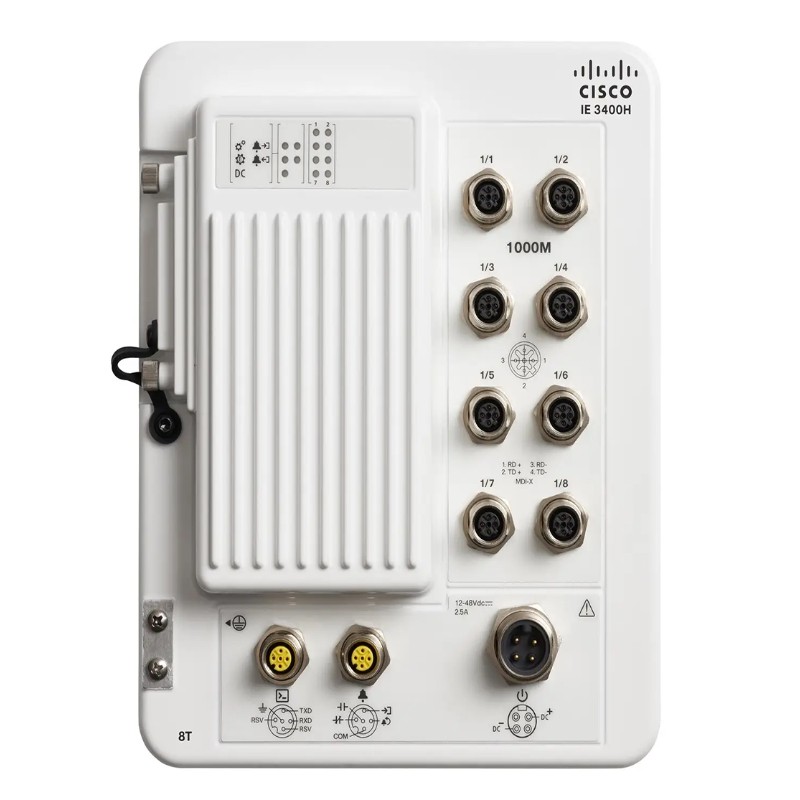


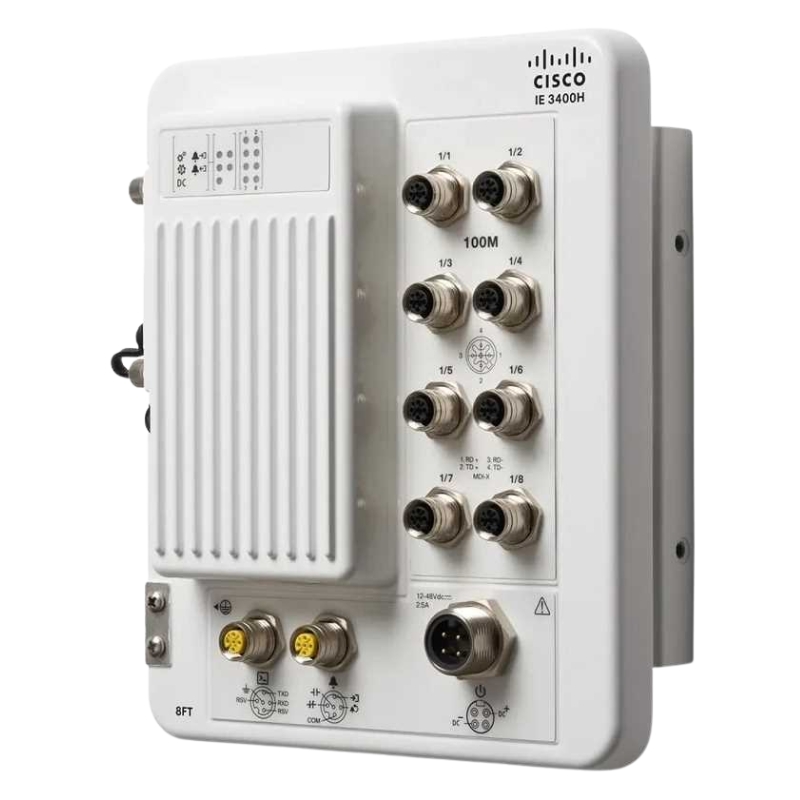
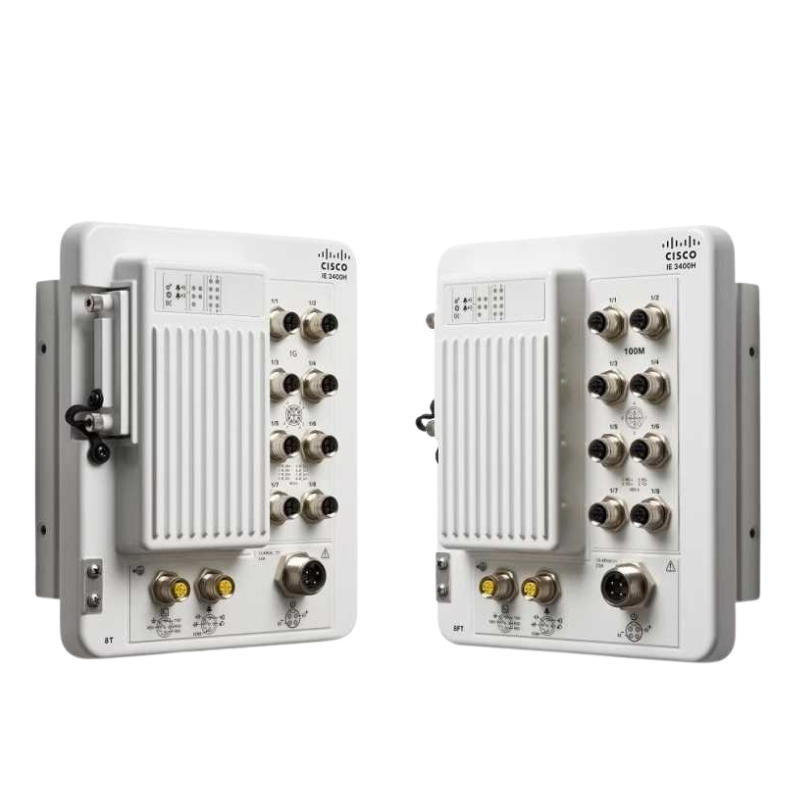
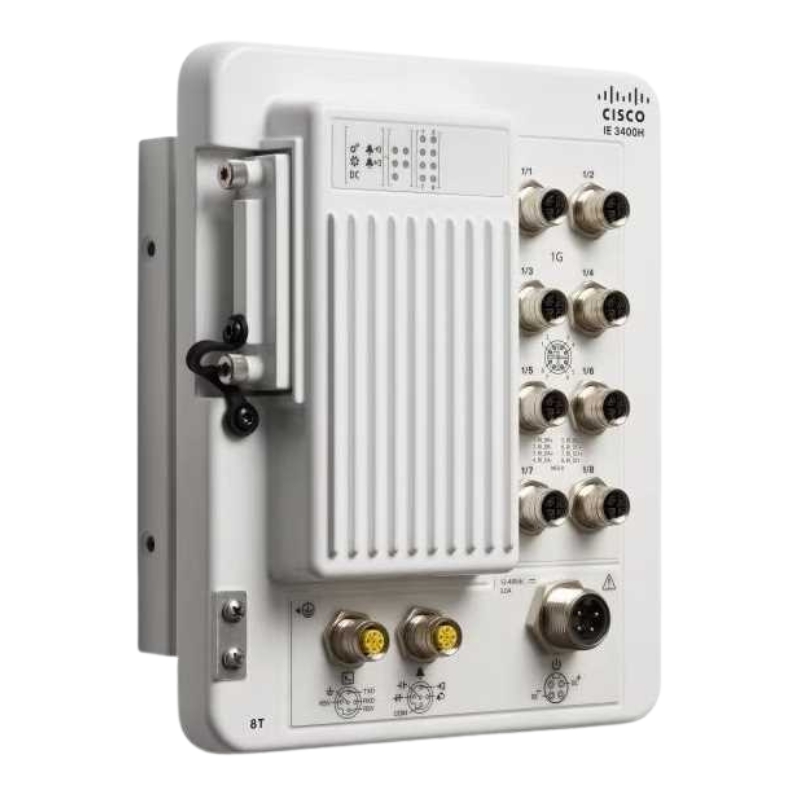
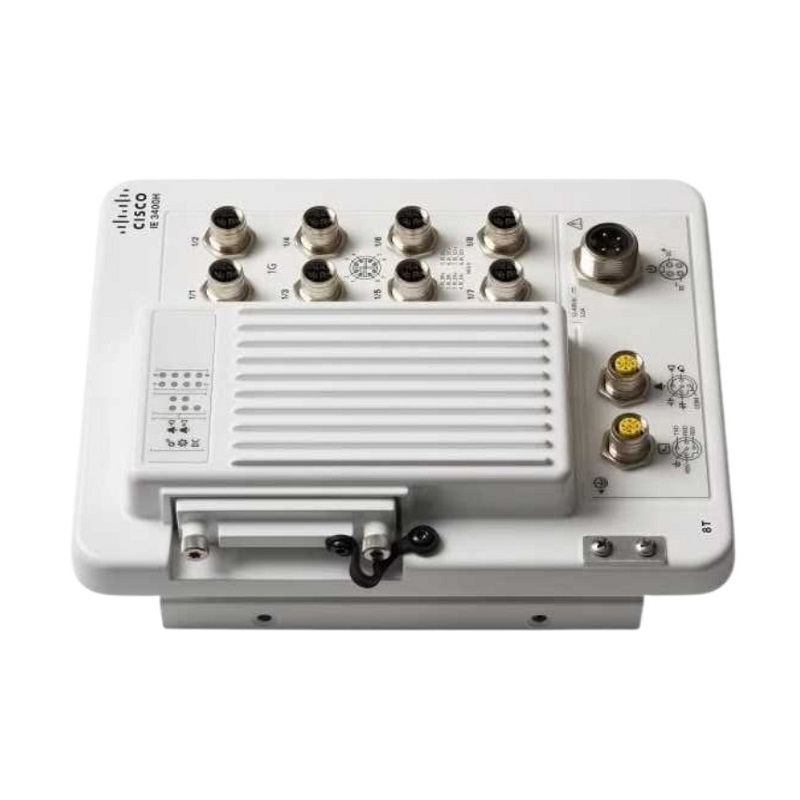
Cisco IE-3400H-8T-A Catalyst IE3400 8 Ports Gigabit Ethernet Managed Wall Mountable Switch. Factory-Sealed New in Original Box (FSB) with 1 year replacement warranty
The Cisco Catalyst IE3400 Heavy Duty Ethernet Switch IE-3400H-8T-A is engineered for rugged environments, offering 8 GE M12 interfaces, IP67 protection, and Network Advantage capabilities. Designed for wall mounting, it supports Layer 3 switching and delivers reliable Fast Ethernet connectivity with low power consumption.
The Cisco IE-3400H-8T-A Catalyst IE3400 8 Ports Gigabit Ethernet Managed Wall Mountable Switch represents a class of compact, industrial-grade Ethernet switches engineered for reliable performance at the network edge. Designed to bridge the gap between enterprise-class features and industrial robustness, this switch provides eight Gigabit Ethernet ports in a form factor optimized for wall-mounted installation. It blends managed switching capabilities with hardened hardware characteristics to meet the demands of smart factories, transportation nodes, building automation, and outdoor enclosure deployments where space is limited but reliability cannot be compromised.
The physical design emphasizes compactness, simplicity, and durability. The wall-mountable chassis reduces cabinet footprint and enables placement close to devices it serves, minimizing cable runs and simplifying topology. The front-facing ports and status LEDs allow for quick visual checks and straightforward cable management during deployment. The product's mechanical design is tuned for industrial environments: mounting points are provided for secure fastening, the enclosure offers protection against dust ingress typical of non-cleanroom industrial sites, and the thermal design supports passive or controlled airflow conditions often found in edge installations.
The core connectivity provided by this Catalyst IE-3400H-8T-A IE3400 switch centers on eight 10/100/1000 Mbps Ethernet ports, enabling full Gigabit access for sensors, cameras, controllers, and other edge devices. These ports support auto-negotiation and auto-MDI/MDIX for plug-and-play simplicity. For network expansion and uplink resiliency, the model is often paired with higher-density aggregation switches using fiber or copper uplinks, creating a hierarchical industrial network that balances performance with cost-effectiveness. The managed nature of the device ensures administrators can configure VLANs, interface policies, and port security to segment traffic and protect critical assets.
As a managed switch, the Catalyst IE-3400H-8T-A IE3400 delivers an extensive feature set familiar to network professionals who require precise control over traffic flows. Typical capabilities include VLAN tagging and segmentation, Spanning Tree Protocol and its industrial variants for loop prevention, Quality of Service (QoS) controls to prioritize voice and real-time telemetry, and multicast handling to efficiently distribute broadcast-type traffic to many receivers. These features help guarantee predictable behavior in converged networks where control traffic, telemetry, and user data coexist on the same physical infrastructure.
Reliability is a primary design criterion. The Catalyst IE3400 family is built with components and firmware designed to withstand the shock, vibration, and temperature fluctuations common to industrial settings. The switch's board layout and component selection focus on long-term stability, reducing the likelihood of unexpected failures that can cause downtime and costly site visits. The hardened firmware typically includes watchdog timers, fault logging, and automated recovery features that assist with remote troubleshooting and system resilience.
Power considerations are critical in industrial networks. The switch model supports flexible power inputs that align with varied site requirements. In many deployments, redundant power inputs or options for DC and AC sources are used to provide continuity when a single feed fails. Some deployment scenarios pair the IE3400 with uninterruptible power supplies or centralized power distribution units to maintain connectivity for essential services during transient outages. The switch’s power handling is designed to accommodate attached devices and to maintain predictable operation even under fluctuating supply characteristics.
Network security in industrial environments must be tailored to prevent unauthorized access while allowing necessary operational communication. The Catalyst IE3400 provides multiple layers of defense including port-based authentication (such as 802.1X), Access Control Lists (ACLs) to restrict traffic by source and destination, and MAC address filtering to limit device-level attachment. Management-plane security typically includes role-based administration, secure management protocols like SSH and HTTPS, and integration with centralized identity and access management systems. These measures reduce attack surfaces and enable compliance with operational security policies.
Segmentation is a best practice for protecting industrial control systems from lateral network threats. Administrators leverage VLANs and private VLAN features to isolate traffic flows between device classes—such as separating PLCs, human-machine interfaces, and IP cameras. For more granular policy enforcement, micro-segmentation techniques can be applied using ACLs and policy-based routing. The switch’s support for advanced segmentation empowers organizations to limit the blast radius of any single compromised node.
Edge devices benefit greatly from remote diagnostics since on-site access can be costly. The switch supports remote diagnostic capabilities such as interface test tools, loopback testing, and packet captures. Remote firmware upgrades and configuration snapshots allow technicians to remediate issues without physical intervention. These features reduce mean time to repair and support predictable lifecycle management across dispersed installations.
Industrial applications often demand deterministic network behavior with low latency for control loops and real-time data streams. The IE-3400H-8T-A Catalyst IE3400 is engineered to handle prioritized traffic with minimal jitter. QoS mechanisms ensure that latency-sensitive streams—like control commands and video feeds—receive preferential treatment over bulk transfers. The switch’s forwarding architecture supports wire-speed switching for typical edge use cases, enabling the delivery of consistent performance even as device densities and packet rates increase.
Traffic prioritization through classification and queuing is vital to preserve service quality. Administrators define QoS policies that map application signatures to specific queues and scheduling algorithms, such as strict priority or weighted round-robin. Traffic shaping and policing capabilities help enforce bandwidth limits for non-critical flows, preventing them from starving mission-critical traffic. These controls are especially helpful where uplinks to aggregation layers have finite capacity.
The versatility of the IE3400 8-port switch makes it suitable across multiple verticals. In manufacturing, it connects PLCs, HMIs, sensors, and cameras on the factory floor while withstanding the environmental stresses of that domain. In transportation, it provides local aggregation for signaling, passenger information systems, and CCTV at stations or within light rail cars. In smart buildings, the switch supports building automation controllers, security devices, and access systems. Utilities and energy providers use such hardened switches at substations and remote monitoring points to ensure continuous telemetry and control.
As edge computing becomes ubiquitous, the IE3400 enables local processing nodes by connecting compute modules, gateways, and storage devices. The switch’s ability to segregate traffic and prioritize telemetry reduces contention between machine-to-machine chatter and higher-level analytics traffic. This allows organizations to deploy real-time analytics close to where data is produced and to reduce latency for control decisions that depend on instantaneous insights.
Interoperability with existing network infrastructure is a key advantage. The switch adheres to industry standards for Ethernet, VLAN tagging, and link aggregation, enabling seamless integration with non-Cisco equipment and legacy systems. Standards compliance also simplifies audits and supports multi-vendor strategies that many large deployments rely on for cost optimization or phased refresh cycles. Protocol support includes industry-standard management and security protocols, helping ensure consistent behavior across heterogeneous networks.
Organizations that standardize on Cisco platforms benefit from an ecosystem of compatible tools, modules, and support services. The IE3400 works within Cisco’s portfolio so that features such as centralized policy enforcement, threat detection, and lifecycle management can be leveraged end-to-end. This extensibility means the edge switch can participate in broader initiatives like network segmentation projects, operational technology (OT) visibility programs, and cybersecurity measures that span from edge to core.
Proper planning improves the longevity and effectiveness of any edge switch deployment. Factors to consider include the physical environment, mounting orientation, cable routing, and power distribution. Selecting the correct power input options and ensuring adequate surge protection helps avoid premature failures. Network architects should reserve capacity for growth and consider port utilization, uplink bandwidth, and redundancy schemes. Documenting device configurations and automating backups reduces time to recover from human error or hardware replacement scenarios.
Designing resilient topologies mitigates single points of failure. Common approaches include redundant uplinks to different aggregation switches, dual-homing critical devices, and leveraging fast convergence protocols that restore paths quickly after a failure. For geographically distributed sites, central monitoring and configuration management ensure consistent policies and simplify firmware lifecycle tasks. These redundancy strategies can be tuned to balance cost with required availability.
Cable management is often overlooked but has a direct impact on serviceability and airflow. Properly labeled cables and tidy routing reduce troubleshooting time and lower the risk of accidental disconnections. Physical security—locking enclosures, tamper-evident seals, and controlled access—protects the switch from unauthorized physical interactions that could impact network integrity or uptime.
Keeping the management plane and data plane software up-to-date helps protect against known vulnerabilities and introduces optimizations. Compatibility matrices should be consulted to confirm that firmware releases are compatible with management systems and higher-layer network services. Scheduled maintenance windows and rollback plans are recommended to handle any unforeseen interactions during updates.
Selecting the right edge switch involves evaluating capacity, environmental tolerance, managed features, and total cost of ownership. The Catalyst IE3400 8-port configuration is a fit when compactness and industrial robustness are priorities. For installations requiring higher port density, uplink fiber options, or Power over Ethernet (PoE) for powering endpoints, buyers might compare across the Catalyst IE3400 family and other series to match exact needs. Considerations such as support contracts, software licensing, and integration with existing orchestration platforms should factor into procurement decisions.
Edge hardware often must adhere to local and international regulatory requirements. While specific certifications vary by region and model, the design intent of industrial Ethernet switches is usually to comply with electromagnetic compatibility standards, safety norms, and environmental directives relevant to commercial and industrial equipment. Buyers should confirm the exact certifications required for their geography and sector before procurement to ensure regulatory compliance and avoid deployment delays.
Energy efficiency is an increasingly important selection criterion. Efficient power conversion and low idle consumption are beneficial for cumulative operational costs and thermal budgets within enclosures. Features such as energy-aware Ethernet and adaptive power modes can reduce energy usage over the lifecycle of the equipment and support sustainability initiatives in large-scale deployments.


 Contact Us
 Information
 Catalog
 Solid State Drives (SSD)
 Network Switches
 Hard Disk Drives
 HBA & Controllers
 PC & Servers
 PC & Server Memory
 CPU & Processors
 Network Routers
 Power Supplies
 Tape Drives & Libraries
 Network Devices
 Computer & Network Cables