(7% discount is applied at checkout)
Cart is empty
Your go-to destination for cutting-edge server products
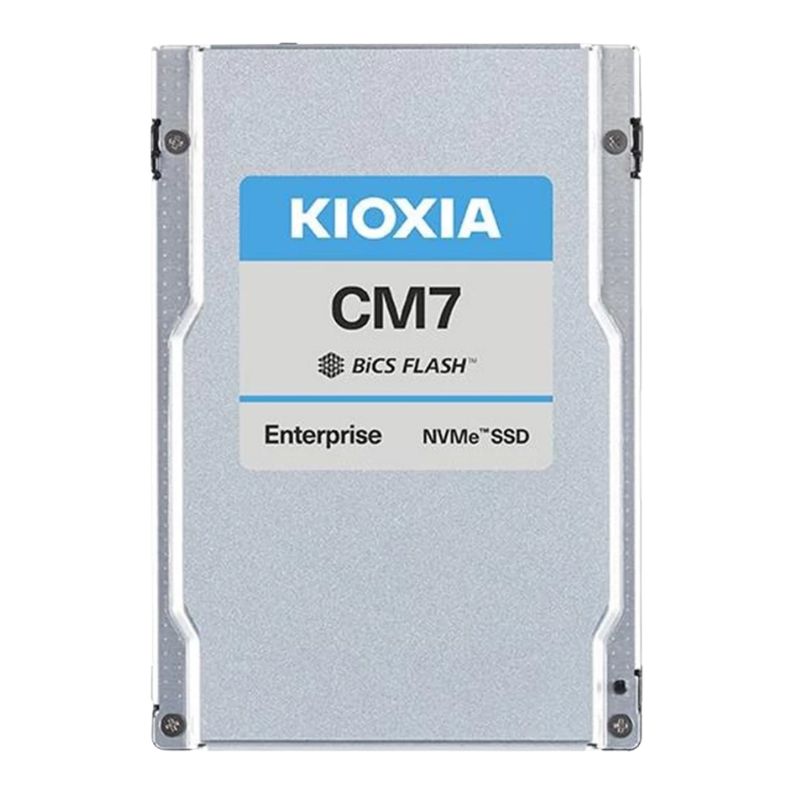


Kioxia KCMYDRUG7T68 CM7-R 7.68TB PCI-E Gen4 NVMe U.2 2.5 Inch Read Intensive Solid State Drive. New Sealed in Box (NIB) with 3 years Replacement Warranty
The Kioxia KCMYDRUG7T68 CM7-R 7.68TB solid state drive is engineered for enterprise-grade read-centric performance, offering a balanced blend of high throughput, efficiency, and endurance. Designed for scalable data center ecosystems, this model leverages PCIe Gen4 NVMe connectivity and advanced 3D TLC NAND flash to meet the demanding needs of large-scale workloads. Businesses seeking dependable storage acceleration benefit from its robust performance metrics, solid construction, and optimized power usage.
The Kioxia CM7-R series incorporates high-speed PCIe Gen4 technology, allowing rapid transactional movement and efficient handling of simultaneous requests. Its ability to support heavy read operations makes it an optimal choice for content-rich systems.
Designed with efficiency in mind, this SSD balances strong performance with power-conscious engineering, making it suitable for dense server racks and heavy-use environments.
Enterprises require dependable storage hardware capable of operating continuously under pressure. The Kioxia CM7-R model meets rigorous durability benchmarks, ensuring long-term stability and predictable performance.
With its sturdy build and compact measurements, this SSD integrates seamlessly into enterprise server platforms while maintaining compatibility with existing hardware bays.
Built to endure diverse environmental conditions, this model maintains stable, reliable performance even in challenging datacenter climates.
The Kioxia KCMYDRUG7T68 CM7-R 7.68TB PCIe Gen4 NVMe U.2 2.5 Inch Read Intensive Solid State Drive belongs to an advanced class of enterprise-grade flash storage engineered for servers, modern datacenters, virtualization clusters, cloud platforms, and analytics-driven infrastructures. This category emphasizes exceptional sustained read throughput, low-latency responsiveness, secure data handling processes, and long-term operational integrity demanded by mission-critical workloads. By leveraging PCIe Gen4 bandwidth, NVMe protocol efficiency, and U.2 mechanical compatibility, this category of Kioxia CM7-R Read Intensive SSDs delivers dependable performance for environments that rely on stable provisioning, predictable operations, and highly optimized flash behavior.
The PCIe Gen4 NVMe U.2 standard represents a significant uplift in throughput and queue management efficiency for modern enterprise storage. Drives within this category, including the Kioxia KCMYDRUG7T68 7.68TB model, utilize dual-port capabilities, multi-lane signaling, and latency-optimized NVMe commands to enhance overall responsiveness. The U.2 form factor supports hot-swapping functionality, standardized 2.5 Inch server bay compatibility, and robust thermal dissipation characteristics suited for continuous high-volume workloads. Category-level improvements include stronger controller logic, improved NAND endurance algorithms, enhanced power-loss protection, more advanced error correction, and predictable quality-of-service patterns essential for hyperscale server optimization.
Enterprise NVMe drives within this category are constructed to support thousands of concurrent queues with deep queue depths to ensure that virtualized workloads, containerized microservices, or data-heavy processes do not encounter read bottlenecks. The streamlined NVMe command set removes traditional storage protocol overhead, allowing the Kioxia CM7-R Read Intensive models to deliver consistent bandwidth for sustained high-volume read transactions. Systems that depend on predictable performance patterns, such as content delivery platforms or search index processing, benefit from the efficient scheduling and optimized latency architecture of this category.
The 2.5 Inch U.2 design used by this category supports stable thermal distribution for environments demanding continuous operation. The enclosure and internal layout facilitate heat movement away from the NAND packages and controller to maintain consistent performance over extended operational periods. Datacenters benefit from reduced temperature spikes, lower risk of throttling events, and improved long-term reliability. Mechanical durability also ensures vibration resistance, firm mounting stability, and structured environmental resilience, making these drives suitable for dense server racks with constant airflow.
This category of Kioxia enterprise SSDs is engineered specifically for read-heavy environments, which require stable throughput, consistent low-latency transactions, and high-volume access patterns. Read Intensive drives are designed with specialized NAND flash arrangements, optimized read channels, and tailored firmware routines that emphasize fast retrieval operations rather than equal distribution between read and write workloads. This architecture makes the KCMYDRUG7T68 CM7-R 7.68TB model ideal for large-scale datasets, persistent cloud instances, streaming platforms, content libraries, monitoring systems, and systems that depend on frequent retrieval of structured or unstructured data.
Although these drives focus on read-driven operations, they include strong durability mechanisms to accommodate periodic write patterns inherent to enterprise tasks. Advanced wear management ensures uniform cell usage and prevents premature aging of specific NAND areas. The category emphasizes long-term stability through ECC engines, multi-level data integrity layers, robust lifetime monitoring, and firmware safeguards. Data-path protection combined with predictive failure analytics supports consistent service-level operations critical for organizations that cannot risk disruption in storage availability.
Drives in this category maintain a low-latency architecture powered by high-speed controller logic and optimized NAND mapping. This design ensures microsecond-level responsiveness, a requirement for real-time applications, edge compute environments, high-frequency transaction systems, and distributed processing frameworks. Stable read latency allows virtual machines, container workloads, and platform services to operate smoothly without unpredictable slowdowns. This category’s optimized latency behavior ensures consistent response times at scale even during high queue depth loads.
Enterprise tasks frequently operate under high demand, making power-loss protection essential. Category-level features include capacitor-backed safeguards, rapid commit mechanisms, and structural firmware protection routines designed to preserve data in the event of sudden power removal. These safeguards ensure that ongoing transactions complete successfully and metadata remains intact, preventing corruption or loss. This is vital for enterprise platforms that manage financial systems, customer databases, healthcare information, or mission-critical analytics pipelines.
Hardware encryption strengthens data confidentiality by encoding stored information using secure cryptographic standards. Firmware access protocols ensure only authorized administrators can manage, update, or reconfigure drive settings. These protections are crucial in environments requiring compliance with organizational, governmental, or regulatory requirements governing data privacy. The category design ensures full drive encryption performance without degrading read-intensive operational throughput.
The KCMYDRUG7T68 drive and its category peers are suited for workloads that predominantly depend on stable reading patterns at scale. These include analytics engines, cloud platforms, virtualization clusters, content distribution systems, file indexing platforms, real-time dashboards, and object storage retrieval frameworks. Read-intensive designs bring powerful efficiency improvements to workloads where data is queried frequently and modified intermittently. Their high-capacity structure supports large datasets, mirrored storage arrays, and replicated environments used in enterprise architectures.
In virtualized deployments, consistent low latency helps maintain smooth VM migrations, continuous service uptime, and responsive guest operating system behavior. Multi-tenant cloud infrastructure benefits from the ability to deliver predictable quality-of-service across diverse workloads. Containers and microservices, due to their dynamic scaling requirements, operate more effectively when read-heavy access patterns are satisfied with high throughput. The category provides dependable performance that aligns with the needs of Kubernetes clusters, cloud-native schedulers, and on-demand scaling automation.
Although transaction-heavy systems may include balanced or write-optimized drives, read-intensive SSDs contribute significant performance improvements to workloads dominated by queries, lookups, and data retrieval tasks. Enterprise resource systems, operational dashboards, and configuration management tools rely on rapid access to reference datasets. These drives ensure consistent user responsiveness, stable backend processing, and efficient system-level indexing operations across large distributed environments.
Although categorized as read-intensive, these drives still incorporate advanced wear-management routines to mitigate NAND stress from periodic writes. Predictive monitoring tools track cell usage patterns and allocate wear-leveling routines to ensure balanced distribution. The category design supports long drive life expectancy, reduced maintenance requirements, and improved planning for upgrade cycles. Administrators benefit from predictable operational behavior, simplified monitoring, and stable storage planning metrics across large deployments.
The Kioxia CM7-R Read Intensive series delivers reliable performance for enterprise infrastructures experiencing rapid data growth. Datacenter scaling benefits from high-density storage footprints, consistent read behavior at scale, and compatibility with standard U.2 backplanes. Integration is simplified through streamlined NVMe-based architectures, allowing organizations to consolidate storage resources, enhance data retrieval workflows, and maintain operational efficiency across distributed systems.
This category aligns with contemporary server ecosystems that rely on PCIe Gen4 lanes, NVMe storage stacks, and U.2 drive bays. Broad chipset compatibility ensures easy deployment in most modern enterprise environments, allowing organizations to upgrade storage performance without replacing entire server clusters. The uniform interface architecture simplifies long-term scalability and supports transitions to next-generation storage frameworks.
Because these drives maintain low power consumption relative to their performance output, datacenters reduce cooling requirements and overall energy expenditure. The efficient thermal behavior, stable latency, and space-saving design contribute to higher density configurations and lower operational costs. Organizations benefit from improved resource utilization and simplified lifecycle management, making this category a practical choice for long-term infrastructure planning.


 Contact Us
 Information
 Catalog
 Solid State Drives (SSD)
 Network Switches
 Hard Disk Drives
 HBA & Controllers
 PC & Servers
 PC & Server Memory
 CPU & Processors
 Network Routers
 Power Supplies
 Tape Drives & Libraries
 Network Devices
 Computer & Network Cables