(7% discount is applied at checkout)
Cart is empty
Your go-to destination for cutting-edge server products
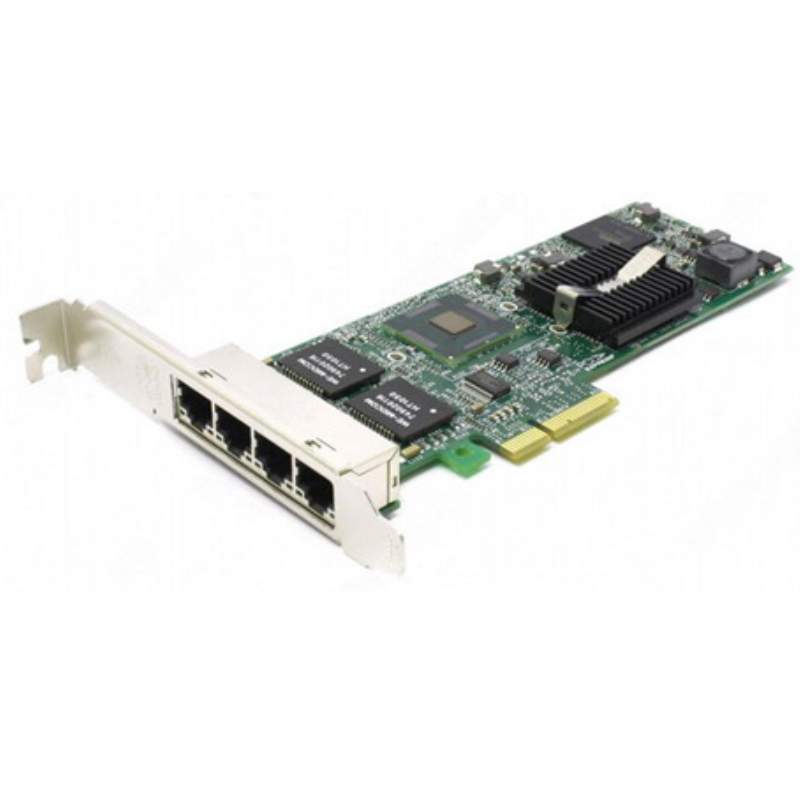


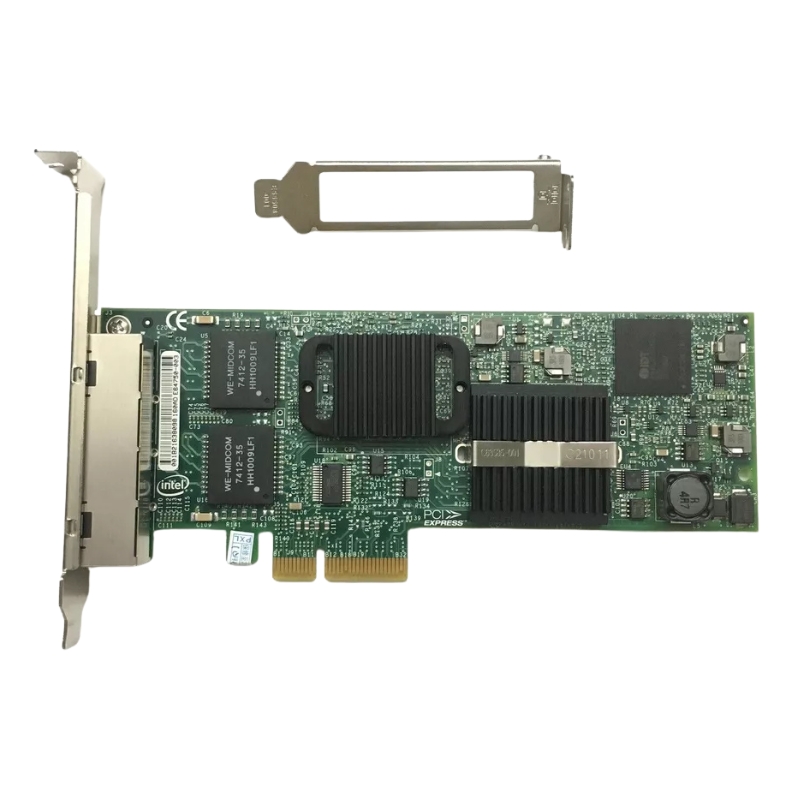
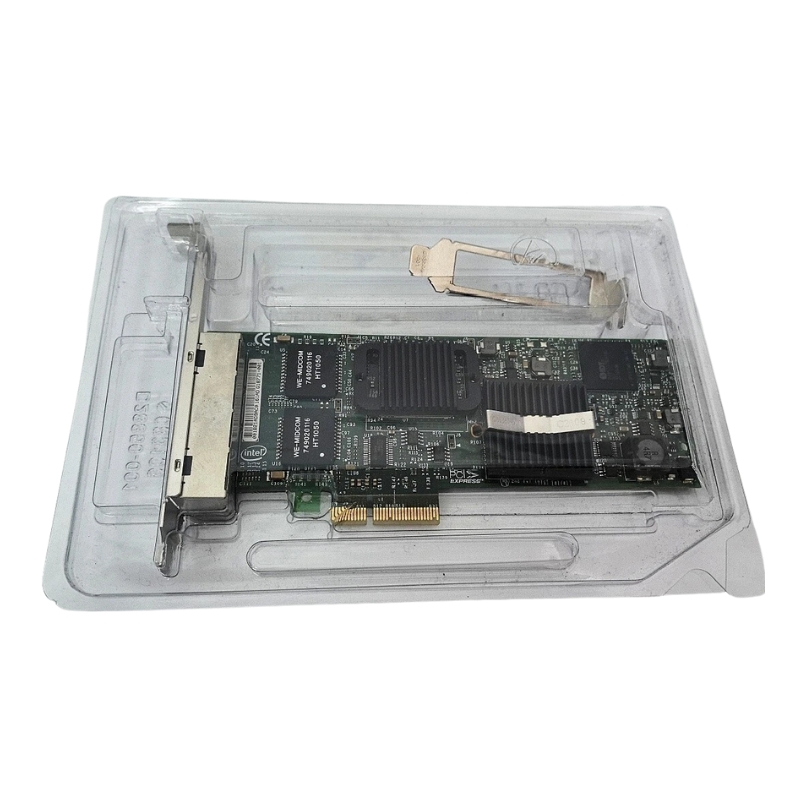
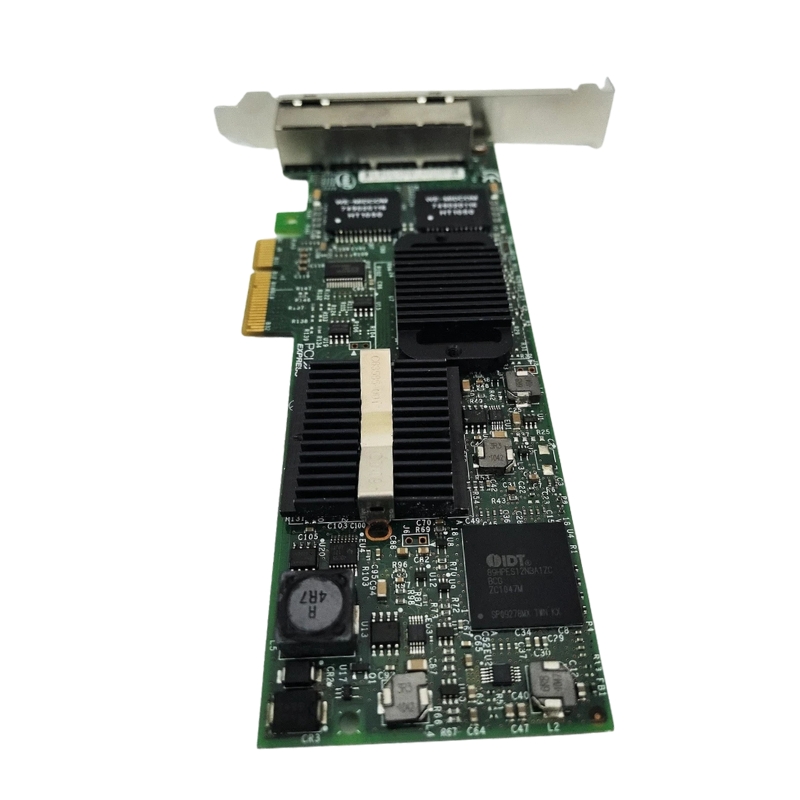
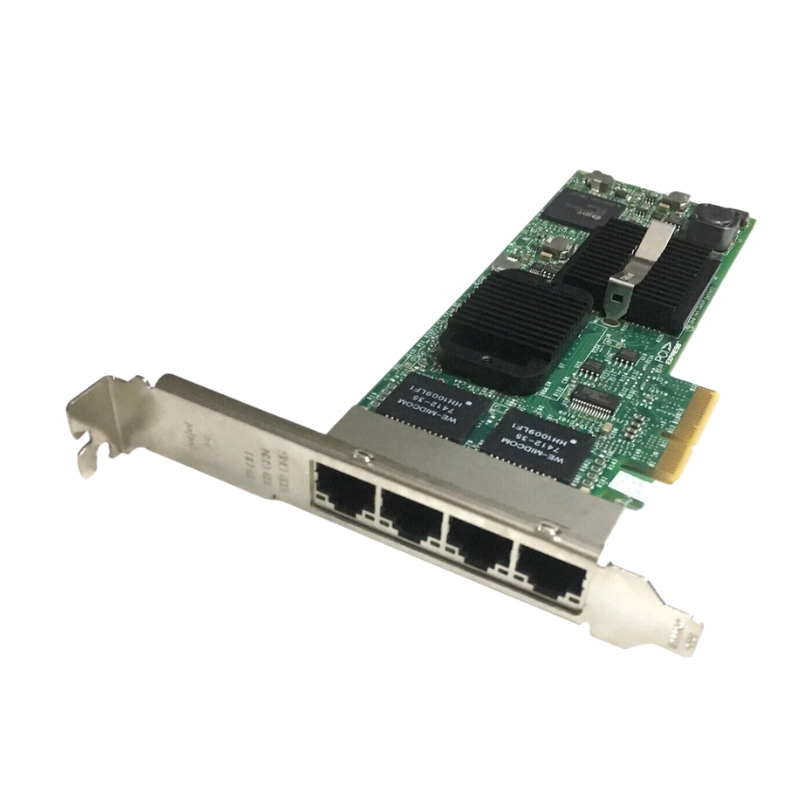
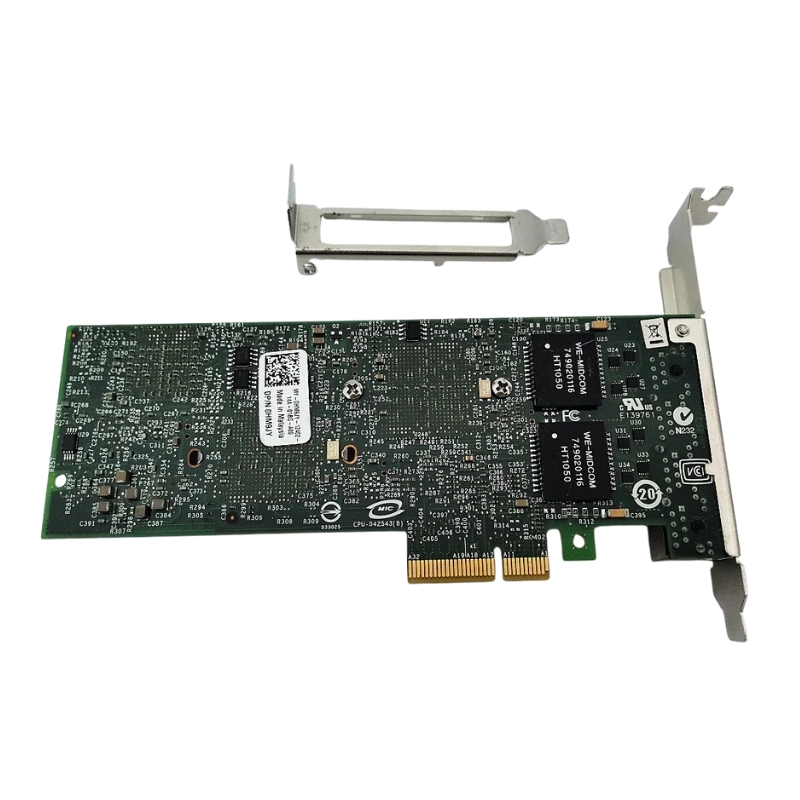
Intel E1G44ET2 4-Port Gigabit Ethernet PCI Express x4 Server Adapter. Excellent Refurbished with 1 year replacement warranty
The Intel E1G44ET2 is a quad-port Gigabit Ethernet server adapter designed to deliver dependable wired network connectivity for enterprise servers, storage environments, and virtualization platforms. Built as a PCI Express network interface card, this adapter provides four independent RJ-45 Gigabit Ethernet ports, making it a practical choice for organizations that need higher port density, improved traffic distribution, and efficient network segmentation without consuming multiple expansion slots. Its multi-port architecture helps support bandwidth-intensive workloads, server consolidation, and stable LAN connectivity in business-critical environments.
The Intel E1G44ET2 4-Port Gigabit Ethernet PCI Express x4 Server Adapter belongs to a class of enterprise networking hardware designed for stable, multi-port copper Ethernet connectivity in rack servers, tower servers, network appliances, virtualization hosts, storage platforms, and business-critical infrastructure. Built around Intel’s proven server networking architecture, this adapter category is intended for environments where one onboard LAN port is not enough and where dependable wired throughput, traffic segmentation, link redundancy, and efficient server I/O behavior matter every day. The adapter integrates four independent Gigabit Ethernet RJ45 interfaces on a single PCI Express card, giving IT teams a practical way to add more copper network ports without consuming several expansion slots or relying on multiple standalone adapters.
In data centers, branch offices, cloud edge deployments, virtualization clusters, backup servers, firewall appliances, and application hosts, the value of a quad-port Gigabit adapter lies in flexibility. A single adapter can separate production traffic from management traffic, isolate backup traffic from user access traffic, dedicate interfaces to hypervisor uplinks, or create redundant paths for uninterrupted network availability. The Intel E1G44ET2 category is therefore not simply about adding four LAN ports. It is about improving network architecture inside the server, giving administrators more options for performance planning, failover design, virtual machine connectivity, and workload isolation. Because it uses a PCI Express x4 interface and is associated with Intel’s 82576 controller family, it fits into a long-established segment of server adapters known for broad operating system support, compatibility with enterprise platforms, and reliable long-term deployment in business environments.
Organizations often continue to use Gigabit Ethernet in large numbers because it remains cost-effective, familiar, and suitable for a broad range of server roles. Many line-of-business applications, domain services, file serving tasks, monitoring platforms, and security appliances do not need 10GbE or 25GbE to function effectively. Instead, they benefit from multiple one-gigabit links that can be distributed across workloads, bonded for redundancy, or assigned to separate VLAN and service groups. The Intel E1G44ET2 category is particularly relevant in these scenarios because it allows a single server to participate in multiple network segments while maintaining the management standards expected from enterprise Intel NICs.
A quad-port server adapter serves a different role from a basic desktop network card. Desktop NICs typically provide a single network connection for general connectivity. A server-class quad-port adapter is intended for persistent operation, structured traffic control, virtualization, and network resilience. The Intel E1G44ET2 category exists for administrators who need to turn a server into a multi-network endpoint rather than a simple device with one LAN connection. For example, a virtualization host may dedicate one pair of ports to virtual machine traffic and another pair to storage or management traffic. A security appliance may use separate ports for WAN, LAN, DMZ, and monitoring. A backup server may isolate replication traffic from user file access. A unified communications server may keep voice traffic separate from management and system synchronization traffic.
This category is also highly relevant for organizations that want to maintain copper Ethernet infrastructure. The E1G44ET2 is a 10/100/1000Base-T class adapter, which means it can operate across standard twisted-pair Ethernet cabling already present in many facilities. For companies with structured Cat5e or Cat6 cabling and existing Gigabit switch deployments, a copper RJ45 server adapter offers easy integration without introducing optical transceivers, direct-attach cabling requirements, or more expensive switching changes. As a result, the Intel E1G44ET2 category appeals to businesses seeking practical expansion rather than full network redesign.
The Intel E1G44ET2 4-Port Gigabit Ethernet PCI Express x4 Server Adapter is generally associated with a four-port copper Ethernet design built around Intel 82576 networking silicon. This architecture is important because the controller defines much of the adapter’s operational behavior, driver support, queue handling, interrupt efficiency, virtualization awareness, and compatibility with enterprise operating systems. In a category page context, understanding the controller class helps buyers and infrastructure planners identify whether the adapter aligns with their intended use case. Intel’s server networking products have historically been valued for mature driver ecosystems, broad OS support, and integration into both branded servers and custom-built infrastructure platforms.
The four RJ45 ports allow each interface to function independently, which means a server can expose four separate Ethernet connections to the operating system or hypervisor. These ports can be configured as individual interfaces, grouped in teams, assigned to different VLAN trunks, or distributed across service roles depending on the software environment. The physical density of four copper ports on one PCIe card is especially useful in compact servers, firewall systems, and virtualization nodes where expansion space is limited but network segmentation needs are growing.
From a hardware perspective, the PCI Express x4 form factor is also significant. A PCIe x4 adapter is designed for a server or workstation motherboard with an appropriate slot, though in many systems it can operate in larger x8 or x16 mechanical slots if electrically supported. This gives infrastructure teams flexibility when installing the card in different server chassis or appliance platforms. Because the card belongs to a server-adapter class rather than a consumer desktop category, the installation target is usually a platform that runs continuously under load, not a casual office PC.
Each port in the Intel E1G44ET2 category supports Gigabit Ethernet operation over copper cabling, making it suitable for 10 Mbps, 100 Mbps, and 1000 Mbps environments where backward compatibility and broad switch interoperability matter. In real deployments, the most common use is 1GbE operation to modern switches, but the lower-speed compatibility can still be useful in mixed legacy networks, lab environments, or migration scenarios. The presence of four ports does not simply multiply raw bandwidth in a simplistic way; it provides administrators with multiple traffic paths that can be assigned intelligently according to workload design.
For example, a file server may use one port for user access, one for backup traffic, one for replication to another server, and one for management or monitoring. A hypervisor can present separate uplinks to multiple virtual switches. A network monitoring appliance can dedicate one interface to mirrored traffic and another to administrative access. A branch server can keep ERP traffic apart from VoIP and apart from domain management. This is where the Intel E1G44ET2 category gains long-term value: it supports architecture choices rather than only providing a single shared uplink.
Where supported by the operating system and switching environment, ports may also participate in teaming or aggregation arrangements. This can improve resilience and, depending on configuration, help distribute traffic across multiple links. In server deployments, link aggregation is often as much about redundancy and traffic distribution as it is about raw speed. A quad-port adapter allows the server to remain reachable if one cable, one switch path, or one port fails. For environments where uptime matters, this kind of redundancy is often more valuable than a single faster interface with no backup path.
The PCI Express x4 interface is central to the Intel E1G44ET2 product category because it defines how the adapter connects to the host system and how it is positioned within server expansion planning. Server administrators care about slot type because it affects physical compatibility, lane availability, airflow, and future upgrade paths. A quad-port server adapter with a PCIe x4 interface fits neatly into the design logic of many business systems where a balance must be struck between available slots, network needs, and budget.
Compared with using several separate single-port or dual-port cards, a four-port PCIe x4 adapter can reduce slot consumption and simplify cable layout. This matters in 1U and 2U rack servers where expansion space is limited, and it also matters in edge appliances or compact tower systems where internal room is at a premium. By concentrating four copper interfaces on one card, the Intel E1G44ET2 category allows one slot to serve multiple networking roles. That is a practical advantage for organizations that want to preserve other slots for RAID controllers, HBAs, GPUs, NVMe expansion, or specialized acceleration hardware.
Another important point is that server-class adapters are generally intended for stable driver behavior and predictable compatibility. In business environments, the card is not chosen only for physical fit. It is chosen because the network adapter must coexist with hypervisors, monitoring software, backup tools, security stacks, and long-term support operating systems. The Intel E1G44ET2 category therefore appeals to IT departments that value consistency, especially when deploying the same adapter model across several identical systems.
In many server builds, networking requirements evolve over time. A system that starts as a simple application server may later become a virtualization host, a storage node, or a security gateway. Choosing a quad-port adapter category such as the Intel E1G44ET2 can help accommodate those changes because it provides more network interfaces than are needed on day one. That headroom can be valuable during later phases of deployment. A spare port may be repurposed for backup software, out-of-band traffic on a management VLAN, dedicated monitoring, or temporary migration work during infrastructure changes.
Expansion planning is often overlooked during procurement, yet it is one of the strongest reasons to choose a multi-port server NIC. Instead of adding another card later and consuming another slot, the server may already have enough copper connectivity built into a single Intel adapter. For organizations managing fleets of branch servers, lab hosts, or application appliances, this simplifies standardization and reduces the number of hardware variations that technicians must support.
A key reason the Intel E1G44ET2 category remains relevant is its association with the Intel 82576 Gigabit Ethernet Controller family. In server networking, the controller matters because it influences how packets are processed, how interrupts are distributed, how virtualization features are exposed, and how efficiently the adapter interacts with multi-core processors. Enterprise servers are not single-threaded desktop machines. They run many services at once, often on multi-core CPUs under hypervisors, and they benefit from NIC features that reduce software overhead and spread work more intelligently.
Intel’s server networking approach has historically emphasized queue-based traffic handling, efficient interrupt models, and virtualization-oriented enhancements. In practical terms, that means a quad-port adapter in this category is more suitable for business workloads than a generic low-cost consumer NIC. Virtualized infrastructure, especially, can benefit from network adapters that understand how to assist the host when multiple virtual machines are sharing the same physical network resources. When an adapter supports multiple queues and advanced traffic steering features, the host can process packets more efficiently, helping improve response times and reduce unnecessary CPU load.
In a category page description, this matters because many buyers looking for an Intel E1G44ET2 are not simply adding network access to a machine. They are often deploying it into a server that hosts several services, several users, or several virtual machines. The NIC must therefore support more than basic link connectivity. It must participate in a broader performance and stability strategy.
Virtualization is one of the strongest use cases for the Intel E1G44ET2 4-Port Gigabit Ethernet PCI Express x4 Server Adapter category. Hypervisor hosts benefit from multiple physical interfaces because virtual workloads frequently need distinct network paths. One network can be dedicated to management, another to VM production traffic, another to storage, and another to backup or migration. Even when 10GbE is not required, having four dependable Gigabit interfaces can make a virtualization environment easier to design and easier to secure.
Intel adapters in this class are often selected for VMware, Microsoft Hyper-V, Linux KVM, and other hypervisor-based platforms because administrators prefer hardware with broad driver support and well-understood behavior. In virtual environments, poor NIC support can lead to unstable connectivity, inconsistent throughput, or configuration complexity. By contrast, a recognized Intel server adapter category gives administrators confidence when planning host builds, especially in environments where the same server image may be replicated many times.
Virtualization also benefits from NIC features that reduce hypervisor overhead by sorting traffic efficiently, helping distribute receive processing, and improving how virtual machines share physical network resources. Even if an organization is not using every advanced feature exposed by the adapter, the underlying controller design still contributes to stable and predictable server networking.
One of the most practical reasons to deploy the Intel E1G44ET2 category is the ability to segment traffic inside the server. Modern infrastructure rarely carries one homogeneous stream of data. Servers may handle user traffic, administrative traffic, storage traffic, backup traffic, monitoring traffic, cluster heartbeat traffic, and application replication all at once. If everything is forced through one interface, troubleshooting becomes harder, security policy becomes broader than necessary, and performance visibility declines. A four-port adapter gives administrators the freedom to divide these roles across separate interfaces or separate teamed groups.
Traffic isolation is particularly useful in regulated industries and in organizations that maintain strict internal segmentation rules. For instance, a database server may expose one interface to the application tier, another to the backup network, another to management, and another to a reporting or analytics network. A monitoring appliance may use one port to receive SPAN traffic, one port to forward logs, one port for updates, and one port for management. A branch virtualization host may use separate uplinks for guest Wi-Fi services, internal office services, and centralized administrative control.
Although VLANs can also segment traffic logically, physical interface separation still has value. It can simplify policy design, reduce accidental overlap between workloads, and provide a clearer operational picture during troubleshooting. In many organizations, a combination of physical port separation and VLAN-based segmentation produces the most manageable result. The Intel E1G44ET2 category supports that strategy well because it offers four independent copper interfaces in one compact server adapter.
Enterprise network adapters are judged not only by speed and port count but also by how well they behave across operating systems and server lifecycles. The Intel E1G44ET2 category has long been associated with broad compatibility across Windows Server, Linux distributions, virtualization platforms, and related business operating environments. That broad compatibility matters because servers often remain in service for many years, and their software roles may change during that time.
An adapter with mature driver support can move from one server generation to another, from one hypervisor version to another, or from one project role to another with less friction. This matters for organizations that repurpose hardware or maintain spare parts inventories. A quad-port Intel adapter may begin life in a virtualization host, then later be redeployed into a backup server, a firewall appliance, or a branch application system. The more operating environments it supports reliably, the more value it retains.
Long-term deployment value also comes from familiarity. Technicians know how to configure Intel NIC drivers, how to update them, how to monitor them, and how to integrate them into standard server builds. In a category page, this should be highlighted because business buyers are often selecting not only the product but also the support experience that comes with it. A known Intel server adapter category can reduce deployment uncertainty and training overhead for internal IT teams.


 Contact Us
 Information
 Catalog
 Solid State Drives (SSD)
 Network Switches
 Hard Disk Drives
 HBA & Controllers
 PC & Servers
 PC & Server Memory
 CPU & Processors
 Network Routers
 Power Supplies
 Tape Drives & Libraries
 Network Devices
 Computer & Network Cables