(7% discount is applied at checkout)
Cart is empty
Your go-to destination for cutting-edge server products
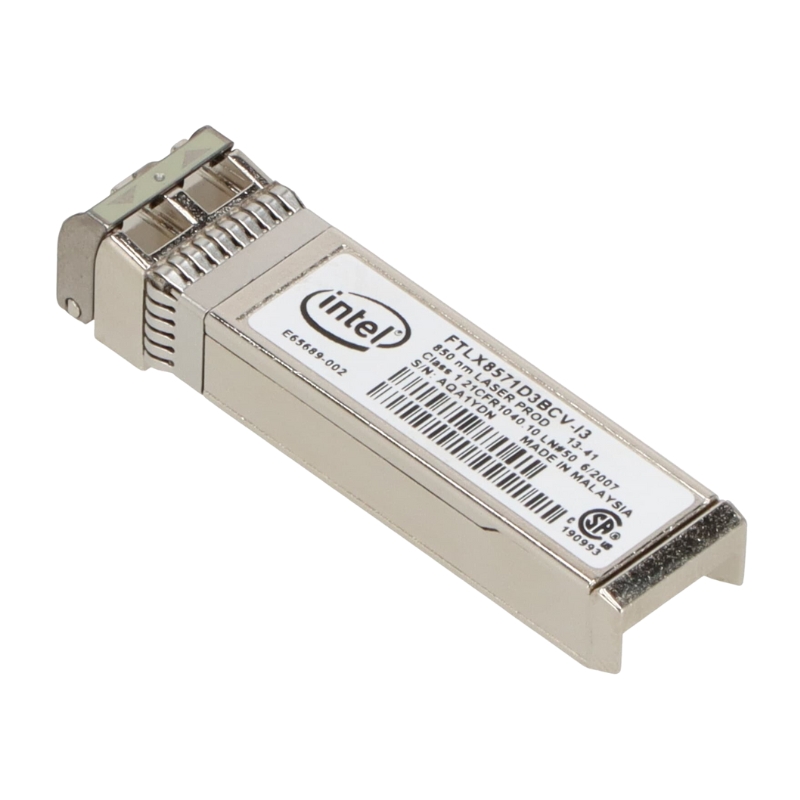


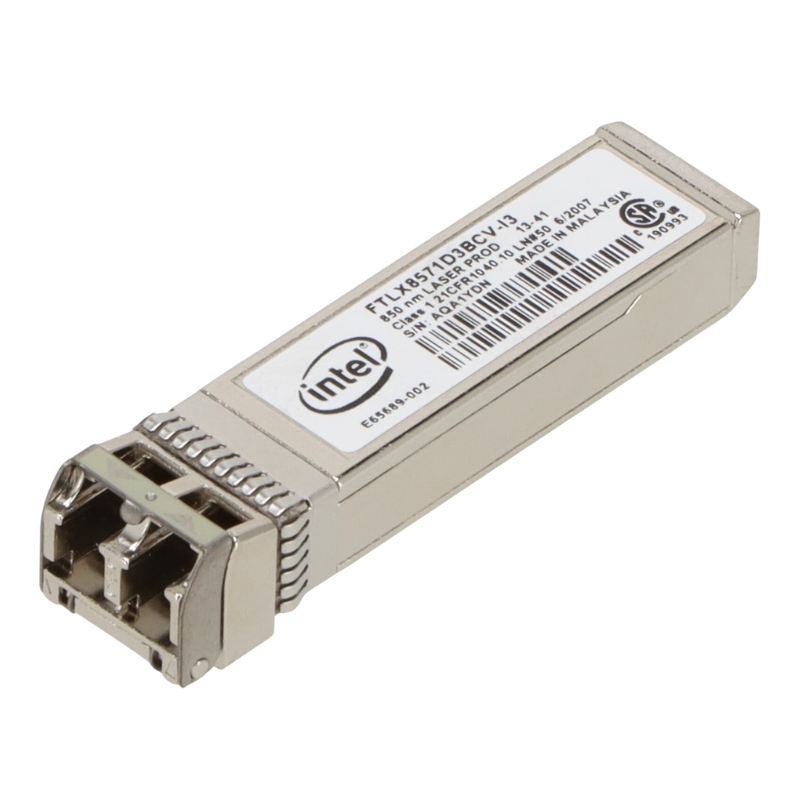
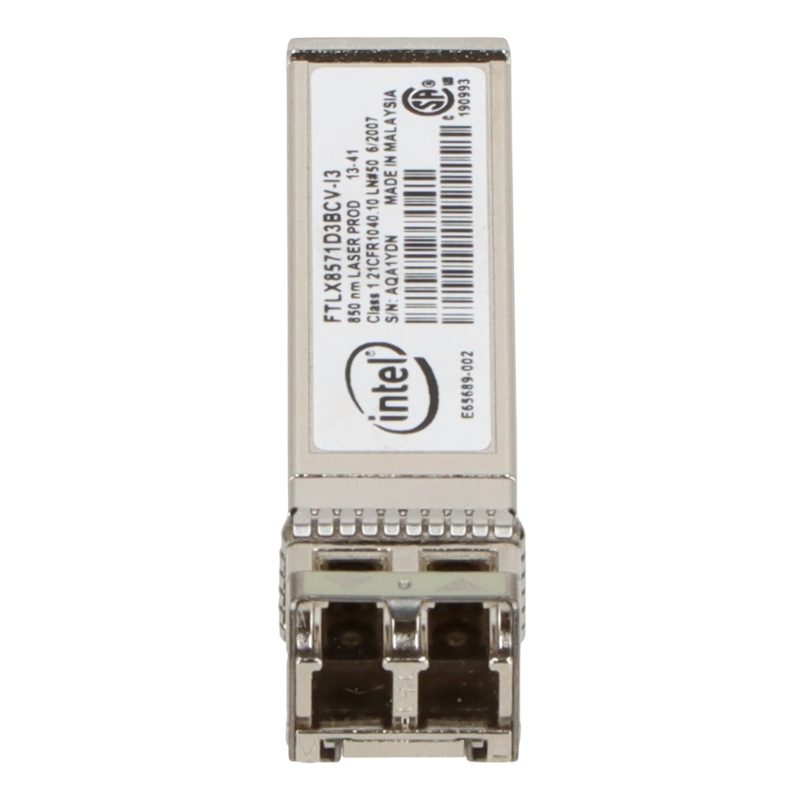
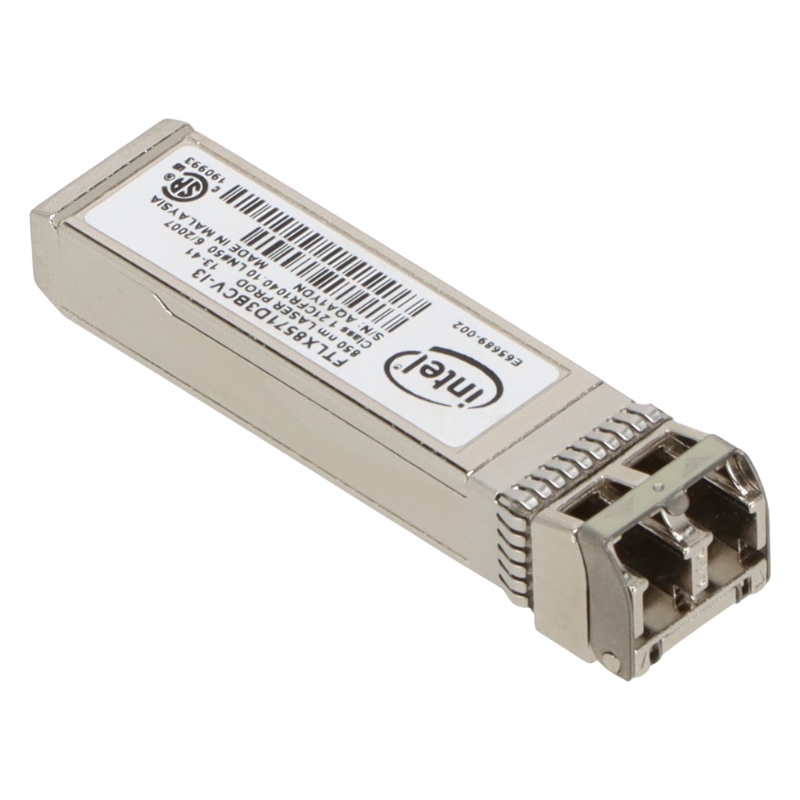
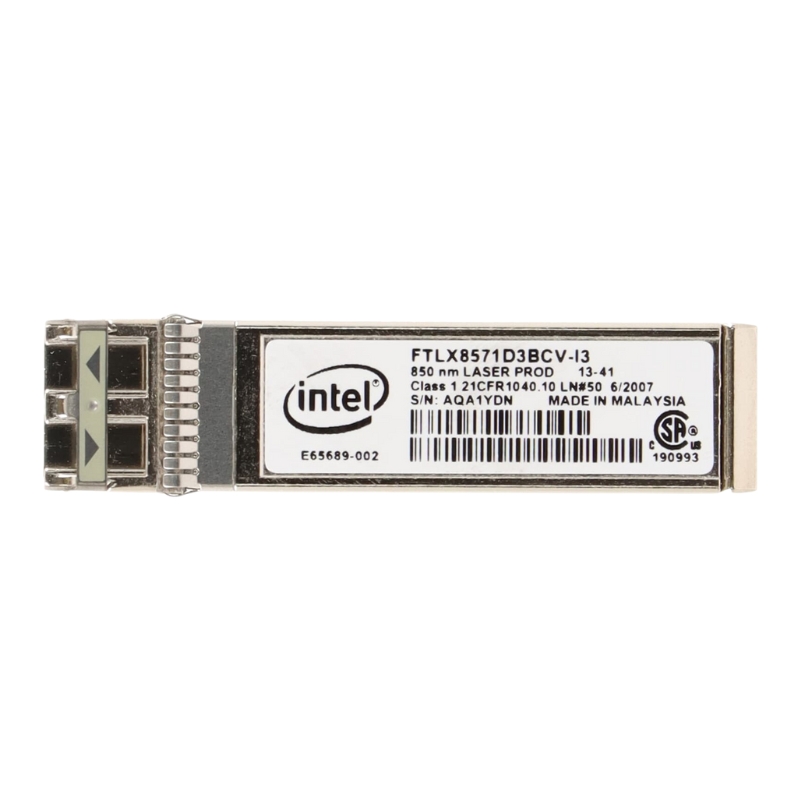
Intel E65689-002 SFP+ Transceiver with LC Connector for Multi-mode Fiber, 1GBPS, 300m, 850nm. Excellent Refurbished with 1 year replacement warranty
The Intel E65689-002 SFP+ Transceiver is a high-performance optical networking module engineered for reliable short-range data transmission across multi-mode fiber (MMF) infrastructure. Built with an LC connector and operating at 850nm, this compact transceiver is designed for fast, stable connectivity in enterprise networks, server rooms, storage environments, and data center deployments. It supports high-speed optical communication over distances up to 300 meters, making it a practical solution for bandwidth-intensive networking applications where dependable signal integrity and efficient fiber connectivity are essential.
The Intel E65689-002 SFP+ transceiver category is built around compact fiber-optic connectivity for enterprise networks, storage fabrics, server environments, campus backbones, and short-reach data links that demand stable signal delivery, clean optical performance, and dependable interoperability with compatible Intel networking hardware. This transceiver family is associated with multi-mode fiber transmission, LC optical connectivity, short-wave signaling at 850nm, and deployment scenarios where organizations need a practical optical module for switching, server uplinks, aggregation layers, and rack-to-rack communication. In environments where copper cabling introduces distance limitations, electromagnetic interference concerns, or cable management inefficiencies, the Intel E65689-002 optical transceiver category provides a compact and scalable way to support high-integrity fiber networking while preserving modularity inside dense network infrastructures.
Designed for use with fiber-based Ethernet environments, this transceiver type fits into a compatible SFP+ port and provides optical connectivity through an LC interface. The category is especially relevant for administrators planning short-distance fiber runs across server rooms, enterprise offices, managed network closets, colocation environments, or departmental switching installations. Multi-mode fiber support makes it suitable for short-range optical communication where low-latency connectivity, reduced signal loss, and straightforward installation are essential. The 850nm optical specification aligns with common short-range fiber standards used across modern LAN and data center deployments, while the compact pluggable form factor helps network teams scale ports and replace modules without redesigning the entire switching platform.
Because this Intel transceiver category is tied to optical infrastructure rather than fixed copper interfaces, it plays a key role in environments that prioritize flexibility. Network architects can pair the module with compatible fiber patch cables, structured cabling pathways, and matching optics on the opposite end of the link to create reliable point-to-point communication across cabinets, rows, floors, or adjacent facilities. The result is a cleaner, more scalable, and more manageable approach to network expansion, particularly in spaces where bandwidth growth, equipment density, and service continuity matter as much as raw transmission speed.
Optical transceivers occupy a central role in enterprise networking because they bridge the gap between active network hardware and physical fiber cabling. The Intel E65689-002 category belongs to the class of pluggable optical modules that convert electrical signals from a host system into optical signals for transmission across fiber and then convert incoming optical signals back into electrical form. This process enables servers, switches, routers, and storage devices to communicate over fiber links rather than relying exclusively on copper Ethernet ports.
For network planners, the value of this category extends beyond the module itself. It represents a building block for structured optical connectivity. A properly selected Intel transceiver can help standardize short-range fiber deployment across the environment, allowing similar link characteristics between top-of-rack switches, aggregation equipment, blade servers, hyperconverged nodes, and storage arrays. Instead of treating every link as a separate custom design, organizations can use a common optical strategy that simplifies inventory management, maintenance planning, and long-term scaling.
In many enterprise spaces, optical transceivers are chosen not only for distance support but also for signal quality, reduced susceptibility to interference, and support for high-density network design. Fiber links are often preferred in noisy electrical environments, between racks with power-heavy systems, or in facilities where administrators want predictable cabling pathways without the bulk of large copper bundles. The Intel E65689-002 category fits naturally into these requirements by offering a modular optical link option with a familiar connector type and a form factor suited to modern networking equipment.
The SFP+ form factor is one of the most widely used modular networking formats because it allows administrators to match the optical interface to the specific link requirement instead of being locked into a single permanent media type. With a pluggable module such as the Intel E65689-002, a switch or network adapter can be configured with the transceiver best suited to the environment, whether that means short-range multi-mode fiber in one rack, longer-distance optics elsewhere, or a migration path from copper to fiber over time.
This flexibility becomes especially valuable in growing infrastructures. A business may initially deploy a switch with only a few fiber uplinks and later expand to additional fiber-connected hosts, storage nodes, or aggregation links. Rather than replacing the entire switch, the administrator can populate more compatible SFP+ slots with matching transceivers as needed. The transceiver category therefore supports staged expansion and better capital efficiency. Organizations can invest in the optical links they need today while keeping a practical path for future upgrades, link additions, and topology changes.
The compact size of the SFP+ module also helps preserve port density. High-density switches and network adapters often need to provide many interfaces within limited rack space. Large fixed optical assemblies would reduce flexibility and increase replacement difficulty, but a modular transceiver design keeps the network hardware versatile. If a module fails, if a different fiber type is needed, or if a port must be repurposed, the transceiver can be swapped without replacing the underlying switch or adapter. This modularity is one of the defining advantages of the Intel E65689-002 category.
One of the most important aspects of the Intel E65689-002 category is its association with multi-mode fiber and 850nm optical operation. Multi-mode fiber is widely used for short-distance links inside buildings, data centers, and campus facilities because it offers an efficient balance of cost, performance, and installation practicality for localized optical communication. Rather than targeting very long-haul links, multi-mode optics are optimized for internal connectivity where devices are separated by tens or hundreds of meters rather than kilometers.
The 850nm wavelength is a common short-wave optical standard for multi-mode deployments. In practical terms, it supports the kinds of links often required between switches and servers, between access and aggregation layers, between storage equipment and host adapters, or between network closets inside the same building. When paired with suitable multi-mode cabling and compatible devices at both ends, the Intel E65689-002 transceiver category supports clean short-reach optical transport in spaces where reliable throughput and cable simplicity are essential.
Because this category is associated with a 300-meter reach profile, it is especially relevant to structured short-distance installations. Administrators can use it for server-room interconnects, cross-rack uplinks, building-floor distribution, and other in-building pathways where fiber is preferred but extreme distance is not required. This makes it a strong fit for campus IT rooms, business offices, healthcare facilities, school networks, industrial control environments, and regional data centers that want the performance and cleanliness of optical cabling without the complexity of long-distance single-mode optics.
Multi-mode fiber remains a practical choice for many enterprise installations because it is well suited to short and medium in-building links. For organizations deploying fiber within the same floor, between nearby racks, or across moderate structured cabling runs, multi-mode cabling often provides a straightforward and cost-conscious path to optical networking. The Intel E65689-002 category complements this approach by aligning with the optical characteristics commonly used in such installations.
In a server room or data hall, multi-mode fiber can support orderly cable routing, improved airflow compared with bulky copper bundles, and clearer separation between network, storage, and management pathways. It can also help simplify cable identification when paired with consistent patching standards and labeled optical panels. Since the Intel E65689-002 module uses an LC optical connection, it fits into the dense patching practices that many enterprise teams prefer for modern switch ports and structured fiber panels.
Another reason multi-mode optics remain relevant is deployment convenience. Many businesses do not need long-distance single-mode transmission for every link. Instead, they need dependable short-range connectivity between devices that already sit within a manageable footprint. In those situations, the Intel E65689-002 category delivers the right type of optical interface for practical enterprise use, balancing compact module design with the characteristics of short-wave multi-mode networking.
The reach profile associated with the Intel E65689-002 category makes it particularly useful in structured cabling designs where administrators must plan not just for port connectivity but also for patch panels, cable pathways, and endpoint placement. A 300-meter optical reach is often sufficient for numerous enterprise scenarios, including inter-rack links in larger data halls, switch-to-switch uplinks between rooms, or server-to-core connectivity within a contained building footprint.
Reach planning matters because optical modules should be selected according to both media type and link distance. Choosing a transceiver category that aligns with the intended cable run helps reduce deployment issues, signal mismatch, and unnecessary expense. In a campus IT environment, for example, an administrator may have dozens of short optical runs between access switches and an aggregation switch. A transceiver category like the Intel E65689-002, built around short-range multi-mode communication, is well suited to that kind of repeated deployment model.
When properly matched with appropriate fiber, connectors, and peer optics, the module category can contribute to stable communication with minimal complexity. This is particularly valuable in environments where network teams need repeatable installations rather than one-off custom builds. Standardized short-range optics allow faster provisioning, easier spare stocking, and more predictable maintenance across the network estate.
The LC connector is a defining feature of this Intel transceiver category because it reflects how the module interfaces physically with the optical cabling plant. LC connectors are widely used in enterprise fiber networking due to their compact size, secure fit, and suitability for high-density installations. In network rooms where port counts are high and space is limited, LC connectivity allows administrators to deploy many fiber links within a relatively small patching footprint.
For the Intel E65689-002 category, the LC interface supports integration with common duplex fiber patch cables used in Ethernet and storage networking. This makes the module relevant to environments where structured fiber panels, switch uplinks, blade chassis interconnects, and server NICs all rely on LC-based optical patching. The small connector size helps preserve front-panel density on switches and adapters, while the mature ecosystem of LC patch cables, couplers, and panels simplifies procurement and deployment.
Connector consistency also matters for operational efficiency. When a network standardizes on LC-based multi-mode optics for short-range links, technicians can reduce the number of cable types and connector adapters they must keep on hand. Troubleshooting becomes easier because patching practices remain consistent across multiple racks and devices. The Intel E65689-002 category benefits from this familiarity, making it suitable for infrastructures that value predictable fiber handling and standardized cable management.
Dense network environments demand connectors that support compact front-panel design without sacrificing reliability. LC connectors are well suited to this need because they occupy less space than larger legacy optical connectors while still delivering dependable alignment and secure engagement. In high-port-count switches, where many optical links terminate in a narrow horizontal space, the LC format helps administrators preserve airflow, maintain visibility, and reduce congestion around the switch face.
The Intel E65689-002 category is therefore well aligned with data center and enterprise switching environments that use multiple optical uplinks per device. In top-of-rack switching, virtualization clusters, and converged network deployments, administrators often need to patch several fiber links within a confined rack unit. LC-based transceivers help support that density without creating excessive connector bulk or cable strain.
From a maintenance standpoint, LC connectivity also supports faster moves, adds, and changes. Technicians familiar with LC patching can quickly replace cables, move transceivers between ports, or test alternate pathways when diagnosing link issues. This contributes to operational agility, especially in facilities where network changes happen regularly and downtime windows are limited.
The practical performance of any optical transceiver depends not only on the module itself but also on the quality and type of fiber patching used with it. The Intel E65689-002 category is intended for multi-mode fiber environments, so cable selection should align with that optical mode. Using compatible patch cables, properly cleaned connectors, and well-managed bend radii helps preserve signal quality and reduce avoidable faults.
Patch cable planning matters in both small and large deployments. In a small server room, a single poor-quality patch lead can prevent a link from coming up. In a larger facility, inconsistent cable types can complicate troubleshooting across dozens of links. By standardizing around the Intel E65689-002 transceiver category and pairing it with properly matched LC multi-mode patching, organizations can simplify deployment and improve the repeatability of their fiber installations.
Administrators also benefit from consistent labeling and cable routing. Because short-range optical links are often installed in clusters, especially around switches and servers, good patch discipline prevents accidental disconnects and reduces the time needed to identify the correct path during maintenance. The transceiver category fits neatly into this structured approach to optical cabling.
The Intel E65689-002 category is relevant across a broad range of network designs where compact short-range fiber connectivity is required. It can be used in enterprise switching environments, server uplink configurations, blade infrastructure, hypervisor clusters, network-attached storage platforms, and departmental backbone segments. In each case, the transceiver serves as the optical interface that allows compatible equipment to communicate over multi-mode fiber with a small, replaceable module rather than a fixed media port.
One common use case is switch uplink deployment. Access switches in branch offices, campus closets, or floor-level cabinets often need fiber uplinks to an aggregation switch. If those links remain within the supported short-range optical envelope, a transceiver category like the Intel E65689-002 provides an efficient way to build the uplink while preserving switch modularity. Another common use case is server connectivity in racks where optical NIC uplinks connect compute nodes to top-of-rack or end-of-row switches. In such environments, multi-mode optics help maintain clean cable routing and support a scalable network fabric.
Storage networking is another area where optical modules remain important. Environments that use dedicated storage traffic, clustered storage appliances, or high-availability data pathways may prefer optical links for their reliability and cabling discipline. A short-range Intel transceiver category can support those internal storage-adjacent links when the equipment and media standards align with the module’s capabilities.
The practical value of the Intel E65689-002 category lies in its ability to contribute to stable optical communication when deployed correctly. Reliability in a fiber link is not determined by one factor alone; it depends on module quality, connector cleanliness, cable compatibility, proper insertion, port health, and correct pairing at both ends of the link. A well-matched transceiver category provides the optical foundation for dependable communication, but it must be part of a complete and disciplined deployment approach.
In enterprise networks, signal integrity matters because intermittent optical faults can be difficult to trace and disruptive to production workloads. A transceiver category designed for standardized short-range multi-mode use helps reduce uncertainty by aligning with well-established optical practices. When both ends of the link use compatible optics, the fiber plant is correctly specified, and connector care is maintained, administrators can expect consistent link establishment and stable ongoing performance for the workloads assigned to that connection.
Reliability also matters for serviceability. Optical modules are frequently installed in critical devices that support dozens or hundreds of users, multiple virtual machines, or important storage paths. A modular transceiver design allows failed or suspect optics to be replaced quickly without replacing the host switch or network adapter. The Intel E65689-002 category supports this operational model by keeping the optical component separate from the larger networking platform.


 Contact Us
 Information
 Catalog
 Solid State Drives (SSD)
 Network Switches
 Hard Disk Drives
 HBA & Controllers
 PC & Servers
 PC & Server Memory
 CPU & Processors
 Network Routers
 Power Supplies
 Tape Drives & Libraries
 Network Devices
 Computer & Network Cables