(7% discount is applied at checkout)
Cart is empty
Your go-to destination for cutting-edge server products
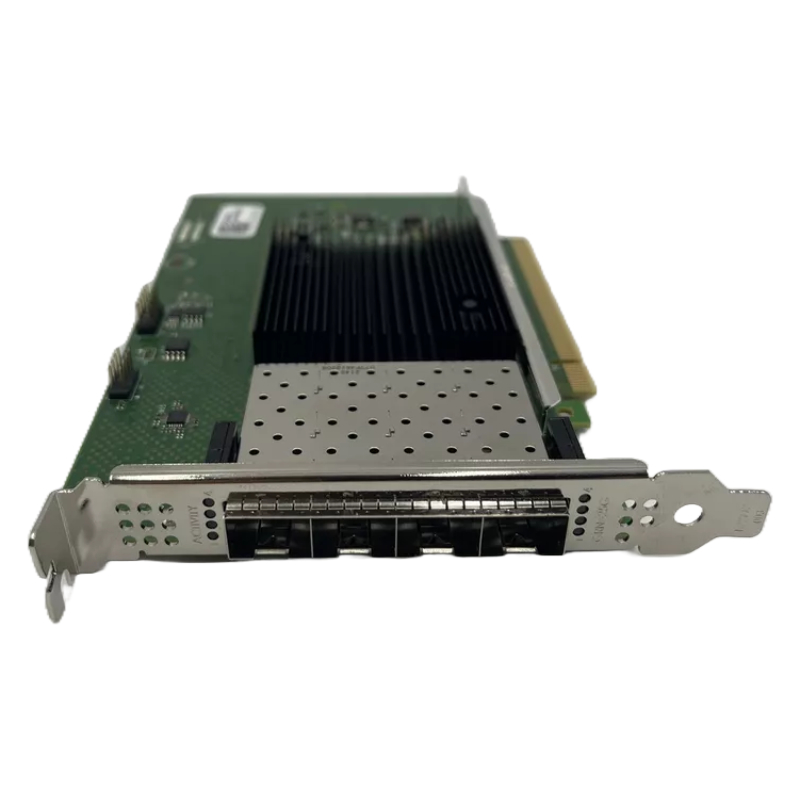


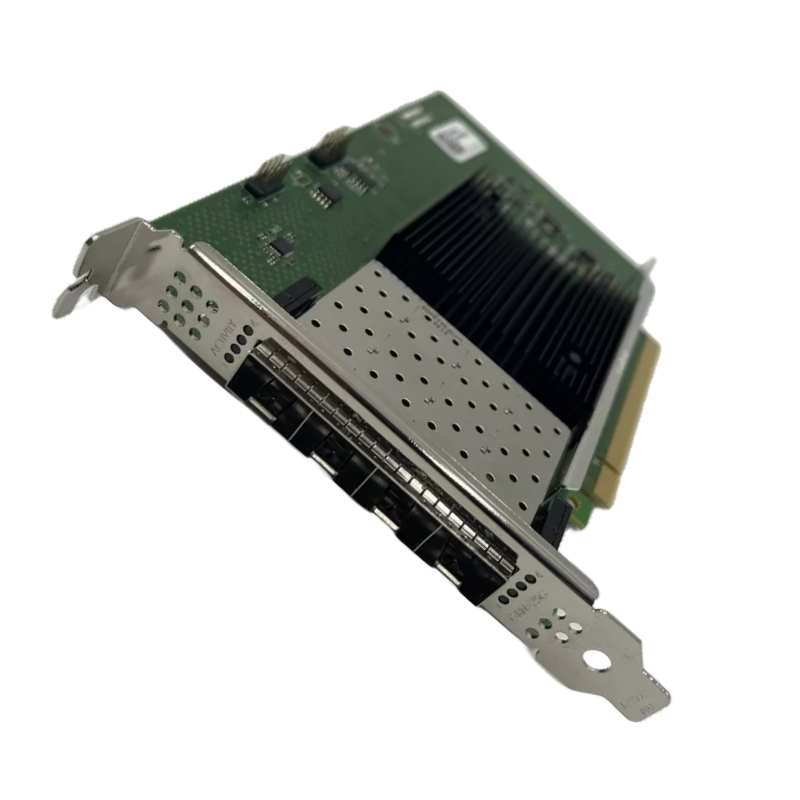
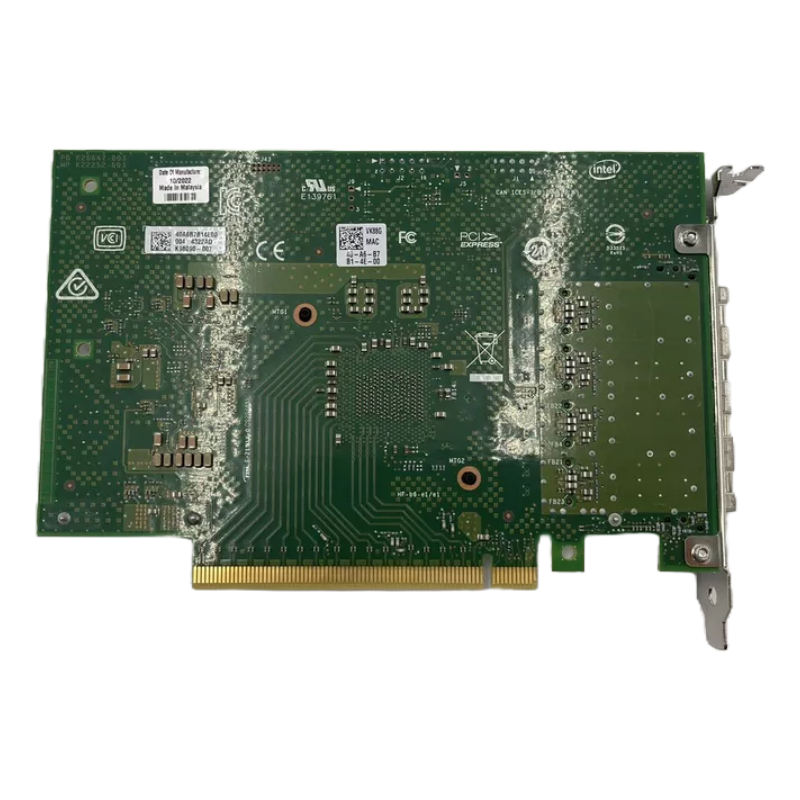
Intel E810XXVDA4G1P5 Quad Port Adapter PCI-E 4.0X16 25 GBE SFP 28 x 2 Ethernet Network Adapter. New Sealed in Box (NIB) with 3 years Replacement Warranty
The Intel E810XXVDA4G1P5 is a high-performance server-class network interface card designed for modern data centers, enterprise networking, virtualization environments, and cloud infrastructure workloads. Built by
Featuring a dual-port SFP28 interface supporting up to 25 Gigabit Ethernet speeds, this adapter is optimized for scalability, efficiency, and next-generation networking architectures. It is engineered to handle intensive data traffic while ensuring consistent performance across virtualized and software-defined environments.
The Intel E810XXVDA4G1P5 Quad-Port PCIe 4.0 x16 Full-Height 25 Gigabit SFP28 x 2 Ethernet Network Adapter is engineered as a next-generation data center networking solution designed to meet the rapidly increasing demands of modern cloud infrastructures, high-performance computing environments, and enterprise-scale virtualization platforms. Built upon Intel’s advanced Ethernet controller architecture, this adapter delivers exceptional bandwidth density, scalable throughput, and deterministic low-latency performance suitable for mission-critical workloads.
As enterprises transition toward software-defined infrastructure, the need for high-speed, reliable, and programmable network adapters has become more critical than ever. This adapter integrates PCI Express 4.0 x16 interface capabilities, enabling significantly higher upstream bandwidth compared to previous PCIe generations, while supporting high-density SFP28 optical connectivity designed for 25 Gigabit Ethernet links. The result is a balanced combination of raw throughput, efficient packet processing, and enterprise-grade reliability.
At the core of the Intel E810XXVDA4G1P5 network adapter lies Intel’s E810 Ethernet controller architecture, which is optimized for scalable cloud workloads and modern virtualization environments. The architecture focuses on reducing CPU overhead while improving packet processing efficiency through hardware offloading mechanisms, intelligent traffic segmentation, and dynamic workload distribution. This ensures that compute resources are maximized for applications rather than being consumed by networking tasks.
The adapter integrates a highly optimized packet processing engine capable of handling large volumes of small and large packets simultaneously. This is essential in environments such as virtualization clusters, software-defined storage systems, and microservices-based architectures where packet diversity and unpredictability are common. The architecture ensures consistent throughput even under heavy mixed traffic conditions, maintaining stable network performance.
Hardware-based offloading is a key feature in the Intel E810XXVDA4G1P5 design. Tasks such as checksum calculations, segmentation offload, and encryption processing are handled directly by the adapter hardware. This reduces latency and frees CPU cycles for application-level workloads. The result is improved system efficiency and better workload consolidation, especially in virtualized environments where CPU contention is a critical factor.
The PCIe 4.0 x16 interface is one of the defining features of this adapter, offering double the per-lane throughput of PCIe 3.0. This expanded bandwidth capacity ensures that the network adapter can fully utilize its 25 Gigabit Ethernet ports without being bottlenecked by the host system. In high-density data center deployments, this becomes essential for maintaining consistent performance across multiple virtual machines and containerized workloads.
The design of the PCIe 4.0 x16 interface is optimized for low-latency data transfer between the network adapter and the system CPU. Reduced latency is crucial for latency-sensitive applications such as financial trading systems, real-time analytics platforms, and distributed storage clusters. The architecture ensures that data packets move efficiently between network and memory subsystems with minimal delay.
Modern server architectures often integrate multiple accelerators such as GPUs, FPGAs, and additional network interface cards. The PCIe 4.0 x16 interface provides sufficient bandwidth headroom to support these configurations without introducing congestion. This makes the Intel E810XXVDA4G1P5 suitable for AI training clusters and high-performance computing workloads that require simultaneous high-speed data exchange.
The adapter supports SFP28 interfaces designed for 25 Gigabit Ethernet connectivity, which can operate over both optical fiber and compatible direct attach copper cables. This flexibility allows data center administrators to deploy the adapter in a wide range of network topologies, from short-range rack-to-rack connections to long-distance interconnects within large campus environments.
The SFP28 ports are engineered to maximize port density while maintaining signal integrity and low power consumption. In high-density server racks, this enables efficient scaling of network capacity without increasing physical footprint. The design also supports modular transceiver selection, allowing organizations to choose optical modules based on distance and bandwidth requirements.
Maintaining signal integrity at 25 Gigabit speeds requires advanced equalization and error correction mechanisms. The Intel E810XXVDA4G1P5 incorporates these mechanisms at the hardware level to ensure stable transmission even in electrically noisy environments. This is particularly important in large data centers where electromagnetic interference and cable congestion are common challenges.
The quad-port design of the Intel E810XXVDA4G1P5 enables parallel network processing across multiple channels, improving overall throughput and redundancy. Each port operates independently while being managed under a unified controller framework, allowing for intelligent traffic distribution and failover capabilities in enterprise environments.
The architecture supports logical segmentation of network traffic across ports, enabling isolation between workloads such as storage traffic, application traffic, and management traffic. This improves security, performance predictability, and operational stability in complex infrastructure deployments.
High availability is achieved through multi-port redundancy configurations, where traffic can be rerouted dynamically in the event of a link failure. This ensures uninterrupted service delivery for mission-critical applications. The adapter’s firmware and driver stack work together to detect failures and redistribute workloads seamlessly across available links.
Single Root I/O Virtualization (SR-IOV) is a key feature of the Intel E810XXVDA4G1P5, enabling a single physical network adapter to present multiple virtual functions to hypervisors and virtual machines. This significantly reduces overhead in virtualized environments and improves network performance consistency across workloads.
The adapter is optimized for compatibility with major hypervisors used in enterprise cloud environments. It ensures efficient packet routing between virtual machines while maintaining isolation and security boundaries. This allows organizations to scale virtual infrastructure without compromising network performance.
In container orchestration platforms, the adapter provides efficient network namespace handling and fast packet switching between container instances. This is particularly important for microservices architectures where service-to-service communication occurs at high frequency and low latency is essential.
The Intel E810XXVDA4G1P5 supports RDMA capabilities that enable direct memory-to-memory data transfer between systems without involving CPU intervention. This dramatically reduces latency and increases throughput for distributed computing workloads and storage replication systems.
In storage-heavy environments, RDMA enables faster synchronization between distributed nodes, reducing bottlenecks in data replication and backup systems. This is essential for modern software-defined storage architectures where performance and consistency are critical.
Applications that depend on microsecond-level response times benefit significantly from RDMA-enabled networking. Financial trading platforms, real-time analytics engines, and high-frequency transaction systems can achieve improved performance consistency using this adapter.
Security is deeply integrated into the Intel E810XXVDA4G1P5 architecture, with hardware-based acceleration for encryption and secure packet processing. This reduces the burden on host CPUs while ensuring that data-in-transit is protected using modern encryption standards.
In virtualized environments, the adapter ensures strict isolation between virtual machines through hardware-enforced segmentation. This prevents unauthorized access to network streams and improves overall system security posture.
The adapter supports intelligent traffic filtering and anomaly detection mechanisms that help identify and mitigate potential network-based threats. This contributes to a more resilient data center infrastructure capable of withstanding modern cyber threats.
Power efficiency is a critical aspect of the Intel E810XXVDA4G1P5 design. The adapter incorporates dynamic power scaling technologies that adjust energy consumption based on network load. This ensures optimal performance while minimizing power draw during low-traffic periods.
The full-height form factor allows for improved airflow and heat dissipation, making it suitable for dense server environments. Efficient thermal management ensures stable operation even under sustained high-load conditions.
The adapter is widely suited for hyperscale data center deployments where massive bandwidth aggregation and low latency communication are essential. It supports distributed computing architectures that rely on fast interconnects between thousands of nodes.
In HPC environments, the Intel E810XXVDA4G1P5 enables fast node-to-node communication essential for scientific simulations, machine learning model training, and large-scale computational workloads. Its low-latency design ensures consistent synchronization across compute nodes.
Enterprise virtualization platforms benefit from the adapter’s SR-IOV capabilities, high throughput, and efficient CPU offloading. This allows organizations to maximize server utilization while maintaining predictable network performance.
The adapter is supported by a comprehensive driver ecosystem designed for major operating systems and virtualization platforms. These drivers provide advanced configuration options for tuning performance, optimizing latency, and managing traffic prioritization.
Network administrators can leverage centralized management tools to monitor performance metrics, configure port behavior, and deploy firmware updates across large-scale environments. This simplifies operational complexity in enterprise deployments.
Quality of Service mechanisms allow administrators to prioritize critical network traffic, ensuring that essential workloads receive sufficient bandwidth even during peak usage periods. This is vital for maintaining service-level agreements in enterprise environments.
The adapter supports detailed tuning options that allow optimization for specific workloads such as storage replication, virtual machine migration, or high-frequency transaction processing. These adjustments ensure that the hardware can be tailored to diverse operational requirements.
Adaptive load balancing ensures that network traffic is distributed efficiently across available ports, reducing congestion and improving overall system responsiveness. This dynamic behavior enhances scalability in large distributed systems.


 Contact Us
 Information
 Catalog
 Solid State Drives (SSD)
 Network Switches
 Hard Disk Drives
 HBA & Controllers
 PC & Servers
 PC & Server Memory
 CPU & Processors
 Network Routers
 Power Supplies
 Tape Drives & Libraries
 Network Devices
 Computer & Network Cables