
(7% discount is applied at checkout)
Cart is empty
Your go-to destination for cutting-edge server products
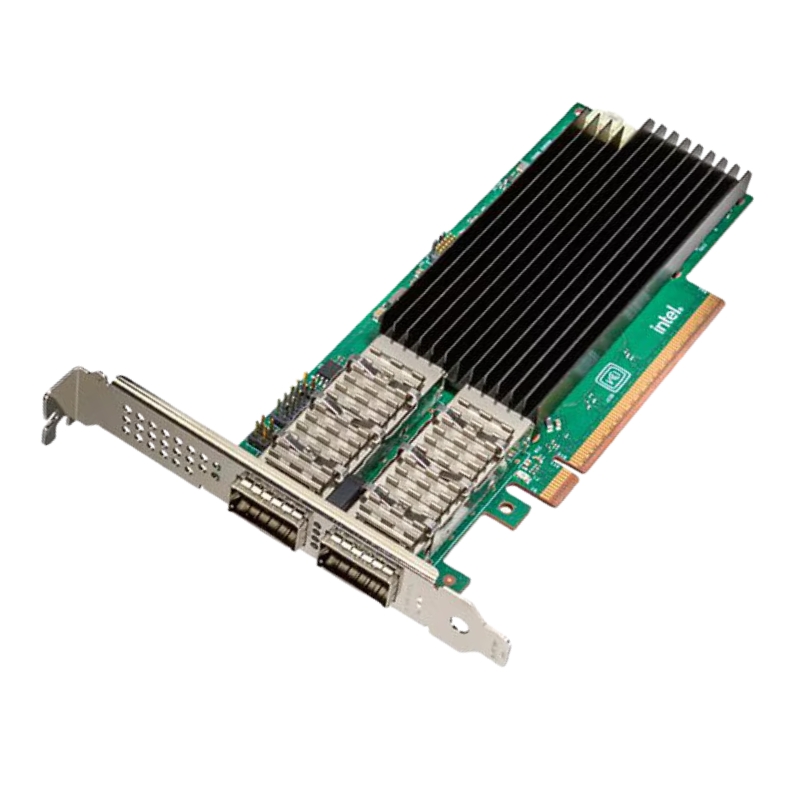
Intel E830-CQDA2 2 Ports 200GbE QSFP28 PCI-Express 5.0 x8 Plug-In Card Ethernet Network Adapter. New Sealed in Box (NIB) with 3 Years Warranty
The Intel E830-CQDA2 2 Port 200GbE QSFP28 PCI-Express 5.0 x8 Plug-In Card represents a transformative leap in Ethernet adapter technology, engineered for the most demanding data center, high-performance computing (HPC), and cloud infrastructure environments. The adapter leverages the groundbreaking PCI-Express 5.0 x8 host interface. This is a critical differentiator, as PCIe 5.0 doubles the bandwidth per lane compared to the previous PCIe 4.0 generation. An x8 PCIe 5.0 slot provides a total bidirectional bandwidth of approximately 63 GB/s (or ~504 Gb/s), which comfortably saturates the dual 200GbE ports without creating a host bus bottleneck.
The Intel E830-CQDA2 network adapter represents a pinnacle of high-performance Ethernet connectivity, engineered for data centers and enterprises operating at the forefront of digital infrastructure. This plug-in card is purpose-built to alleviate network bottlenecks, enabling seamless data flow for the most demanding workloads, from high-performance computing (HPC) and artificial intelligence (AI) to cloud-scale storage and real-time analytics. By implementing dual 200 Gigabit Ethernet (GbE) ports via QSFP28 interfaces on a PCI-Express 5.0 x8 host bus, the E830-CQDA2 delivers an aggregate bandwidth of 400 Gbps per card, providing the foundational throughput required for next-generation applications.
At its core, the adapter leverages Intel's proven Ethernet controller architecture, enhanced for extreme speed and low latency. It is designed to interoperate seamlessly with existing 200GbE, 100GbE, 50GbE, and 40GbE infrastructure through the use of appropriate QSFP28 transceivers and breakout cables, offering significant investment protection and network design flexibility. The E830-CQDA2 is more than just a network interface card (NIC); it is a critical data processing engine that offloads protocol and virtualization overhead from the host CPU, ensuring that server resources are dedicated to application performance.
The Intel E830-CQDA2 is defined by a robust set of technical specifications that underline its capabilities as a premier network adapter. Understanding these specifications is key to planning and deploying a high-bandwidth network infrastructure.
The adapter is designed in a standard full-height, full-length (FHFL) PCI Express form factor. This universal form factor ensures broad compatibility with a wide range of server and storage system chassis from leading OEM vendors. The card's component layout and heatsink design are optimized for efficient thermal dissipation in high-ambient temperature data center environments, maintaining stable operation under continuous full-load traffic conditions.
The primary host interface is a PCI-Express 5.0 x8 slot. PCIe 5.0 technology doubles the bandwidth per lane compared to PCIe 4.0, allowing the x8 link to provide ample headroom for the dual 200GbE ports without becoming a bottleneck. This interface delivers a theoretical bidirectional bandwidth of approximately 63 GB/s (504 Gb/s), comfortably exceeding the 400 Gb/s (50 GB/s) requirement of the dual ports, ensuring zero compromise on performance.
The card edge connector follows the PCI Express x16 mechanical specification but is wired for x8 electrical lanes, allowing it to be installed in any x8, x16, or larger PCIe 5.0 slot. It requires a standard 75-watt power delivery from the PCIe slot, with no need for auxiliary power connectors, simplifying cabling and installation.
The card features two independent QSFP28 (Quad Small Form-factor Pluggable 28) network ports. Each port supports link speeds of 200GbE, 100GbE, 50GbE, and 40GbE, with auto-negotiation capabilities. The specific speed is determined by the installed QSFP28 transceiver module or direct-attach copper (DAC) cable.
The Intel E830-CQDA2 supports a comprehensive range of industry-standard optical and copper interfaces. This includes 200GBASE-SR4, DR4, and FR4 optics for multi-mode and single-mode fiber deployments over various distances. For cost-effective short-reach connections within a rack or between adjacent racks, the card is fully compatible with 200GbE and 100GbE passive and active Direct Attach Copper (DAC) cables. Furthermore, it supports breakout configurations, allowing a single 200GbE port to be split into four 50GbE or two 100GbE connections using appropriate breakout DACs or fan-out cables, providing exceptional flexibility in network topology design.
Raw bandwidth is only one aspect of the E830-CQDA2's performance profile. Its true value is realized through a suite of advanced features that optimize data transfer, reduce latency, and improve overall system efficiency.
Engineered for financial trading, high-frequency databases, and clustered compute applications, the adapter minimizes latency through hardware-optimized data paths and cut-through switching architecture. It is capable of processing millions of packets per second (PPS) per port, ensuring that high-volume, small-packet workloads do not incur performance penalties.
The Intel Ethernet Controller integrated into the E830-CQDA2 provides a comprehensive set of stateless offloads. These include TCP/UDP/IP checksum offload, Large Send Offload (LSO), and Receive Side Scaling (RSS). These hardware accelerations offload network processing tasks from the server CPU, freeing valuable processor cycles for applications and reducing overall system power consumption.
For virtualized and cloud environments, the adapter supports SR-IOV, allowing a single physical port to be partitioned into multiple virtual functions (VFs). Each virtual machine or container can be assigned a dedicated VF, providing near-bare-metal network performance while maintaining strong isolation and security between tenants. This is critical for maximizing server utilization and performance in virtualized data centers.
The card is a cornerstone for building high-performance, low-latency storage networks and disaggregated infrastructure.
The Intel E830-CQDA2 offers full hardware offload for NVMe-over-Fabrics, both as an initiator and a target. This allows servers to access remote NVMe storage devices as if they were locally attached, with minimal latency overhead. It enables the creation of efficient, scalable, and high-performance storage area networks (SANs) using Ethernet, consolidating network and storage fabrics.
A key performance feature is its robust support for Remote Direct Memory Access (RDMA) via three major protocols: iWARP, RoCEv2, and RoCE. RDMA allows data to be moved directly from the memory of one computer to another without involving the operating system or CPU of either machine. This drastically reduces latency and CPU utilization for distributed applications. The adapter includes optimizations for both iWARP and RoCE, providing flexibility to deploy in standard routed IP networks (iWARP/RoCEv2) or in Layer 2 controlled environments (RoCE).
The immense bandwidth and advanced features of the Intel E830-CQDA2 make it the ideal choice for specific, high-intensity computing scenarios.
In HPC environments, applications for computational fluid dynamics, financial modeling, and genomic sequencing rely on tightly coupled parallel processing. The network's ability to handle massive MPI traffic with minimal latency is critical to overall job completion time. The E830-CQDA2's performance ensures that the network is not the limiting factor in achieving exascale-level computations.
For cloud service providers and large enterprises building software-defined storage (SDS) or hyper-converged infrastructure, the adapter provides the necessary throughput for east-west traffic between nodes and north-south traffic to clients. It enables faster live migrations of VMs, more responsive distributed storage (like Ceph or vSAN), and the ability to consolidate multiple lower-speed connections into a single, high-performance card, simplifying network design and cabling.
In industries where microseconds matter, the combination of PCIe 5.0's low latency and the adapter's optimized drivers and RDMA support provides the deterministic, high-speed network pipeline required for processing market data feeds and executing trades with the utmost speed.


 Contact Us
 Information
 Catalog
 Solid State Drives (SSD)
 Network Switches
 Hard Disk Drives
 HBA & Controllers
 PC & Servers
 PC & Server Memory
 CPU & Processors
 Network Routers
 Power Supplies
 Tape Drives & Libraries
 Network Devices
 Computer & Network Cables