(7% discount is applied at checkout)
Cart is empty
Your go-to destination for cutting-edge server products
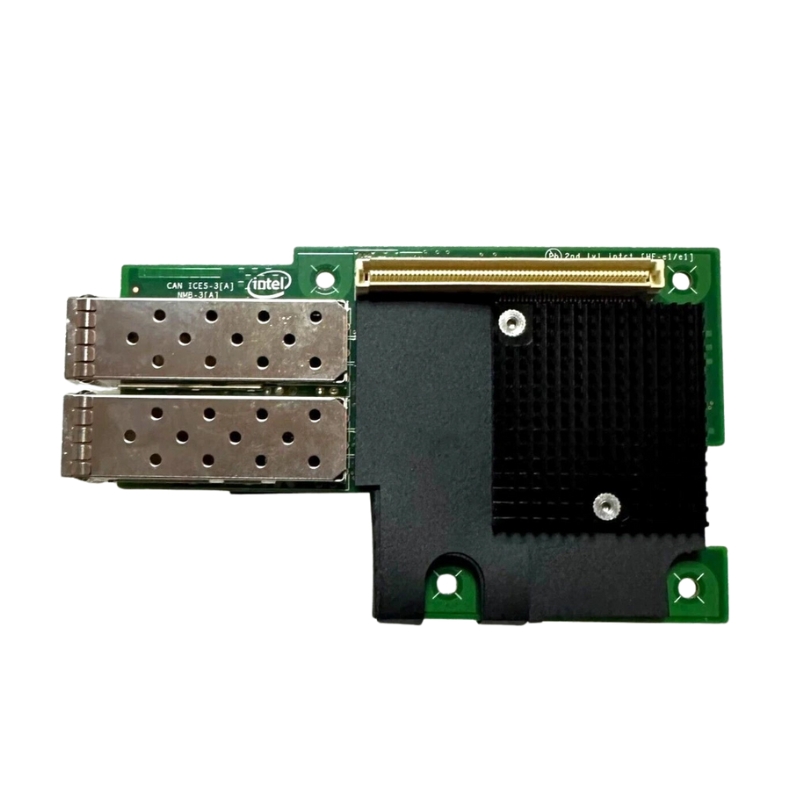


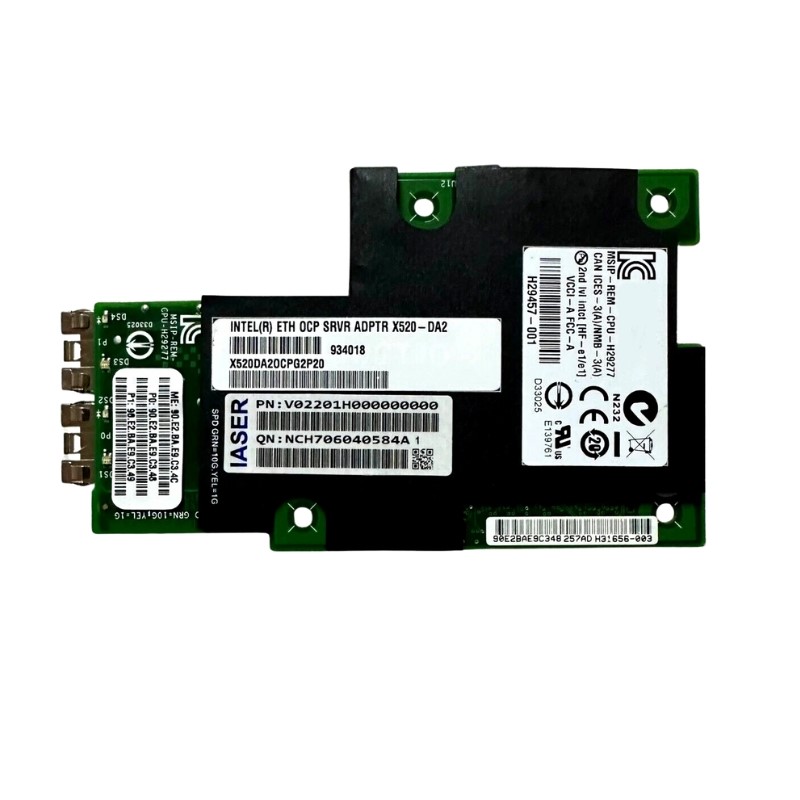
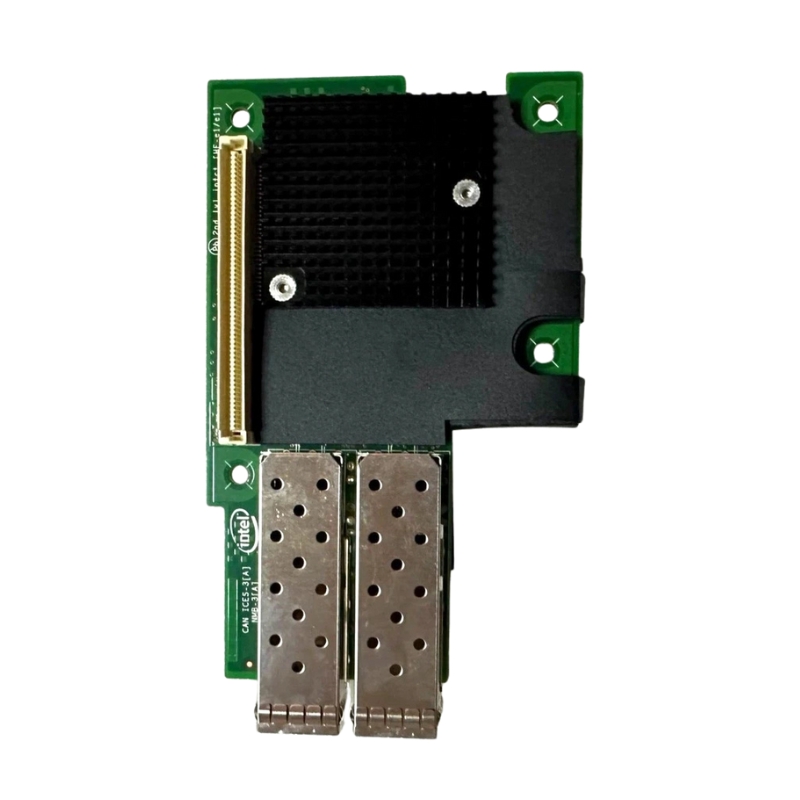
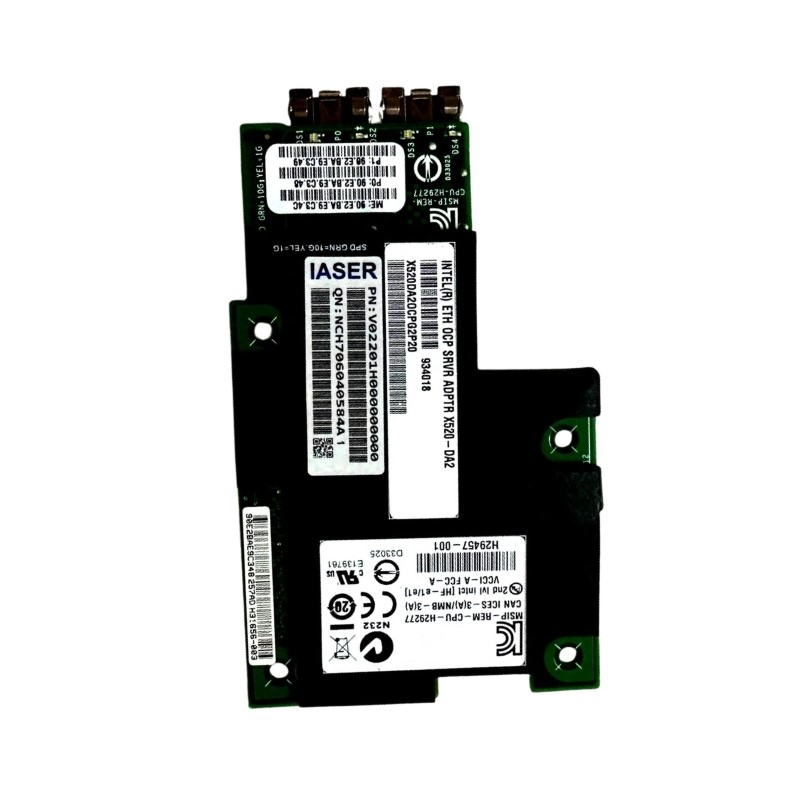
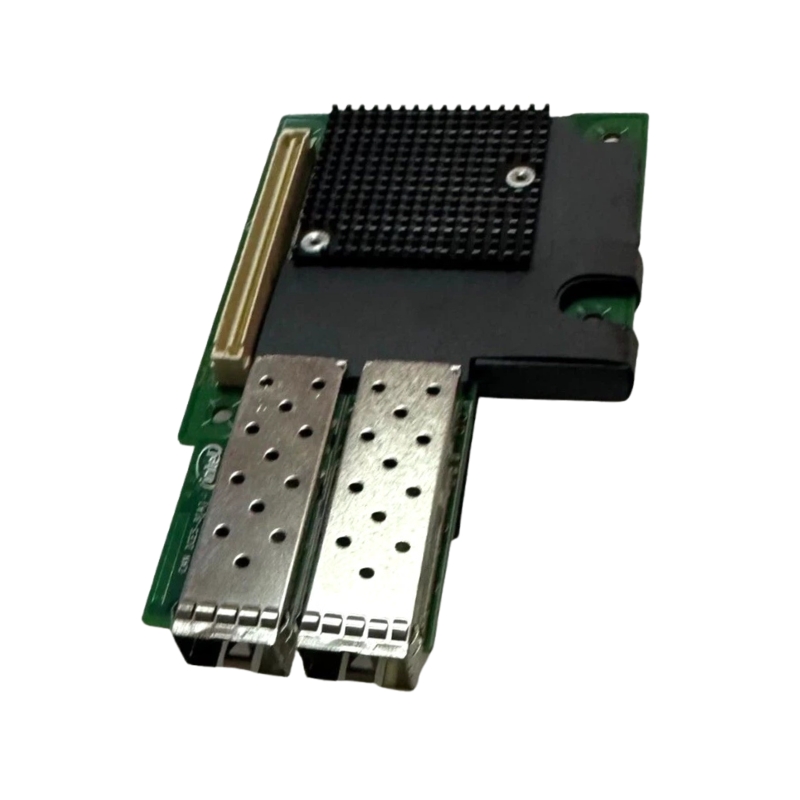
Intel X520DA2OCP Low Profile SFP+ PCI-Express Server Network Adapters with 10 Gigabit Ethernet. Excellent Refurbished with 1 year replacement warranty
The Intel 10GB Ethernet Server Adapter X520-DA2 for OCP Dual Port (X520DA2OCP) is a high-performance network adapter designed for seamless integration into modern server environments. It provides fast, reliable, and scalable network connectivity for data centers, enterprises, and cloud computing.
The Intel X520DA2OCP low profile SFP+ PCI-Express server network adapter category represents a class of high-performance Ethernet connectivity solutions designed specifically for data-intensive enterprise infrastructures. Built around 10 Gigabit Ethernet (10GbE) capabilities, these adapters are engineered to meet the demands of virtualization clusters, cloud-scale deployments, storage networking, and high-throughput application environments. The dual-port architecture combined with SFP+ optical or direct attach copper support ensures flexible deployment across diverse networking topologies.
These adapters are widely adopted in enterprise data centers due to their balance of performance, scalability, and compatibility with standard PCI-Express server slots and OCP (Open Compute Project) server architectures. The low-profile bracket design allows installation in compact rack-mounted servers, blade systems, and dense compute nodes where physical space optimization is critical.
The Intel X520 series is based on a mature and highly optimized controller architecture that emphasizes offloading networking tasks from the CPU to the network interface card itself. This approach significantly reduces host system overhead while increasing packet processing efficiency. The dual-port SFP+ interface enables simultaneous high-speed connections, supporting redundancy, link aggregation, and load balancing strategies in enterprise networks.
At the hardware level, the adapter integrates advanced packet processing engines, multi-queue architecture, and intelligent interrupt moderation. These features collectively ensure that high-volume traffic flows are processed efficiently without bottlenecks, even under sustained load conditions typical in virtualization or database environments.
The PCI-Express interface plays a crucial role in the overall performance of the X520DA2OCP category. Typically utilizing PCIe Gen2 x8 lanes, the adapter is capable of delivering sufficient bandwidth to fully saturate dual 10GbE ports under ideal conditions. This ensures that data transfer between the server CPU, memory, and network interface remains smooth and uninterrupted.
The architecture is optimized for low latency communication between the NIC and system memory, reducing jitter and improving response times for latency-sensitive applications such as financial trading platforms, real-time analytics systems, and high-frequency database queries.
A defining characteristic of the Intel X520DA2OCP adapter category is its use of SFP+ (Small Form-Factor Pluggable Plus) interfaces. These interfaces allow administrators to choose between fiber optic transceivers and DAC cables depending on infrastructure requirements. This flexibility makes the adapter suitable for both short-range intra-rack connections and long-distance inter-switch communication.
Fiber optic modules provide extended reach and electromagnetic interference immunity, making them ideal for data center backbone connections. DAC cables, on the other hand, offer a cost-effective, low-latency solution for short-range connections between servers and top-of-rack switches.
The SFP+ ports on this adapter category are designed to comply with industry standards, ensuring compatibility with a wide range of third-party transceivers. This includes 10GBASE-SR for short-range multimode fiber, 10GBASE-LR for long-range single-mode fiber, and passive or active DAC modules.
Such interoperability enables organizations to standardize networking components across heterogeneous infrastructure environments without being locked into proprietary hardware ecosystems.
Signal quality is a critical factor in 10GbE environments, and the Intel X520 architecture incorporates advanced error correction and signal conditioning mechanisms. These features help maintain stable transmission even in electrically noisy environments or across extended cable runs. Adaptive equalization and digital signal processing contribute to maintaining packet integrity under varying load conditions.
The inclusion of OCP-compatible designs within the Intel X520DA2OCP category reflects the growing adoption of standardized server hardware in hyperscale and cloud data centers. OCP form factors are designed to improve serviceability, airflow efficiency, and hardware density while reducing operational costs.
By conforming to OCP specifications, these adapters can be deployed in modern server chassis that prioritize modularity and rapid replacement capability. This is particularly valuable in large-scale environments where downtime must be minimized.
The low profile bracket configuration enables installation in compact server systems where full-height expansion slots are not available. This is especially relevant for blade servers and edge computing nodes, where physical space constraints are a primary design consideration.
Despite its compact form, the adapter maintains full performance capabilities, ensuring that space efficiency does not compromise network throughput or reliability.
Thermal management is a critical concern in high-density deployments. The X520DA2OCP category is designed with optimized heat dissipation pathways, ensuring that the controller and transceiver modules remain within operational temperature ranges even under sustained load. Efficient airflow compatibility allows integration into server systems with front-to-back cooling architectures commonly used in data centers.
One of the defining advantages of the Intel X520 series is its ability to offload compute-intensive networking tasks from the host CPU. This includes checksum offloading, TCP segmentation offload (TSO), and large receive offload (LRO). These features significantly reduce CPU utilization, freeing processing resources for application workloads.
In virtualization environments, this offloading capability becomes even more important, as multiple virtual machines share the same physical network interface. By handling packet segmentation and reassembly at the hardware level, the adapter ensures consistent performance across virtual workloads.
Receive Side Scaling (RSS) distributes network processing across multiple CPU cores, enabling parallel handling of incoming traffic streams. The multi-queue design of the X520DA2OCP adapter ensures that network interrupts are balanced efficiently, reducing bottlenecks and improving throughput scalability.
This architecture is particularly beneficial for multi-threaded applications, distributed computing clusters, and microservices-based infrastructures where network traffic is highly parallelized.
Interrupt moderation mechanisms help balance CPU utilization and network responsiveness by controlling the frequency of hardware interrupts generated by network traffic. This reduces CPU overhead during high traffic bursts while maintaining acceptable latency levels for real-time applications.
The Intel X520DA2OCP adapter category is widely supported across major virtualization platforms, including VMware ESXi, Microsoft Hyper-V, and various Linux distributions. This broad compatibility ensures seamless integration into heterogeneous cloud environments.
Virtualization environments benefit significantly from SR-IOV (Single Root Input/Output Virtualization) support, which allows a single physical adapter to be partitioned into multiple virtual functions. Each virtual machine can then access dedicated network resources with near-native performance.
SR-IOV enables efficient sharing of network hardware while maintaining isolation between virtual machines. This improves security, reduces latency, and enhances performance predictability in multi-tenant environments.
By bypassing hypervisor network stacks, SR-IOV reduces processing overhead and ensures that virtual machines experience direct hardware-level throughput.
In cloud-scale deployments, scalability is a primary concern. The dual-port architecture of the X520DA2OCP allows for redundancy and link aggregation, enabling administrators to build resilient network topologies that can scale horizontally without requiring significant hardware redesign.
The Intel X520DA2OCP adapter category is commonly used in storage networking environments where high bandwidth and low latency are essential. iSCSI-based storage systems benefit from the adapter’s ability to handle large data transfers efficiently, while NAS deployments rely on stable throughput for file sharing and backup operations.
The adapter’s hardware acceleration features ensure that storage traffic does not interfere with general-purpose application traffic, maintaining predictable performance across workloads.
In enterprise backup systems, high-speed network interfaces are critical for reducing backup windows and ensuring timely data replication across geographically distributed sites. The 10GbE capability of the X520DA2OCP significantly accelerates these processes, enabling near real-time replication in some configurations.
Database systems such as SQL clusters and distributed NoSQL platforms benefit from the low latency characteristics of the adapter. Reduced packet processing delays contribute to faster query response times and improved transaction throughput in high-demand environments.
Power efficiency is an important consideration in modern data centers. The Intel X520 architecture is designed to balance performance with energy consumption, ensuring that high throughput does not result in excessive power draw.
Dynamic power management features allow the adapter to adjust energy usage based on network load, contributing to overall data center efficiency and reduced operational costs.
Enterprise-grade reliability is achieved through robust hardware design, error correction mechanisms, and thermal stability. The adapter is built to operate continuously under heavy workloads without degradation in performance.


 Contact Us
 Information
 Catalog
 Solid State Drives (SSD)
 Network Switches
 Hard Disk Drives
 HBA & Controllers
 PC & Servers
 PC & Server Memory
 CPU & Processors
 Network Routers
 Power Supplies
 Tape Drives & Libraries
 Network Devices
 Computer & Network Cables