
(7% discount is applied at checkout)
Cart is empty
Your go-to destination for cutting-edge server products
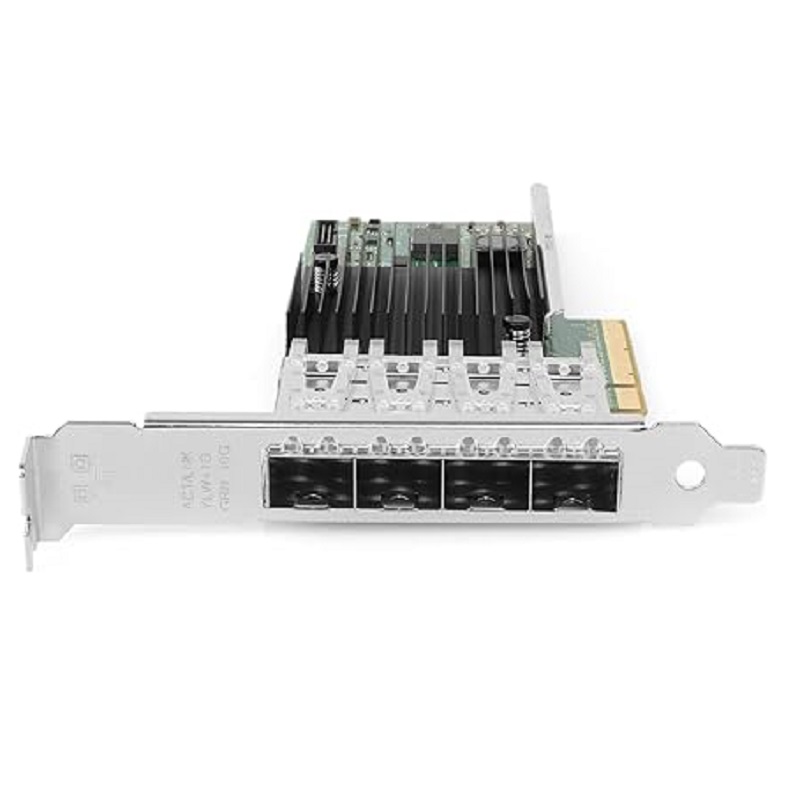
Intel X710-DA4 10 Gigabit Ethernet Quad Port Low Profile SFP+ PCI-Express Optical Fiber Network Adapter. Excellent Refurbished with 1 year replacement warranty - Dell Version
The Intel X710-DA4 10 Gigabit Ethernet Quad-Port SFP+ PCI Express 3.0 x8 network adapter is a high-performance optical fiber connectivity solution engineered for demanding enterprise, cloud, and data center environments. Designed to deliver ultra-fast and stable data transmission, this advanced adapter integrates four independent 10GbE SFP+ interfaces, enabling scalable bandwidth, efficient virtualization support, and optimized network traffic handling. Built with Intel’s proven networking architecture, it enhances server throughput, reduces latency, and ensures reliable wired connectivity for mission-critical workloads.
The Intel X710-DA4 10 Gigabit Ethernet Quad Port Low Profile SFP+ PCI-Express Optical Fiber Network Adapter is designed for environments that demand sustained high bandwidth, low latency communication, and reliable multi-port connectivity within dense computing infrastructures. Built on a mature and highly optimized controller architecture, this adapter delivers four independent 10 Gigabit Ethernet interfaces that operate over SFP+ optical transceivers, enabling scalable fiber-based networking for enterprise servers, data center nodes, virtualization hosts, and storage systems.
At its core, the adapter is engineered to maximize throughput efficiency across multiple network streams simultaneously. Each port operates independently, allowing simultaneous data transmission and reception without contention, making it suitable for environments where workload segmentation and traffic isolation are essential. This design supports modern distributed computing frameworks, where multiple virtual machines or containers require dedicated high-speed network paths.
The PCI Express interface ensures that the network adapter can communicate directly with the host system at high speed, minimizing bottlenecks between the CPU, memory subsystem, and network interface. The low profile form factor allows installation in compact server chassis and blade systems, while maintaining full electrical and mechanical compatibility with standard PCIe slots used in enterprise-grade motherboards.
This adapter is typically deployed in systems where efficient lane utilization is essential. It leverages PCIe bandwidth allocation strategies to distribute traffic across all four SFP+ ports without saturating host bus resources. This ensures consistent packet delivery performance even under sustained high-load conditions such as database replication, virtual machine migration, or real-time analytics processing.
The use of SFP+ optical fiber interfaces provides flexibility in selecting compatible transceivers and fiber types. This enables deployment across short-range intra-rack connections as well as long-range inter-switch or inter-building links. Optical connectivity also reduces electromagnetic interference, making it suitable for environments with high electrical noise or dense cabling infrastructure.
Each port supports modular transceiver insertion, allowing network architects to tailor the physical layer to specific deployment requirements. Whether using single-mode fiber for extended distances or multi-mode fiber for short-range high-throughput links, the adapter maintains consistent signal integrity and stable throughput across all ports.
The quad-port configuration enables advanced network aggregation strategies that enhance both redundancy and performance. Traffic can be distributed across multiple links to balance network load, reducing congestion and improving response times in high-demand environments. This is particularly beneficial in clustered computing systems where multiple nodes exchange large volumes of data continuously.
The architecture supports parallel traffic handling, allowing each port to operate as an independent communication channel. This independence ensures that a failure or degradation on one link does not impact the performance of other active connections, maintaining service continuity in mission-critical systems.
The Intel X710-DA4 adapter is widely adopted in virtualization platforms where network efficiency directly impacts workload performance. In hypervisor-based environments, each virtual machine or container can be assigned dedicated virtual functions or segmented bandwidth allocation to ensure predictable network behavior.
Support for advanced virtualization offloading reduces CPU overhead associated with packet processing. This allows compute resources to focus on application workloads rather than network stack management. As a result, cloud infrastructure deployments achieve higher consolidation ratios and improved energy efficiency while maintaining consistent network responsiveness.
Modern data centers require network adapters capable of handling east-west traffic patterns, where communication between servers is more intensive than traditional north-south internet traffic. The quad-port design of this adapter supports high-density switching environments, enabling servers to participate in leaf-spine architectures with multiple redundant uplinks.
Scalability is achieved through flexible port utilization strategies. Administrators can allocate ports for different roles such as storage access, management traffic, backup replication, or application layer communication. This segmentation improves traffic organization and reduces contention across shared network pathways.
In storage-intensive environments, the adapter provides reliable connectivity for distributed storage systems and high-speed block-level data access protocols. The ability to sustain consistent throughput across multiple ports ensures that storage replication and synchronization processes occur without introducing latency spikes.
This makes the adapter suitable for storage area networks where predictable latency and sustained bandwidth are critical. It supports environments where large datasets are frequently transferred between compute nodes and storage arrays, such as virtualization storage clusters and distributed file systems.
Applications requiring real-time data exchange benefit significantly from the low latency characteristics of this network adapter. Financial trading systems, live analytics platforms, and real-time monitoring infrastructures rely on deterministic packet delivery to maintain operational accuracy and responsiveness.
By minimizing software and hardware processing overhead, the adapter ensures that packet traversal between network and host memory occurs with minimal delay. This predictable latency profile is essential for systems where microsecond-level timing differences can influence operational outcomes.
The adapter incorporates hardware-based offloading mechanisms that reduce CPU utilization during network processing tasks. These mechanisms handle segmentation, checksum calculations, and traffic classification at the hardware level, allowing the system processor to allocate resources more efficiently.
This offloading capability is particularly important in environments with high packet-per-second workloads, such as web service clusters, API gateways, and distributed microservices architectures. By reducing software intervention in packet handling, system stability and throughput consistency are significantly improved.
Effective bandwidth utilization is achieved through intelligent traffic distribution across all available ports. The adapter supports environments where multiple high-bandwidth applications operate simultaneously, ensuring that no single application monopolizes network resources.
Traffic engineering strategies can be applied at the system or network level to prioritize specific workloads, ensuring optimal performance for latency-sensitive or bandwidth-intensive operations. This adaptability makes the adapter suitable for diverse enterprise workloads.
The low profile design allows installation in high-density rack systems where space efficiency is critical. Data centers with constrained physical infrastructure benefit from the compact form factor, which enables more network interfaces per server unit without increasing chassis size requirements.
This compact integration capability supports modern rack-scale computing designs, where compute, storage, and networking resources are tightly coupled within shared physical environments. The adapter’s thermal efficiency and airflow compatibility further enhance its suitability for dense deployments.
Optimal performance is achieved through careful system configuration, including queue balancing, interrupt moderation, and memory allocation strategies. These tuning parameters allow administrators to align network performance with workload characteristics, ensuring consistent throughput under varying conditions.
When deployed in high-performance computing environments, tuning adjustments can further reduce latency and improve parallel processing efficiency. This makes the adapter suitable for scientific computing, large-scale simulations, and data-intensive research workloads.
The adapter integrates seamlessly into cloud-native architectures where microservices, container orchestration, and distributed workloads dominate system design. Its ability to handle high packet throughput and dynamic network allocation makes it well suited for environments that rely on elastic scaling and automated resource management.
In such environments, the network adapter becomes a foundational component of infrastructure scalability, supporting rapid deployment cycles and continuous integration pipelines that depend on stable network performance.
The design philosophy behind the Intel X710-DA4 emphasizes long-term operational stability in enterprise environments. It is engineered to maintain consistent performance across extended deployment cycles, reducing the need for frequent hardware replacement or intervention.
This stability is particularly valuable in infrastructure environments where hardware consistency is essential for maintaining predictable system behavior across years of continuous operation. Its robust architecture ensures dependable performance in both static and dynamically scaling network ecosystems.


 Contact Us
 Information
 Catalog
 Solid State Drives (SSD)
 Network Switches
 Hard Disk Drives
 HBA & Controllers
 PC & Servers
 PC & Server Memory
 CPU & Processors
 Network Routers
 Power Supplies
 Tape Drives & Libraries
 Network Devices
 Computer & Network Cables