
(7% discount is applied at checkout)
Cart is empty
Your go-to destination for cutting-edge server products
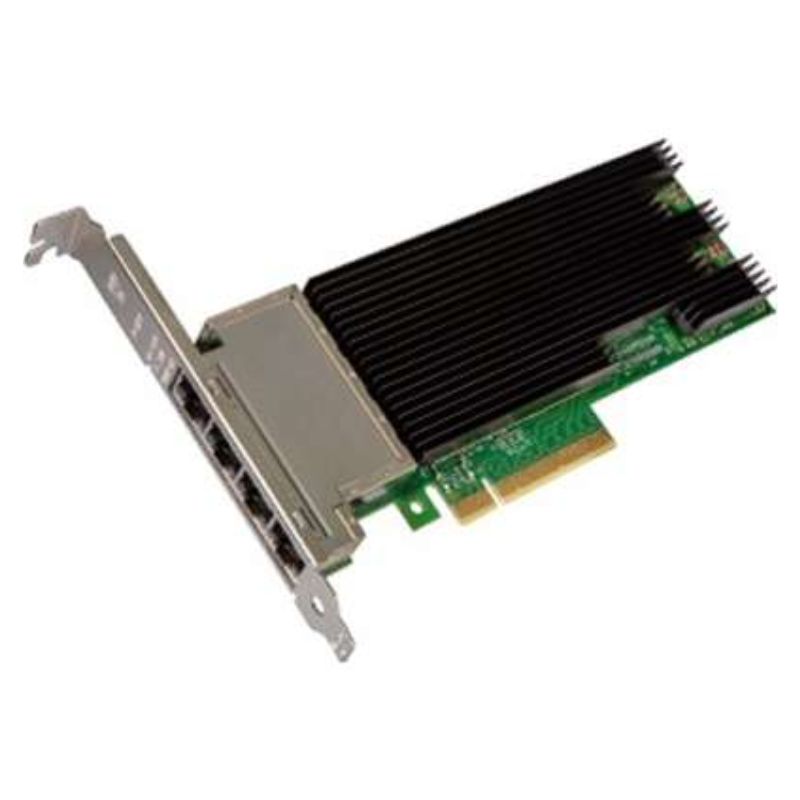
Intel X710-KR4 Qual-port Network Adapter Ethernet Server Blade Network Daughter Card. Excellent Refurbished with 1 year replacement warranty - Dell Version
Intel X710-KR4 Quad-Port Ethernet Network Daughter Card is engineered for advanced server connectivity, delivering robust throughput, efficient packet handling, and optimized virtualization support for modern data center environments. Built on a PCI Express 3.0 x8 interface, this adapter is designed to enhance communication efficiency across multi-port networking infrastructures, supporting high-density workloads, cloud computing platforms, and network function virtualization deployments. It integrates Intel’s advanced Ethernet controller technology to ensure stable, scalable, and responsive data transmission for enterprise-grade systems requiring consistent low-latency performance.
The Intel X710-KR4 Qual-Port Network Adapter Ethernet Server Blade Network Daughter Card represents a high-performance networking solution engineered for modern data center environments where throughput density, virtualization efficiency, and low latency communication are essential. Built on advanced Ethernet controller architecture, this adapter is designed to integrate seamlessly into blade server infrastructures, delivering multi-port connectivity and optimized data handling capabilities for enterprise-grade workloads.
This network daughter card is widely deployed in environments that require stable and scalable network communication between server blades and switching fabrics. Its architecture is aligned with next-generation cloud computing demands, supporting virtualization platforms, distributed computing frameworks, and high-volume transactional systems. The design emphasizes efficiency in packet processing, offload capabilities, and reliable multi-queue traffic handling to ensure balanced network performance under sustained load conditions.
The underlying architecture of the Intel X710-KR4 is built around a high-throughput Ethernet controller platform designed to reduce CPU overhead and enhance packet processing efficiency. By shifting intensive networking tasks from the main processor to dedicated hardware logic, the adapter improves overall system responsiveness and ensures consistent data flow across multiple virtual and physical interfaces.
The quad-port configuration provides multiple independent communication channels that allow simultaneous data streams. This is particularly beneficial in blade server environments where dense compute nodes require isolated yet high-speed network paths. Each port is engineered to maintain consistent bandwidth performance while supporting advanced traffic segmentation techniques used in modern virtualization deployments.
As a server blade network daughter card, the Intel X710-KR4 is designed for direct integration into blade chassis architectures. This integration model minimizes physical cabling complexity while maximizing internal bandwidth efficiency. The card connects directly to the server blade’s internal interconnect system, ensuring low-latency communication between compute modules and upstream network switches.
The compact form factor allows multiple blades to operate within a single enclosure without sacrificing network performance. This is particularly useful in large-scale data center deployments where space optimization and energy efficiency are key operational requirements.
The Intel X710-KR4 adapter is engineered to support high-speed Ethernet connectivity suitable for enterprise data center workloads. It is capable of handling large volumes of packet traffic with minimal latency, making it suitable for applications such as virtual machine migration, distributed storage systems, and real-time analytics processing.
Through intelligent load distribution across its multiple ports, the adapter ensures that network congestion is minimized even under peak traffic conditions. This multi-channel design enables consistent performance across both east-west and north-south data flows within modern cloud infrastructures.
One of the core strengths of this network adapter lies in its packet processing optimization capabilities. It incorporates hardware-level acceleration features that handle checksum offloading, segmentation tasks, and interrupt moderation. These enhancements reduce the processing burden on host CPUs, allowing server resources to be allocated more effectively to application workloads.
The efficient handling of small and large packet sizes ensures that the adapter performs reliably in mixed workload environments, where both transactional and bulk data transfers occur simultaneously.
The Intel X710-KR4 Qual-Port Network Adapter is well-suited for virtualized environments where multiple virtual machines share physical network resources. It supports advanced virtualization technologies that allow network traffic segmentation and isolation across different virtual instances.
This capability is essential for cloud service providers and enterprise data centers that operate multi-tenant infrastructures. Each virtual machine can be assigned dedicated network resources, ensuring predictable performance and secure traffic separation.
The adapter supports the creation of multiple virtual functions, allowing hypervisors to allocate network resources dynamically. This enables efficient scaling of virtual workloads without requiring additional physical network hardware. The result is improved infrastructure utilization and reduced operational complexity.
By distributing network processing tasks across virtual interfaces, the system achieves better workload balancing and minimizes bottlenecks during peak usage periods.
In modern data center environments, the Intel X710-KR4 plays a critical role in enabling scalable cloud computing architectures. Its multi-port design and advanced traffic handling capabilities make it suitable for large-scale server clusters that support distributed applications and cloud-native services.
The adapter is frequently used in environments that require high availability and redundancy. Its ability to maintain stable network connections under varying workloads ensures consistent service delivery across cloud platforms.
Distributed computing systems rely heavily on efficient network communication between nodes. The Intel X710-KR4 facilitates this communication by providing reliable high-speed data exchange pathways. This allows distributed applications to scale horizontally without experiencing network-related performance degradation.
As workloads increase, additional server blades equipped with this network adapter can be integrated into existing infrastructure with minimal configuration adjustments, ensuring seamless scalability.
The Intel X710-KR4 includes a range of offloading features that significantly enhance system efficiency. These features reduce the computational workload on host CPUs by delegating network processing tasks to dedicated hardware components within the adapter.
Tasks such as segmentation, checksum validation, and packet classification are handled at the hardware level, enabling faster data processing and reduced latency. This results in improved application performance, particularly in environments where real-time data processing is required.
By offloading repetitive network tasks, the adapter allows CPU resources to be redirected toward application-level processing. This is particularly beneficial in high-density server environments where CPU cycles are a critical resource. The reduction in CPU overhead leads to improved system efficiency and better overall workload distribution.
Reliability is a key consideration in enterprise networking environments, and the Intel X710-KR4 is designed with redundancy and failover capabilities in mind. The multi-port configuration allows for redundant network paths, ensuring continuous connectivity even in the event of a port or link failure.
This redundancy is essential in mission-critical applications where network downtime can result in significant operational disruptions. By maintaining multiple active communication channels, the adapter enhances system resilience and uptime reliability.
The adapter supports intelligent load balancing across its available ports, distributing network traffic evenly to prevent congestion. This ensures that no single port becomes a performance bottleneck, maintaining consistent throughput across the system.
Load balancing mechanisms also contribute to improved fault tolerance, as traffic can be rerouted dynamically in response to changing network conditions.
The Intel X710-KR4 Qual-Port Network Adapter is designed for compatibility with a wide range of blade server systems that support daughter card expansion modules. It integrates with standardized server architectures used in enterprise and hyperscale data centers, ensuring broad interoperability across hardware platforms.
Its design allows it to function effectively within modular server chassis where multiple compute nodes share centralized networking resources. This compatibility makes it a versatile choice for organizations deploying heterogeneous infrastructure environments.
Within modular server enclosures, the adapter connects directly to internal switching fabrics, eliminating the need for external cabling. This reduces physical infrastructure complexity and improves airflow management within server racks. The compact integration also contributes to improved energy efficiency by minimizing signal loss and transmission overhead.
High-density computing environments require network adapters capable of maintaining stable performance under heavy workload conditions. The Intel X710-KR4 is optimized for such scenarios, delivering consistent throughput even when multiple virtual machines and applications generate simultaneous network traffic.
Its architecture ensures that packet processing remains efficient regardless of workload intensity, making it suitable for enterprise applications such as database clusters, virtualization farms, and high-performance computing workloads.
Low latency is a critical requirement for modern data center applications. The adapter incorporates design features that minimize packet processing delays and optimize data transmission pathways. This results in faster response times for applications that depend on real-time data exchange.
Latency reduction is particularly important in financial systems, cloud-based analytics platforms, and distributed storage networks where timing precision directly impacts system performance.


 Contact Us
 Information
 Catalog
 Solid State Drives (SSD)
 Network Switches
 Hard Disk Drives
 HBA & Controllers
 PC & Servers
 PC & Server Memory
 CPU & Processors
 Network Routers
 Power Supplies
 Tape Drives & Libraries
 Network Devices
 Computer & Network Cables