
(7% discount is applied at checkout)
Cart is empty
Your go-to destination for cutting-edge server products
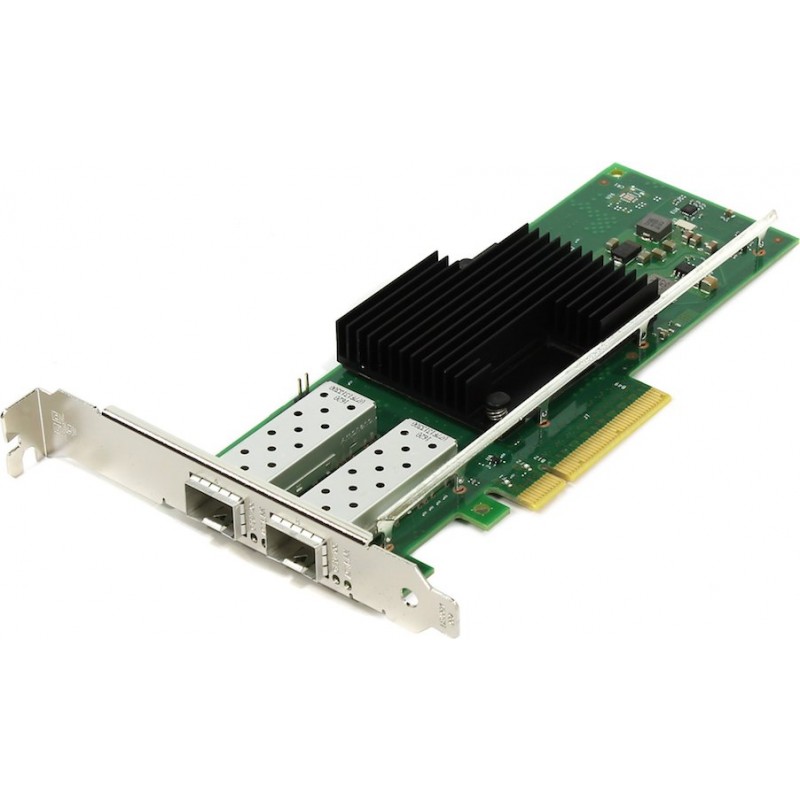
Intel X710DA2 Dual Port 10 Gigabit Ethernet SFP+ PCI-Express Converged Network Adapters. New Sealed in Box (NIB) with 1 Year Warranty - Dell Version
Ethernet adapter is engineered to deliver enterprise-grade connectivity for modern data centers, cloud infrastructures, and virtualization-heavy environments. Built on a PCI Express 3.0 x8 interface, this dual-port 10 Gigabit SFP+ network interface card ensures ultra-fast data throughput, low latency communication, and highly stable network performance under demanding workloads.
The Intel X710DA2 Dual Port 10 Gigabit Ethernet SFP+ PCI-Express Converged Network Adapter category represents a class of advanced, high-throughput networking hardware engineered to meet the evolving demands of enterprise data centers, cloud computing environments, virtualization platforms, and high-performance computing clusters. These adapters are designed around Intel’s Ethernet controller architecture, delivering reliable dual-port 10GbE connectivity through SFP+ optical interfaces and PCI-Express host integration. The category focuses on scalable bandwidth, low latency communication, and advanced offload capabilities that reduce CPU overhead and enhance system efficiency across demanding workloads.
In modern IT infrastructure, the need for rapid data transmission, efficient network virtualization, and resilient redundancy has never been greater. The Intel X710DA2 series fulfills these requirements by offering dual-port 10 Gigabit Ethernet connectivity, enabling simultaneous high-speed data transfer across multiple channels. This dual-port configuration enhances redundancy, load balancing, and traffic segmentation, making it a critical component in enterprise-grade deployments where uptime and performance consistency are essential.
At the core of the Intel X710DA2 adapter family is a PCI-Express interface designed to deliver maximum throughput between the network card and the host system. The PCIe architecture ensures a direct and high-speed communication pathway, reducing bottlenecks and enabling the full utilization of 10 Gigabit Ethernet bandwidth. These adapters typically leverage PCIe Gen3 lanes, allowing them to sustain high data transfer rates required for virtualization, storage networking, and distributed computing environments.
The PCIe design also contributes to improved scalability. By utilizing multiple lanes, the adapter can handle large volumes of simultaneous traffic without degradation in performance. This makes it suitable for environments where network traffic is highly dynamic and unpredictable, such as cloud service providers and enterprise virtualization clusters.
The Intel X710DA2 dual-port configuration relies on SFP+ (Small Form-factor Pluggable Plus) interfaces to provide flexible and high-performance optical or direct-attach copper connectivity. The SFP+ standard supports 10 Gigabit Ethernet transmission over short-range and long-range media, depending on the transceiver modules used. This flexibility allows organizations to tailor their network infrastructure based on distance requirements, cost considerations, and performance needs.
SFP+ connectivity also enables hot-swappable module replacement, which is essential for maintaining uptime in mission-critical systems. Network administrators can replace or upgrade transceivers without shutting down the system, ensuring continuous service availability and minimal disruption during maintenance operations.
One of the defining features of the Intel X710DA2 category is its strong support for network virtualization technologies. These adapters are optimized for environments utilizing VMware, Microsoft Hyper-V, KVM, and other virtualization platforms. Through technologies such as Single Root I/O Virtualization (SR-IOV), the adapter can partition a single physical network port into multiple virtual interfaces, allowing virtual machines to communicate directly with the network hardware.
This virtualization capability reduces latency, improves throughput, and minimizes CPU utilization. By bypassing traditional software-based networking stacks, SR-IOV enables near-native network performance for virtual workloads. This is particularly important in cloud data centers where hundreds or thousands of virtual machines operate concurrently on shared infrastructure.
Intel X710DA2 adapters incorporate a range of hardware offloading features that reduce the processing burden on the host CPU. These include TCP/IP checksum offload, Large Send Offload (LSO), and Receive Side Scaling (RSS). By delegating repetitive networking tasks to the hardware, system resources are freed for application-level processing, resulting in improved overall system efficiency.
Hardware acceleration also enhances packet processing performance in high-traffic environments. The adapter can efficiently handle packet segmentation, reassembly, and routing operations, ensuring smooth data flow even under heavy network loads. This makes the X710DA2 ideal for workloads such as big data analytics, financial computing, and real-time application delivery.
The dual-port 10 Gigabit Ethernet configuration of the Intel X710DA2 enables an aggregated bandwidth potential of up to 20Gbps when both ports are utilized simultaneously. This provides a significant performance advantage in environments requiring high-speed data replication, backup operations, and clustered computing communication.
Low latency is another critical feature of this adapter category. The optimized hardware design minimizes packet processing delays, enabling near real-time communication between network nodes. This is essential in latency-sensitive applications such as high-frequency trading platforms, real-time video processing, and distributed database synchronization.
The dual-port design also enables advanced load balancing and failover mechanisms. Network traffic can be distributed evenly across both ports to maximize utilization and prevent congestion. In the event of a port failure, traffic can automatically reroute to the remaining active port, ensuring uninterrupted network connectivity.
This redundancy feature is crucial for enterprise environments that require continuous uptime and high availability. By implementing adapter-level failover, organizations can reduce the risk of network downtime and maintain consistent service delivery even during hardware failures or maintenance events.
In enterprise data centers, Intel X710DA2 adapters serve as a foundational component for high-speed server connectivity. They enable efficient communication between servers, storage arrays, and networking equipment, ensuring smooth data flow across the infrastructure. Their ability to handle large volumes of traffic makes them ideal for virtualization clusters, database servers, and application hosting environments.
Cloud service providers rely heavily on scalable and efficient networking solutions. The Intel X710DA2 category supports cloud architectures by providing flexible bandwidth allocation, virtualization support, and multi-tenant isolation capabilities. These features allow cloud platforms to deliver consistent performance across diverse workloads while maintaining secure and isolated network segments for different users.
High-performance computing (HPC) environments demand extremely low latency and high throughput networking solutions. The Intel X710DA2 dual-port adapters provide the necessary bandwidth and processing efficiency to support parallel computing workloads, scientific simulations, and large-scale data analysis. Their ability to maintain stable high-speed communication between compute nodes enhances cluster performance significantly.
Storage environments benefit greatly from 10 Gigabit Ethernet connectivity. The Intel X710DA2 adapter category enables rapid data transfer between storage systems, backup servers, and replication nodes. This ensures that data integrity is maintained while minimizing backup windows and replication delays. In modern SAN and NAS architectures, these adapters play a critical role in maintaining data availability and consistency.
The Intel X710 controller architecture is designed for efficient packet processing and intelligent traffic management. It incorporates multiple hardware engines that handle networking tasks independently from the main CPU. This design reduces overhead and improves system responsiveness under heavy network loads.
Energy efficiency is a key consideration in modern data center hardware. The Intel X710DA2 adapters are engineered to deliver high performance while maintaining optimized power consumption levels. Advanced power management features allow the adapter to dynamically adjust power usage based on network activity, reducing operational costs and thermal output.
Thermal efficiency is also enhanced through optimized component layout and heat dissipation design. This ensures stable performance even in densely packed server environments where airflow may be limited.
The Intel X710DA2 dual-port adapters are compatible with a wide range of server platforms, operating systems, and virtualization environments. They support major enterprise operating systems and are commonly integrated into rack-mounted servers, blade servers, and custom-built compute systems.
Their broad compatibility ensures that organizations can deploy them across heterogeneous infrastructure without requiring extensive reconfiguration or specialized driver support. This simplifies deployment and reduces operational complexity.
Scalability is a defining feature of the Intel X710DA2 category. As network demands grow, additional adapters can be deployed to increase bandwidth capacity and redundancy. This modular scalability allows organizations to expand their infrastructure incrementally without redesigning the entire network architecture.
Advanced traffic segmentation capabilities enable administrators to isolate workloads, prioritize traffic types, and manage bandwidth allocation effectively. This ensures that critical applications receive the necessary network resources while maintaining overall system balance.
By optimizing packet handling and reducing CPU intervention, the Intel X710DA2 adapters improve overall data flow efficiency. This results in smoother application performance, reduced latency, and improved user experience across network-dependent services.
Reliability is a core requirement in enterprise networking environments. The Intel X710DA2 series is designed to operate continuously under heavy workloads without performance degradation. Its robust hardware design ensures long-term stability in mission-critical applications.
Built-in error correction and packet validation mechanisms ensure that data integrity is maintained throughout transmission. These features reduce the likelihood of packet loss and enhance overall network reliability, particularly in high-density traffic environments.


 Contact Us
 Information
 Catalog
 Solid State Drives (SSD)
 Network Switches
 Hard Disk Drives
 HBA & Controllers
 PC & Servers
 PC & Server Memory
 CPU & Processors
 Network Routers
 Power Supplies
 Tape Drives & Libraries
 Network Devices
 Computer & Network Cables