(7% discount is applied at checkout)
Cart is empty
Your go-to destination for cutting-edge server products
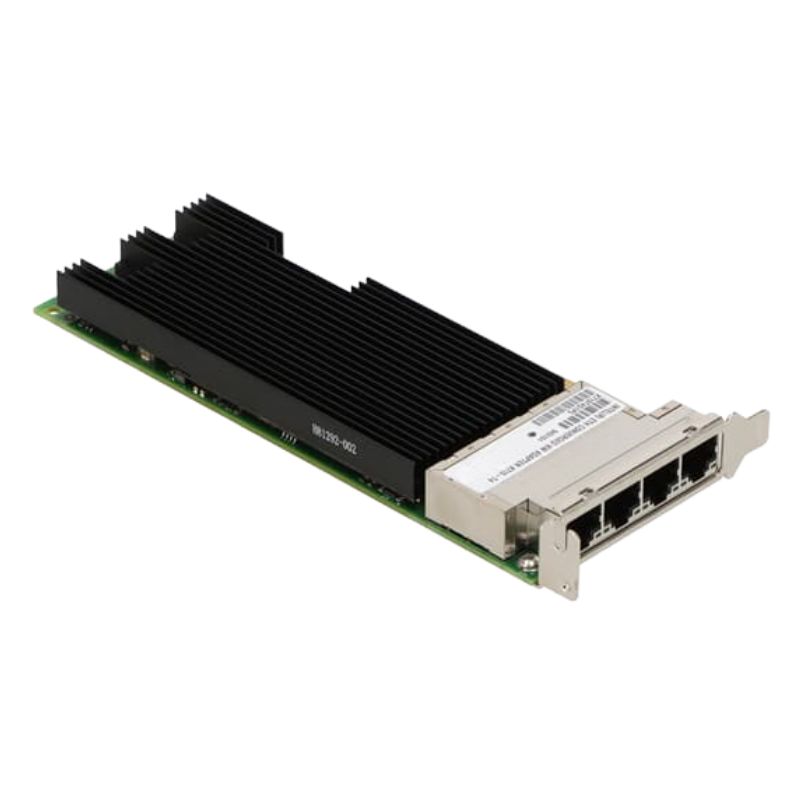


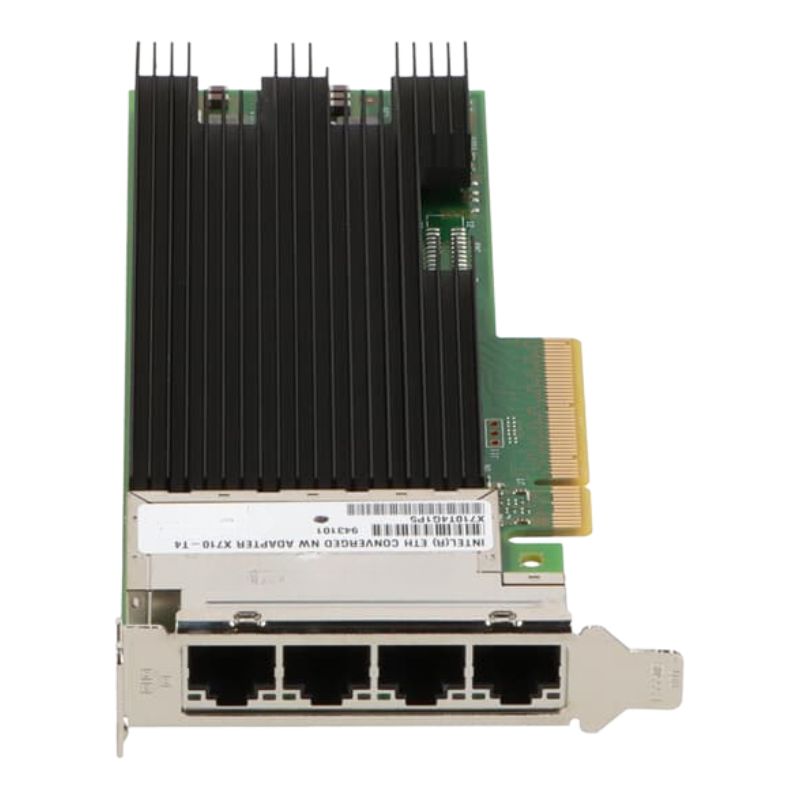
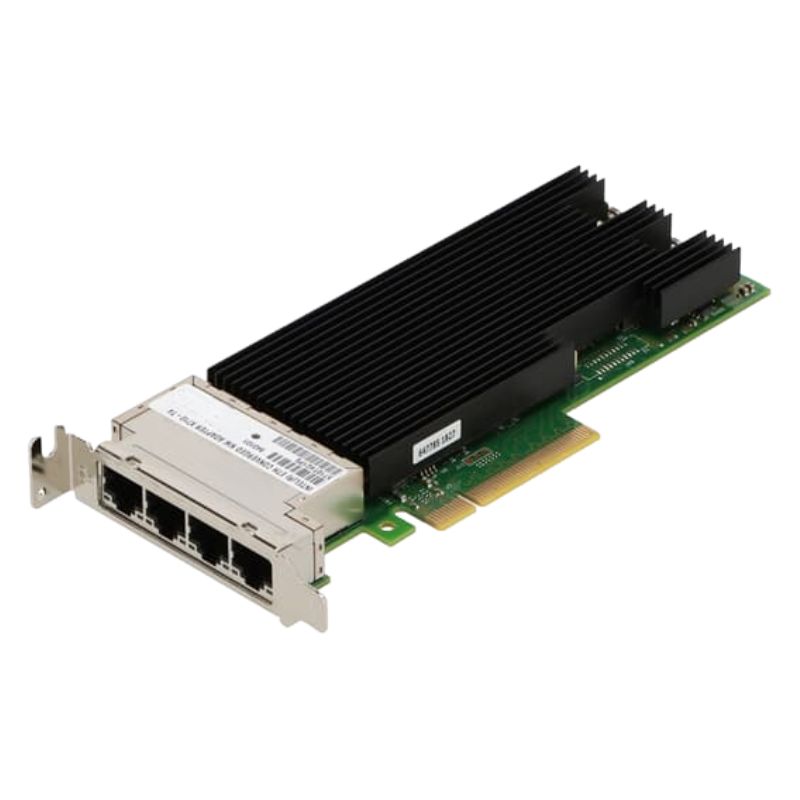
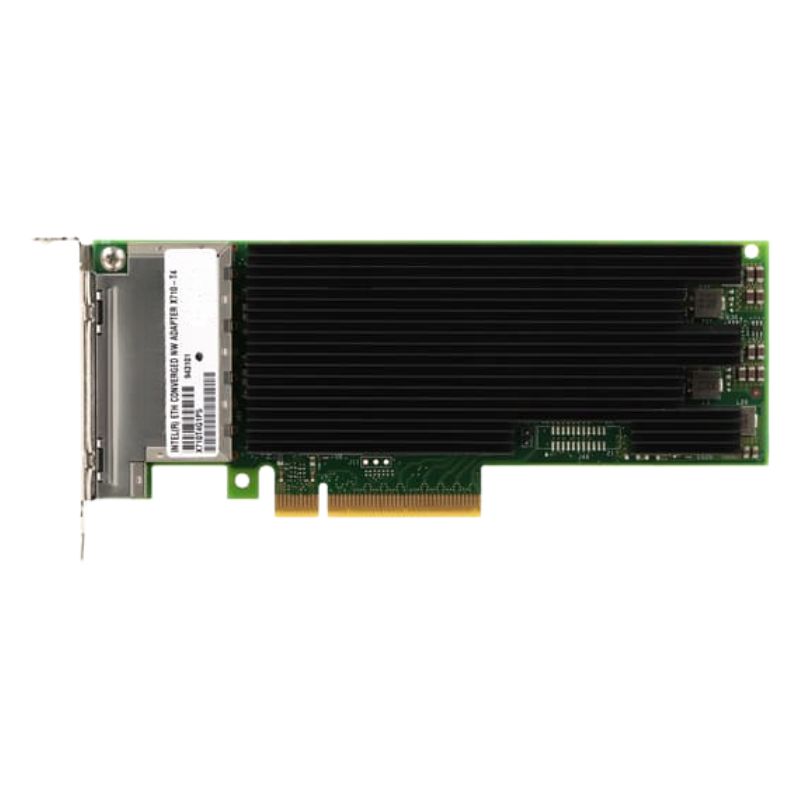
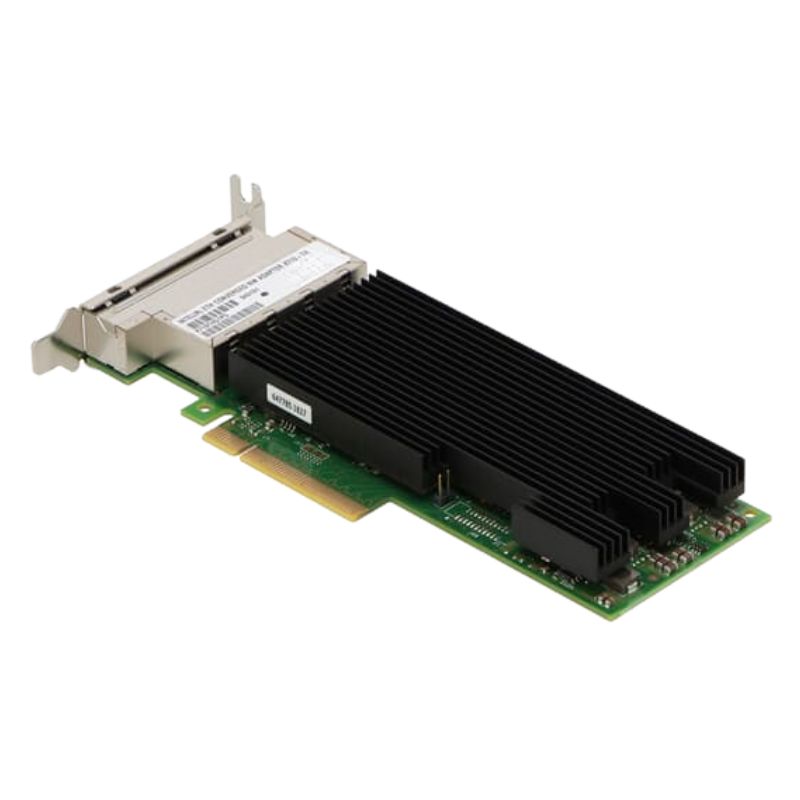
Intel X710T4BLK Low Profile PCI-Express Converged Network Adapter with 4 Ports of 10 Gigabit Ethernet. New Sealed in Box (NIB) with 3 Years Warranty
The Intel X710T4BLK low-profile PCI Express converged network adapter is engineered to deliver advanced networking performance through four independent 10 Gigabit Ethernet ports. Designed for modern data-intensive environments, this adapter provides a powerful balance of speed, efficiency, and virtualization capabilities. It is optimized for enterprise servers, cloud infrastructures, and high-throughput workloads where stable and scalable connectivity is essential.
The Intel X710-T4BLK Low Profile PCI Express Converged Network Adapter is engineered for high performance, density-focused server environments requiring reliable multi-port 10 Gigabit Ethernet connectivity over copper infrastructure. Designed around the Intel Ethernet controller architecture, this adapter integrates four independent 10GBASE-T ports, enabling aggregated throughput, redundant networking paths, and advanced virtualization support within enterprise and data center systems. Its low profile bracket design ensures compatibility with compact server chassis while maintaining full bandwidth capabilities across all ports simultaneously.
Built to operate over standard twisted pair copper cabling, this adapter provides a practical solution for organizations transitioning from Gigabit Ethernet environments to 10 Gigabit infrastructures without requiring fiber optic transceivers. The converged design supports both traditional networking workloads and modern virtualized environments, making it suitable for compute clusters, storage networks, virtualization hosts, and high density rack deployments.
The four-port configuration of the Intel X710-T4BLK enables significant network consolidation by reducing the number of physical adapters required per server. Each port supports independent 10 Gigabit Ethernet operation, allowing separation of traffic types such as storage, management, virtual machine data, and backup streams. This segmentation enhances performance stability while reducing congestion across shared infrastructure layers.
The 10GBASE-T interface supports auto negotiation with lower speeds, ensuring backward compatibility with 1 Gigabit and 100 Megabit Ethernet networks. This flexibility simplifies integration into mixed infrastructure environments, where gradual upgrades are often required. With support for long-distance copper cabling, deployment becomes more cost effective compared to fiber-based equivalents in many enterprise scenarios.
The adapter utilizes a PCI Express interface designed to maximize throughput efficiency between the host system and network layer. Operating over a high bandwidth PCIe lane configuration, it ensures that all four 10 Gigabit ports can function concurrently without internal bottlenecks. This is essential for environments where sustained throughput is required, such as virtualization clusters and database replication systems.
The architecture is optimized for parallel packet processing, reducing latency and improving packet handling efficiency under heavy network load. This makes the adapter suitable for environments with high transaction rates, real-time analytics workloads, and distributed computing systems where network performance directly impacts application responsiveness.
The Intel X710-T4BLK is designed with virtualization environments in mind, supporting advanced offload technologies that reduce CPU overhead and improve virtual machine density per host. Features such as Single Root Input Output Virtualization enable physical port partitioning into multiple virtual interfaces, allowing isolated network channels for each virtual machine instance.
Virtual machine device queues improve packet distribution efficiency by balancing network processing across multiple CPU cores. This reduces bottlenecks and ensures predictable network performance in environments running hypervisors and container platforms. As a result, system administrators can achieve higher consolidation ratios while maintaining consistent network responsiveness.
Hardware-based offloading plays a central role in the performance profile of the Intel X710-T4BLK adapter. By shifting tasks such as checksum calculation, segmentation, and packet classification away from the CPU, system resources are preserved for application-level workloads. This enhances overall system efficiency, particularly in high throughput environments.
The adapter also supports advanced packet filtering and classification functions, enabling precise traffic control at the hardware level. This ensures that network policies are enforced efficiently without requiring excessive software intervention, which is critical in environments with strict latency and performance requirements.
In storage-intensive environments, the Intel X710-T4BLK provides reliable connectivity for iSCSI-based storage networks. The ability to dedicate specific ports to storage traffic allows for predictable performance in data replication, backup operations, and distributed file systems. This separation reduces contention between application and storage traffic, improving overall system stability.
The adapter is also suitable for environments utilizing converged networking architectures where compute and storage traffic share the same physical infrastructure. Its multi-port design enables segmentation of storage traffic across multiple channels, supporting scalable storage deployments in enterprise data centers.
Reliability is a key aspect of the Intel X710-T4BLK design. The four independent ports can be configured for redundancy, ensuring continuous network availability in the event of link or port failure. This is particularly important in mission critical systems where downtime can have significant operational impact.
Load balancing across multiple ports allows traffic distribution that prevents congestion and improves resilience under peak workloads. Combined with link aggregation technologies, the adapter supports scalable bandwidth expansion while maintaining fault tolerance across network paths.
The use of 10GBASE-T technology enables deployment over existing copper cabling infrastructure, reducing the need for extensive rewiring when upgrading from Gigabit Ethernet systems. This lowers total deployment cost and simplifies migration strategies in enterprise environments.
Copper-based 10 Gigabit connectivity also provides flexibility in rack design and cable management, allowing easier installation in dense server environments. The support for standard Ethernet cabling ensures compatibility with widely deployed networking equipment and simplifies maintenance operations.
The Intel X710-T4BLK is widely applicable in modern data center environments where high bandwidth and low latency networking are essential. It supports distributed computing architectures, cloud infrastructure nodes, and high performance application clusters. Its multi-port configuration allows administrators to segment traffic efficiently across different operational layers.
In enterprise environments, the adapter is frequently deployed in application servers, virtualization hosts, and database systems requiring consistent and predictable network throughput. Its compatibility with advanced network management tools ensures integration into existing monitoring and orchestration frameworks.
Scalability is a defining characteristic of the Intel X710-T4BLK architecture. Its multi-port design allows incremental scaling of network capacity without requiring additional server expansion slots. This makes it an efficient choice for growing infrastructures where network demand increases over time.
The adapter supports modular network design principles, enabling administrators to build layered networking architectures that can expand horizontally across multiple server nodes. This flexibility is essential in modern distributed computing environments where scalability and adaptability are key requirements.
High availability systems depend on redundant network paths and resilient hardware components. The Intel X710-T4BLK supports these requirements through multi-port redundancy and failover capabilities that maintain connectivity even under hardware or link failures. This ensures continuous service availability in critical infrastructure environments.
Integration with clustering and load balancing systems further enhances reliability, enabling seamless workload migration and failover between nodes without interrupting network connectivity. This is essential for enterprise systems requiring uninterrupted service delivery.
The adapter can be deployed across multiple networking layers, including access, aggregation, and core server connectivity. Its flexibility allows it to serve both as a primary network interface and as a dedicated high throughput channel for specialized workloads such as storage replication or analytics processing.
This versatility makes it suitable for a wide range of deployment scenarios, from small enterprise server rooms to large scale hyperscale data centers requiring consistent and scalable network performance across thousands of compute nodes.


 Contact Us
 Information
 Catalog
 Solid State Drives (SSD)
 Network Switches
 Hard Disk Drives
 HBA & Controllers
 PC & Servers
 PC & Server Memory
 CPU & Processors
 Network Routers
 Power Supplies
 Tape Drives & Libraries
 Network Devices
 Computer & Network Cables