
(7% discount is applied at checkout)
Cart is empty
Your go-to destination for cutting-edge server products
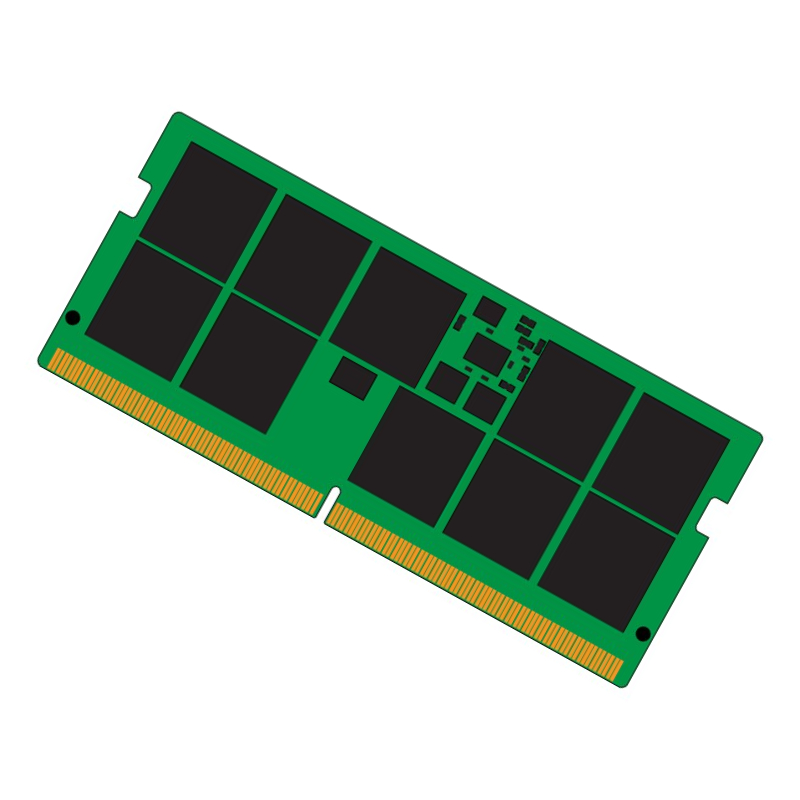
Kingston KSM56T46BD8KM-48HM 48GB DDR5 SODIMM Memory Module with 5600MT/S Speed. Factory-Sealed New in Original Box (FSB) with 3-Years Warranty
As a 48GB DDR5 SODIMM module operating at a swift 5600MT/s, this memory component is engineered for professionals and power users who demand exceptional bandwidth, capacity, and efficiency from their laptops, mini-PCs, high-end notebooks, and mobile workstations.
The landscape of portable and compact computing has been fundamentally reshaped by the advent of DDR5 SODIMM memory. This category represents the pinnacle of high-performance, power-efficient memory for laptops, high-end notebooks, compact desktops, and specialized systems like small form factor (SFF) PCs and industrial embedded solutions. As a successor to DDR4, DDR5 SODIMM introduces a revolutionary architecture that dramatically increases bandwidth, improves power management, and enhances reliability, enabling a new tier of responsiveness and capability in mobile workstations, gaming laptops, and content creation machines. Modules like the Kingston KSM56T46BD8KM-48HM exemplify this leap forward, packing advanced features into the compact 260-pin SODIMM form factor.
The transition to DDR5 is not merely an incremental speed bump; it is a comprehensive redesign of memory subsystem architecture. For SODIMM modules, this brings desktop-grade performance to mobile platforms.
Unlike DDR4's single 64-bit channel, each DDR5 SODIMM incorporates two independent 32-bit sub-channels. This architectural shift effectively doubles the memory controller's ability to access data concurrently, reducing latency and improving overall efficiency for multi-threaded applications. Coupled with an increased Burst Length of 16 (BL16), DDR5 can transfer larger chunks of data per column access command. This is particularly beneficial for data-intensive tasks such as video editing, scientific computing, and modern gaming, where larger asset files are the norm.
A cornerstone of DDR5 reliability is On-Die ECC. This feature involves an integrated error correction circuit within the DRAM chips themselves. It continuously monitors and corrects bit errors that may occur within the chip's array before data is sent to the memory controller. While not a replacement for full module-level ECC used in servers, On-Die ECC significantly improves data integrity and signal stability, which is critical for maintaining high data rates and system reliability over the long term, especially in thermally constrained laptop environments.
DDR5 SODIMM modules relocate the power management from the motherboard to the module itself via an integrated PMIC. This allows for more precise voltage regulation and cleaner power delivery to the DRAM chips. The benefits are multifold: improved signal integrity for stable overclocking, better power efficiency, and reduced noise. For system integrators and laptop manufacturers, this also simplifies motherboard design. The PMIC is a key enabler for achieving and sustaining the high data rates of modules like the 5600MT/s Kingston unit.
This specific module serves as a flagship example within the high-capacity DDR5 SODIMM category. Its part number encodes its key characteristics, which we will elaborate on in detail.
The 48GB capacity is a notable configuration in the DDR5 era. It is achieved by utilizing high-density DRAM chips. This capacity sits strategically between the more common 32GB and 64GB offerings, providing an optimal balance for power users who find 32GB limiting but may not require the full investment of a 64GB kit. It is ideal for running multiple virtual machines, ultra-high-resolution photo editing, complex 3D modeling, and keeping dozens of browser tabs and applications open simultaneously without any swap to storage.
The Small Outline Dual In-Line Memory Module (SODIMM) form factor is the standard for space-constrained devices like laptops, Intel NUCs, and small form factor (SFF) PCs. The Kingston KSM56T46BD8KM-48HM adheres to the 260-pin DDR5 SODIMM specification, ensuring mechanical compatibility with a wide range of modern portable computers released from 2022 onward. Its compact size is a direct enabler of high-performance computing in mobile form factors.
DDR5 technology operates at a lower voltage than its DDR4 predecessor. The KSM56T46BD8KM-48HM typically runs at 1.1V, contributing to improved power efficiency and reduced heat generation. This is paramount in laptops, where thermal headroom and battery life are constant engineering challenges. The module also features enhanced power management, with the Power Management Integrated Circuit (PMIC) moving from the motherboard to the memory module itself. This onboard PMIC allows for more stable power delivery, cleaner signals, and better overclocking potential, resulting in a more robust and consistent performance profile.
The 5600 Megatransfers per second (MT/s) data rate is a key performance indicator. This high speed translates directly into faster data movement between the memory and the processor (CPU). For users, this means reduced load times for massive files, smoother real-time previews in editing suites, and a more responsive system when multitasking across heavyweight applications. The inherent bandwidth advantage of DDR5 is further amplified by this speed grade, ensuring that even the latest Intel and AMD mobile processors are fully fed with data, minimizing idle cycles and maximizing computational throughput.
Professionals in fields such as 8K video editing in DaVinci Resolve or Adobe Premiere, architectural visualization using Lumion or V-Ray, and data scientists working with large local datasets will find the 48GB capacity immensely beneficial. It allows for larger project files to reside entirely in RAM, drastically reducing render and processing times. For high-end gaming laptops, 48GB provides ample headroom for the game itself, background streaming software, communication apps, and future, more demanding titles.
The 5600MT/s speed rating denotes the number of data transfer operations the module can perform per second on each data pin. In practical terms, this translates to a peak theoretical bandwidth of 44.8 GB/s per module (5600 MT/s * 8 bytes per transfer * 1 channel). This massive bandwidth is crucial for feeding data-hungry CPUs and GPUs in modern laptops, preventing bottlenecks that can stall performance in CPU-bound games and creative applications. It represents a significant boost over standard DDR4-3200 (25.6 GB/s) and even entry-level DDR5-4800.
For systems with integrated graphics (like AMD Ryzen 7000/8000 series or Intel Iris Xe), memory bandwidth is the sole determinant of graphics memory bandwidth. A 5600MT/s module like this directly translates to higher frame rates and smoother performance in light gaming and GPU-accelerated tasks. For discrete GPU systems, the high-speed memory ensures the CPU can prepare frames, physics, and AI data quickly enough to keep the dedicated graphics card fully utilized.
The part number indicates a specific configuration of DRAM chips. The "46BD8" segment typically refers to the organization of the memory components. This 48GB module likely utilizes 16-gigabit (Gb) DRAM chips in a dual-rank configuration on a single module. Dual-rank modules offer a performance advantage over single-rank by allowing the memory controller to interleave accesses between the two ranks, improving efficiency and often resulting in slightly higher real-world bandwidth compared to a single-rank module of the same speed.
While the primary specification emphasizes speed, timings are equally important. The Kingston KSM56T46BD8KM-48HM operates at industry-standard timings for its speed grade. A key timing is CAS Latency (CL), which is the number of clock cycles between a read command and the moment data is available. DDR5 generally has higher numerical CL values than DDR4 (e.g., CL46 vs. CL22) due to its vastly higher clock speeds, but the actual time in nanoseconds (ns) is often similar or lower. The effective latency in nanoseconds is calculated as (CL / Clock Speed in MHz) * 2000. For a 5600MT/s module at CL46, the first-word latency is approximately 16.4 nanoseconds, delivering a strong balance of high bandwidth and responsive access.
For maximum performance, memory should be installed in matching pairs to enable dual-channel mode. This doubles the available bandwidth by allowing the memory controller to access two modules simultaneously. When installing a single 48GB module like the KSM56T46BD8KM-48HM, the system will operate in more flexible (but potentially slightly less bandwidth-optimized) single-channel mode. For a performance-critical system, purchasing two identical 48GB modules to achieve a 96GB dual-channel configuration is recommended where supported by the platform.
This Kingston module supports Intel's Extreme Memory Profile (XMP) 3.0 technology. XMP is a pre-programmed profile stored on the module that contains optimized settings for speed, timings, and voltage. When enabled in the system BIOS, it allows the module to automatically run at its rated 5600MT/s speed, rather than defaulting to a standard JEDEC baseline speed (often 4800MT/s for DDR5). Many modern gaming laptops and mobile workstations offer BIOS options to enable XMP for a straightforward performance boost. AMD's equivalent technology is EXPO (Extended Profiles for Overclocking), and modules are often cross-compatible.
While DDR5 SODIMMs incorporate advanced power management, high-speed operation can generate heat. This module features a low-profile heat spreader, often a foil label or a thin aluminum layer, designed to dissipate heat passively. In the confined space of a laptop, this is typically sufficient when combined with the system's own cooling airflow. Ensuring that the laptop's ventilation paths are clear and the cooling system is functioning properly is key to maintaining consistent memory performance over long, intensive workloads.


 Contact Us
 Information
 Catalog
 Solid State Drives (SSD)
 Network Switches
 Hard Disk Drives
 HBA & Controllers
 PC & Servers
 PC & Server Memory
 CPU & Processors
 Network Routers
 Power Supplies
 Tape Drives & Libraries
 Network Devices
 Computer & Network Cables