
(7% discount is applied at checkout)
Cart is empty
Your go-to destination for cutting-edge server products
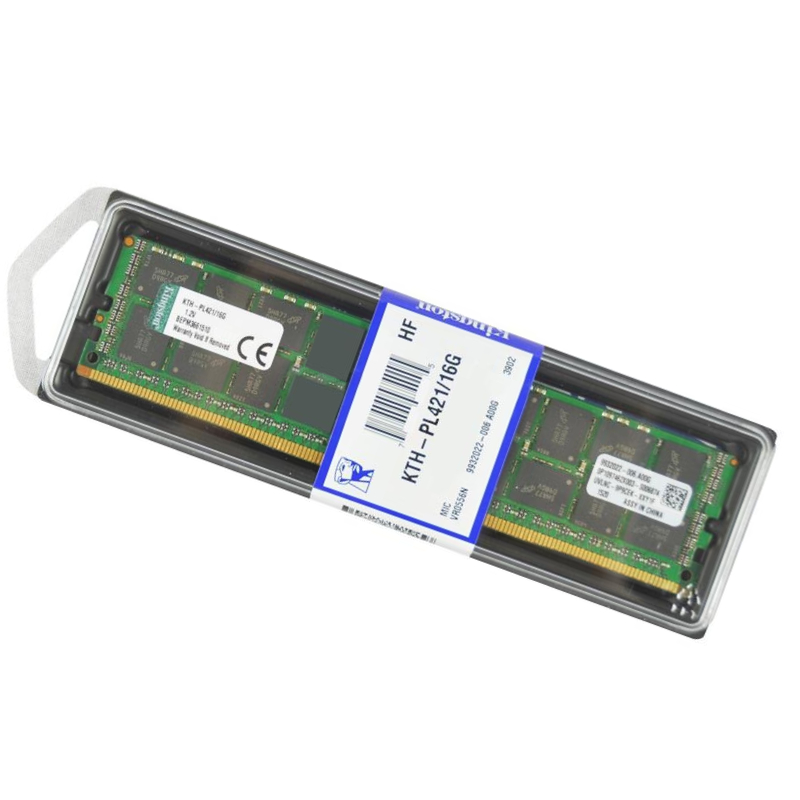
Kingston KTH-PL421/16G 16GB RAM PC4-17000 2133mhz DDR4 SDRAM Ecc Reg. New (System) Pull with 1 year replacement warranty
The Kingston KTH-PL421/16G is a reliable and high-performance 16GB DDR4 SDRAM memory module designed specifically for enterprise servers and professional workstations. Built to meet strict industry standards, this RAM module ensures stability, data integrity, and smooth multitasking for demanding workloads. This Kingston server-grade memory module delivers dependable performance for HP ProLiant Gen9 servers and HPE workstations. With ECC error correction and registered signal processing, it minimizes system crashes and protects critical data.
The Kingston KTH-PL421/16G memory module is tested and certified for seamless compatibility with a wide range of HPE servers and workstations.
The category of enterprise-grade DDR4 ECC Registered (RDIMM) server memory represents a critical foundation for modern data centers, professional workstations, and mission-critical computing environments. Products within this category, including the Kingston KTH-PL421/16G 16GB RAM PC4-17000 2133MHz DDR4 SDRAM ECC Registered module, are engineered specifically to deliver stability, reliability, and predictable performance under continuous heavy workloads. Unlike consumer desktop memory, ECC Registered DDR4 RAM is designed for systems where uptime, data accuracy, and long-term durability are more important than raw gaming performance or overclocking potential.
This category focuses on memory modules that support error detection and correction, registered buffering for improved signal integrity, and compatibility with server-grade chipsets and CPUs. Such RAM is commonly deployed in enterprise servers, virtualization hosts, database servers, cloud infrastructure, and professional IT environments where even a single memory error could result in data corruption, system crashes, or costly downtime.
DDR4 ECC Registered memory modules are built using advanced memory architecture that enhances both electrical stability and data integrity. ECC, or Error-Correcting Code, allows the memory to automatically detect and correct single-bit memory errors, significantly reducing the risk of silent data corruption. Registered memory, also known as buffered memory, introduces a register between the memory controller and the DRAM chips, which reduces electrical load and enables the system to support higher memory capacities more reliably.
Registered DDR4 memory modules include a register chip that buffers command and address signals before they reach the memory chips. This buffering reduces the electrical stress on the memory controller, allowing servers to populate more memory modules per channel without stability issues. As a result, systems using RDIMM modules can achieve higher total memory capacities compared to unbuffered DIMMs.
This category of memory is especially suited for multi-CPU servers and high-density memory configurations, where signal integrity becomes a major concern. The presence of the register slightly increases memory latency, but the trade-off is vastly improved stability and scalability.
The PC4-17000 designation refers to the theoretical maximum bandwidth of the DDR4 memory module, approximately 17 GB/s per module. Operating at 2133MHz, this performance class was one of the foundational DDR4 speed standards widely adopted by enterprise platforms during the early DDR4 generation. Despite the availability of higher-frequency DDR4 modules today, 2133MHz memory remains highly relevant for compatibility with a wide range of server platforms.
The 16GB capacity tier occupies an important position within the enterprise memory category. It provides a practical balance between cost, density, and scalability, making it suitable for both entry-level and mid-range servers. In multi-slot server architectures, 16GB RDIMM modules allow for flexible memory configurations, enabling systems to scale from modest deployments to high-capacity setups without replacing existing modules.
Within this category, 16GB DDR4 ECC Registered modules are commonly used to populate servers incrementally. Organizations can start with a smaller memory footprint and expand as workloads increase. This approach is particularly valuable for virtualization environments, where memory demands grow as additional virtual machines are deployed.
Server memory categories adhere to stricter quality and validation standards than consumer RAM. Modules like those in the Kingston KTH-PL421/16G category are manufactured using high-quality DRAM chips and undergo extensive testing to ensure consistent performance over extended operating periods. This level of quality control is essential for systems that operate 24/7 under constant load.
DDR4 technology introduced improved power efficiency compared to DDR3, operating at lower voltages while delivering higher densities. Within this category, ECC Registered DDR4 modules are optimized for thermal stability, ensuring reliable operation even in densely packed server chassis with limited airflow.
The ECC Registered DDR4 memory category addresses a wide array of enterprise and professional use cases. These applications demand reliability, scalability, and predictable performance rather than experimental overclocking or aesthetic enhancements.
Virtualization platforms rely heavily on system memory to host multiple virtual machines simultaneously. ECC Registered memory ensures that each virtual environment operates without data corruption, while registered buffering allows servers to scale memory capacity efficiently. This makes the category ideal for private cloud deployments and enterprise virtualization hosts.
Databases are highly sensitive to memory errors. Even minor data corruption can have serious consequences. The ECC protection offered by this category ensures data accuracy, making it well-suited for relational databases, in-memory databases, and transaction processing systems.
ECC functionality ensures that memory errors are corrected automatically, significantly reducing the risk of silent data corruption. This feature alone differentiates the category from standard desktop RAM and justifies its use in mission-critical systems.
Registered buffering enables servers to support more memory modules per channel, allowing for higher total system memory. This scalability is essential for modern applications that demand large memory footprints.


 Contact Us
 Information
 Catalog
 Solid State Drives (SSD)
 Network Switches
 Hard Disk Drives
 HBA & Controllers
 PC & Servers
 PC & Server Memory
 CPU & Processors
 Network Routers
 Power Supplies
 Tape Drives & Libraries
 Network Devices
 Computer & Network Cables