
(7% discount is applied at checkout)
Cart is empty
Your go-to destination for cutting-edge server products
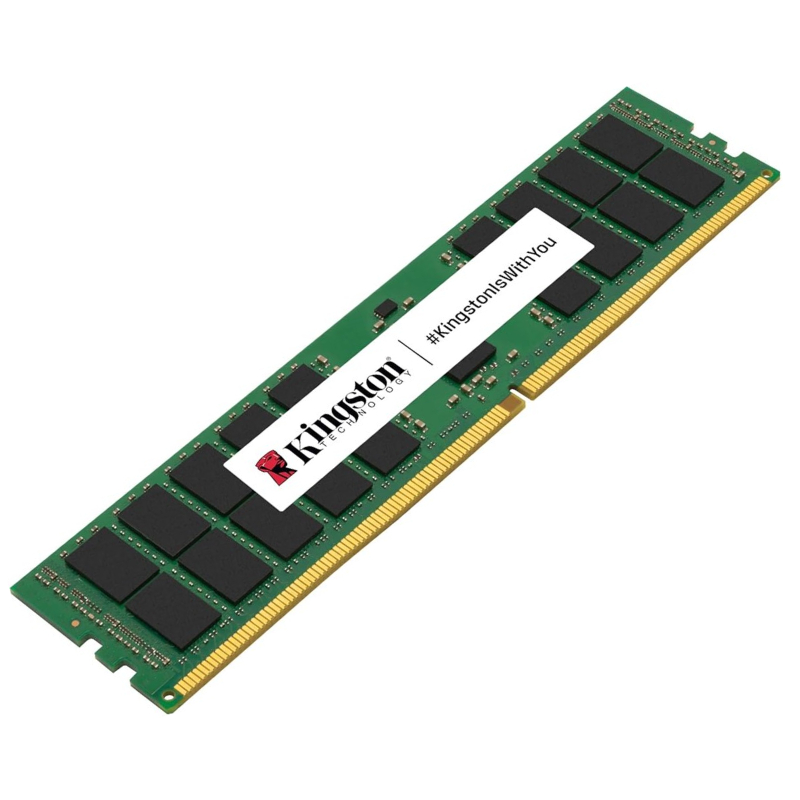
Kingston KSM56R46BD4-64HA 64GB DDR5-5600MHz PC5-44800 ECC Registered RDIMM CL46 2Rx4 1.1V 288-Pin Memory Module. Factory-Sealed New in Original Box (FSB) with 3 Years Warranty
The Kingston KSM56R46BD4-64HA is a high-performance 64 GB DDR5 memory module designed for demanding server, motherboard, and computer applications. Operating at 5600 MT/s with DDR5-5600/PC5-44800 standards, this module offers exceptional speed and reliability. With its ECC (Error Correcting Code) feature and registered signal processing, it ensures stability in enterprise-level environments.
The Kingston KSM56R46BD4-64HA represents a pivotal advancement in server memory technology, engineered to deliver uncompromising performance, reliability, and data integrity for mission-critical enterprise systems, data centers, and high-performance computing (HPC) environments. As a 64GB DDR5-5600MHz Registered ECC RDIMM, this module is meticulously designed to meet the rigorous demands of modern server platforms, providing the foundational memory bandwidth and capacity required for virtualization, in-memory databases, AI/ML workloads, and large-scale cloud infrastructure.
At the heart of this module lies the latest DDR5 architecture, which introduces a paradigm shift over previous DDR4 generations. The Kingston KSM56R46BD4-64HA is built to leverage these innovations, offering a substantial leap in performance and efficiency for server deployments.
The transition to DDR5 brings several key architectural improvements. Unlike DDR4, DDR5 features a dual sub-channel design within each module, allowing for more efficient data transfer and reduced latency for concurrent operations. The onboard Power Management IC (PMIC) redistributes power regulation from the motherboard to the memory module itself, enabling more stable voltage delivery, improved signal integrity, and enhanced power efficiency—a critical factor in dense server configurations where power and cooling budgets are paramount.
Operating at a data rate of 5600 Megatransfers per second (MT/s) and adhering to the PC5-44800 classification, this module provides a peak theoretical bandwidth of approximately 44.8 GB/s per module. When deployed in multi-channel server architectures (typically 8 or 12 channels), this aggregates to massive system-level bandwidth, effectively eliminating data bottlenecks for CPU-intensive applications and allowing processors to maintain optimal utilization.
The 64GB capacity is achieved using high-density components in a 2 Rank by 4 (2Rx4) organization. This configuration balances performance and loading on the memory controller, allowing for efficient rank interleaving and effective population of memory channels in multi-socket servers. The 64GB density is the current sweet spot for maximizing total system memory in standard server platforms, enabling configurations reaching 2TB or more per server.
For enterprise and data center applications, data integrity and system uptime are non-negotiable. The Kingston KSM56R46BD4-64HA incorporates two complementary technologies to ensure flawless operation: Error-Correcting Code (ECC) and Registering (Registered RDIMM).
ECC is an essential feature for any server memory. It goes beyond simple parity checking by detecting and correcting the most common types of data corruption—single-bit errors—in real-time, without any performance penalty. It can also detect (though not correct) multi-bit errors. This proactive correction prevents silent data corruption, application crashes, and system downtime, which is vital for financial transactions, scientific computations, and database integrity.
In addition to standard ECC, DDR5 introduces On-Die ECC (ODECC). This feature works within the DRAM chips themselves to correct minor internal errors before data is sent to the system-level ECC. This two-tiered approach—ODECC handling internal chip errors and the module's ECC handling bus and system errors—dramatically improves the overall reliability and longevity of the memory subsystem.
The "Registered" designation indicates the presence of a register (or buffer) on the module, situated between the memory controller and the DRAM chips. This register buffers the command and address signals, reducing the electrical load on the memory controller.
This buffering enables servers to support significantly higher quantities of memory modules per channel (commonly two RDIMMs per channel) without overloading the controller. It results in superior signal integrity, especially at high speeds like 5600MT/s, and allows for the creation of systems with very large total memory capacities. This makes the KSM56R46BD4-64HA ideal for memory-hungry applications and large-scale server consolidation.
While raw speed is important, the true performance of memory is determined by the interplay of frequency, timings, and latency. The Kingston module is optimized for a balance that favors robust server workloads.
The CAS Latency (CL), specified as CL46, is the number of clock cycles between a read command and the moment data is available. While this number is higher than typical DDR4 latencies, it must be understood in the context of the much faster DDR5 clock cycle. The absolute latency in nanoseconds is a more meaningful metric. At 5600MT/s, the CL46 timing provides a balance that ensures stable operation under the full range of server thermal and electrical conditions while delivering high bandwidth.
DDR5 operates at a lower standard voltage of 1.1V compared to DDR4's 1.2V. This reduction, combined with the more efficient PMIC, translates directly into lower power consumption per module. In a server rack populated with dozens or hundreds of such modules, this power savings compounds, reducing operational expenses (OpEx) and thermal output for the data center.
The module uses the standard 288-pin RDIMM form factor, with a notch position unique to DDR5 to prevent accidental insertion into incompatible DDR4 slots. The printed circuit board (PCB) is of server-grade quality, with optimized trace layouts for signal integrity at high speeds.
This memory is designed for next-generation server platforms based on Intel Xeon Scalable Processors (Sapphire Rapids and later) and compatible AMD EPYC platforms that support DDR5 Registered ECC memory. System compatibility should always be verified against the motherboard or server manufacturer's Qualified Vendor List (QVL).
The combination of high capacity, robust bandwidth, and superior reliability makes this module perfectly suited for a wide array of demanding workloads. These include enterprise resource planning (ERP) systems, large-scale virtualization (VMware, Hyper-V, KVM), SQL/NoSQL databases (Oracle, SQL Server, MongoDB), data analytics platforms (SAP HANA), high-performance computing (HPC) simulations, and artificial intelligence/machine learning (AI/ML) training and inference tasks where large datasets must be held in memory.


 Contact Us
 Information
 Catalog
 Solid State Drives (SSD)
 Network Switches
 Hard Disk Drives
 HBA & Controllers
 PC & Servers
 PC & Server Memory
 CPU & Processors
 Network Routers
 Power Supplies
 Tape Drives & Libraries
 Network Devices
 Computer & Network Cables