
(7% discount is applied at checkout)
Cart is empty
Your go-to destination for cutting-edge server products
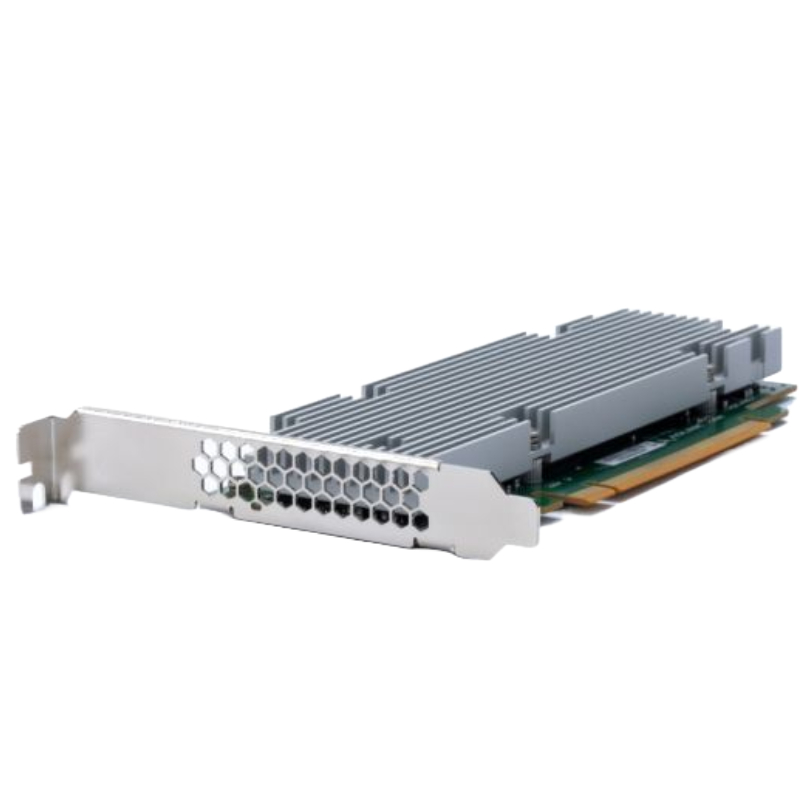
Lenovo SN37B02838 Intel vRAN Accelerator ACC100 PCI-Express 3.0 X16 Harq Buffer Management Adapter. New Sealed in Box (NIB) with 3 Years Warranty
The Lenovo SN37B02838 Intel vRAN Accelerator ACC100 is a high-performance PCIe-based hardware acceleration adapter engineered for modern virtualized Radio Access Network (vRAN) workloads. Designed to offload compute-intensive baseband processing tasks from the CPU, this enterprise-grade accelerator enhances throughput, reduces latency, and improves overall network efficiency in 4G LTE and 5G NR deployments.
The Lenovo SN37B02838 Intel vRAN Accelerator ACC100 PCI-Express 3.0 x16 HARQ Buffer Management Adapter represents a highly specialized class of telecom infrastructure acceleration hardware designed to support next-generation virtualized Radio Access Network (vRAN) deployments. Built around Intel’s ACC100 architecture, this adapter is engineered to offload computationally intensive baseband processing tasks from general-purpose CPUs, allowing telecom operators and edge computing providers to achieve higher throughput, lower latency, and improved energy efficiency in 4G LTE and 5G NR environments.
As mobile networks evolve toward cloud-native and software-defined architectures, hardware accelerators like the Lenovo SN37B02838 play a critical role in ensuring that signal processing workloads such as Forward Error Correction (FEC), HARQ buffer management, and LDPC decoding are executed with deterministic performance. This allows network functions to be virtualized without sacrificing the strict timing requirements essential for mobile communications.
At the core of the Lenovo SN37B02838 adapter lies the Intel ACC100 accelerator, a purpose-built silicon platform designed specifically for vRAN workloads. Unlike traditional NICs or general-purpose compute accelerators, the ACC100 is optimized for baseband signal processing, enabling it to handle computational tasks that would otherwise consume a significant portion of CPU resources in a virtualized base station environment.
This specialized design allows telecom infrastructure to separate control plane and data plane workloads more effectively, ensuring that critical timing-sensitive operations such as HARQ retransmission handling are executed without delay or jitter.
Hybrid Automatic Repeat Request (HARQ) is a fundamental mechanism in modern wireless communication systems that ensures reliable data transmission over noisy radio channels. The HARQ buffer management function integrated into the ACC100 architecture is responsible for storing transmitted data blocks, tracking acknowledgments, and facilitating fast retransmissions when errors are detected.
By offloading HARQ buffer management from the host CPU to the accelerator, the Lenovo SN37B02838 significantly reduces processing overhead and improves deterministic latency behavior. This is especially critical in 5G Ultra-Reliable Low-Latency Communication (URLLC) scenarios where retransmission timing must be tightly controlled.
The accelerator ensures that failed packet transmissions are rapidly identified and retransmitted using pre-stored buffer states. This reduces dependency on software-based scheduling loops and allows the system to maintain consistent sub-millisecond response times across high-density network loads.
The Lenovo SN37B02838 utilizes a PCI-Express 3.0 x16 interface, providing a high-throughput connection between the accelerator and the host server system. This interface ensures that large volumes of baseband data can be transferred efficiently between CPU memory and the ACC100 processing engine without creating bottlenecks.
PCIe 3.0 x16 offers sufficient bandwidth for demanding vRAN workloads, supporting simultaneous uplink and downlink processing streams in dense virtualized deployments. This makes the adapter suitable for both centralized and distributed RAN architectures.
In vRAN environments, latency is a critical metric that directly impacts user experience and network performance. The PCIe architecture of the Lenovo SN37B02838 is optimized for predictable data transfer cycles, ensuring that baseband frames are delivered to the accelerator with minimal queuing delays.
This deterministic behavior is essential for maintaining synchronization between distributed network functions, especially when deployed in multi-node edge computing clusters.
The transition from traditional hardware-based RAN systems to virtualized RAN architectures has transformed how mobile networks are deployed and managed. The Lenovo SN37B02838 adapter is designed specifically to accelerate this transformation by providing dedicated hardware support for compute-intensive PHY layer processing tasks.
In a vRAN environment, baseband functions are decomposed into software components running on general-purpose servers. Without acceleration, these workloads would overwhelm CPU resources. The ACC100-based adapter ensures that computationally heavy tasks are offloaded efficiently.
The physical layer of 5G New Radio (NR) requires extensive signal processing, including channel coding, modulation, and error correction. The Lenovo SN37B02838 significantly accelerates these operations, enabling scalable deployment of 5G base stations using cloud-native infrastructure.
This hardware acceleration ensures that operators can support higher user densities while maintaining consistent service quality and spectral efficiency.
Low-Density Parity Check (LDPC) coding is widely used in 5G systems to enhance error correction efficiency. The ACC100 architecture integrates dedicated hardware engines for LDPC encoding and decoding, dramatically reducing CPU utilization and improving throughput in high-load scenarios.
As mobile networks increasingly adopt Multi-Access Edge Computing architectures, the need for localized processing power becomes more critical. The Lenovo SN37B02838 adapter is well-suited for MEC environments, where low-latency processing must occur close to end users.
By enabling vRAN workloads to be processed at the edge, this accelerator helps reduce backhaul congestion and improves responsiveness for latency-sensitive applications such as autonomous systems, augmented reality, and industrial IoT.
Cloud RAN (C-RAN) architectures rely heavily on centralized processing resources. However, distributed cloud models require flexible acceleration capabilities at multiple network layers. The ACC100-based Lenovo adapter supports this distributed model by providing scalable hardware acceleration across edge nodes.
Network operators can distribute baseband processing tasks dynamically across multiple edge servers equipped with SN37B02838 adapters, ensuring balanced workloads and optimized resource utilization.
HARQ processes require temporary storage of transmitted data packets until acknowledgment is received. The Lenovo SN37B02838 integrates specialized buffer management systems that ensure efficient memory allocation and rapid retrieval of retransmission data.
This reduces dependency on system memory bandwidth and improves overall data flow efficiency in high-throughput environments.
When transmission errors occur, the accelerator quickly initiates retransmission sequences using stored buffer data. This hardware-level execution reduces latency compared to software-based implementations, which may suffer from scheduling delays.
By offloading compute-intensive tasks to dedicated hardware, the Lenovo SN37B02838 reduces the overall power consumption of telecom servers. This is particularly beneficial in large-scale deployments where energy efficiency directly impacts operational costs.
The reduction in CPU utilization also leads to improved thermal profiles, allowing for denser server configurations without exceeding cooling limitations.
Telecom edge environments often operate under constrained physical conditions. The ACC100 architecture is designed to maintain stable performance under sustained workloads, ensuring consistent thermal behavior even in high-density rack configurations.
The Lenovo SN37B02838 adapter is engineered for seamless integration into Lenovo’s enterprise server platforms used in telecom and cloud environments. Its PCIe form factor ensures compatibility with a wide range of rack-mounted systems optimized for virtualization workloads.
This integration capability allows network operators to deploy standardized hardware stacks across multiple sites while maintaining consistent performance characteristics.
The adapter supports integration with leading virtualization platforms used in vRAN deployments. This includes compatibility with containerized network functions and virtual machine-based baseband processing environments.
Modern telecom networks rely on orchestration frameworks to manage distributed workloads. The SN37B02838 accelerates key components of these frameworks by ensuring baseband tasks are executed efficiently at the hardware level.
The accelerator enables telecom operators to scale network capacity without proportionally increasing CPU resources. This is essential for supporting dense urban environments where subscriber density is extremely high and network demand fluctuates rapidly.
By improving processing efficiency, the adapter ensures consistent service delivery even during peak traffic conditions.
Reliability is a core requirement in telecom infrastructure. The Lenovo SN37B02838 is designed with robust error handling and buffer management mechanisms that maintain system stability under heavy load conditions.
In smart city deployments, massive numbers of connected devices generate continuous data streams that must be processed in real time. The accelerator enables efficient handling of these workloads by ensuring low-latency communication between devices and network cores.
Private 5G networks used in industrial environments require deterministic latency and high reliability. The Lenovo SN37B02838 supports these requirements by offloading critical baseband tasks and ensuring predictable processing behavior.
Applications such as autonomous robotics, remote control systems, and real-time monitoring benefit from the accelerator’s ability to maintain stable and low-latency communication channels.


 Contact Us
 Information
 Catalog
 Solid State Drives (SSD)
 Network Switches
 Hard Disk Drives
 HBA & Controllers
 PC & Servers
 PC & Server Memory
 CPU & Processors
 Network Routers
 Power Supplies
 Tape Drives & Libraries
 Network Devices
 Computer & Network Cables