
(7% discount is applied at checkout)
Cart is empty
Your go-to destination for cutting-edge server products
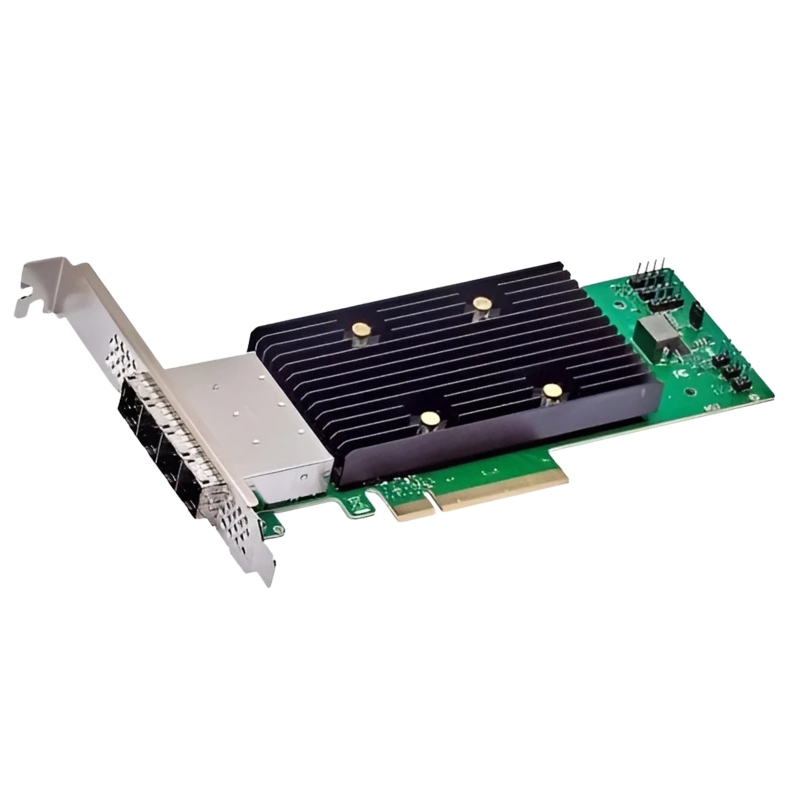
LSI Logic SAS9600-16E Ehba Tri-mode Pci Express Storage Adapter. Factory-Sealed New in Original Box (FSB) with 3 Years Warranty.
This enterprise-grade storage controller delivers exceptional flexibility and speed for demanding workloads.
The LSI Logic SAS9600-16E eHBA Tri-Mode PCIe Storage Adapter category centers on high-bandwidth, flexible, enterprise-class storage host bus adapters (HBAs) designed to bridge SAS, SATA, and NVMe ecosystems. Marketed historically under the LSI/Broadcom family of 96xx Tri-Mode adapters, the SAS9600-16E is built for data centers, JBOFs (Just a Bunch Of Flash/Drives), and external storage expansion where multi-protocol compatibility, bandwidth efficiency, and scalability are critical selection criteria. The category includes new, OEM-branded variants (for example Supermicro AOC-SAS9600-16E) and refurbished or surplus boards sold to organizations seeking to expand external storage arrays without re-architecting their server I/O fabric.
The SAS9600-16E uses a PCI Express Gen4 x8 host interface which delivers high aggregate bandwidth to the host processor and allows the adapter to fully support external multi-lane connections and switch-attached NVMe topologies. That PCIe Gen4 x8 link is a fundamental characteristic for modern data center throughput requirements.
The adapter family leverages high-speed SerDes lines capable of SAS data transfer rates up to 24G (advertised as 22.5Gb/s per lane in some negotiated modes), compatibility with SATA 6Gb/s devices, and PCIe data rates suitable for NVMe signaling through the appropriate topology. This broad speed envelope gives administrators the flexibility to attach a variety of drive classes while preserving link-level efficiencies and backward compatibility.
Typical external cabling for this adapter consists of four SlimSAS (SFF-8644) x4 external connectors, yielding a total of 16 external ports for SAS/SATA lanes when fully populated with breakout cables. This layout supports high port density and predictable wiring to external JBOD/JBOD-like enclosures. Verify the vendor’s SKU and bracket options for exact connector placement.
In practical deployments the SAS9600-16E can address a very large number of endpoints — commonly listed as the ability to support up to 240 SAS/SATA devices through expanders and up to approximately 32 NVMe endpoints in switch-attached NVMe topologies — making it suitable for large external expansions and high-density storage shelves. Topology design (direct attach vs. switch) and enclosure capabilities determine exact device counts and recommended layouts.
The SAS9600-16E excels as the aggregation adapter in external enclosure setups where dozens to hundreds of drives are managed by a smaller number of host adapters. Its Tri-Mode capability allows operators to attach mixed drive shelves — for example a mix of 24G SAS HDDs for capacity and NVMe U.2/U.3 drives behind a switch for performance — enabling hybrid external arrays without complex adapter multiplexing.
In NVMe-centric next-generation topologies the 9600 family supports NVMe devices through switch-based fabrics rather than direct-attach in many models; this makes the adapter a practical choice for environments transitioning toward NVMe over Fabrics or for those that use Broadcom/NVMe-aware switching silicon in front of the drives. Keep in mind that certain external-port variants are optimised for switch-attached NVMe rather than direct-attach NVMe.
For virtualization clusters and database servers that rely on external storage arrays, the SAS9600-16E can provide predictable throughput and the multiprotocol flexibility to leverage both low-latency NVMe appliances and large-capacity SAS shelves in the same deployment. The card’s offload and protocol negotiation reduce the complexity of host-side storage logic and allow hypervisors to focus on compute tasks.
Before procurement, check whether your target enclosure supports Tri-Mode topologies, the correct SFF-8644 cabling, and whether any expanders in the path are rated for 24G speeds and NVMe passthrough where needed. Compatibility with device expanders and switch silicon is important — mismatches can limit performance or prevent NVMe discovery.
Verify that the host server has an available PCIe Gen4 x8 (or compatible) slot and that BIOS/UEFI firmware and platform firmware are updated to support newer PCIe link speeds. Some older server platforms may operate the adapter at lower link speeds (Gen3) and will not expose the full Gen4 bandwidth until platform updates are applied.
Make sure you plan for driver and firmware management: Broadcom (LSI) provides firmware packages, driver bundles, and management utilities for Tri-Mode adapters. In production systems, align firmware versions across adaptors and switch fabrics where recommended by the vendor to minimize interoperability issues, and maintain a documented upgrade path with rollback artifacts.
For maximum throughput, use certified SFF-8644 mixed-mode cables and ensure expanders/switches in the path are capable of the adapter’s rated 24G SERDES speeds. If a path contains lower-rated components, the entire link can fall back to slower rates, so always design the path for uniform capability.
Integrate adapter telemetry into your monitoring stack (SNMP, vendor agents, or host utilities) to track link states, device discovery, error counters, and firmware alerts. Proactive monitoring of link-level errors and expander health reduces the chances of degraded performance or partial device visibility during maintenance windows.
Newer variants of the 9600 family include hardware secure boot features and SPDM attestation to validate firmware and secure firmware updates, improving the overall security posture of the adapter when deployed in regulated or high-trust environments. These features help prevent unauthorized firmware tampering and provide cryptographic assurances about the adapter state.
The 9600-series documentation outlines support for end-to-end data protection models (EEDP/T-10) and other error checking mechanisms that help detect and mitigate data corruption in transit across the storage fabric — a key capability for multi-enclosure topologies. When data integrity is paramount, confirm that both the adapter firmware and the connected storage expanders or enclosures honor EEDP metadata.
Tri-Mode eHBAs give you protocol-level flexibility and futureproofing at the cost of added complexity in topology planning. Traditional SAS-only HBAs are simpler when you only need SAS/SATA support and prefer HBA-level predictability. If your environment includes or will include NVMe devices (now or soon), Tri-Mode provides a lower-friction migration path.
NVMe-native controllers and HBAs that implement NVMe over Fabrics are optimized for end-to-end NVMe traffic and reduce translation overheads. If your environment is fully NVMe-first, a dedicated NVMe solution can offer simpler performance scaling. Tri-Mode sits in the middle — enabling mixed fleets and preserving existing SAS investment while enabling NVMe attachment through switch fabric architectures.
If attached devices are not visible, confirm cable pinouts, SFF-8644 breakout compatibility, expander firmware, and adapter firmware versions. Mixed-protocol topologies sometimes require specific firmware revisions to correctly negotiate NVMe and SAS devices simultaneously. Use vendor utilities to dump logs and run diagnostics.
Short product lines for listings:
Customers browsing this Tri-Mode eHBA category often purchase related items such as:
Tri-Mode adapters are powerful and flexible, but their behavior is topology sensitive. Mismatched expanders or switch silicon can lead to degraded link speed or partial device visibility. Always validate your enclosure and switch component compatibility before large-scale rollouts.
When buying refurbished boards, request the seller’s refurbishment report, firmware version, and whether accessories such as brackets or cables are included. Refurbished units may be cost-effective but require stricter validation before deployment in mission-critical environments.


 Contact Us
 Information
 Catalog
 Solid State Drives (SSD)
 Network Switches
 Hard Disk Drives
 HBA & Controllers
 PC & Servers
 PC & Server Memory
 CPU & Processors
 Network Routers
 Power Supplies
 Tape Drives & Libraries
 Network Devices
 Computer & Network Cables