
(7% discount is applied at checkout)
Cart is empty
Your go-to destination for cutting-edge server products
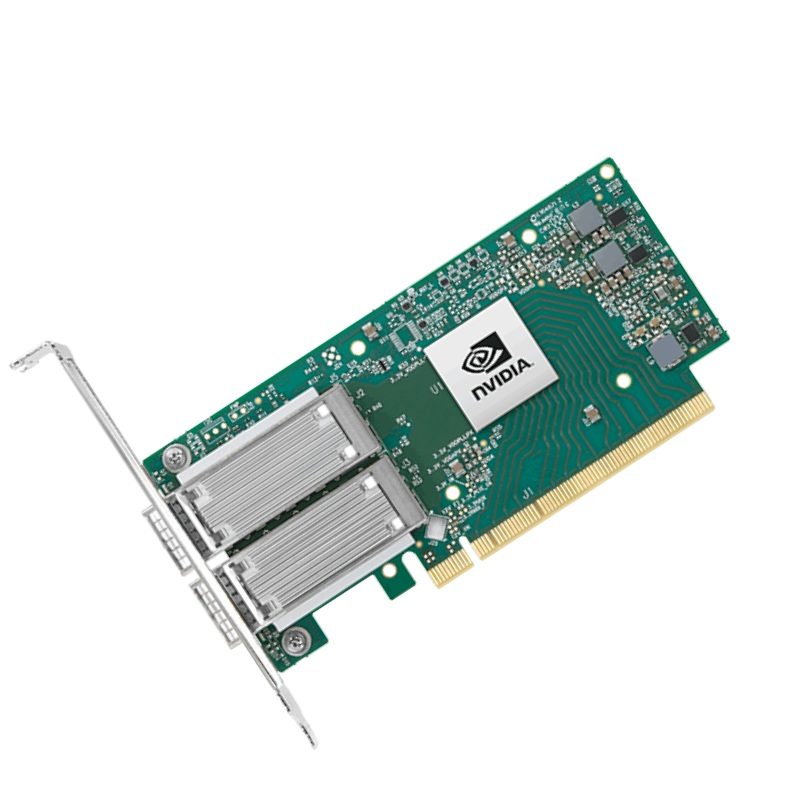
Nvidia MCX713106AS-CEAT Connectx-7 Ethernet Adapter Card 100GBE Dual-port Qsfp Pcie 5.0 X16 Secure Boot No Crypto. New Sealed in Box (NIB) with 3 Years Warranty
The Nvidia MCX713106AS-CEAT ConnectX-7 Ethernet Adapter Card is a high-performance dual-port QSFP112 solution designed for next-generation networking. With PCIe Gen5 x16 support, secure boot, and optimized features for AI, HPC, and cloud workloads, this adapter ensures enterprise-class reliability and scalability.
The Nvidia MCX713106AS-CEAT ConnectX-7 Ethernet Adapter Card represents a new generation of high-performance networking solutions designed for enterprise servers, cloud infrastructure, and advanced computing environments. This dual-port QSFP adapter delivers 100 Gigabit Ethernet connectivity through PCIe 5.0 x16 architecture, ensuring maximum throughput and efficiency for demanding workloads. With secure boot functionality and no crypto acceleration, it is tailored for environments where stability, compliance, and streamlined performance are prioritized.
The adapter leverages PCIe 5.0 x16 lanes, offering double the bandwidth compared to PCIe 4.0. This ensures that data-intensive applications such as artificial intelligence, machine learning, and large-scale data analytics can operate without bottlenecks. The architecture supports extremely high packet processing rates, making it suitable for environments requiring ultra-low latency and consistent throughput.
Equipped with dual QSFP ports, the card supports 100 Gigabit Ethernet connections. This dual-port design allows for redundancy, load balancing, and enhanced scalability. QSFP interfaces are compatible with both copper and optical transceivers, enabling flexible deployment across different networking infrastructures.
Secure boot functionality ensures that only trusted firmware and drivers are loaded during initialization. This feature enhances system integrity and protects against unauthorized modifications. By excluding crypto acceleration, the card focuses on raw networking performance while maintaining compliance with environments that require non-cryptographic configurations.
With 100GbE capability, the adapter supports massive data transfers across distributed systems. This is critical for workloads such as real-time analytics, scientific simulations, and cloud-native applications. The card’s design minimizes latency, ensuring that applications requiring immediate response times can operate seamlessly.
The ConnectX-7 architecture is optimized for latency-sensitive applications. By reducing packet processing delays, it enables high-frequency trading platforms, HPC clusters, and AI inference systems to achieve superior performance. Latency is consistently maintained at microsecond levels, ensuring predictable and reliable communication.
Data centers deploying this adapter benefit from its scalability features. The dual-port design allows administrators to expand bandwidth capacity without replacing existing infrastructure. PCIe 5.0 ensures compatibility with next-generation servers, making it a future-proof investment for enterprises planning long-term growth.
The adapter is designed for enterprise-grade servers supporting PCIe 5.0 x16 slots. Its low-profile form factor ensures compatibility with dense server racks, while its thermal design supports efficient cooling in high-performance environments. Integration with Nvidia GPU servers enhances AI and ML workloads by providing balanced compute and networking resources.
Compatibility extends across major operating systems including Linux distributions, Windows Server editions, and VMware ESXi. Nvidia provides optimized drivers ensuring seamless integration with these platforms. This broad compatibility allows enterprises to deploy the adapter across diverse environments without compatibility concerns.
The adapter integrates with Ethernet-based infrastructures ranging from 10GbE to 100GbE. It supports advanced networking protocols, ensuring interoperability with existing switches, routers, and storage systems. This makes it suitable for hybrid environments where legacy systems coexist with modern high-speed networks.
The card supports virtualization technologies, enabling efficient resource allocation across multiple virtual machines. This is essential for cloud service providers and enterprises running containerized workloads. Virtualization offload features reduce CPU overhead, allowing servers to dedicate more resources to application performance.
Hardware offload capabilities accelerate packet processing, reducing the burden on host CPUs. This includes support for TCP/IP stack offloading, ensuring efficient handling of large-scale traffic. Applications requiring consistent throughput benefit from these enhancements, as they minimize jitter and maximize stability.
Despite its high performance, the adapter maintains energy efficiency through optimized power consumption. This reduces operational costs in large-scale deployments and contributes to sustainable data center practices. Thermal management ensures that the card operates within safe temperature ranges, even under heavy workloads.
In HPC environments, the adapter supports parallel processing workloads requiring massive data exchanges between nodes. Its low latency and high bandwidth make it ideal for scientific research, simulations, and engineering applications where precision and speed are critical.
AI and ML workloads benefit from the adapter’s ability to handle large datasets with minimal delay. Integration with Nvidia GPU servers ensures balanced performance across compute and networking layers. Training and inference tasks achieve faster completion times, improving productivity in research and enterprise deployments.
Cloud service providers rely on high-speed networking to deliver consistent performance across distributed environments. The adapter supports virtualization, scalability, and secure boot, making it a reliable choice for cloud-native applications. Its dual-port design ensures redundancy, minimizing downtime in mission-critical services.
The card features a low-profile design suitable for dense server environments. Its dimensions allow installation in standard enterprise servers without requiring modifications. The dual-port QSFP connectors are positioned for easy access, simplifying cable management in complex data center setups.
Optimized power consumption ensures that the adapter delivers high performance without excessive energy usage. This balance between performance and efficiency makes it suitable for enterprises seeking to reduce operational costs while maintaining top-tier networking capabilities.
Secure boot functionality ensures that only verified firmware and drivers are loaded during initialization. This protects against malicious modifications and enhances system integrity. Enterprises deploying sensitive workloads benefit from this added layer of security.
The adapter complies with industry standards for Ethernet networking and PCIe architecture. This ensures interoperability with existing infrastructure and adherence to regulatory requirements. Enterprises can deploy the card confidently, knowing it meets compliance benchmarks.
By excluding crypto acceleration, the adapter focuses on raw networking performance. This configuration is suitable for environments where cryptographic processing is handled by dedicated hardware or software solutions. It ensures streamlined performance without unnecessary overhead.
The adapter is designed for next-generation data centers requiring high-speed, low-latency networking. Its PCIe 5.0 architecture ensures compatibility with upcoming server technologies, making it a future-proof investment. Enterprises planning long-term infrastructure upgrades benefit from its scalability and adaptability.
As technologies such as edge computing and distributed AI evolve, the adapter provides the necessary networking foundation. Its high bandwidth and low latency ensure that emerging workloads can be supported without compromise. This positions enterprises to adopt new technologies seamlessly.
Built with enterprise-grade components, the adapter ensures long-term reliability in demanding environments. Its robust design and secure boot functionality provide consistent performance across extended operational lifecycles. Enterprises benefit from reduced maintenance costs and improved infrastructure stability.


 Contact Us
 Information
 Catalog
 Solid State Drives (SSD)
 Network Switches
 Hard Disk Drives
 HBA & Controllers
 PC & Servers
 PC & Server Memory
 CPU & Processors
 Network Routers
 Power Supplies
 Tape Drives & Libraries
 Network Devices
 Computer & Network Cables