
(7% discount is applied at checkout)
Cart is empty
Your go-to destination for cutting-edge server products
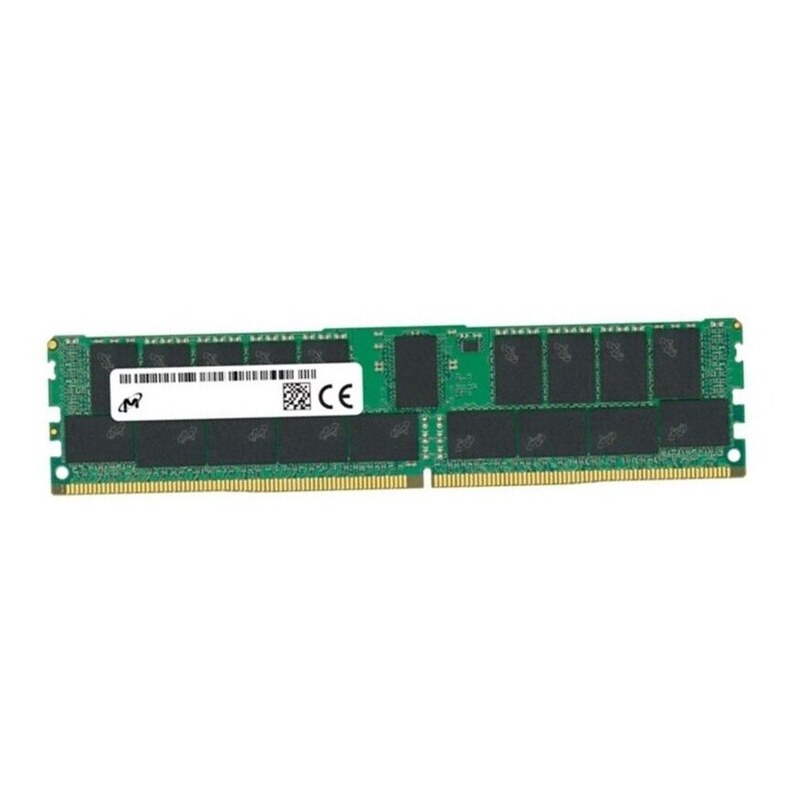
Micron MTA144ASQ16G72LSZ-2S6E1 128GB RAM 2666MHz PC4-21300 Reg DDR4 SDRAM. New (System) Pull with 1 year replacement warranty
The Micron MTA144ASQ16G72LSZ-2S6E1 is a 128GB DDR4 Registered ECC Load Reduced DIMM (LRDIMM), engineered for the most demanding enterprise server and data center environments. This module represents a pinnacle of high-capacity, high-reliability memory technology, designed to maximize performance in multi-socket servers, high-performance computing (HPC) clusters, and large-scale virtualization platforms.
The Micron MTA144ASQ16G72LSZ-2S6E1 is a premium-grade 128GB load reduced DIMM (LRDIMM) engineered for data center servers and high-performance computing environments. This module utilizes advanced memory technology to deliver exceptional density and stability, enabling enterprises to maximize their server memory capacity while maintaining stringent reliability standards. Its design is focused on overcoming the limitations of traditional registered DIMMs (RDIMMs) in high-capacity configurations, making it a critical component for memory-intensive applications.
At its core, this module is defined by a set of specifications that place it in the upper echelon of server memory. Understanding these parameters is essential for system compatibility and performance tuning.
With a formidable 128GB (Gigabytes) of capacity per module, this LRDIMM allows for massive memory configurations in modern multi-socket servers. A single server with 16 memory slots can theoretically support up to 2 Terabytes of RAM using these modules. It adheres to the standard 288-pin Dual Inline Memory Module (DIMM) form factor, ensuring physical compatibility with DDR4 server motherboards.
Micron's part number reveals key attributes. "MTA" denotes a module product. "144" indicates an LRDIMM type. "ASQ" references the specific component revision and technology. "16G72" breaks down to 16 Gigabit DRAM components with a 72-bit bus (including ECC). "LSZ" signifies the lead-free and halogen-free RoHS-compliant package. "2S6E1" indicates the rank configuration, speed bin, and other internal design codes.
The module operates at a base frequency of DDR4-2666MHz, which translates to a data transfer rate of 2666 million transfers per second (MT/s). In terms of peak bandwidth, this equates to approximately 21.3 GB/s per module (calculated as 2666 MT/s * 8 bytes/transfer). The industry-standard designation PC4-21300 derives from this bandwidth, where 21300 MB/s is the theoretical maximum.
The CAS Latency (CL) is specified at CL19 (tCL=19). This is a typical latency for high-density DDR4-2666 modules. The full primary timing sequence (e.g., tRCD, tRP) is aligned with JEDEC standards for this speed bin. While not the tightest timings available, this balance between speed, capacity, and signal integrity is optimized for server stability over raw low-latency performance.
Operating at the standard DDR4 voltage of 1.2V, this LRDIMM provides improved power efficiency compared to older DDR3 (1.5V) technology. The Load Reduced design incorporates additional power management features to minimize the electrical load on the server's memory controller, a crucial factor when populating all channels with high-density modules.
This module's classification as an LRDIMM, rather than a standard RDIMM, is its most defining technological characteristic. This architecture is pivotal for large-scale, high-capacity deployments.
In traditional RDIMM designs, the memory controller's electrical signal is distributed to multiple DRAM chips on the module. As the number of ranks and DRAM chips increases—especially in 128GB modules—the electrical load (capacitance) on the memory bus becomes significant. This increased load can degrade signal integrity, limit clock speeds, and restrict the number of modules that can be installed per channel.
The LRDIMM addresses this by employing a specialized memory buffer (often from companies like IDT or Renesas). This buffer sits between the memory controller and the DRAM chips. It isolates the controller from the high electrical load of the DRAMs, presenting a consistent, low-impedance load to the system. The buffer handles all data, command, and address traffic, regenerating clean signals to the DRAMs. This isolation allows servers to support more DIMMs per channel at higher speeds with high-density modules.
The module is configured as an Octal Rank (8-rank) DIMM. This is achieved by utilizing high-density 16Gb (Gigabit) DRAM components organized in a complex arrangement. The buffer chip is essential for managing this many ranks effectively. This high rank count is a primary method of achieving the 128GB capacity on a single module while staying within the constraints of the DDR4 specification.
Data integrity is non-negotiable in server and data center applications. This module incorporates a robust suite of error-handling technologies.
The module features Error Correcting Code, indicated by the 72-bit bus (64 data bits + 8 ECC bits). ECC can detect and correct single-bit errors within a data word. It can also detect, but not correct, multi-bit errors. This hardware-level correction prevents silent data corruption, soft memory errors, and potential system crashes, thereby enhancing overall system uptime and data reliability.
These are system-level features enabled by the interaction of the ECC memory and a compatible memory controller (e.g., Intel Xeon Scalable, AMD EPYC). Demand Scrubbing corrects errors when a faulty memory location is read. Patrol Scrubbing proactively scans the entire memory space during idle periods to find and correct errors before they are accessed by the operating system, serving as a preventive maintenance mechanism.
While an LRDIMM, it also incorporates registering clock drivers (RCDs) for the address and command lines, a hallmark of Registered DIMMs. These registers buffer the addresses and commands, providing electrical stability and reducing the load on the memory controller. This is separate from the data buffer function but works in concert with it in an LRDIMM to achieve maximum stability and capacity.
This memory module is not designed for consumer PCs. Its target ecosystem is exclusively modern enterprise server platforms.
The module is validated for use with server processors that support DDR4-2666 LRDIMMs. This primarily includes the Intel Xeon Scalable processor families (Cascade Lake, Cooper Lake, and compatible platforms) and the AMD EPYC 7002 "Rome" and 7003 "Milan" series processors. It is critical to consult the server manufacturer's (Dell EMC, HPE, Lenovo, Cisco, etc.) Qualified Parts List to ensure this specific Micron part number is certified for a given server model (e.g., Dell PowerEdge R740xd, HPE ProLiant DL380 Gen10, Cisco UCS C240 M5).
When deploying high-density LRDIMMs, strict population rules outlined in the server's technical manual must be followed. These rules govern the order in which slots should be populated to ensure optimal signal integrity and performance. Mixing LRDIMMs with RDIMMs or UDIMMs within the same system or memory channel is strictly prohibited and will result in a system failure to boot.
The massive capacity and high reliability of this module make it suitable for memory-hungry enterprise applications. These include in-memory databases (SAP HANA, Oracle Exadata), large-scale virtualization and cloud hosting (VMware vSphere, Microsoft Hyper-V), high-performance computing (HPC) simulations, big data analytics (Apache Spark, Hadoop), and enterprise resource planning (ERP) systems.
Selecting an LRDIMM involves understanding its performance profile relative to other DIMM types.
The memory buffer on an LRDIMM introduces a small, fixed amount of additional latency (typically on the order of a few nanoseconds) compared to an RDIMM of the same speed. This is the trade-off for achieving higher capacity and better signal integrity. For most data center workloads, which are throughput-sensitive rather than latency-sensitive, this is an acceptable and worthwhile exchange.
Because LRDIMMs reduce the electrical load on the memory controller, systems can often achieve higher stable speeds with more modules per channel than with RDIMMs. This can lead to better aggregate memory bandwidth in fully populated systems. The key advantage is total capacity, not necessarily peak per-module bandwidth.
The advanced buffer chip and numerous DRAM components generate heat. Server platforms provide strong airflow directly over the memory slots to manage this. The module itself may include a thermal sensor (not explicitly stated in this part number) for monitoring. Power consumption, while efficient at 1.2V, is higher per module than a lower-density RDIMM due to more active components, which is a factor in total system power budgeting.


 Contact Us
 Information
 Catalog
 Solid State Drives (SSD)
 Network Switches
 Hard Disk Drives
 HBA & Controllers
 PC & Servers
 PC & Server Memory
 CPU & Processors
 Network Routers
 Power Supplies
 Tape Drives & Libraries
 Network Devices
 Computer & Network Cables