
(7% discount is applied at checkout)
Cart is empty
Your go-to destination for cutting-edge server products
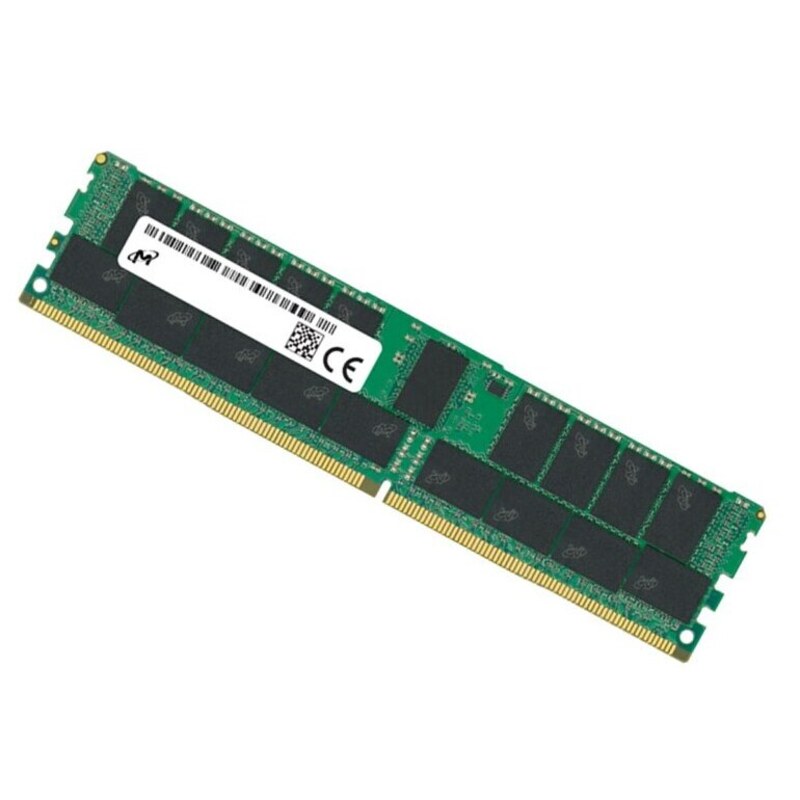
Micron MTA144ASQ16G72LSZ-2S6G1 128GB RAM PC4-21300 2666V 288P 8RX4 LRDIMM. New (System) Pull with 1 year replacement warranty
In the realm of enterprise computing and data center infrastructure, memory is not merely a component; it is the vital conduit through which all data processing flows. For servers tasked with handling massive datasets, running virtual machines, or managing high-transaction databases, the choice of memory module directly impacts stability, capacity, and overall system performance.
In the realm of enterprise computing, server memory modules represent a foundational pillar of system stability, capacity, and throughput. The category of Registered ECC Load Reduced DIMMs, exemplified by modules like the Micron MTA144ASQ16G72LSZ-2S6G1, is specifically designed for mission-critical servers, high-density virtualization hosts, and large-scale database systems where uptime and data accuracy are non-negotiable.
To appreciate the value of this specific module, one must first understand the evolution of server memory buffering. Registered DIMMs (RDIMMs) utilize a register to buffer the address and command lines, reducing the electrical load on the memory controller and allowing for greater module counts per channel. However, the data lines on an RDIMM are still directly connected to the DRAM chips, which imposes a limit on the total number of DRAM chips—and thus total capacity—that can be placed on a single module while maintaining signal integrity. A Load Reduced DIMM solves this challenge. It introduces an additional data buffer, or Isolation Memory Buffer (iMB), between the memory controller and the DRAM chips. This buffer completely isolates the electrical load of the DRAM from the memory controller, dramatically reducing the load it sees. This architecture enables the population of significantly more DRAM chips per module, paving the way for high-capacity modules like this 128GB offering.
LRDIMMs are the primary vehicle for achieving the highest memory capacities in modern servers. By allowing more ranks and more chips per module, they enable system builders to populate servers with terabytes of RAM using fewer DIMM slots, preserving slots for future expansion.
The iMB ensures clean, strong signals to the DRAM, which is critical at high speeds and with high chip counts. This leads to greater stability, especially in fully populated memory configurations where electrical noise can be a concern.
While the iMB itself consumes a small amount of power, the overall system power efficiency can improve because the memory controller operates with less electrical strain. This is a critical consideration in large-scale data center deployments where power and cooling costs are paramount.
This memory module is a meticulously engineered component designed for mission-critical deployment. Its part number, MTA144ASQ16G72LSZ-2S6G1, follows Micron's naming convention, encoding its specifications. Decoding this reveals a module built for performance, compatibility, and unwavering reliability.
The headline feature of this DIMM is its massive 128 Gigabyte (GB) capacity. This is achieved through an advanced "Octal Rank" architecture. Traditional DIMMs are typically single, dual, or quad rank. An octal rank module effectively doubles the logical organization of a quad rank DIMM. It is constructed using 3DS (3-Stacked Die) DRAM components, where multiple DRAM die are stacked and interconnected within a single package. This 3D stacking, combined with the LRDIMM's data buffering, is what makes 128GB on a single module feasible. This density is essential for memory-hungry applications like in-memory databases (SAP HANA, Oracle Exadata), large-scale virtualization (VMware vSphere, Microsoft Hyper-V), and high-performance computing (HPC) simulations.
Raw capacity must be matched with adequate performance. This module strikes a balance optimized for data-centric workloads.
The module operates at a data rate of 2666 Megatransfers per second (MT/s), commonly referred to as DDR4-2666. The "PC4-21300" designation denotes the module's theoretical peak bandwidth. Calculated as 2666 MT/s * 8 bytes (64-bit bus) = ~21,300 MB/s, this "PC4" number is a useful indicator for compatibility and performance comparison. A 2666MT/s speed is a robust mainstream speed for enterprise DDR4, offering excellent throughput for data movement between CPU and memory.
The CAS Latency (CL), specified as 19 clock cycles for this module, is a critical timing parameter representing the delay between the memory controller requesting data and the first bit being available. While higher latency figures might seem counterintuitive, they are a normal trade-off in high-density, high-reliability server modules. The electrical complexity of managing eight ranks of 3DS DRAM necessitates slightly relaxed timings to ensure absolute stability across all operating conditions. The focus here is on colossal, reliable data access, not ultra-low-latency gaming performance.
This module operates at the standard DDR4 voltage of 1.2 volts, a reduction from DDR3's 1.5V standard. This lower voltage is a key contributor to reduced power consumption and heat generation at the system level, which is magnified when deploying dozens or hundreds of these modules in a rack.
The physical interface is the standard 288-pin DDR4 DIMM design, ensuring it fits into standard DDR4 server memory slots. However, compatibility is determined by more than just the pin count. It is absolutely imperative that this LRDIMM is used only in server platforms (from vendors like Dell, HPE, Cisco, Lenovo, and Supermicro) whose specific motherboard and CPU support Load Reduced DIMMs. Not all servers that accept DDR4 can use LRDIMMs; the BIOS and memory controller must be designed to initialize and communicate through the iMB. This module is intended for Intel Xeon Scalable (Purley platform and later) or AMD EPYC platforms that explicitly list LRDIMM support.
This is a Registered ECC (Error-Correcting Code) DIMM. The "Registered" aspect refers to the address/command register mentioned earlier. The ECC functionality is non-negotiable for enterprise environments. ECC memory can detect and correct single-bit errors on-the-fly and detect multi-bit errors. This prevents data corruption, silent data errors, and potential system crashes, which is fundamental for ensuring data integrity in financial calculations, scientific research, and database transactions. The combination of RCD (Register Clock Driver) for addresses/commands and iMB for data makes this a true LRDIMM.
The specific profile of the Micron 128GB LRDIMM makes it ideal for a distinct set of high-end computing scenarios.
Modern cloud and private virtualization hosts aim to consolidate as many Virtual Machines (VMs) as possible onto a single physical server. Each VM requires an allocation of RAM. With 128GB per module, a dual-processor server with 16 memory slots can theoretically hold 2 Terabytes of RAM using only half the slots. This allows for immense VM density, improving resource utilization and reducing hardware, power, and cooling overhead per VM.
Technologies like SAP HANA, Microsoft SQL Server In-Memory OLTP, and various real-time analytics platforms store entire databases in system memory for blistering query performance. These systems are often sized in terabytes of RAM. High-capacity LRDIMMs like this 128GB module are the building blocks of such deployments, enabling large datasets to reside entirely in RAM without the latency of disk access.
The training phases of machine learning models and the processing of massive datasets in frameworks like Apache Spark benefit enormously from large, fast system memory. Having ample RAM prevents constant disk swapping, drastically reducing the time required for data iteration and model training. The high bandwidth of DDR4-2666 helps feed multiple CPU cores simultaneously.
Any application where downtime is measured in dollars per minute requires the utmost in hardware reliability. The ECC protection, rigorous testing, and robust construction of this Micron module meet the demands of tier-1 enterprise applications such as ERP systems (Oracle, SAP), large-scale transaction processing, and telecommunications infrastructure.
In scientific computing, engineering simulations, and financial modeling, problems are often broken down to fit into system memory. Larger memory capacity allows researchers and engineers to tackle more complex, higher-resolution models without resorting to slower disk-based computation methods. The stability offered by ECC is also critical for ensuring the accuracy of long-running calculations.
Modern server CPUs have multiple memory channels (typically 6 or 8). For best performance, channels should be populated symmetrically. The use of high-capacity LRDIMMs often allows for a "fewer DIMMs per channel" configuration, which can sometimes enable higher memory speeds or lower latencies compared to fully populating every slot with lower-capacity DIMMs. The server's BIOS and hardware manual will provide the recommended population sequences.
While DDR4 is efficient, a fully loaded server with multiple 128GB LRDIMMs will generate significant heat. Proper airflow across the memory slots as designed by the server chassis is essential. Most servers include temperature sensors for memory and will throttle performance if DIMMs overheat. Ensuring the data center environment and server cooling are adequate is crucial for maintaining rated speeds and longevity.


 Contact Us
 Information
 Catalog
 Solid State Drives (SSD)
 Network Switches
 Hard Disk Drives
 HBA & Controllers
 PC & Servers
 PC & Server Memory
 CPU & Processors
 Network Routers
 Power Supplies
 Tape Drives & Libraries
 Network Devices
 Computer & Network Cables