
(7% discount is applied at checkout)
Cart is empty
Your go-to destination for cutting-edge server products
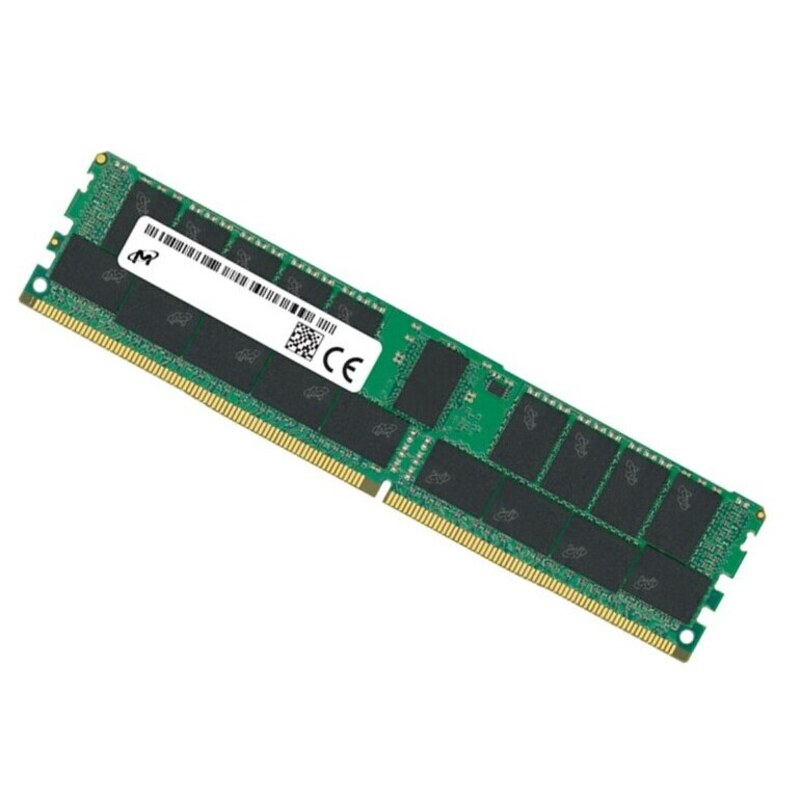
Micron MTA144ASQ16G72LSZ-2S9 128GB Memory Module 8rx4 PC4-23400 DDR4-2933MHz Registered. New (System) Pull with 1 year replacement warranty
The Micron MTA144ASQ16G72LSZ-2S9 is a quintessential example of advanced LRDIMM engineering. This module is not merely a collection of DRAM chips but a sophisticated, optimized subsystem designed for maximum performance and reliability in enterprise environments. Its part number encodes specific technical attributes, which we will elaborate on in the following sections. This module represents a high-capacity, high-performance solution for next-generation servers requiring immense memory footprints.
In the realm of enterprise computing and high-density data centers, memory is not merely a component; it is the critical determinant of system throughput, stability, and scalability. Among the various memory form factors and technologies, the Load Reduced Dual Inline Memory Module (LRDIMM) represents the pinnacle of capacity and performance for modern servers. The Micron MTA144ASQ16G72LSZ-2S9 128GB module is a quintessential example of this advanced technology, engineered to meet the relentless demands of cloud infrastructure, virtualization, in-memory databases, and high-performance computing (HPC).
Unlike standard Registered ECC DIMMs (RDIMMs), which use a register to buffer command and address signals, Load Reduced DIMMs introduce an additional data buffer, known as an Isolation Memory Buffer (iMB). This fundamental architectural difference is the key to their superior performance in high-capacity configurations.
The iMB on an LRDIMM, such as this Micron module, sits between the memory controller and the DRAM chips. It buffers not only the command/address signals (like an RDIMM) but also the data (DQ) signals. This dramatically reduces the electrical load on the memory controller, allowing it to support significantly more memory modules and ranks per channel without sacrificing signal integrity or speed.
An RDIMM presents the electrical load of a single device (the register) to the controller, but the DRAM chips' data lines remain connected directly, increasing capacitive load. An LRDIMM presents the load of only the iMB for all signals, effectively isolating the controller from the electrical load of the many DRAM chips. This enables the population of all DIMM slots with high-density modules—a common requirement in today's multi-socket servers like the Intel Xeon Scalable (Skylake, Cascade Lake, and newer) and AMD EPYC platforms.
The part number MTA144ASQ16G72LSZ-2S9 is a precise blueprint of the module's capabilities. Let's dissect its key technical attributes.
With a massive 128-gigabyte capacity, this module is designed for memory-intensive applications. This density allows system administrators to achieve terabyte-scale memory configurations in a single server with fewer modules, saving power, reducing cooling requirements, and simplifying future upgrades.
The module operates at a data rate of 2933 million transfers per second (MT/s), designated as DDR4-2933. The "PC4-23400" refers to the theoretical peak bandwidth in megabytes per second (MB/s). Calculated as 2933 MT/s * 8 bytes (64-bit bus) = 23,464 MB/s ≈ 23400 MB/s. This high bandwidth is crucial for reducing data access latency and improving overall CPU efficiency.
In a multi-channel memory architecture, the aggregate bandwidth scales with the number of populated channels. A dual-socket server with multiple DIMMs per channel running at 2933 MT/s can deliver tremendous bandwidth, feeding hungry CPUs and accelerating workloads like scientific simulations, financial modeling, and real-time analytics.
The Column Access Strobe (CAS) Latency of 21 clock cycles is a critical timing parameter. While this number is higher than typical consumer DDR4 modules, it is a characteristic of high-density, registered server memory. The trade-off for immense capacity and robust signal integrity (via the iMB) is a modest increase in absolute latency, which is often mitigated by the system's large memory footprint and high bandwidth, keeping the CPUs saturated with data.
The module adheres to the standard 288-pin layout defined for DDR4 server modules. The physical design and notch key are specific to LRDIMMs/RDIMMs, preventing accidental insertion into incompatible motherboard sockets designed for Unbuffered DIMMs (UDIMMs).
Operating at the standard DDR4 voltage of 1.2V, this module balances performance with power efficiency. The iMB component itself consumes a small amount of additional power, but this is offset by the ability to use fewer modules for the same total capacity and the overall lower power per gigabyte compared to older-generation, lower-density modules.
Micron designs incorporate features like chip-level self-refresh and temperature-compensated refresh to minimize power consumption during periods of low activity, a vital consideration.
This is one of the most technically significant aspects of the module. "Octal Rank" indicates it presents 8 logical ranks to the memory controller. It uses "x4" DRAM chips, meaning each chip has a 4-bit wide data interface. To form a 64-bit wide DIMM, the module aggregates data from many chips (16 chips per rank * 8 ranks = 128 chips, though actual stacking/packing may vary). The x4 configuration enhances reliability as it supports stronger Chipkill error correction, equivalent to correcting a full DRAM chip failure.
Error-Correcting Code (ECC) is non-negotiable for enterprise memory. This module goes beyond standard single-bit error correction and double-bit error detection (SECDED).
Leveraging the x4 DRAM architecture, this LRDIMM supports advanced ECC schemes like Chipkill, which can survive the complete failure of a single DRAM chip. This provides far greater protection than basic ECC, guarding against multi-bit errors and ensuring data integrity for the most sensitive workloads.
Proper integration is key to unlocking the module's potential. It is not a plug-and-play component for any system.
This 128GB DDR4-2933 LRDIMM is designed for modern enterprise servers, including platforms based on Intel Xeon Scalable processors (Cascade Lake SP/AP and compatible generations) and AMD's 2nd and 3rd Gen EPYC (Rome, Milan) processors. Always consult the server manufacturer's (Dell EMC, HPE, Lenovo, Cisco, Supermicro) qualified vendor list (QVL) to confirm compatibility for specific motherboard and CPU configurations.
Server memory population follows strict rules. LRDIMMs and RDIMMs cannot be mixed within the same channel. Channels must be populated symmetrically for optimal performance. Most servers require LRDIMMs to be installed in a specific slot order, often starting with the slot farthest from the CPU. Adhering to the system's technical white paper is essential for booting and achieving the advertised speed of 2933 MT/s.
In multi-socket (2P, 4P, 8P) servers, memory configuration affects Non-Uniform Memory Access (NUMA) performance. Balanced memory population across all CPUs (NUMA nodes) is recommended to ensure local memory access and avoid performance degradation from cross-node memory traffic.
The specific characteristics of this Micron LRDIMM make it ideal for a distinct set of demanding applications.
High memory density is paramount for virtualization. A single server equipped with modules like the 128GB LRDIMM can host hundreds of virtual machines (VMs), improving consolidation ratios and reducing physical footprint, power, and management overhead.
Platforms such as SAP HANA, Oracle Database In-Memory, and Redis hold entire datasets in RAM. The combination of high capacity (128GB per module), high bandwidth (2933 MT/s), and supreme reliability (Chipkill ECC) ensures maximum transaction throughput and minimal latency for real-time analytics.
Scientific computing, complex modeling, and machine learning training often involve manipulating vast datasets that must reside in memory. The bandwidth provided by multiple channels of these LRDIMMs prevents the CPU from stalling while waiting for data, accelerating time-to-solution.
Frameworks like Apache Spark perform iterative processing on large datasets in memory. Large, fast memory pools reduce the need to spill data to slower storage drives, dramatically speeding up data exploration and business intelligence tasks.


 Contact Us
 Information
 Catalog
 Solid State Drives (SSD)
 Network Switches
 Hard Disk Drives
 HBA & Controllers
 PC & Servers
 PC & Server Memory
 CPU & Processors
 Network Routers
 Power Supplies
 Tape Drives & Libraries
 Network Devices
 Computer & Network Cables