
(7% discount is applied at checkout)
Cart is empty
Your go-to destination for cutting-edge server products
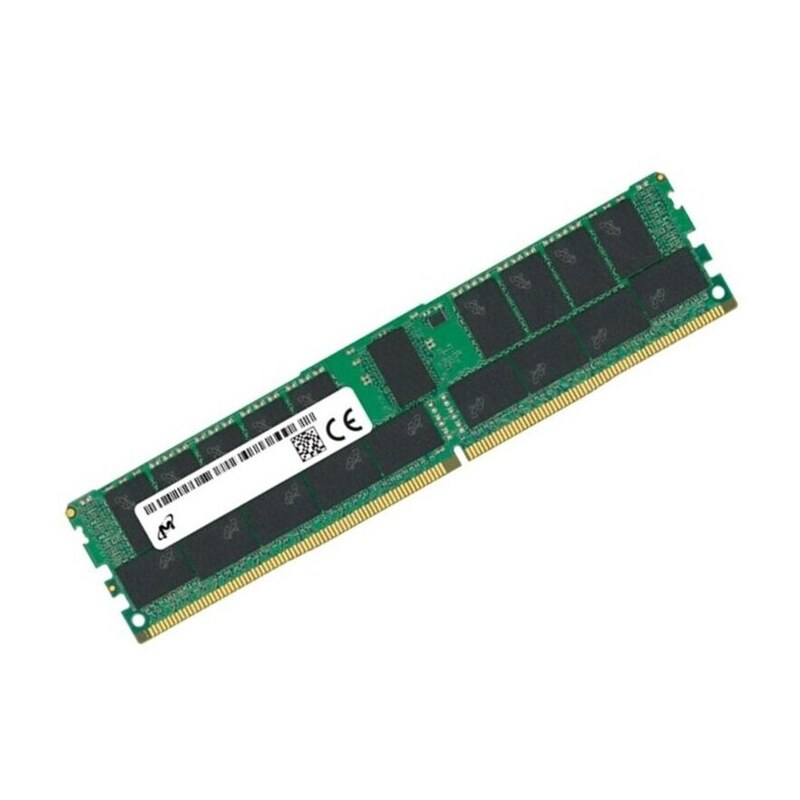
Micron MTA144ASQ16G72PSZ-2S6E1 128GB Memory Module 2666mhz Ddr4 Pc4-21300 Cl19 Ecc Registered. New (System) Pull with 1 year replacement warranty
The Micron MTA144ASQ16G72PSZ-2S6E1 represents a pinnacle of high-density server memory engineering, designed for mission-critical enterprise and data center applications. This 128GB DDR4 module is engineered to deliver exceptional reliability, substantial bandwidth, and massive capacity in a single dual in-line memory module (DIMM) form factor.
In the realm of enterprise servers, data centers, and high-performance computing (HPC) environments, memory is not merely a component; it is the critical artery through which data flows. The category of server memory modules, specifically Registered ECC DDR4 DIMMs, represents a specialized class of memory engineered for unwavering reliability, massive capacity, and error-free operation under continuous, heavy loads. These modules are the workhorses behind cloud infrastructure, virtualization hosts, large databases, and mission-critical applications where system uptime and data integrity are paramount. Unlike standard desktop memory, server memory incorporates advanced technologies to address the physical and electrical challenges of populating a server motherboard with many modules and to correct errors before they cause system crashes or data corruption.
The product code "Micron MTA144ASQ16G72PSZ-2S6E1" is a detailed technical specification in itself, defining every key attribute of the memory module. Breaking down this nomenclature and the accompanying parameters is essential to understanding its place within the server ecosystem and its compatibility with target systems.
Micron's part numbering convention provides a wealth of information. "MT" identifies Micron Technology. "A" signifies a DRAM component. "144" indicates a 288-pin Registered DIMM (RDIMM) form factor. "ASQ" is a designator for the specific product family and revision. "16G" denotes the density per die. "72" reveals the organization and width: a 72-bit wide module (64 data bits + 8 ECC bits). "PSZ" specifies the component type, speed bin, and power. Finally, "-2S6E1" indicates a DDR4-2666 speed grade, the operating temperature (commercial, 0°C to 85°C), and is part of the general product qualification string. This granular level of detail is crucial for IT procurement specialists and system integrators to ensure exact compatibility.
This 128 Gigabyte capacity is a flagship specification for high-density server configurations. It allows data center managers to achieve tremendous total system memory using fewer DIMM slots. For example, in an 8-socket server with 24 DIMM slots per socket, populating each slot with a 128GB module yields a staggering 24.5 Terabytes of RAM per server. This massive capacity is indispensable for memory-intensive workloads such as in-memory databases (SAP HANA, Oracle Exadata), large-scale virtualization (consolidating hundreds of virtual machines), big data analytics (Apache Spark), and high-performance scientific computing, where keeping entire datasets in RAM drastically reduces latency and accelerates processing times.
The designation "PC4-21300" refers to the module's theoretical peak transfer rate: 21,300 MB/s. This is derived from the bus clock speed of 2666 million transfers per second (MT/s), often colloquially called MHz. DDR4-2666 operates on a 1333 MHz I/O clock, leveraging Double Data Rate (DDR) technology to transfer data on both the rising and falling edges of the clock cycle, hence the effective 2666 MT/s rate. This speed represents a balanced point in the DDR4 server spectrum, offering significantly higher bandwidth than entry-level DDR4-2133 or DDR4-2400, while maintaining relatively lower latency and voltage than extreme-performance DDR4-3200 modules. It provides an optimal blend of performance, power efficiency, and compatibility with a wide range of Intel Xeon Scalable (Skylake, Cascade Lake, Cooper Lake) and select AMD EPYC platform processors.
The terms "Registered" and "ECC" define the core technologies that differentiate server memory from its consumer counterparts. These features are non-negotiable for enterprise stability.
ECC is a fundamental data integrity mechanism. On a module like this 72-bit wide DIMM, 64 bits are used for data and an additional 8 bits are dedicated to the ECC code. As data is written to memory, the system calculates a checksum based on the data bits and stores it in the ECC bits. When the data is read, the checksum is recalculated and compared to the stored value. This allows the memory controller to detect and correct single-bit errors (Single Error Correction, or SEC) on the fly, completely transparent to the operating system and applications. It can also detect, but not correct, multi-bit errors (Double Error Detection, or DED). This proactive error correction prevents silent data corruption, soft crashes, and system instability caused by cosmic rays, electrical noise, or subtle component degradation, which become statistically significant at scale in data centers with petabytes of RAM.
The "Registered" aspect, denoted by the "R" in RDIMM, addresses electrical load and signal integrity. A Register (or buffer) is placed on the DIMM for the address and command signals (but not the data signals) from the memory controller. This register acts as a traffic cop, reducing the electrical load on the controller by presenting a single load instead of the load from every DRAM chip on the module. This stabilization of the electrical signal is absolutely critical when populating all memory channels in a multi-socket server with high-density DIMMs. It allows for more modules to be installed per channel (commonly 2DPC - 2 DIMMs Per Channel) without overloading the controller, enabling the large total memory capacities required by enterprise applications. It should be noted that this buffering introduces a slight latency penalty (typically one clock cycle), which is a worthwhile trade-off for the gains in capacity and system stability.
The "Octal Rank" specification is an advanced feature tied directly to achieving the 128GB capacity on a single DIMM. A rank is an independently addressable set of DRAM chips that covers the full data width (72 bits in this case). An octal rank module effectively packages eight of these sets onto one physical stick. This is an engineering feat achieved through 3D stacking technologies like Through-Silicon Via (TSV) or dense packaging, allowing Micron to place a vast number of memory dies within the standard DIMM form factor. Managing eight ranks presents a challenge for the memory controller's scheduling and electrical management, which is why such high-density modules often have specific compatibility requirements with server platforms and may mandate lower population rules (e.g., 1DPC instead of 2DPC at top speeds) to maintain signal integrity. They represent the cutting edge of capacity-per-slot technology.
Beyond the primary features, the module's detailed technical specifications dictate its operational parameters, compatibility, and physical installation requirements.
The CAS Latency (CL) of 19, often expressed in a timing string such as 19-19-19, refers to the number of clock cycles between the memory controller issuing a read command and the first piece of data being available. At DDR4-2666, a clock cycle is 0.75 nanoseconds. Thus, a CL19 translates to an absolute latency of 14.25 nanoseconds for the initial access. While this is numerically higher than the CL of a desktop DDR4-3200 module, server memory prioritizes reliability, capacity, and sustained bandwidth over ultra-low latency. These timings are carefully optimized by the manufacturer to ensure rock-solid stability across a wide range of server workloads and environmental conditions, often running continuous operations for years without interruption.
The DDR4 standard lowered the operating voltage from DDR3's 1.5V to 1.2V, representing a significant 20% reduction. This 1.2V operation is a key contributor to improved power efficiency in modern data centers. For a fully populated server rack, the reduced power draw from dozens or hundreds of memory modules translates directly to lower electricity costs, reduced heat output, and a smaller carbon footprint. The module also supports additional power-saving features like the Self-Refresh mode, which further reduces power during periods of inactivity, a critical capability for cloud environments with variable load patterns.
The physical interface is the 288-pin Dual In-line Memory Module (DIMM). This keyed connector is specific to DDR4 technology and is not backward compatible with DDR3's 240-pin design. The pin layout includes the 64 data lines, ECC lines, address/command lines routed through the register, power, ground, and signals for functions like the Serial Presence Detect (SPD) chip. The SPD is a small EEPROM on the module that stores all its technical parameters (timings, voltage, manufacturer, part number), which the system's BIOS/UEFI reads during POST to automatically configure the memory controller for stable operation.
This memory module is not a general-purpose component; it is designed for specific enterprise and data center platforms that demand its combination of high density, reliability, and performance.
The Micron MTA144ASQ16G72PSZ-2S6E1 is engineered for compatibility with mainstream enterprise server platforms from leading OEMs such as Dell EMC (PowerEdge series), HPE (ProLiant and Apollo), Lenovo (ThinkSystem), Cisco (UCS), and Supermicro. Its primary compatibility lies with servers based on Intel Xeon Scalable processors (codenamed Skylake-SP, Cascade Lake-SP, and Cooper Lake). It is also validated for use in certain AMD EPYC 7002 and 7003 series (Rome and Milan) platforms that support DDR4-2666 RDIMMs. It is imperative for buyers to consult their server's official memory compatibility list or qualified vendor list (QVL) to confirm that this specific part number, density, speed, and rank configuration is supported for their desired motherboard and CPU combination, as improper configuration can lead to failure to boot or operate at reduced speeds.
The characteristics of this 128GB RDIMM make it perfectly suited for the most demanding tier of enterprise computing. Its high density is a natural fit for virtualization hypervisors (VMware vSphere, Microsoft Hyper-V, KVM), where it allows for hosting an extremely high count of virtual machines with ample allocated RAM, improving consolidation ratios and hardware utilization. For database servers (Microsoft SQL Server, MySQL, PostgreSQL), large amounts of RAM serve as a massive cache, keeping frequently accessed data and indexes in memory to minimize slow disk I/O and accelerate query response times exponentially. In the fields of artificial intelligence and machine learning, large models and training datasets benefit from being loaded entirely into the collective system memory. Finally, for high-performance computing (HPC) clusters used in financial modeling, genomic sequencing, and computational fluid dynamics, the combination of high bandwidth (PC4-21300) and enormous capacity per node is essential for solving complex problems in a reasonable timeframe.


 Contact Us
 Information
 Catalog
 Solid State Drives (SSD)
 Network Switches
 Hard Disk Drives
 HBA & Controllers
 PC & Servers
 PC & Server Memory
 CPU & Processors
 Network Routers
 Power Supplies
 Tape Drives & Libraries
 Network Devices
 Computer & Network Cables