(7% discount is applied at checkout)
Cart is empty
Your go-to destination for cutting-edge server products


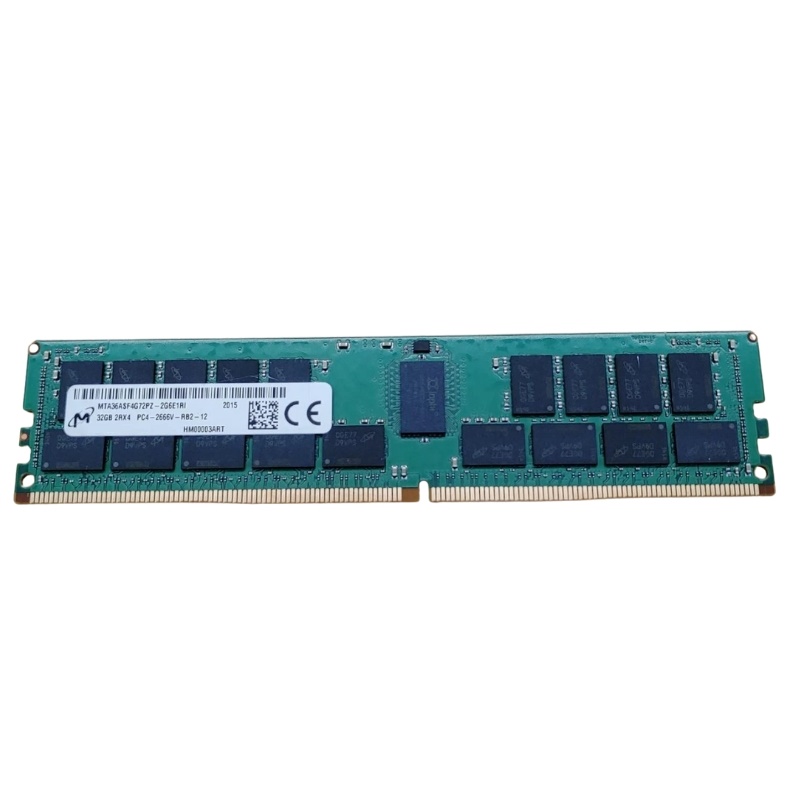
Micron MTA36ASF4G72PZ-2G9E2R 32GB PC4-23400 DDR4 2933MHz ECC Registered CL21 288-Pin RDIMM 1.2V Dual Rank Memory Module. New Sealed in Box (NIB) with 3 Years Warranty
The Micron MTA36ASF4G72PZ-2G9E2R stands as a critical component within the landscape of enterprise and data center computing. This specific 32GB DDR4 memory module is engineered for systems demanding unwavering reliability, high-capacity bandwidth, and advanced error correction. Falling under the category of server memory, it is meticulously designed to operate in multi-processor environments, high-performance workstations, and critical storage or networking infrastructure.
For IT professionals, system integrators, and data center managers, understanding the precise technical specifications of server memory is paramount for ensuring compatibility, performance, and reliability. The Micron MTA36ASF4G72PZ-2G9E2R is a 32GB DDR4 RDIMM engineered for demanding enterprise and data center environments. At its core, this module operates at a data rate of PC4-23400, which translates to an effective transfer speed of 2933 million transfers per second (MT/s). This high-speed data pathway is critical for bandwidth-intensive applications. The module utilizes a 288-pin RDIMM form factor, the standard for modern server platforms, and operates at a low voltage of 1.2V, balancing performance with power efficiency—a key consideration for large-scale deployments. Error-Correcting Code (ECC) functionality and a Registered (Buffered) design are non-negotiable for server stability, correcting single-bit memory errors and buffering the memory address and command lines to reduce electrical load on the memory controller.
Micron's part numbering system provides a concise blueprint of the module's capabilities. Breaking down MTA36ASF4G72PZ-2G9E2R reveals its key attributes. 'MTA' denotes a Micron Technology module. '36' indicates a 288-pin RDIMM form factor. 'A' signifies an advance product feature set. 'SF' confirms it is a Server DRAM product. '4G72' reveals the component density and organization; here, it points to 4Gb components in a x72 configuration (64 data bits + 8 ECC bits). 'PZ' designates the specific revision and feature set, including the dual rank architecture. Finally, the suffix '-2G9E2R' is crucial: '2G9' confirms the 2933 MT/s speed grade, while 'E2' indicates a CL21 latency timing (tCL=21) and 'R' specifies a registered (RDIMM) design. Understanding this nomenclature empowers buyers to accurately verify the module against system compatibility lists and procurement requirements.
The 32GB capacity represents a optimal balance for many modern server configurations, providing substantial headroom for virtualization, database operations, and in-memory processing without the premium cost of higher-density modules. This module is configured as a Dual Rank (2R) module. A rank is an independent set of DRAM chips accessed simultaneously by the memory controller. Dual rank modules effectively interleave access between two banks of chips, often providing better performance efficiency and higher capacity per module compared to single-rank designs, while being more readily available and cost-effective than quad-rank modules. This makes the 32GB Dual Rank RDIMM a workhorse for populating servers with high total memory capacities efficiently.
Performance in server memory is a multi-faceted metric defined by speed, latency, and the resulting bandwidth. The MTA36ASF4G72PZ-2G9E2R is engineered to deliver robust performance optimized for server workloads where consistency and throughput are prioritized over ultra-low latency.
Operating at a data rate of 2933 MT/s (often marketed as 2933MHz), this module sits in the upper tier of standard DDR4 speeds, surpassing common base speeds of 2133MT/s and 2400MT/s. The peak theoretical bandwidth of a single module can be calculated as follows: (Data Rate) x (Bus Width in bytes). For a 72-bit (9-byte) wide RDIMM at 2933 MT/s, the calculation is 2933,000,000 transfers/second x 9 bytes/transfer = 26.4 GB/s (Gigabytes per second). In a typical dual-channel or multi-channel server motherboard configuration, this bandwidth is multiplied by the number of channels, enabling massive aggregate memory bandwidth that can feed multiple CPUs and alleviate data bottlenecks for applications like scientific computing, financial modeling, and large-scale data analytics.
While speed defines how much data can move, latency defines how quickly the memory can respond to an initial request. The primary latency metric is CAS Latency (CL or tCL), measured in clock cycles. This module has a CAS Latency of 21 cycles at 2933 MT/s (CL21). In server memory, a balance is struck; higher data rates can sometimes necessitate slightly higher cycle latencies. The true measure of absolute latency in nanoseconds is (CAS Latency / Data Rate in MHz) * 2000. For this module: (21 / 2933) * 2000 ≈ 14.3 nanoseconds. This represents excellent real-world responsiveness. Other critical timing parameters, such as tRCD, tRP, and tRAS, are also optimized in conjunction with tCL to ensure smooth and efficient data flow within the memory subsystem, contributing to overall system performance stability.
It is instructive to compare this 2933 MT/s module with other common DDR4 server speeds. A 2133 MT/s module (CL15) may have a lower cycle latency but a significantly higher nanosecond latency (~14.1ns) and lower bandwidth. A 2666 MT/s module (CL19) offers a middle ground. The 2933 MT/s CL21 module provides a tangible performance uplift, especially in bandwidth-sensitive tasks, making it a preferred choice for newer server platforms (Intel Purley/ Skylake-SP or later, AMD EPYC 2nd Gen/ Rome or later) that officially support this speed. When populated in matched sets, these modules allow the system to run at the highest supported speed, maximizing the investment in server hardware.
The Micron 32GB 2933MT/s RDIMM is designed for broad compatibility within the server ecosystem, but understanding its primary use cases and platform requirements is essential for a successful deployment.
This memory module is ideally suited for enterprise servers and data center hardware from the 2017-2021 timeframe and beyond. Key compatible platforms include Intel Xeon Scalable Processors (Skylake-SP, Cascade Lake-SP, and Cooper Lake-SP generations) on the Purley and Whitley platforms. For AMD-based systems, it is compatible with 2nd Generation AMD EPYC (Rome) processors and later, which natively support 2933/3200 MT/s speeds. It is commonly found in servers from Dell EMC (PowerEdge R740, R740xd, R840), HPE (ProLiant DL380 Gen10, DL360 Gen10), Lenovo (ThinkSystem SR650, SR670), and Cisco UCS series, as well as in storage area networks (SANs) and hyper-converged infrastructure (HCI) appliances. Always consult the specific system or motherboard Qualified Vendor List (QVL) for definitive compatibility.
The combination of high capacity, respectable speed, and ECC reliability makes this module versatile for numerous demanding workloads. In virtualized environments (VMware vSphere, Microsoft Hyper-V), these modules allow for higher virtual machine density and smoother consolidation. For relational databases (Microsoft SQL Server, Oracle DB, MySQL), the capacity and bandwidth support faster query processing and transaction times. They are also excellent for in-memory analytics platforms, big data processing (Hadoop, Spark), high-performance computing (HPC) clusters, and as core memory for mid-tier application servers. The ECC protection is indispensable for all these use cases, ensuring data integrity and preventing silent data corruption.
To achieve optimal performance, memory modules should be installed in matched sets according to the server manufacturer's guidelines. Most modern servers require memory to be installed in pairs or multiples per CPU to enable multi-channel architecture (e.g., Dual, Triple, or Quad Channel). For best results with the MTA36ASF4G72PZ-2G9E2R, install identical modules (same part number, rank, and speed) in symmetric slots. While mixing with other compatible Micron 2933 MT/s modules of the same rank and capacity may work at a common supported speed, it is not guaranteed and can cause the system to downclock to a lower speed. For memory expansion, refer to the system's technical white paper for detailed population rules regarding rank, slot order, and interleaving.
Enterprise memory distinguishes itself from consumer-grade memory through advanced features designed for maximum uptime and data fidelity. This Micron module incorporates several key technologies that are standard requirements in the server space.
ECC is a critical memory feature that detects and corrects the most common types of internal data corruption. It works by adding extra bits (8 ECC bits for every 64 data bits, hence the 72-bit bus) to store an encrypted code. When data is read, the memory controller recalculates the code and compares it to the stored code. Single-bit errors (the most common type caused by cosmic rays, electrical interference, or minor cell degradation) are detected and corrected on-the-fly without any operating system or application involvement. Multi-bit errors are detected (but not corrected) and reported, allowing the system to log the event and potentially take a component offline. This proactive error handling is fundamental to maintaining system stability and preventing crashes or corrupted data in sensitive applications.
The "R" in RDIMM stands for Registered. This module includes a register clock driver (RCD), which acts as a buffer for the address and command lines between the memory controller and the DRAM chips. The RCD reshapes and boosts the electrical signals, reducing the capacitive load on the memory controller. This allows a server motherboard to support a much greater number of memory modules (and thus higher total capacity) without signal degradation. The trade-off is an additional clock cycle of latency on address/command signals, which is a negligible penalty for the massive gains in capacity and signal integrity. For any server supporting more than a few DIMMs per channel, Registered memory is not just an option—it is a requirement.
This memory module contributes directly to the RAS characteristics of the overall server platform. Beyond basic ECC, it supports other RAS features as defined by the platform. These may include memory mirroring (where data is duplicated on a pair of modules for redundancy), memory sparing (where a spare rank is held in reserve to automatically replace a failing rank), and extensive fault logging. The module's Serial Presence Detect (SPD) chip contains detailed information about its size, speed, timing, and manufacturer, which the system BIOS uses to configure it correctly and reliably at boot. These features collectively maximize server availability, a key metric for data centers where downtime is measured in significant financial loss.
The physical design of the memory module is as important as its electrical characteristics, ensuring it fits, operates reliably, and remains cool within the confines of a server chassis.
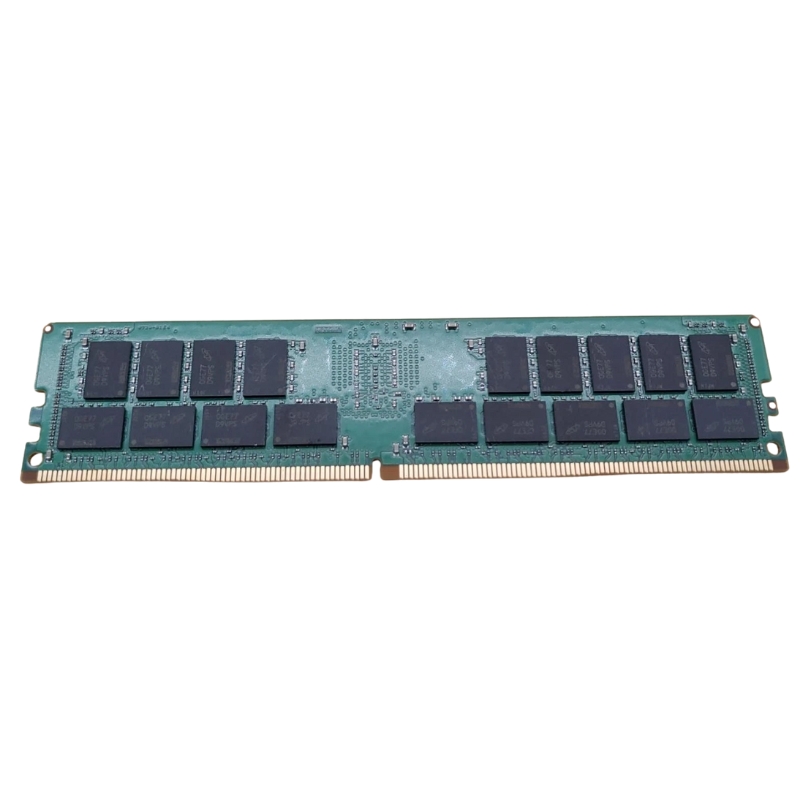
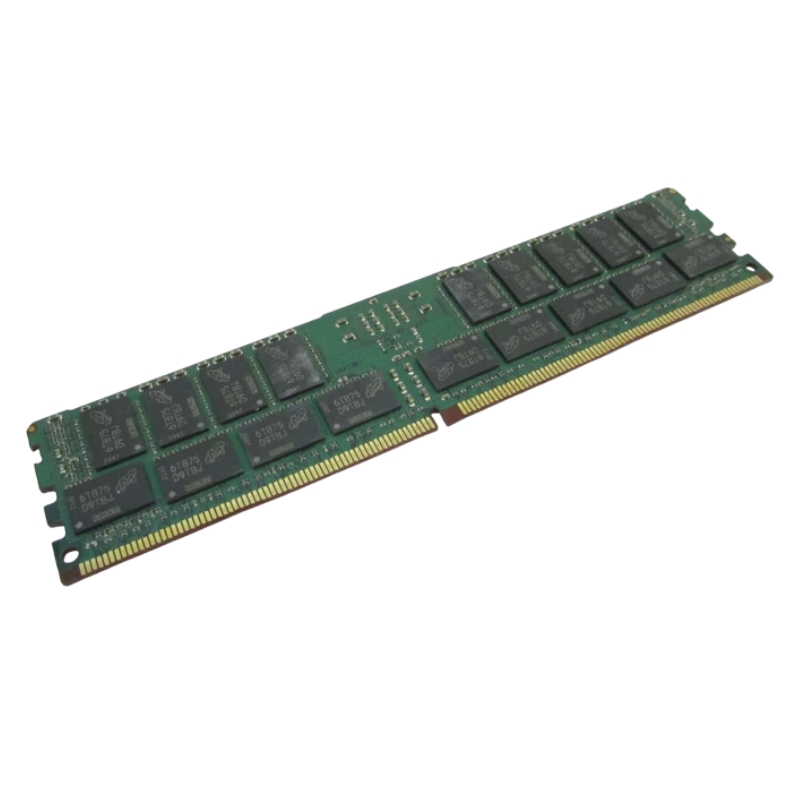
The module uses the standard 288-pin RDIMM form factor, measuring approximately 133.35mm in length. The edge connector has a single notch (key) located off-center to prevent insertion into an incompatible motherboard slot (e.g., a DDR3 or UDIMM slot). This physical keying is a foolproof method to ensure correct installation. The PCB (Printed Circuit Board) is typically a multi-layer design with precise trace routing to maintain signal integrity at high speeds. The components are soldered using high-reliability processes to withstand the vibration and thermal cycling common in data center environments. The module is designed for easy insertion and removal using the ejector tabs on either end of the DIMM slot.


 Contact Us
 Information
 Catalog
 Solid State Drives (SSD)
 Network Switches
 Hard Disk Drives
 HBA & Controllers
 PC & Servers
 PC & Server Memory
 CPU & Processors
 Network Routers
 Power Supplies
 Tape Drives & Libraries
 Network Devices
 Computer & Network Cables