
(7% discount is applied at checkout)
Cart is empty
Your go-to destination for cutting-edge server products
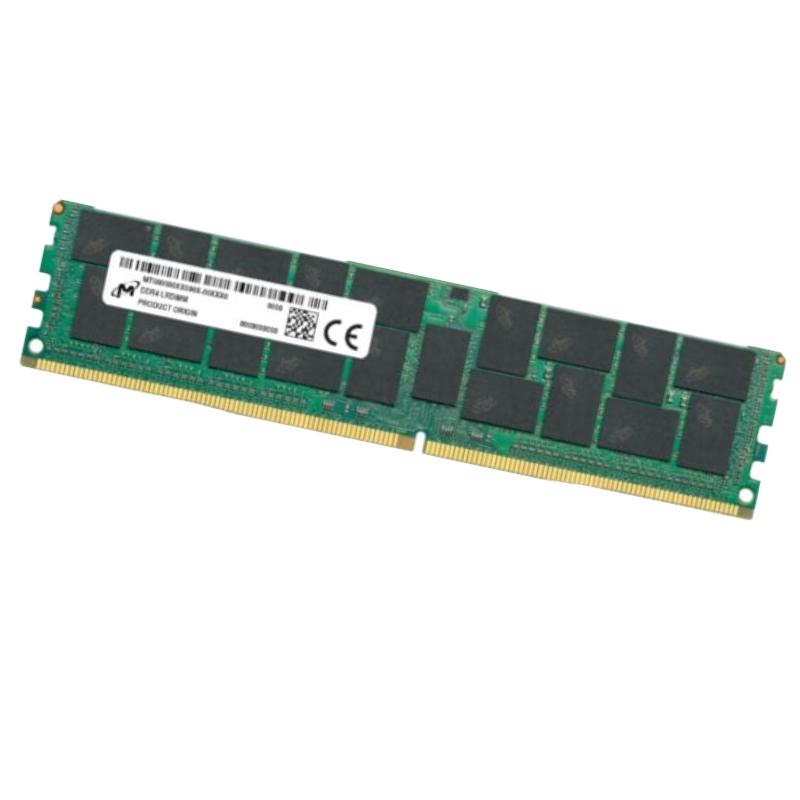
Micron MTA72ASS8G72PSZ-2S6 64GB PC4-21300 DDR4 2666MHz Registered Memory Module. New (System) Pull with 1-Year Replacement Warranty
The Micron MTA72ASS8G72PSZ-2S6 is a high-capacity 64GB DDR4 Registered Memory Module designed for enterprise-grade performance and reliability. This advanced component ensures seamless multitasking, stability, and efficiency in demanding computing environments.
The Micron MTA72ASS8G72PSZ-2S6 64GB PC4-21300 DDR4 2666MHz Registered Memory Module belongs to a critical category of enterprise-grade server memory designed to meet the demanding requirements of modern data centers, virtualization platforms, cloud infrastructures, and mission-critical computing systems. This category focuses on high-capacity, high-reliability registered DIMMs engineered to support consistent performance under sustained workloads, making them a foundational component in scalable server architectures.
Registered memory modules, commonly referred to as RDIMMs, are distinct from unbuffered memory due to the inclusion of a register between the memory controller and the DRAM chips. This design characteristic allows servers to support higher memory densities and larger total memory capacities without compromising signal integrity. As data-intensive applications continue to evolve, memory modules in this category are optimized to deliver both stability and efficiency in multi-processor and multi-channel environments.
DDR4 memory represents a significant advancement in system memory architecture, and this category fully leverages its capabilities. Operating at a standard voltage of 1.2V, DDR4 memory modules offer reduced power consumption compared to previous generations, while also supporting increased data transfer rates. The PC4-21300 classification indicates a theoretical peak bandwidth of 21.3 GB/s per module, making this category well-suited for applications requiring fast and predictable memory access.
Within enterprise servers, DDR4 memory plays a vital role in supporting parallel processing, large dataset manipulation, and memory-intensive workloads such as database management, virtualization, and real-time analytics. The Micron MTA72ASS8G72PSZ-2S6 falls into a subcategory that emphasizes high-capacity configurations, enabling fewer modules to deliver more memory per channel and improving overall system efficiency.
The 2666MHz operating frequency positions this memory category at an optimal balance between performance and compatibility. Many enterprise-grade processors and server chipsets are designed to operate efficiently at this speed, ensuring stable operation without the need for overclocking or specialized firmware configurations. This frequency supports faster data transfers between the CPU and memory, reducing latency in memory-bound workloads.
In environments where predictable performance is more important than peak benchmark results, memory modules in the 2666MHz category provide consistent throughput across extended uptime periods. This makes them ideal for systems running continuously, such as application servers, file servers, and virtualization hosts.
The 64GB capacity of the Micron MTA72ASS8G72PSZ-2S6 places it within a category of high-density memory modules designed to maximize memory availability per DIMM slot. This approach allows system architects to achieve large total memory capacities while minimizing the number of physical modules installed. Fewer modules can translate into improved airflow, reduced power consumption, and simplified system maintenance.
High-density memory categories are particularly valuable in dual-socket and quad-socket server platforms where DIMM slot availability may be limited. By deploying 64GB registered modules, organizations can scale memory to hundreds or even terabytes without requiring full population of all slots, leaving room for future expansion.
Memory-intensive workloads such as in-memory databases, enterprise resource planning systems, and virtualization platforms benefit significantly from high-capacity memory modules. In these scenarios, having ample memory reduces reliance on slower storage-based caching mechanisms and enables more data to reside directly in RAM, improving response times and system responsiveness.
Virtualization hosts, in particular, rely heavily on memory capacity to support multiple virtual machines simultaneously. Memory modules in this category allow administrators to allocate sufficient RAM to each virtual instance without oversubscribing resources, resulting in more predictable performance and reduced contention.
Registered memory modules differ fundamentally from unbuffered DIMMs through the use of a register that buffers address and command signals. This architectural feature is central to the category in which the Micron MTA72ASS8G72PSZ-2S6 resides. By reducing the electrical load on the memory controller, RDIMMs enable systems to support more memory modules per channel and higher total capacities.
Signal integrity is a critical consideration in server environments where multiple DIMMs operate simultaneously at high speeds. The register acts as an intermediary, ensuring that signals are clean and well-timed as they propagate through the memory subsystem. This results in improved stability, particularly in systems with large memory footprints.
Memory modules in this category are designed with broad compatibility in mind, aligning with industry standards for DDR4 registered memory. This ensures seamless integration with a wide range of server motherboards and processor platforms that support DDR4 RDIMMs. Compatibility testing and validation are essential aspects of this category, minimizing the risk of deployment issues.
The Micron MTA72ASS8G72PSZ-2S6 is representative of memory modules that are engineered to meet strict electrical and timing specifications, allowing them to function reliably across different system configurations. This flexibility is valuable for organizations managing heterogeneous server fleets or planning phased hardware upgrades.
As applications grow in complexity and data volumes increase, memory requirements continue to rise. High-capacity RDIMM categories provide a scalable foundation that allows systems to adapt to future demands without requiring complete hardware replacements. By selecting memory modules that support large capacities, organizations can extend the useful life of their server investments.
The Micron MTA72ASS8G72PSZ-2S6 exemplifies this scalable approach, fitting into a category that supports gradual expansion and evolving workload requirements. This makes it a strategic choice for long-term infrastructure planning.
Memory modules in this category adhere to stringent enterprise standards for quality and reliability. Extensive testing, validation, and quality assurance processes ensure that each module meets defined performance and durability criteria. This focus on quality reduces the risk of early failures and contributes to overall system resilience.
By aligning with established DDR4 and RDIMM specifications, this category ensures interoperability and predictable behavior across diverse server platforms. This standardization is a cornerstone of enterprise computing, enabling organizations to deploy and manage systems with confidence.


 Contact Us
 Information
 Catalog
 Solid State Drives (SSD)
 Network Switches
 Hard Disk Drives
 HBA & Controllers
 PC & Servers
 PC & Server Memory
 CPU & Processors
 Network Routers
 Power Supplies
 Tape Drives & Libraries
 Network Devices
 Computer & Network Cables