
(7% discount is applied at checkout)
Cart is empty
Your go-to destination for cutting-edge server products
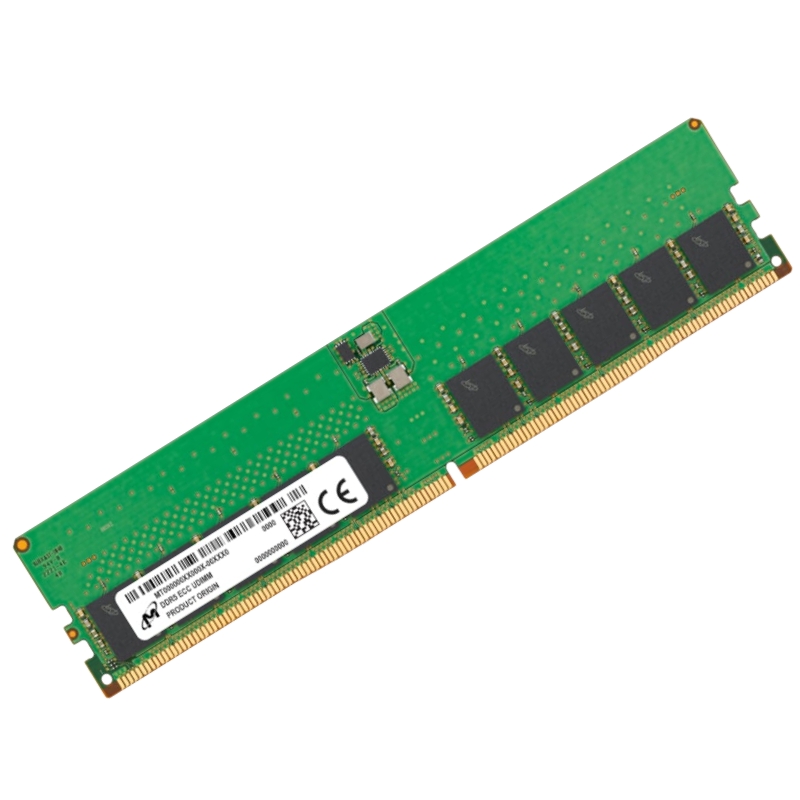
Micron MTC20C2085S1EC56BR 32GB 5600MT/s PC5-44800 ECC CL46 Unbuffered Dual Rank X8 DDR5 SDRAM 288-Pin Udimm Memory Module. New Sealed in Box (NIB) with 3 Year Warranty
The Micron MTC20C2085S1EC56BR is a high-performance 32GB DDR5 ECC desktop memory module designed for professional workloads, advanced computing and demanding multitasking environments. With fast 5600MT/s data rate, robust error correction and dual-rank architecture, it delivers reliable and efficient operation for compatible servers and workstations.
The Micron MTC20C2085S1EC56BR 32GB DDR5 ECC Unbuffered UDIMM belongs to a specialized category of system memory engineered for professional computing environments where data integrity, electrical efficiency, and sustained performance are mandatory requirements. This category bridges the gap between consumer-grade DDR5 desktop memory and fully registered server DIMMs, offering error correction and enterprise-level reliability in a form factor compatible with a wide range of workstation and entry-level server platforms.
DDR5 ECC UDIMM memory modules are designed to support modern processors that integrate memory controllers capable of handling on-die ECC and external ECC logic without the complexity of registered buffering. This category is increasingly relevant for content creation systems, scientific workstations, virtualization hosts, database appliances, and edge computing deployments that demand dependable memory behavior under continuous load conditions.
The transition from DDR4 to DDR5 represents a significant architectural leap in memory subsystem design, particularly within ECC-enabled unbuffered modules. DDR5 introduces dual independent 32-bit subchannels per DIMM, improving memory access efficiency and reducing latency under parallel workloads. In ECC UDIMM configurations, this architecture enhances error detection and correction processes by enabling more granular access paths while maintaining compatibility with workstation-class chipsets.
Micron’s DDR5 ECC UDIMM category incorporates on-die error correction in addition to traditional ECC at the module level. This layered approach strengthens reliability by addressing transient faults within the DRAM silicon itself before they propagate to the system. The MTC20C2085S1EC56BR exemplifies this advancement by combining Micron’s validated DRAM dies with enterprise-grade module engineering.
Error Correcting Code memory plays a critical role in safeguarding data integrity by detecting and correcting single-bit memory errors in real time. In ECC UDIMM modules, this functionality is implemented without the use of a register or buffer between the memory controller and the DRAM chips. This design choice preserves lower latency characteristics while still delivering protection against common memory faults caused by electrical interference, cosmic radiation, or component aging.
The category of DDR5 ECC UDIMM memory is particularly suitable for systems that prioritize accuracy over extreme capacity scaling. Unlike RDIMM or LRDIMM solutions, ECC UDIMMs are optimized for single-socket platforms and moderate memory densities, making them ideal for professional desktops and compact servers that require stability without the overhead of registered signaling.
Operating at a data rate of 5600 megatransfers per second, PC5-44800 DDR5 memory modules deliver a substantial bandwidth increase compared to previous generations. This performance class is well suited for applications that rely on high-throughput memory access, including real-time data processing, simulation workloads, and multi-threaded compilation tasks.
The Micron MTC20C2085S1EC56BR module adheres to JEDEC specifications for DDR5-5600 operation, ensuring predictable performance and broad compatibility. Within this category, standardized timings such as CAS Latency 46 are balanced against the increased frequency to provide effective real-world responsiveness in professional workloads.
Higher memory bandwidth directly impacts workloads that process large datasets or perform frequent memory transactions. DDR5-5600 ECC UDIMM modules enable faster data movement between the CPU and system memory, reducing bottlenecks in tasks such as 3D rendering, video encoding, and computational modeling. The dual-channel architecture intrinsic to DDR5 further enhances throughput when multiple cores access memory concurrently.
This category of memory is particularly beneficial for systems running modern multi-core processors, where memory bandwidth scalability is essential to fully utilize available compute resources. By pairing ECC protection with high-speed DDR5 operation, these modules support both performance and reliability objectives.
A 32GB capacity per module represents an optimal balance between memory density and system expandability within the ECC UDIMM category. Dual rank configurations, such as the one implemented in the Micron MTC20C2085S1EC56BR, allow the memory controller to interleave access across ranks, improving effective bandwidth and access efficiency under load.
Dual rank x8 organization is widely supported across workstation and server-grade platforms, offering compatibility and performance advantages without introducing excessive electrical loading. This configuration supports higher sustained throughput compared to single rank modules, particularly in multi-threaded scenarios.
Systems designed around ECC UDIMM memory typically support multiple DIMM slots per channel, enabling scalable memory configurations up to platform-defined limits. Using 32GB modules allows system integrators and IT professionals to populate fewer slots while achieving substantial total memory capacity, which can be advantageous for airflow, power efficiency, and future upgrades.
This category is well suited for environments where memory reliability and moderate scalability are required, such as virtualization hosts running multiple virtual machines or database servers handling transactional workloads.
Unbuffered DIMMs connect directly to the memory controller, eliminating the latency introduced by register or buffer components. In DDR5 ECC UDIMM modules, advanced signal integrity techniques and improved power delivery designs mitigate the challenges traditionally associated with unbuffered architectures at high frequencies.
Micron’s engineering within this category emphasizes precise PCB layout, optimized trace routing, and stringent validation processes. These factors ensure stable operation at DDR5-5600 speeds while maintaining ECC functionality and compliance with JEDEC standards.
While CAS Latency values such as CL46 may appear higher than previous-generation memory, the increased clock frequency of DDR5 results in comparable or improved absolute latency measured in nanoseconds. For professional workloads, this translates into responsive system behavior and consistent performance under sustained memory access patterns.
The ECC UDIMM category prioritizes predictable latency and stability over aggressive tuning, making it suitable for systems where uptime and data accuracy are critical.
DDR5 ECC UDIMM modules utilize the standardized 288-pin form factor, ensuring compatibility with modern motherboards designed for DDR5 memory. This category requires platform support for ECC UDIMM operation, which is typically found in workstation-class chipsets and select server platforms.
The physical keying and voltage requirements of DDR5 differ from previous generations, preventing accidental installation in incompatible slots. This design promotes system integrity and simplifies deployment for IT professionals and system builders.
DDR5 introduces on-module power management through an integrated Power Management IC, shifting voltage regulation from the motherboard to the DIMM itself. This advancement improves power delivery efficiency and reduces electrical noise, contributing to overall system stability.
Within the ECC UDIMM category, this feature supports consistent operation under varying load conditions, which is essential for professional systems that run continuously.
Enterprise and workstation memory categories prioritize long product lifecycles and stable supply chains. Micron’s DDR5 ECC UDIMM offerings are designed to remain available over extended periods, supporting system standardization and reducing the need for frequent requalification.
This characteristic is particularly valuable for organizations managing fleets of workstations or servers, where consistency across hardware configurations simplifies maintenance and support.
ECC UDIMM memory operates transparently at the operating system level, providing error correction without requiring specialized software configuration. Modern operating systems and professional applications are designed to take advantage of stable memory subsystems, reducing the risk of crashes and data corruption.
This category aligns with enterprise software requirements, making it a reliable foundation for systems running continuous workloads.
DDR5 memory modules are engineered to operate efficiently within defined thermal envelopes. The Micron ECC UDIMM category incorporates materials and designs that facilitate heat dissipation, supporting stable operation even in compact workstation enclosures.
Proper airflow and system-level cooling remain important considerations, particularly in multi-DIMM configurations. However, the power efficiency improvements introduced with DDR5 contribute to manageable thermal profiles in professional systems.


 Contact Us
 Information
 Catalog
 Solid State Drives (SSD)
 Network Switches
 Hard Disk Drives
 HBA & Controllers
 PC & Servers
 PC & Server Memory
 CPU & Processors
 Network Routers
 Power Supplies
 Tape Drives & Libraries
 Network Devices
 Computer & Network Cables