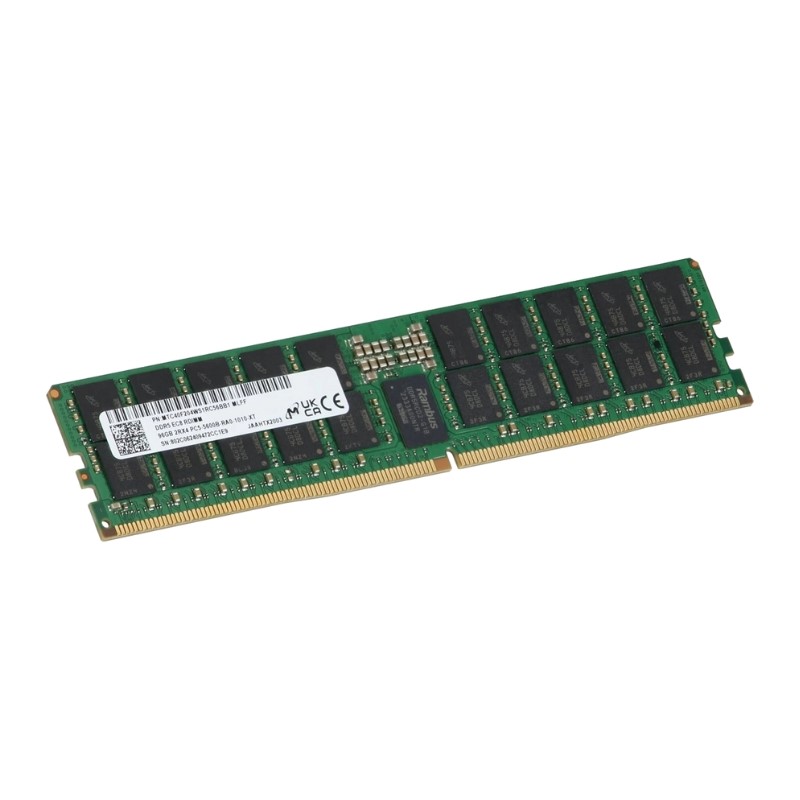
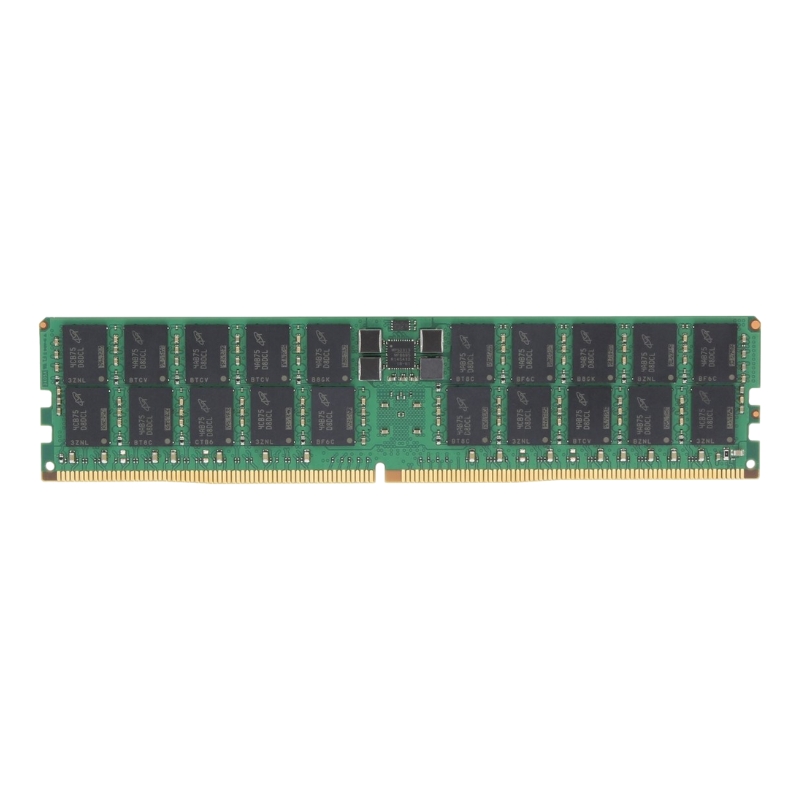
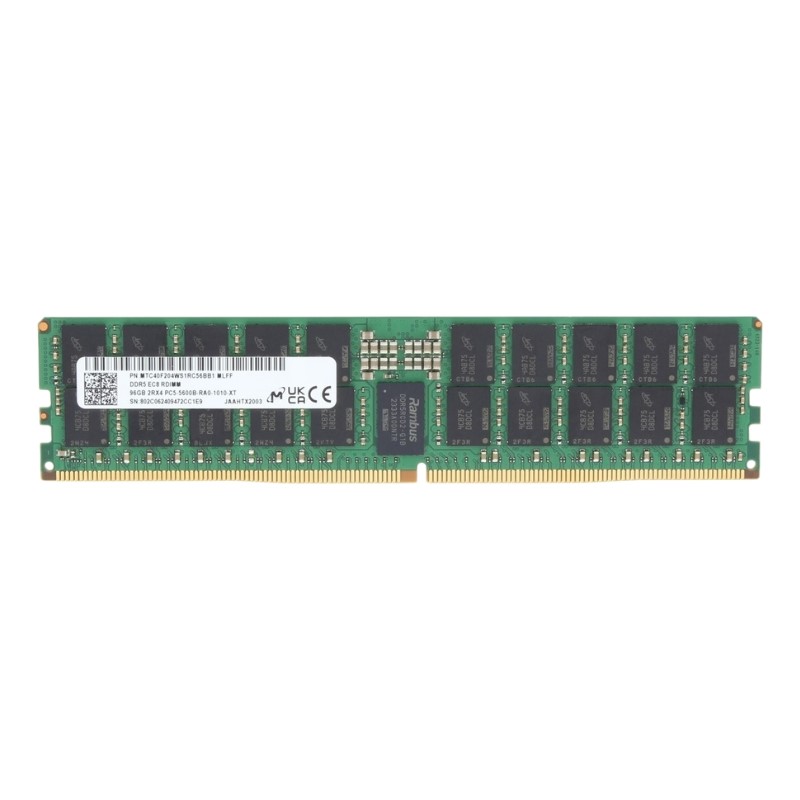
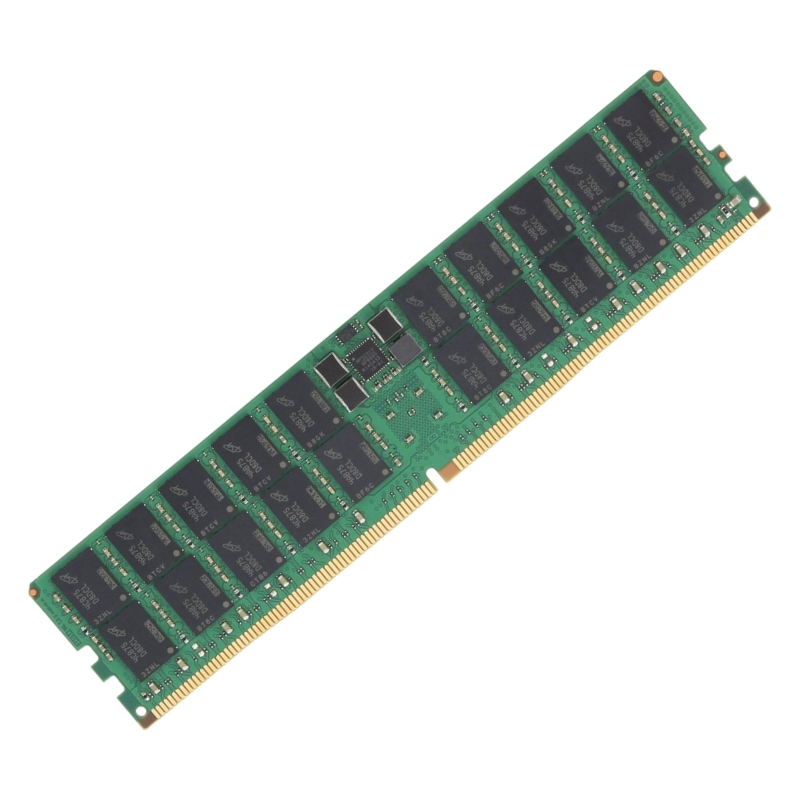
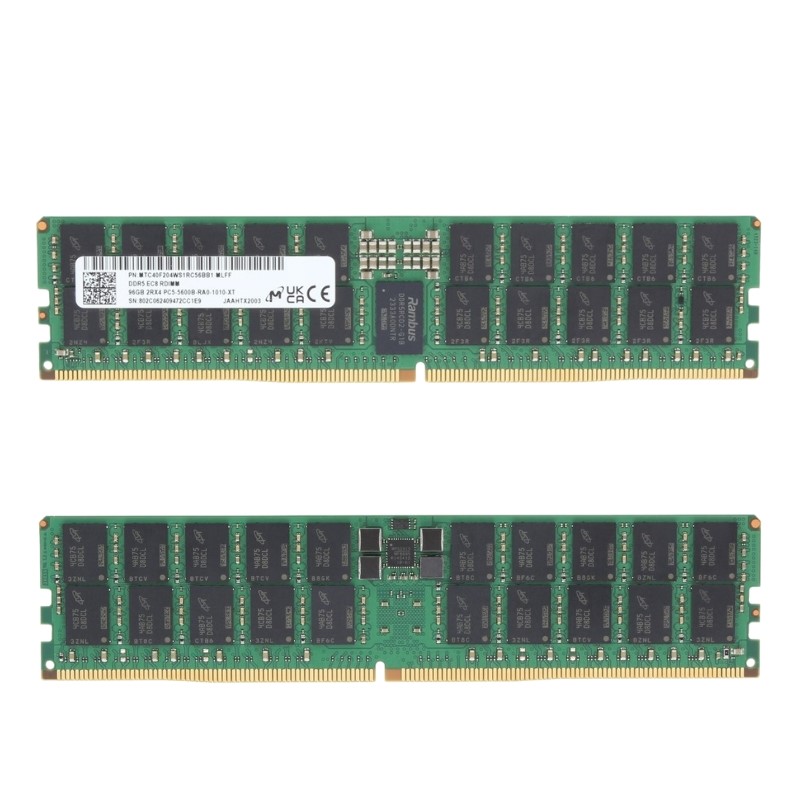
Micron MTC40F204WS1RC64BC1 96GB 6400mhz Pc5-51200 Memory Module.
- — Free Ground Shipping
- — Min. 6-month Replacement Warranty
- — Genuine/Authentic Products
- — Easy Return and Exchange
- — Different Payment Methods
- — Best Price
- — We Guarantee Price Matching
- — Tax-Exempt Facilities
- — 24/7 Live Chat, Phone Support
- — Visa, MasterCard, Discover, and Amex
- — JCB, Diners Club, UnionPay
- — PayPal, ACH/Bank Transfer (11% Off)
- — Apple Pay, Amazon Pay, Google Pay
- — Buy Now, Pay Later - Affirm, Afterpay
- — GOV/EDU/Institutions PO's Accepted
- — Invoices
- — Deliver Anywhere
- — Express Delivery in the USA and Worldwide
- — Ship to -APO -FPO
- — For USA - Free Ground Shipping
- — Worldwide - from $30
Micron MTC40F204WS1RC64BC1 96GB DDR5 RDIMM — High-Performance Server Memory
Boost multi-core workloads and virtualized environments with the Micron MTC40F204WS1RC64BC1 memory module. This 96GB (1x96GB) DDR5 SDRAM stick delivers fast 6400 MT/s (DDR5-6400 / PC5-51200) throughput, ECC reliability, and registered (RDIMM) signal buffering for stable, enterprise-grade performance at just 1.1V operating voltage.
Key Highlights at a Glance
- Capacity: 96GB single module (1x96GB)
- Speed Grade: DDR5-6400 / PC5-51200
- Latency: CL52 for responsive memory access
- Error Protection: ECC (Error-Correcting Code)
- Buffering: Registered (RDIMM) for superior signal integrity
- Rank Layout: Dual Rank (2R x4)
- Voltage: 1.1V for improved power efficiency
- Interface: 288-pin RDIMM
- Manufacturer: Micron | MPN: MTC40F204WS1RC64BC1
Product Overview
The Micron MTC40F204WS1RC64BC1 is purpose-built for modern servers and workstations that demand higher bandwidth, lower latency, and enhanced data integrity. With DDR5 technology, on-module power management, and ECC, it helps administrators scale memory-bound applications while minimizing downtime.
General Information
Manufacturer Details
- Brand: Micron
- Manufacturer Part Number (MPN): MTC40F204WS1RC64BC1
- Product Name: 96GB DDR5 SDRAM RDIMM Memory Module
Technical Specifications
Core Specs
- Total Capacity: 96GB
- Module Count: 1 (single stick)
- Memory Generation: DDR5 SDRAM
- Data Rate / Bandwidth: 6400 MT/s (PC5-51200)
- CAS Latency: CL52
- Error Handling: ECC for automatic single-bit error correction
- Buffering Type: Registered (RDIMM)
- Rank Configuration: Dual Rank, x4 organization
- Operating Voltage: 1.1V
- Pin Count / Interface: 288-pin RDIMM
Performance Advantages
- Higher throughput: DDR5-6400 speed accelerates memory-intensive tasks.
- Improved stability: Registered buffering and ECC safeguard against signal noise and soft errors.
- Power efficiency: 1.1V operation helps reduce thermal output and energy consumption.
- Scalability: 96GB per module simplifies capacity upgrades without occupying multiple DIMM slots.
Reliability & Uptime
- ECC protection minimizes data corruption risk in mission-critical environments.
- Micron-grade quality ensures rigorous validation for server platforms.
- Consistent latency helps maintain predictable application performance under heavy load.
Physical Characteristics
- Form Factor: 288-pin RDIMM
- Shipping Dimensions: 1.00" (H) x 6.75" (D)
- Shipping Weight: 0.20 lb
Compatibility & Platform Guidance
Platform Fit
- Designed for server-class motherboards supporting DDR5 RDIMMs.
- Ideal for platforms that accept dual-rank x4 ECC registered modules.
- Not intended for consumer desktops that require UDIMM or SODIMM formats.
Before You Install
- Confirm BIOS/UEFI supports DDR5-6400 RDIMM speeds and 96GB densities.
- Update firmware to the latest vendor-approved release for best compatibility.
- Mixing different capacities, speeds, or ranks may down-clock to the slowest common configuration.
Use Cases & Benefits
Data-Heavy Applications
- In-memory databases: Faster query response and improved concurrency.
- Virtual machines & containers: Higher consolidation ratios per host.
- Analytics pipelines: Smoother ETL, caching, and batch processing.
Creative & Engineering Workloads
- Rendering & VFX: Handle large scenes and complex timelines.
- CAD/CAE: Manage expansive assemblies and simulations without frequent paging.
- Video editing: Comfortable headroom for multi-stream 4K/8K workflows.
Summary
The Micron MTC40F204WS1RC64BC1 96GB DDR5-6400 ECC Registered RDIMM delivers a powerful combination of capacity, bandwidth, and reliability. With CL52 latency, dual-rank x4 design, and 1.1V efficiency, it’s an excellent upgrade for enterprise servers and professional workstations that need dependable, high-throughput memory.
Alternate Search Phrases
- Micron 96GB DDR5-6400 ECC RDIMM
- MTC40F204WS1RC64BC1 server memory
- 96GB PC5-51200 registered DIMM
- DDR5 288-pin ECC RAM module
Micron MTC40F204WS1RC64BC1 96GB Memory Module
The Micron MTC40F204WS1RC64BC1 96 GB 6400 MHz PC5-51200 ECC Registered Dual Rank 288-pin memory module represents a high-capacity DDR5 RDIMM engineered for servers, workstations, and mission-critical computing. This category covers the unique advantages of ECC Registered DIMMs, ideal deployment scenarios, performance characteristics at 6400 MT/s, and practical guidance for configuration, compatibility, and maintenance. Whether you are expanding a multi-socket server for database workloads or outfitting a professional workstation for virtualization and content creation, this comprehensive overview helps you evaluate, select, and implement Micron’s 96 GB DDR5 RDIMM for stable high-throughput memory subsystems.
Primary Use Cases
- Database servers handling large in-memory caches (OLTP/OLAP), columnar analytics, and HTAP scenarios.
- Virtualization platforms (KVM, Hyper-V, VMware) consolidating many VMs per host and leveraging memory overcommit strategies.
- High-performance computing (HPC) nodes running scientific simulations, numerical methods, and Monte Carlo workloads.
- Professional content creation and post-production (VFX compositing, 3D rendering, 8K video editing, CAD/CAE).
- In-memory data processing frameworks (Spark, Flink) and distributed caching (Redis, Memcached) at scale.
- AI/ML training orchestration hosts, data loaders, and feature stores that benefit from capacious system RAM.
Key Characteristics of Micron MTC40F204WS1RC64BC1
This category centers on a DDR5 RDIMM with the following positioning: 96 GB capacity, 288-pin form factor, ECC with on-die parity features typical to DDR5, and a Registered (buffered) design aimed at server-class motherboards. The PC5-51200 designation describes the theoretical peak bandwidth (64-bit data bus × 6400 MT/s), aligning with modern multi-core CPUs that demand high sustained memory throughput. Dual-rank topology can improve bank-level parallelism, aiding workloads that interleave memory transactions across ranks.
ECC and Data Integrity Advantages
- Single-bit error correction, multi-bit detection: Helps maintain correctness during long-running tasks.
- Enhanced reliability for 24×7 operation: Reduces the risk of silent data corruption that could propagate to storage or analytics results.
- Improved service availability: Diminishes the frequency of crashes or application anomalies attributable to memory faults.
Technical Overview and Terminology
Understanding the naming conventions helps with cross-shopping, compatibility checks, and fleet planning. “MTC40F204WS1RC64BC1” is Micron’s specific part code denoting device generation, density configuration, speed bin, and packaging. “96 GB” states the per-module capacity; “6400 MT/s” or “PC5-51200” signals the speed grade; “ECC Registered” differentiates it from unbuffered consumer DIMMs; and “288-pin” indicates the physical connector standard for DDR5. “Dual Rank” refers to two memory ranks on one module, a factor that influences controller scheduling and, in many cases, sustained bandwidth characteristics.
Form Factor and Physical Design
- Standard 288-pin DDR5 RDIMM: Designed for server/workstation boards with RDIMM support.
- Module height and thermal profile: Fits most standard chassis; verify cooler clearance in dense rack servers.
- High-quality PCB layout and components: Optimized trace routing and power delivery to support 6400 MT/s.
How DDR5 RDIMMs Differ from DDR4
DDR5 introduces architectural advances over DDR4, including on-DIMM power management (PMIC), dual 32-bit sub-channels per DIMM for improved efficiency, increased bank groups, and higher base speeds. These changes collectively boost throughput and enhance concurrent transaction handling. The RDIMM buffer bolsters signal integrity across multi-DIMM per channel configurations typical in servers. The result is a platform that scales capacity and bandwidth without sacrificing stability.
Compatibility and Platform Considerations
This module targets motherboards and CPUs that explicitly support DDR5 ECC Registered DIMMs. Many server platforms and certain high-end workstation boards accept RDIMMs; mainstream consumer boards usually require unbuffered DIMMs (UDIMMs) and are not compatible with registered modules. Always consult the motherboard’s Qualified Vendor List (QVL) and the CPU memory controller specifications to confirm support for 96 GB RDIMMs at 6400 MT/s. When populating multiple channels, ensure identical speed grades and, preferably, identical part numbers to maximize stability and performance.
Multi-Channel and Multi-Socket Deployments
- Channel population: Follow the vendor’s slot priority to achieve symmetrical interleaving across channels.
- Rank balance: Matching rank counts across channels helps controllers distribute requests efficiently.
- NUMA awareness: On multi-socket systems, bind workloads to local memory nodes to reduce cross-socket latency.
BIOS/UEFI and Firmware Settings
For best results, update to the latest BIOS/UEFI and BMC firmware recommended by the motherboard or server vendor. Many platforms expose memory training parameters, power policies, and RAS controls. Leave timings on “Auto” unless you have vendor-approved settings. Enabling performance presets for memory interleaving and power management can help the controller reach and maintain the 6400 MT/s data rate under full load.
Operating System Compatibility
Modern server and workstation operating systems (Linux distributions, Windows Server editions, and virtualization hypervisors) typically require no special drivers for RDIMMs. However, kernel versions and microcode updates can improve memory management and NUMA scheduling, so keeping the OS current is recommended for large-memory systems.
Bandwidth, Latency, and Scaling
At PC5-51200, theoretical peak bandwidth per 64-bit channel is substantial; real-world bandwidth depends on controller efficiency, channel count, rank interleaving, and workload behavior. Dual-rank RDIMMs often sustain higher effective throughput than single-rank modules due to increased opportunities for command reordering and bank interleaving. Latency is influenced by CAS and secondary/tertiary timings as well as platform microarchitecture; still, the overall performance uplift from 6400 MT/s bandwidth frequently outweighs modest latency differences for bandwidth-heavy tasks.
Workload Profiles That Benefit Most
- Analytics and data science: Large datasets streamed from memory benefit from wider pipes and better parallelism.
- Virtual machines and containers: Dense consolidation per host drives aggregate memory bandwidth needs upward.
- Media and simulation: Frame buffers, point clouds, particle systems, and solver matrices all scale with RAM speed and size.
Scaling With Additional Modules
Adding more 96 GB modules increases total capacity and, on multi-channel architectures, can improve bandwidth utilization. Observe per-channel DIMM limits: populating additional slots may reduce maximum achievable speed on some platforms, particularly at very high densities. Review your motherboard’s memory population guide to balance capacity versus speed for the intended workload.
Power and Thermal Efficiency
DDR5 designs emphasize improved power efficiency per bit transferred. Nevertheless, higher data rates and higher densities draw measurable power. Ensure adequate chassis airflow. In 1U/2U rack enclosures, use baffles and high-pressure fans to maintain a stable inlet temperature across DIMM banks. For tower workstations, verify that front-to-back airflow is unobstructed and that dust filters are clean to prevent thermal throttling and improve component longevity.
Reliability, Availability, Serviceability (RAS) With ECC Registered DIMMs
ECC RDIMMs provide robust protection against soft errors and help maintain uptime for services that cannot tolerate frequent restarts. The register/buffer isolates the memory controller from the electrical load of multiple DRAM chips, improving signal integrity across heavy configurations. Combined with platform RAS features—such as patrol scrubbing, demand scrubbing, and predictive failure analysis—ECC RDIMMs form the backbone of enterprise-class memory subsystems.
Error Handling Best Practices
- Enable logging: Keep system logs for corrected and uncorrected errors; many BMCs expose DIMM health telemetry.
- Perform periodic burn-in/tests: Use vendor-approved memory diagnostics during maintenance windows.
- Replace proactively: If corrected error counts trend upward on a specific DIMM, plan maintenance before failure.
Data Integrity for Critical Applications
Applications such as financial transaction processing, medical imaging, engineering simulation, and source-code compilation pipelines can ill-afford silent corruption. ECC reduces the likelihood of undetected bit flips, safeguarding databases, caches, and compiled artifacts. It also complements RAID or erasure coding at the storage layer by preventing bad data from being written in the first place.
First Boot and Training
- Clear CMOS only if necessary: Most boards self-train; avoid resetting tuned settings unless advised.
- Observe POST codes or BMC logs: Memory training at high speeds can take longer—do not interrupt.
- Verify capacity and speed: Check BIOS/UEFI screens and OS tools to confirm 96 GB per module at the expected data rate.
Firmware and Microcode Updates
Apply the latest BIOS and BMC updates before large rollouts. Firmware refreshes often expand QVL coverage and improve training stability at higher data rates, especially under full population across sockets or channels. In virtualized environments, validate with your hypervisor’s Hardware Compatibility List and test live migration scenarios to confirm stability.
Memory Interleaving and NUMA
Enable channel interleaving for balanced bandwidth. On multi-socket machines, ensure that DIMMs are evenly distributed between CPU sockets to preserve locality. For performance-critical services, use OS-level NUMA pinning to keep threads and their memory allocations on the same node, reducing cross-socket traffic and latency.
Capacity Planning and Sizing Strategy
A 96 GB per-DIMM density offers flexible planning. Four modules yield 384 GB; eight modules provide 768 GB, and so on—subject to platform limits. Choose a capacity overhead that accommodates memory growth, OS/hypervisor reservations, page cache needs, and headroom for bursty demand. Oversubscription in virtualization benefits from larger physical RAM pools to reduce swapping and ballooning events that degrade performance.
Application-Specific Sizing Tips
- Databases: Size to fit hot working sets in memory; leave headroom for parallel queries and background processes.
- Analytics: Ensure dataset partitions and shuffles can stay resident in RAM to minimize disk I/O.
- Render/Simulation: Account for scene assets, caches, solver scratch space, and per-process overhead.
Future-Proofing Considerations
As core counts rise, memory bandwidth per core can become a bottleneck. High-speed DDR5 RDIMMs at 6400 MT/s help maintain balance between compute and memory throughput. Opting for higher per-slot densities simplifies future upgrades by freeing additional slots for expansion without early platform replacement.
Comparisons Within the Category
When evaluating the Micron MTC40F204WS1RC64BC1 against other memory types, consider trade-offs in stability, performance, and cost per gigabyte. ECC Registered modules differ from ECC UDIMMs and non-ECC UDIMMs in electrical characteristics and platform support. RDIMMs are preferred in servers for large capacities and multi-DIMM per channel scaling, whereas UDIMMs suit consumer desktops that cannot accept registered memory.
RDIMM vs. UDIMM
- Signal integrity: RDIMMs use a register to buffer command/address signals, sustaining stability at high density.
- Capacity scaling: RDIMMs reach higher total system memory due to platform design.
- Compatibility: Consumer boards largely require UDIMMs; server/workstation boards often specify RDIMMs.
ECC vs. Non-ECC
ECC detects and corrects single-bit errors and detects many multi-bit patterns, helping to prevent data corruption. Non-ECC modules omit these capabilities, making them less suitable for enterprise or scientific applications where correctness is paramount. ECC’s slight overhead is typically negligible relative to reliability benefits in production systems.
Dual-Rank vs. Single-Rank
Dual-rank modules may deliver higher effective throughput due to improved bank-level parallelism, especially on architectures that capitalize on rank interleaving. Some controllers also show better sustained performance when multiple ranks are available to hide DRAM refresh and activation penalties.
Best Practices for Stable, High-Performance Operation
To extract the most from Micron’s 96 GB 6400 MT/s RDIMM, adhere to a disciplined deployment approach: consistent part numbers across channels, validated BIOS versions, and conservative thermal design. Avoid mixing different speeds or voltages in the same channel. When combining modules of various capacities, ensure that the platform’s interleaving and mapping still operate in a symmetric fashion or accept the performance trade-offs of asymmetric population.
Monitoring and Telemetry
- Leverage BMC/IPMI: Track DIMM temperatures, error counts, and training outcomes after reboots.
- OS tools: Use vendor utilities or open-source tools to watch corrected error rates and memory bandwidth.
- Alerting: Integrate metrics into your monitoring stack (Prometheus, Zabbix) with thresholds for proactive action.
Maintaining Peak Throughput
Pin critical processes to CPU cores local to the memory node holding their data. Use huge pages when appropriate to reduce TLB pressure. For analytics frameworks, tune executor memory allocations to minimize garbage collection pauses while maximizing in-RAM processing. Keep page cache healthy by balancing workload I/O and buffer sizes, preventing memory thrash.
Power Policies
Some servers allow selectable memory power modes. Performance-oriented policies sustain higher data rates under load; balanced modes reduce power at the potential cost of marginal throughput. Choose according to service-level objectives and datacenter power budgets. Measure before and after changes to quantify impacts on latency and bandwidth.
Stress Testing After Deployment
Run memory diagnostics during maintenance windows to validate new installations. For production workloads, stage changes in a canary environment. Observe performance counters and error logs across 24–72 hours under representative load. Establish a baseline and compare against it after firmware or configuration changes.
RMA and Support Hygiene
Record module serial numbers and slot mappings at install time. Maintain a change log recording BIOS versions, hardware swaps, and environmental adjustments. This documentation streamlines vendor support interactions and shortens mean time to resolution in the event of a fault.
Security and Compliance Considerations
While memory modules themselves do not enforce application-layer security, reliable ECC operation reduces the probability of memory faults that could complicate forensics or incident response. For regulated environments, stable hardware underpins auditability and consistent system behavior. Pair high-quality RDIMMs with secure boot, firmware signing, and proper OS hardening to meet compliance requirements.
Firmware Supply Chain Hygiene
- Signed updates: Apply BIOS/BMC updates from authenticated sources.
- Change control: Schedule updates with rollback plans and test windows.
- Inventory management: Track DIMM part numbers and firmware dependencies across fleets.
Physical Security
In shared colocation environments, ensure that chassis and rails are secured and that only authorized personnel can access the server internals. Proper handling reduces ESD risks and accidental dislodging of DIMMs during adjacent maintenance.
Optimization for Specific Workloads
Workloads differ in how they stress memory subsystems. Tailoring configuration parameters to each domain can yield measurable benefits. Below are domain-specific notes to extract more performance from the Micron 96 GB DDR5 RDIMM category.
Databases and Data Warehousing
- Buffer pool sizing: Align buffer pools to fit frequently accessed indexes and tables entirely in RAM.
- Parallel query tuning: Adjust worker counts to balance CPU saturation against memory concurrency.
- NUMA-aware sharding: Allocate shards per socket to minimize cross-node memory traffic.
Virtualization and Containers
Assign vNUMA topology to match physical sockets and channels. Limit memory ballooning for latency-sensitive VMs. Use large pages for hypervisors that support them and reserve overhead for host services, migration buffers, and orchestration agents.
Media, VFX, and CAD/CAE
Large textures, geometry caches, simulation grids, and multi-layer timelines thrive on high-bandwidth RAM. Place scratch caches on rapid local NVMe but keep working assets in memory during active sessions. Tune application caches to exploit the increased capacity per slot that 96 GB modules provide.
AI/ML Data Infrastructure
- Feature store caching: Keep preprocessed features resident to reduce I/O overhead during training epochs.
- Data loader parallelism: Increase prefetch threads cautiously to avoid starving the CPU cache hierarchy.
- Parameter server and orchestration nodes: Benefit from higher RAM footprints to buffer gradients and checkpoints.
Procurement and Lifecycle Management
For enterprise rollouts, standardize on a specific Micron part number to simplify spares and firmware compatibility. Validate a reference configuration, document it, and replicate across nodes. Stagger purchases to align with depreciation cycles and to accommodate incremental capacity increases as workloads grow. Keep a small pool of identical spare modules for rapid replacement.
Cost-Effectiveness and TCO
Although ECC RDIMMs command a premium over consumer memory, the total cost of ownership often favors enterprise modules due to reduced downtime, fewer incidents, and consistent performance. Higher per-slot density mitigates the need for larger chassis or additional nodes in some scenarios, lowering power, cooling, and licensing expenses per workload.
Vendor Qualification and Testing
- QVL alignment: Choose boards and CPUs with explicit validation for 96 GB RDIMMs at 6400 MT/s.
- Environmental testing: Validate thermal behavior in the exact rack and airflow pattern you will deploy.
- Application soak: Run real workloads, not just synthetic tests, before fleet rollouts.
Glossary of Relevant Terms
- RDIMM (Registered DIMM): A memory module with a register/buffer for command/address signals, enhancing signal integrity for servers.
- ECC (Error-Correcting Code): Mechanism that detects and corrects certain memory errors to protect data integrity.
- DDR5: The fifth generation of double data rate synchronous DRAM with higher bandwidth and efficiency than DDR4.
- PC5-51200: Marketing shorthand indicating ~51,200 MB/s theoretical bandwidth per module at 6400 MT/s.
- MT/s: Mega-transfers per second; the preferred measure of DDR transfer rate.
- Dual Rank: Two ranks of memory on a single module, potentially enabling better parallelism.
- NUMA: Non-Uniform Memory Access; architecture where memory is local to each CPU socket.
- PMIC: On-DIMM power management integrated circuit used in DDR5.
Deployment Patterns and Real-World Scenarios
Enterprises frequently choose 96 GB RDIMMs to elevate node capacity without exhausting DIMM slots. In a dual-socket server with eight memory channels per socket, populating one 96 GB module per channel yields substantial RAM with optimal interleaving. For memory-bound analytics or caching tiers, stepping up from smaller capacities reduces cache misses and disk thrash. In render farms, higher per-workstation memory allows larger scene assemblies and higher fidelity simulation without spilling to disk, accelerating turnarounds.
Hybrid Storage and Memory Strategies
- NVMe + RAM synergy: Use fast NVMe scratch alongside ample RAM to buffer working sets.
- Tiering: Combine DRAM with persistent memory or high-speed SSDs to balance cost and performance.
- Compression caches: Memory-resident compression can multiply effective capacity for compressible datasets.
Scaling Out vs. Scaling Up
Deciding whether to scale out (more nodes) or scale up (more memory per node) depends on licensing, workload distribution, and operational complexity. High-density RDIMMs like this 96 GB module facilitate scaling up, which can lower network overhead and simplify orchestration in certain architectures. Conversely, microservices that shard naturally may prefer scale-out; even then, generous per-node RAM reduces remote calls and tail latency.
Environmental and Mechanical Considerations
In dense racks, airflow direction and pressure matter. Verify that air flows unimpeded across DIMM banks and that cable management does not obstruct intake paths. Employ temperature monitoring within the chassis; many BMCs can trigger alerts if DIMM temperatures approach thresholds. For field deployments in harsh environments, factor in dust filtration and periodic maintenance schedules to preserve thermal headroom over time.
Handling and ESD Precautions
- Store modules in anti-static packaging until installation.
- Avoid touching contacts; hold by the edges of the PCB.
- Use ESD straps or mats in environments with low humidity or carpeting.
Lifecycle and Decommissioning
Track module installation dates and error histories. When decommissioning systems, retain high-quality RDIMMs as spares if they pass diagnostics. Wipe any system configuration data, perform a final test, and label modules accurately for redeployment or resale.
Content-Rich Category Keywords and Synonyms
Micron 96 GB DDR5 RDIMM, ECC Registered memory, PC5-51200 6400 MT/s, dual-rank server RAM, enterprise DDR5 288-pin module, data center memory upgrade, workstation ECC RAM, high-bandwidth DDR5, error-correcting memory module, server-grade registered DIMM, memory for virtualization, database server memory, HPC DDR5 RDIMM, professional workstation RAM, reliable ECC registered 96 GB DIMM, Micron server memory module.
Long-Tail Search Phrases to Capture Buyer Intent
- “96 GB DDR5 ECC Registered RDIMM for server motherboard”
- “Micron MTC40F204WS1RC64BC1 compatibility with DDR5 server boards”
- “Best 6400 MT/s ECC memory for virtualization host”
- “Dual-rank DDR5 RDIMM for HPC and analytics”
- “PC5-51200 ECC registered memory for professional workstation”
Disaster Recovery and High Availability
Reliable memory contributes to resilient services. For systems participating in high availability clusters or active-active replication, stable ECC RDIMMs reduce avoidable failovers triggered by memory faults. In DR runbooks, ensure that standby nodes mirror the primary’s memory configuration so that failover performance remains consistent with production.
Performance Validation Checklist
- Confirm channel interleaving and NUMA balance.
- Run representative application benchmarks, not just synthetic tests.
- Monitor memory bandwidth counters and LLC miss rates.
- Test long-duration workloads to detect thermal drift or training edge cases.
Integration With Modern Server Architectures
Contemporary CPUs feature expansive memory controllers with multiple channels and advanced schedulers. The 96 GB dual-rank RDIMM at 6400 MT/s aligns with these controllers to feed high core counts with ample bandwidth. As software increasingly exploits parallelism—through multi-threading, vectorization, and task-based runtimes—sustained memory throughput becomes foundational to predictable performance.
Consistency Across Fleets
Standardizing on a single vendor and part number across hosts reduces variance and simplifies troubleshooting. Identical DIMM characteristics mean predictable training, uniform thermals, and stable performance, making capacity planning and performance modeling more accurate.
Practical Buying Scenarios
Small teams scaling a virtualization host can start with four 96 GB modules for balanced channel population and expand as needed. Analytics teams working with terabyte-scale datasets may fully populate channels on dual-socket boards to maximize both capacity and bandwidth. Creative studios equipping workstations for 8K timelines and complex composites can choose one or two 96 GB modules initially, then add more as project demands escalate.
Considerations for Mixed Workloads
Mixed environments run databases, caches, API services, and batch analytics on the same hardware. In such cases, isolating memory-intensive workloads with cgroups or container resource limits prevents noisy-neighbor effects. Ample DDR5 bandwidth at 6400 MT/s, coupled with ECC stability, keeps latency more predictable across diverse service mixes.
Spares and Field Replacements
Keep at least one spare identical module per chassis row or per cluster, depending on your service level agreements. Store spares in anti-static packaging with clear labels including part number and purchase date. Test spares during routine maintenance to verify readiness.
Environmental Responsibility and Efficiency
Deploying higher-density modules like 96 GB RDIMMs can reduce the number of systems required for a given workload, trimming datacenter footprint and energy consumption. Consolidation yields fewer motherboards, fans, and power supplies to operate and cool. Monitor power draw before and after consolidation to quantify efficiency gains and to inform future procurement and sustainability reports.
Noise and Acoustic Considerations
In office-adjacent workstation setups, configure fan curves to avoid sudden acoustic spikes during bursts. Ensure the case design directs air across DIMM banks while maintaining acceptable noise levels. For rack servers, prioritize consistent airflow and rely on hot-aisle/cold-aisle containment strategies.
Documentation and Knowledge Transfer
Create internal documentation for memory configurations, including channel diagrams, slot labels, and population rules. Train new team members on safe handling, verification steps, and telemetry interpretation so that knowledge persists as the team evolves.
Micron MTC40F204WS1RC64BC1 96GB Memory
This category highlights a high-density DDR5 ECC Registered RDIMM optimized for enterprise-grade reliability, high bandwidth, and balanced capacity growth. From database servers to creative workstations and HPC nodes, the Micron 96 GB 6400 MT/s module serves as a robust building block for memory-intensive computing. Proper planning—covering compatibility, firmware, airflow, and NUMA topology—ensures smooth deployment and long-term stability. When standardized across fleets, it simplifies operations, reduces downtime, and provides predictable performance that scales with modern multi-core CPUs and evolving workloads.
Actionable Next Steps
- Verify motherboard and CPU support for DDR5 ECC Registered 96 GB modules.
- Plan channel-balanced populations to reach desired capacity and bandwidth.
- Update firmware, install carefully with ESD precautions, validate at first boot.
- Benchmark with real workloads, monitor telemetry, and document configurations.
- Standardize on the Micron MTC40F204WS1RC64BC1 across nodes for consistent results.