(7% discount is applied at checkout)
Cart is empty
Your go-to destination for cutting-edge server products
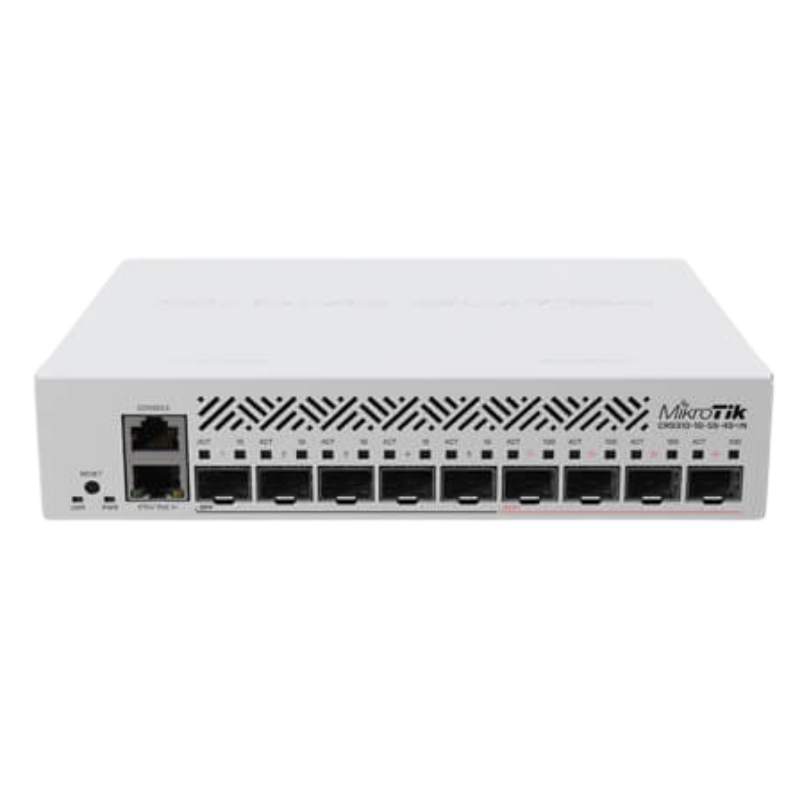


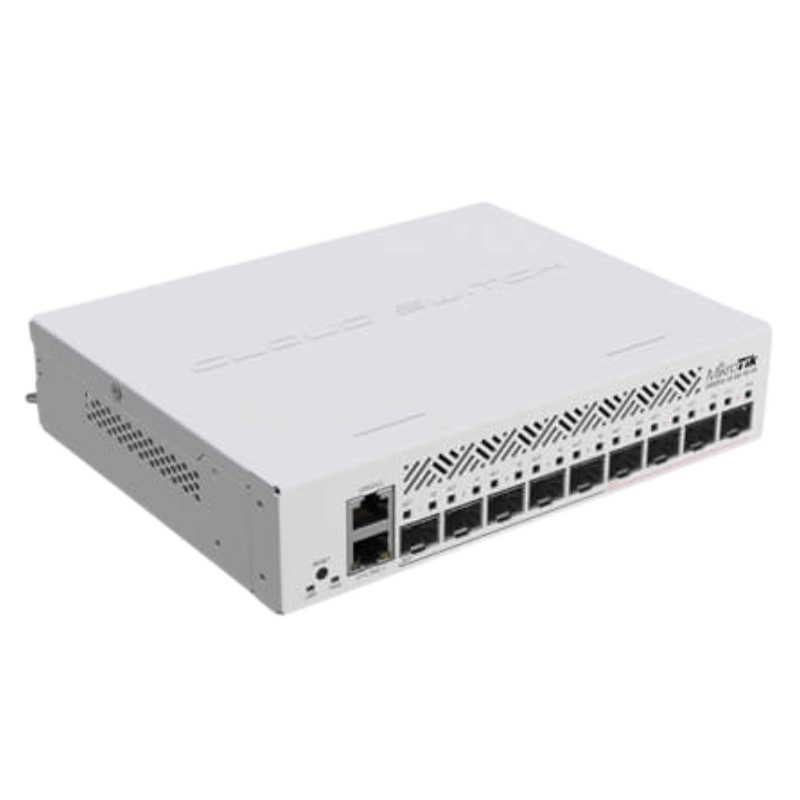
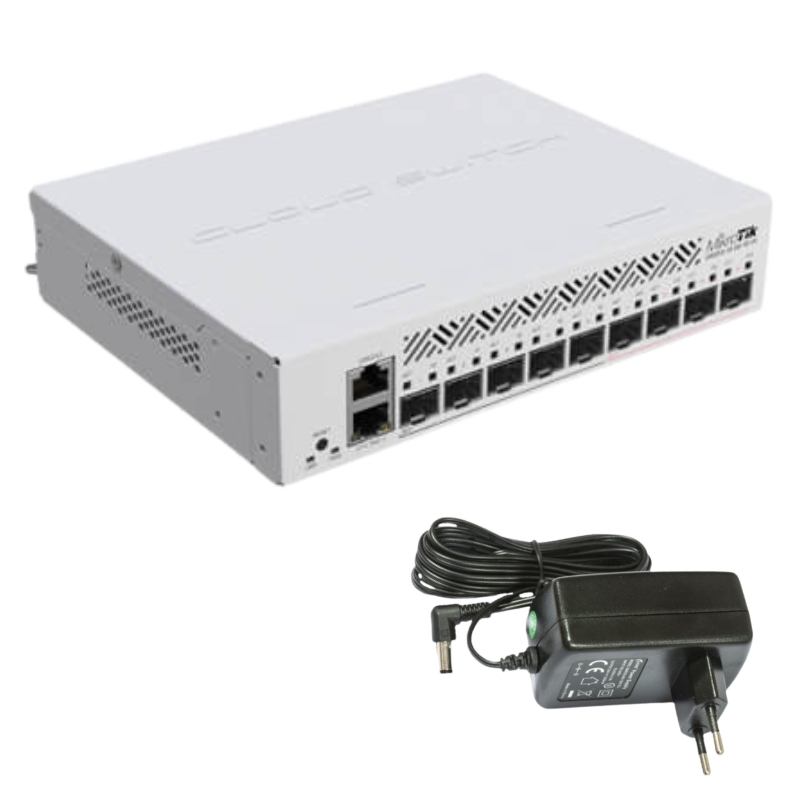
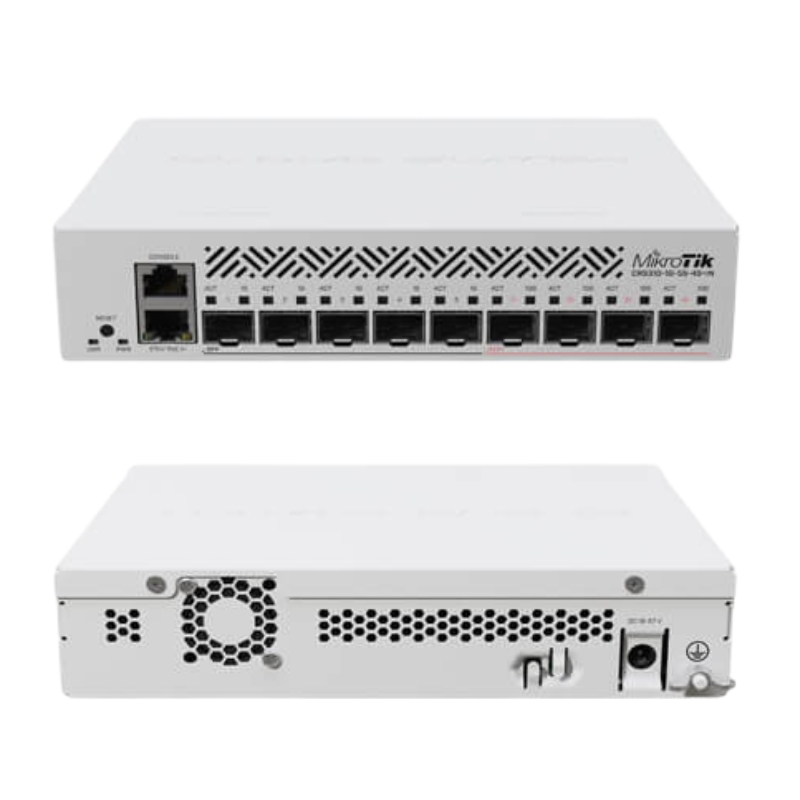
MikroTik CRS310-1G-5S-4S+IN 10 Gigabit Ethernet Cloud SFP Router Switch. Factory-Sealed New in Original Box (FSB) with 3 years Warranty
The MikroTik CRS310-1G-5S-4S+IN is a powerful Cloud Router Switch engineered for high-speed networking environments. Designed with 10 Gigabit Ethernet capabilities, this compact yet robust device is ideal for enterprise networks, data centers, and advanced ISP deployments that demand performance, reliability, and flexibility.
The power of the CRS310-1G-5S-4S+IN lies in its deliberate and modern hardware design, optimized for high-throughput switching and intelligent routing.
At its heart, the device utilizes a robust system-on-chip (SoC) architecture paired with a powerful switching ASIC. This design ensures that all five SFP+ 10G ports and the single 1G RJ45 port operate at wire-speed, non-blocking performance. The dedicated switching hardware handles layer 2 forwarding at line rate, while the CPU is liberated for advanced routing, firewall filtering, and management tasks. This separation guarantees that enabling complex features does not degrade the switching performance of the 10G interfaces.
The unique port arrangement is this switch's defining characteristic, offering exceptional flexibility:
These ports support 10 Gigabit Ethernet via SFP+ fiber modules (e.g., SR, LR) or via 10GBase-T SFP+ copper transceivers for twisted-pair connections. They are ideal for backbone links, high-speed server connectivity, or uplinks to other switches.
Dedicated Gigabit SFP cages provide flexibility for connecting to existing 1G fiber infrastructure or using copper SFP modules, perfect for linking to older switches, routers, or specific network appliances.
This copper port serves as a versatile management access port, a reliable WAN/internet uplink, or a connection for a device that doesn't require 10G speeds. Its inclusion adds significant daily utility.
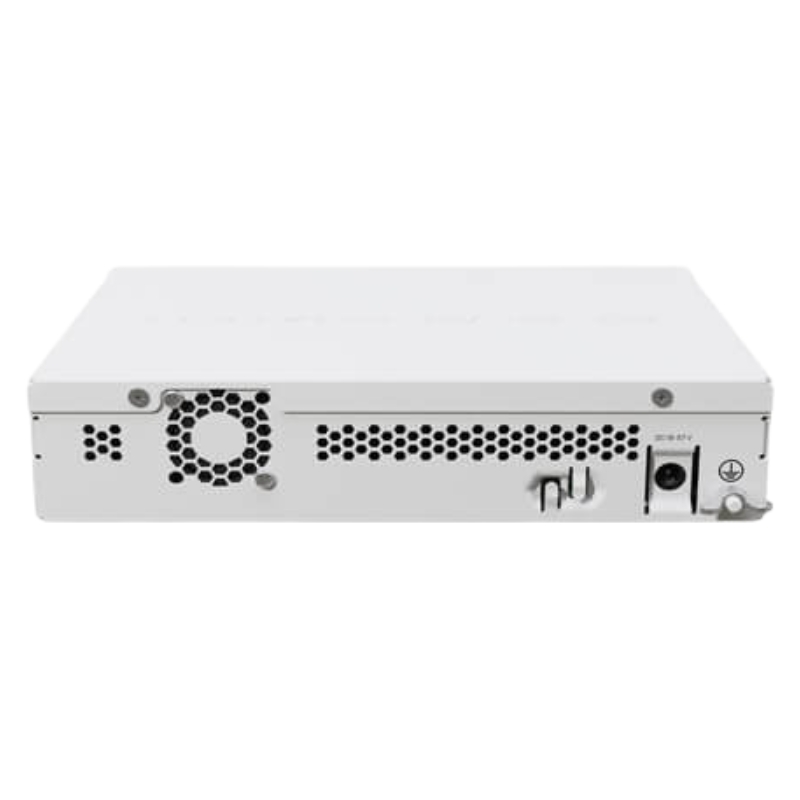
Housed in a all-metal, fanless desktop or rack-mountable (brackets included) enclosure, the CRS310 is built for silent operation and durability. Its passive cooling design makes it perfectly suited for noise-sensitive environments like offices, editing suites, or residential settings. The compact 1U size allows for efficient use of rack space.
What truly elevates this device from a mere switch to a "Cloud Router Switch" is the inclusion of the full-featured MikroTik RouterOS operating system. This provides enterprise-grade networking features typically found in dedicated routers.
The device uniquely supports a dual-firmware approach. By default, it runs the full RouterOS with Switch Menu, offering complete control. For environments requiring only basic switching, it can be switched to SwOS, a simplified, web-based switch management system focused solely on layer 2 features like VLANs, Link Aggregation, and port monitoring. This flexibility is unparalleled in its class.
Under RouterOS, the CRS310-1G-5S-4S+IN supports static routing and dynamic routing protocols such as OSPF, BGP, and RIP. This allows it to act as a core router in a small network or a distribution router in a larger one, making intelligent path decisions based on network topology.
A full-stateful firewall with raw filtering rules protects the network perimeter or internal segments. Access Control Lists (ACLs), connection tracking, and NAT (Network Address Translation) capabilities are all present, enabling secure segmentation and internet sharing.
Hierarchical Token Bucket (HTB) quality of service allows for precise bandwidth management. Administrators can prioritize latency-sensitive traffic (like VoIP or video streams) over bulk data transfers, ensuring optimal performance for critical applications across the 10G links.
The versatility of the CRS310-1G-5S-4S+IN makes it suitable for a wide array of networking scenarios.
It serves as an ideal aggregation switch, collecting traffic from multiple 1G or 2.5G/5G access switches (via the 10G SFP+ ports) and funneling it to a 10G/25G/40G core or to the internet firewall/router. The four 1G SFP ports can be used for out-of-band management or legacy device connections.
For small server racks or homelabs hosting high-performance NAS (Network Attached Storage) systems, virtualization hosts, or rendering workstations, the five 10G ports provide ample high-bandwidth connectivity. The routing and firewall features allow for secure inter-VLAN routing between server segments without needing an external router.
In 4K/8K video editing environments, fast storage access is non-negotiable. The CRS310 provides the low-latency, high-throughput fabric needed for multiple editors to work simultaneously on projects stored on a central NAS. The fanless design ensures silent operation in studio settings.
For a tech-forward small office, this single device can consolidate functions: acting as the internet gateway (firewall/NAT on the 1G port), providing internal wired connectivity (via the 10G and 1G SFP ports), and enforcing security policies between departments using VLANs and inter-VLAN routing—all without the cost and complexity of multiple boxes.
To fully appreciate its capabilities, one must explore the advanced networking features enabled by RouterOS.
The CRS310 supports IEEE 802.1Q VLAN tagging, allowing for the creation of multiple logical networks on a single physical infrastructure. Port-based VLANs, VLAN filtering on the bridge, and management VLANs are fully configurable. The bridge itself is highly tunable, with support for STP (Spanning Tree Protocol), RSTP, and MSTP to prevent network loops and ensure redundancy.
For service providers or complex networks, the device supports Q-in-Q, encapsulating one VLAN tag within another. This is crucial for carrying customer VLANs across a service provider's network transparently.
Multiple physical ports can be bundled into a single logical link using IEEE 802.3ad Link Aggregation Control Protocol. This increases bandwidth and provides redundancy; if one link fails, traffic is automatically redistributed across the remaining links. This is essential for critical uplinks or server connections.
It is important to note that the CRS310-1G-5S-4S+IN does not provide any Power over Ethernet (PoE). Devices connected to it, such as wireless access points or IP phones, will require separate power sources or PoE injectors. This is a trade-off for its compact, fanless, and power-efficient design.
As a "Cloud" Router Switch, it integrates with MikroTik's cloud management system for remote access via a unique Cloud ID. Furthermore, it can act as a controller within the MikroTik CAPsMAN (Controller Access Point System Manager) system, centrally managing multiple MikroTik wireless access points for a unified wireless network.
The CRS310-1G-5S-4S+IN occupies a specific and vital niche within MikroTik's extensive CRS (Cloud Router Switch) series.
It sits between the smaller CRS305-1G-4S+IN (4x SFP+, 1x 1G RJ45) and the larger CRS312-4C+8XG-RM (12 port 10G, with 4 combo ports). Its key differentiator is the mix of five 10G SFP+ and four 1G SFP ports, a configuration not found in other models. This makes it uniquely suited for networks transitioning between 1G and 10G infrastructure. Unlike the CRS3xx series with 25G/100G ports, the CRS310 is firmly focused on the 10G access/aggregation tier, offering the best price-to-port ratio for this specific need.
To achieve maximum performance, especially when using routing features between VLANs (inter-VLAN routing), it is crucial to enable the "Hardware Offloading" feature in the bridge settings. This ensures that traffic between ports on the same switch chip is forwarded at hardware speed, bypassing the CPU. The CPU should be reserved for traffic that truly requires processing, like filtered connections or routed packets crossing subnet boundaries.
While fanless, the metal chassis acts as a heatsink. Adequate airflow around the device, especially in a rack or enclosed space, is necessary for long-term stability. It is designed for standard office/environmental temperatures.
Regularly updating RouterOS to the latest stable firmware is essential to gain new features, performance improvements, and critical security patches. MikroTik provides a straightforward update process through the WebFig or WinBox interfaces.


 Contact Us
 Information
 Catalog
 Solid State Drives (SSD)
 Network Switches
 Hard Disk Drives
 HBA & Controllers
 PC & Servers
 PC & Server Memory
 CPU & Processors
 Network Routers
 Power Supplies
 Tape Drives & Libraries
 Network Devices
 Computer & Network Cables