
(7% discount is applied at checkout)
Cart is empty
Your go-to destination for cutting-edge server products
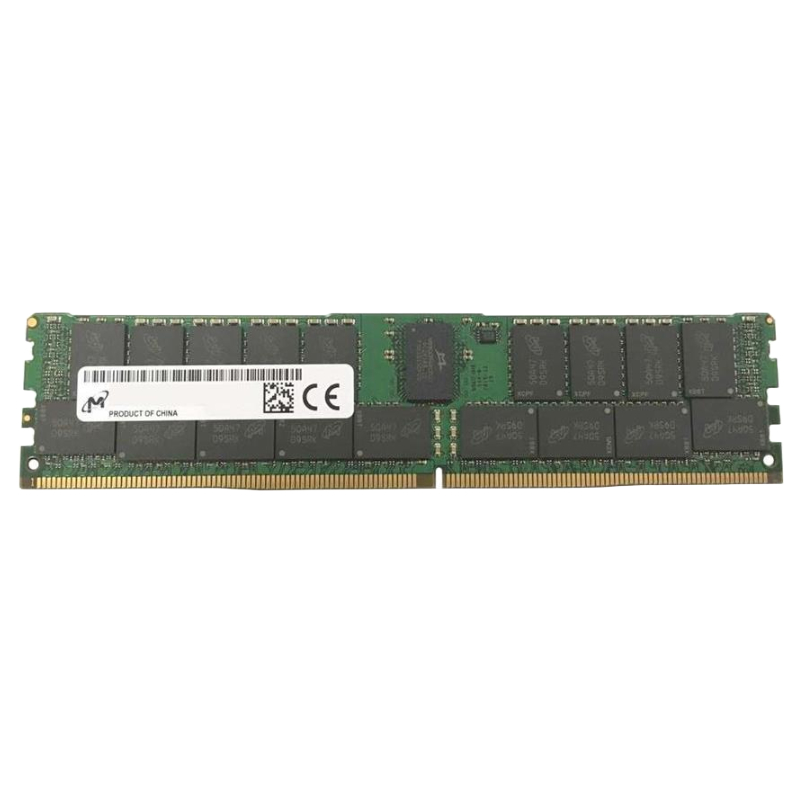
Micron MTA144ASQ16G72PSZ-2S6 128GB Memory Module 2666mhz Ddr4 Pc4-21300 Cl19 Ecc Registered. New (System) Pull with 1 year replacement warranty
The Micron MTA144ASQ16G72PSZ-2S6 Memory Module offers an impressive capacity of 128GB, making it an ideal choice for users who require a high-performance memory solution. With such a large capacity, users can enjoy enhanced multitasking capabilities and improved overall system performance.
At the heart of every enterprise server, data center rack, and high-performance workstation lies a critical component: server memory. Unlike standard desktop memory, server memory is engineered for relentless operation, uncompromising data integrity, and seamless scalability under demanding. This category encompasses specialized modules like the Micron MTA144ASQ16G72PSZ-2S6, designed to deliver not just speed, but also unwavering stability and error correction, which are non-negotiable in professional IT environments. The technology within these modules is what allows for the simultaneous hosting of hundreds of virtual machines, the rapid querying of massive databases, and the smooth operation of critical financial and scientific applications.
The alphanumeric string "MTA144ASQ16G72PSZ-2S6" is a detailed blueprint of the module's specifications. Deciphering this code reveals its core identity. "MT" signifies Micron Technology, the manufacturer. "A144" indicates a standard 288-pin DDR4 Registered DIMM form factor. "S" often denotes a server-grade module. "Q16G72" breaks down to the module's organization and density—a crucial identifier. "PSZ" relates to the specific revision and features. Finally, the suffix "-2S6" explicitly defines the module's performance profile: "2" for the DDR4-2666 speed grade, "S" for the operating voltage of 1.2V (standard for DDR4), and "6" which correlates to its timing characteristics. This precise naming convention allows IT professionals to instantly identify compatibility and key attributes.
The "128GB" designation places this module at the high end of density available for single DDR4 DIMMs. This massive capacity is achieved through advanced memory integrated circuit (IC) packaging and the module's octal rank (8R) architecture. Such high density is essential for modern servers where maximizing memory capacity per physical slot is paramount. It allows data center operators to build systems with terabytes of RAM without consuming excessive physical space and power, directly enabling higher virtual machine densities, larger in-memory databases.
The "Octal Rank" or 8R configuration is a key enabler of the 128GB capacity. A "rank" is a set of memory chips that work together to provide a 64-bit (or 72-bit with ECC) data width to the memory controller. An octal rank module effectively has eight of these sets operating in unison. This design allows the module to utilize a large number of memory chips while managing electrical load and signal integrity through the Register. It represents a sophisticated engineering solution for pushing the boundaries of per-module capacity within the DDR4 standard, typically used in the highest-capacity modules available.
Raw capacity must be matched with adequate performance to feed multi-core processors and prevent system bottlenecks. This module is engineered to deliver high throughput essential for data-intensive applications.
The module operates at a clock frequency of 2666MHz (Megahertz). In the DDR (Double Data Rate) paradigm, this translates to 2666 million data transfers per second per pin. The industry nomenclature "PC4-21300" derives from this: the "4" indicates DDR4, and "21300" refers to the theoretical peak transfer rate in megabytes per second (MB/s). To calculate: 2666 MT/s * 8 bytes (64-bit) = ~21,328 MB/s, rounded to 21300. This high bandwidth ensures that data can flow rapidly between the CPU and memory, accelerating application response times and computational throughput.
While speed (MHz) defines how *fast* data can move, latency defines how *quickly* the memory can respond to an initial request. CAS Latency (CL), measured in clock cycles, is the delay between the memory controller requesting data and the moment it is available. A CAS Latency of 19 (CL19) at 2666MHz represents a balance optimized for server environments, where stability, capacity, and bandwidth are often prioritized over ultra-tight latencies. The actual time in nanoseconds is calculated as (CL / Frequency in MHz) * 2000. For CL19 at 2666MHz, this equates to approximately 14.25 nanoseconds.
This module incorporates two foundational technologies that differentiate server memory from consumer-grade products: Registration and Error-Correcting Code (ECC). These features are essential for mission-critical reliability.
The "Registered" in the module's description refers to the presence of a register, or buffer, placed between the memory controller and the DRAM chips on the module. This register buffers the command and address signals, reducing the electrical load on the memory controller. This stabilization of the electrical signal is what allows servers to support a much larger number of memory modules per channel (commonly 2 or 3 for unbuffered modules vs. 6 or more for RDIMMs) and to populate systems with high-density modules like this 128GB unit. While it adds a minimal one-clock-cycle delay, the benefit in system scalability and stability is immense for multi-socket servers and large memory configurations.
The register chip is a sophisticated component that re-drives the signals with integrity, ensuring clean communication across the densely populated memory bus. This is particularly critical in systems with multiple CPUs and dozens of DIMM slots, where signal degradation would otherwise cause failures. The use of RDIMMs is a non-negotiable requirement for nearly all enterprise servers beyond basic entry-level configurations, enabling the robust, scalable memory subsystems that power modern data centers.
Data corruption in a server can be catastrophic. ECC is a hardware-level technology that detects and corrects the most common types of internal data corruption. The module adds extra memory bits (8 bits for every 64, making a 72-bit bus) to store an encrypted code. When data is written, a code is calculated and stored. When data is read, the code is recalculated and compared. Single-bit errors (the most common type) are automatically corrected on the fly without any system interruption. Multi-bit errors are detected and reported, allowing the system to halt safely. This "self-healing" capability is a cornerstone of data integrity and system uptime in enterprise environments.
The ECC algorithm, often based on Hamming code or similar, provides a robust mathematical framework for error correction. The cyclical redundancy check ensures that even subtle changes in stored charge within a memory cell, which can be caused by cosmic rays, background radiation, or electrical noise, do not lead to silent data corruption. For applications involving financial transactions, scientific research, database management, and virtualized infrastructure, ECC protection is an absolute requirement, making modules like this Micron 128GB RDIMM the standard choice.
The module's physical design is standardized to ensure interoperability while its electrical specs guarantee efficient operation within server ecosystem constraints.
The module utilizes the 288-pin Dual In-line Memory Module (DIMM) interface, the standard physical and electrical connector for DDR4 memory. The pin count and key notch position are specifically defined to prevent insertion into an incompatible socket (e.g., a DDR3 slot). The 288-pin design supports the wider 72-bit data path (64-bit + 8-bit ECC) and provides all necessary power, ground, command, and address signals required for the module's advanced RDIMM functionality.
DDR4 technology operates at a reduced voltage of 1.2V compared to DDR3's 1.5V. This 20% reduction in voltage directly translates to lower power consumption and reduced heat generation at the module and system level. For a data center deploying thousands of servers, this voltage efficiency contributes significantly to lower operational electricity costs and cooling requirements, supporting greener and more sustainable IT operations without sacrificing performance.
Beyond the lower base voltage, DDR4 modules incorporate enhanced power management features such as internal VPP supply for improved efficiency and data bus inversion (DBI) to reduce current draw on the data bus. These features help manage the total power envelope of a server populated with multiple high-capacity modules, ensuring reliable operation within the system's designated thermal design power (TDP).
This memory module is not designed for consumer PCs. Its specific attributes define a clear set of compatible systems and ideal applications.
The Micron MTA144ASQ16G72PSZ-2S6 is engineered for compatibility with enterprise server platforms from leading OEMs such as Dell EMC (PowerEdge series), HPE (Proliant series), Lenovo (ThinkSystem series), and Cisco (UCS series), among others. It is specifically designed for use in servers powered by Intel Xeon Scalable processors (e.g., Skylake-SP, Cascade Lake-SP generations) or compatible AMD EPYC platforms that support DDR4-2666 RDIMMs. Always consult the system's official memory configuration guide or qualified vendor for verified compatibility before installation.
The combination of high density, reliable ECC protection, and registered architecture makes this module perfect for memory-intensive enterprise applications. Key use cases include: Virtualization and Cloud Infrastructure (VMware vSphere, Microsoft Hyper-V), where high memory density allows for greater VM consolidation. In-Memory Databases (SAP HANA, Oracle Database In-Memory), which require massive, fault-tolerant RAM pools for ultra-fast data processing. High-Performance Computing (HPC) clusters tackling complex simulations and modeling. And Enterprise Resource Planning (ERP) and Large-Scale Transaction Processing systems that demand both high throughput and absolute data integrity for business-critical operations.
For optimal performance, these modules must be installed in matching sets per the server manufacturer's guidelines, typically in multiples to populate memory channels symmetrically across CPUs. Modern server CPUs feature multi-channel memory architectures (e.g., 6-channel). Populating all channels with identical modules (in pairs or sets of three per channel) is essential to achieve the advertised peak memory bandwidth. Mixing modules of different speeds, capacities, or ranks can lead to the system down-clocking all memory to the lowest common denominator, reducing overall performance.


 Contact Us
 Information
 Catalog
 Solid State Drives (SSD)
 Network Switches
 Hard Disk Drives
 HBA & Controllers
 PC & Servers
 PC & Server Memory
 CPU & Processors
 Network Routers
 Power Supplies
 Tape Drives & Libraries
 Network Devices
 Computer & Network Cables