
(7% discount is applied at checkout)
Cart is empty
Your go-to destination for cutting-edge server products
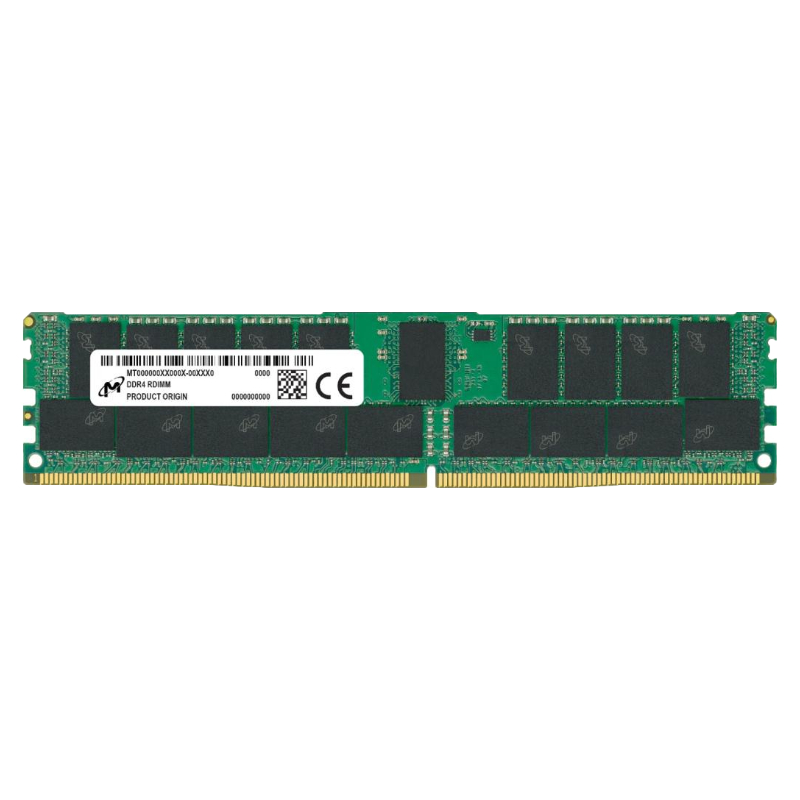
Micron MTA18ADF2G72PZ-3G2E1R 16GB DDR4 ECC Memory Module 3200MHz PC4-25600 1RX4. New (System) Pull with 1 year replacement warranty
At the heart of reliable enterprise and data center computing lies a specific class of memory designed for maximum integrity and stability: Registered ECC DDR4. Modules like the Micron MTA18ADF2G72PZ-3G2E1R are engineered not for consumer desktops but for servers, workstations, and storage systems where uptime and data accuracy are non-negotiable. This category represents the fusion of two critical technologies: Error-Correcting Code (ECC) and Registering (buffering).
The Micron MTA18ADF2G72PZ-3G2E1R is a critical component engineered for modern data centers, enterprise servers, and high-availability workstations. This 16GB DDR4 module represents a synthesis of reliability, performance, and advanced error correction, built upon Micron's world-class semiconductor manufacturing. Designed to meet the rigorous demands of 24/7 operational environments, it ensures data integrity and system stability for business-critical applications, from virtualization and cloud computing to large-scale databases and beyond. Understanding its detailed specifications is paramount for IT professionals, system integrators, and procurement specialists tasked with building and maintaining robust server infrastructure.
At its heart, this module is defined by a precise set of technical parameters that dictate its compatibility and performance envelope. Each specification is a key to unlocking the intended functionality within a server ecosystem.
The part number MTA18ADF2G72PZ-3G2E1R is a detailed code that conveys specific attributes.
MT: Micron Technology. A: Assembly/Module. 18: 1.2V operation. A: 288-pin RDIMM form factor. DF: Specific technology/feature code (indicating DDR4, Registered, ECC). 2G72: Denotes 2 Gig x72 organization (for ECC, which has 72-bit width). PZ: Lead-free and halogen-free packaging. 3G2: 3200MHz speed bin. E: Commercial operating temperature (0°C to 85°C). 1R: Single module (as opposed to a kit). Understanding this nomenclature can assist in precisely identifying and cross-referencing the module against OEM requirements or compatibility lists.
This module offers a 16 Gigabyte (GB) capacity, providing a substantial memory footprint for handling concurrent tasks and large datasets. It operates at a DDR4-3200MHz speed (also correctly listed as PC4-25600). The data rate of 3200MT/s (MegaTransfers per second) offers a peak theoretical bandwidth of 25.6 GB/s per module, significantly enhancing data throughput compared to previous-generation DDR4-2400 or DDR4-2666 speeds. This increased bandwidth is crucial for reducing latency in memory-sensitive applications and improving overall server responsiveness.
The module adheres to the standard 288-pin Dual In-Line Memory Module (DIMM) layout defined for DDR4. This pin count is specific to DDR4 and is not backward compatible with DDR3's 240-pin design. The physical length is 133.35mm, with the key notch positioned differently to prevent accidental insertion into an incompatible motherboard slot. The Registered ECC DIMM (RDIMM) incorporates the aforementioned register buffer chip, typically located in the center of the module. This buffer is crucial for stabilizing command and address signals, which is why RDIMMs are the dominant choice for multi-socket servers and systems with high-density memory configurations.
The module's speed rating is DDR4-3200, meaning it performs 3,200 million data transfers per second (MT/s). This is often paired with the Parallel Core 4 (PC4) classification, which denotes the theoretical peak bandwidth. The calculation is: (3200 MT/s * 64-bit data bus) / 8 bits per byte = 25,600 MB/s. Therefore, this module is also labeled PC4-25600. A single module can deliver up to 25.6 GB/s of bandwidth. In a typical server configuration with multiple modules per CPU across multiple memory channels, the aggregate bandwidth scales dramatically, feeding data-hungry CPUs and alleviating bottlenecks in memory-intensive applications like in-memory databases (e.g., SAP HANA) and scientific simulations.
The designation PC4-25600 follows JEDEC standard naming conventions. "PC4" indicates it is a DDR4 module. The number "25600" refers to the peak transfer rate in megabytes per second (MB/s). This is calculated as 3200 MHz (clock rate) x 8 bytes (the width of a 64-bit data bus) = 25,600 MB/s. This metric is essential for verifying that the module meets the bandwidth requirements of your server platform, particularly in multi-channel configurations where aggregate bandwidth scales with the number of populated channels.
The module utilizes a 288-pin Dual In-Line Memory Module (DIMM) form factor, the standard for DDR4. The Registered (RDIMM) design is a cornerstone of its enterprise functionality. It incorporates a register (or buffer) on the module that buffers the address and command signals between the memory controller and the DRAM chips. This reduces the electrical load on the controller, enabling systems to support a much larger number of DIMMs per channel—a necessity for high-capacity server configurations. The physical 288-pin layout is keyed differently from DDR3 to prevent accidental insertion into an incompatible slot.
Operating at a standard 1.2 volts, this DDR4 module provides improved power efficiency compared to DDR3's 1.5V or 1.35V. This reduced voltage lowers the power consumption and heat generation of the memory subsystem, which is a significant factor in large-scale deployments where power and cooling costs are major operational considerations. The module is designed to operate within strict thermal and electrical parameters to ensure long-term reliability in controlled server environments.
Beyond basic specifications, this module is equipped with technologies that define its role as a server-grade component, focusing on data integrity and signal stability.
The Registered ECC (Error-Correcting Code) feature is non-negotiable for enterprise systems. ECC is a hardware-level technology that detects and corrects the most common types of internal data corruption. Single-bit errors are corrected on-the-fly, while multi-bit errors are detected and reported to the system. This prevents silent data corruption that could lead to application crashes, computational errors, or system instability. The "Registered" aspect complements ECC by ensuring signal integrity in densely populated memory configurations, allowing for higher capacities and more modules per system than unbuffered (UDIMM) alternatives.
This module is configured as a Dual Rank DIMM. A "rank" is a set of DRAM chips that are accessed simultaneously by the memory controller. A dual-rank module essentially presents two logical banks of memory on the same physical stick. This architecture allows the memory controller to interleave accesses between the two ranks, improving overall efficiency and throughput compared to a single-rank module of the same capacity. It represents an optimal balance between performance, capacity, and compatibility across a wide range of server platforms.
The module's latency is denoted by its CAS Latency of CL22 at the 3200MHz speed. CAS Latency (CL) is the number of clock cycles between the memory controller issuing a read command and the first piece of data being available. While higher-frequency memory often comes with higher CL numbers, the overall absolute latency (in nanoseconds) can be similar or better. The CL22 timing is a JEDEC-standard timing for DDR4-3200 registered memory, ensuring broad compatibility and stable operation in server environments where stability is prioritized over ultra-tight timings.
Selecting the correct memory requires a thorough understanding of system compatibility. This module is designed for specific platforms and use cases.
The Micron MTA18ADF2G72PZ-3G2E1R is engineered for compatibility with a wide array of enterprise servers that support DDR4-3200 Registered ECC memory. This includes platforms from leading OEMs such as Dell EMC (PowerEdge series), HPE (ProLiant, Synergy), Lenovo (ThinkSystem, ThinkServer), Cisco (UCS), and Supermicro. It is also compatible with a broad spectrum of motherboards based on Intel Xeon Scalable processors (Cascade Lake, Cooper Lake, Ice Lake SP generations) and compatible AMD EPYC processors that support RDIMMs at 3200MHz. It is critical to always consult your system or motherboard manufacturer's qualified vendor list (QVL) to confirm compatibility for a specific model.
This memory module excels in multi-core, multi-threaded environments where data integrity and capacity are paramount. Ideal deployment scenarios include:
Virtualization Hosts: Servers running VMware vSphere, Microsoft Hyper-V, or other hypervisors require large pools of reliable RAM to host multiple virtual machines efficiently.
Database Servers: Systems housing SQL Server, Oracle, MySQL, or NoSQL databases benefit from the high bandwidth and ECC protection to ensure transaction integrity and fast query performance.
Cloud Infrastructure and High-Performance Computing (HPC): Clustered systems performing complex simulations, data analytics, or rendering rely on the aggregated bandwidth of many such modules across multiple nodes.
Enterprise File and Application Servers: General-purpose servers that underpin business operations require the stability that Registered ECC memory provides.
Micron controls the entire manufacturing process, from semiconductor wafer fabrication (fab) to DRAM die production, assembly, and testing. This vertical integration allows for stringent quality control at every stage. The DRAM chips used on this module are first-party Micron ICs, ensuring consistency, reliability, and adherence to the precise JEDEC specifications the module is designed to meet. This contrasts with third-party assemblers who may source components from various suppliers.


 Contact Us
 Information
 Catalog
 Solid State Drives (SSD)
 Network Switches
 Hard Disk Drives
 HBA & Controllers
 PC & Servers
 PC & Server Memory
 CPU & Processors
 Network Routers
 Power Supplies
 Tape Drives & Libraries
 Network Devices
 Computer & Network Cables