
(7% discount is applied at checkout)
Cart is empty
Your go-to destination for cutting-edge server products
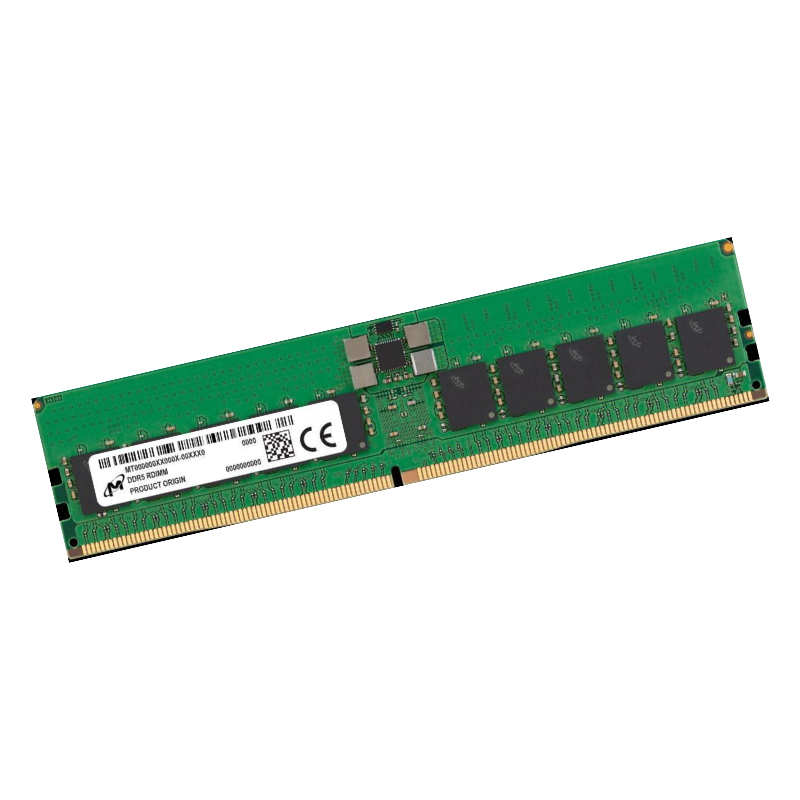
Micron MTC40F204WS1RC56BB1A 96GB 5600MHz Pc5-44800 Ecc Registered Cl46 288-pin DDR5 Memory Module. New Sealed in Box (NIB) with 3 Years Warranty
The Micron MTC40F204WS1RC56BB1A is a high-performance DDR5 memory module built for enterprise servers and professional workstations. Offering a large 96GB capacity and faster 5600MHz data rates, this RDIMM delivers improved bandwidth, stability, and energy efficiency for modern computing environments.
The Micron MTC40F204WS1RC56BB1A 96GB DDR5 5600MHz PC5-44800 ECC Registered 288-Pin DIMM memory module represents a powerful leap forward in server memory technology designed to meet the demands of next-generation enterprise computing. This high-performance memory module leverages DDR5 technology to deliver increased bandwidth, improved power efficiency, and advanced reliability features. With a 96GB capacity, 5600MHz data transfer speed, and ECC Registered design, this module enhances overall system performance in data-intensive environments. It is engineered specifically for mission-critical applications, virtualization, cloud computing, big data analytics, and high-performance computing clusters.
DDR5, or Double Data Rate 5 Synchronous Dynamic Random-Access Memory, represents the latest evolution in memory technology. The Micron MTC40F204WS1RC56BB1A module utilizes this advanced architecture to deliver significant improvements in speed, efficiency, and overall throughput. DDR5 introduces several key enhancements such as increased burst length, improved channel architecture, and on-die error correction capabilities. These advancements translate into faster data access speeds and better multitasking performance, which are essential for servers handling concurrent workloads. Compared to the older DDR4 standard, DDR5 delivers higher data rates and more granular power management, reducing energy consumption while increasing performance.
Operating at 5600MHz, the Micron DDR5 memory module significantly increases data throughput relative to earlier generation DDR4 modules that generally operate in the 2400MHz to 3200MHz range. This enhanced speed ensures that memory-intensive applications such as in-memory databases, AI inference engines, and virtualization environments operate with reduced latency and improved efficiency. Systems equipped with high-speed DDR5 memory experience better responsiveness during peak workloads and more consistent performance under sustained pressure. For organizations that rely on real-time processing, such as financial institutions, healthcare providers, and scientific research facilities, the improved data throughput provided by DDR5 is a strategic advantage.
A primary differentiator of enterprise memory like this Micron module is the integration of Error-Correcting Code (ECC) and Registered DIMM (RDIMM) features. ECC technology detects and corrects single-bit memory errors, preventing data corruption and system instability. This is critically important in enterprise and data center environments where data accuracy and system availability are paramount. Single-bit errors, if uncorrected, can lead to application crashes, corrupted databases, and faulty computational results. The registered design introduces an intermediary register between the memory controller and the DRAM modules, which buffers command and address signals.
Enterprise workloads frequently involve processing large datasets and long-running transactions, where the cost of errors can be significant. ECC ensures that bit-level inaccuracies are corrected in real time, reducing the likelihood of silent data corruption. This makes ECC Registered memory indispensable in environments such as cloud infrastructure, critical database servers, and virtualization platforms that must maintain strict data integrity standards. When combined with advanced DDR5 architecture, ECC enhances both performance and reliability. This dual-layered approach to error management ensures that the memory subsystem remains resilient, even under the most demanding workloads. As a result, system administrators can confidently deploy memory-intensive applications without compromising on data safety or system uptime.
The 96GB capacity of the Micron MTC40F204WS1RC56BB1A module positions it well for environments requiring substantial memory allocation per node. High-capacity memory modules facilitate larger in-memory datasets, which reduce the need to access slower disk storage during computation. This reduction in storage latency is crucial for workloads that depend on rapid access to vast arrays of data, such as analytical processing, AI training, and big data operations. Systems equipped with high-capacity DDR5 memory can support more virtual machines, larger databases, and more complex simulations without performance degradation. This enables organizations to maximize the value they derive from their server hardware, improving overall efficiency and lowering total cost of ownership.
Memory capacity is one of the key limiting factors in server consolidation and virtualization strategies. Each virtual machine requires a dedicated allocation of memory resources. With 96GB modules, it becomes feasible to host more virtual instances per physical server, improving hardware utilization rates and reducing operational costs. Virtualized environments benefit from large DDR5 memory pools because they allow for dynamic memory allocation without significant performance penalties. Virtualization platforms such as VMware ESXi, Microsoft Hyper-V, and KVM rely heavily on memory performance to maintain service level agreements for hosted applications.
The Micron DDR5 memory module’s 5600MHz speed rating translates to a PC5-44800 classification, indicating potential bandwidth of up to 44.8GB/s per module. This high bandwidth is beneficial for data-intensive operations that require rapid movement of data between memory and compute resources. High-speed memory enables faster data caching, improves computational efficiency, and minimizes bottlenecks that can slow application performance. Bandwidth is especially critical for workloads that involve streaming large datasets or performing complex computations across multiple cores. High-frequency memory ensures that data flows smoothly and quickly through the system, minimizing idle processor cycles and improving overall throughput.
Data-centric applications such as real-time analytics, machine learning, and in-memory databases depend on high memory throughput to achieve optimal results. The PC5-44800 rating enables rapid access to data structures, accelerating data retrieval and computation. This enhancement is particularly valuable in analytics frameworks like Apache Spark or Hadoop, where memory bandwidth impacts job completion times and cluster efficiency. In high-performance computing environments, scientific simulations and large-scale modeling tasks also benefit from memory bandwidth improvements. Faster data movement between memory and processing elements ensures that simulation tasks complete more efficiently, enabling researchers to iterate more rapidly and derive insights faster.
The 288-pin DIMM form factor is the standard for DDR5 memory modules in server platforms. This physical configuration ensures compatibility with modern server motherboards designed to support DDR5 memory architecture. The industry-standard pin count allows for uniform installation and simplifies system design for OEMs and system integrators alike. The Micron MTC40F204WS1RC56BB1A memory module is compatible with a wide array of server platforms from leading manufacturers. This ensures flexibility in deployment, whether building new systems or upgrading existing ones. The standardized form factor also facilitates easier scaling of memory resources across a server fleet, reducing complexity for IT teams managing diverse hardware configurations.
Installing high-performance memory in enterprise servers requires careful attention to system documentation and configuration guidelines. Ensuring that memory modules are inserted into the correct DIMM slots and operating in the supported frequency modes helps maximize performance and stability. Server firmware and BIOS settings often include options to tune memory operation, including ECC enablement and speed profiles. System administrators should double-check compatibility lists provided by server vendors to confirm that DDR5 memory modules are supported at the desired speeds. Memory population rules may vary based on the number of processors and DIMM slots available. Following best practices ensures that server systems operate at peak efficiency and maintain the reliability expected in mission-critical deployments.
In multi-socket server architectures, memory configuration becomes more complex, with memory channels distributed across multiple processors. The Micron DDR5 memory module supports such architectures by delivering consistent performance across all channels. This allows servers to balance memory load and ensure uniform access times across processing units, resulting in more predictable application behavior. Multi-socket systems often benefit from higher total memory capacity and increased parallelism. By deploying high-capacity DDR5 modules, organizations can leverage the full potential of multi-socket designs, improving performance for enterprise databases, virtualization, and compute-intensive tasks.
DDR5 memory modules incorporate improved power management features compared to previous generations. One key enhancement is on-module voltage regulation, which shifts certain power management functions from the motherboard to the DIMM itself. This innovation improves power efficiency and helps to maintain stable operating conditions across wide temperature ranges. Lower power consumption translates to reduced heat output, which is particularly important in high-density data center environments. Servers equipped with energy-efficient memory can operate with lower cooling requirements, delivering cost savings over time. Additionally, reduced thermal load contributes to overall system reliability, mitigating the risk of heat-related failures or throttling.
On-module power management not only improves energy efficiency but also supports more precise control over memory behavior. This can help server platforms maintain optimal performance under varying workload conditions. The ability to dynamically adjust power delivery contributes to both improved endurance and reduced risk of thermal stress on memory components. For data centers and enterprise IT teams focused on sustainability and operational efficiency, adopting memory technologies that reduce power draw aligns with broader environmental and cost management goals. High-performance DDR5 modules like the Micron MTC40F204WS1RC56BB1A contribute to these objectives by balancing performance with lower energy requirements.
The Micron 96GB DDR5 5600MHz ECC Registered memory module is engineered for a variety of enterprise workloads that demand high performance, reliability, and scalability. These use cases span across virtualization, cloud computing, big data analytics, scientific research, real-time processing, and high-performance computing clusters. Each of these environments benefits from the increased bandwidth, enhanced error correction, and high memory capacity offered by DDR5 technology. In cloud environments, providers can allocate large memory pools to virtual instances, improving user experience and guaranteeing service quality.
Virtualization frameworks thrive on available memory resources. More memory capacity allows for greater numbers of virtual machines per host, better memory isolation between tenants, and reduced overhead for memory scrambling during peak demands. Memory performance significantly affects deployment agility, workload migration, and overall cloud infrastructure efficiency. DDR5 memory with advanced ECC and registered design enhances cloud environments by providing consistent performance and reducing the risk of memory-related interruptions. Cloud service providers prioritize memory reliability because client workloads often include mission-critical applications.
AI workloads, especially training and inference tasks for deep learning models, place substantial demands on memory bandwidth and capacity. Large neural networks require swift access to massive datasets stored in memory. The 5600MHz speed and PC5-44800 bandwidth improve data access rates, enabling faster training cycles and more efficient execution of inference tasks. These performance gains empower organizations working with artificial intelligence to process extensive datasets without being constrained by memory bottlenecks. In data analytics scenarios, in-memory processing engines such as Apache Spark, Druid, or MemSQL benefit from higher memory throughput since large portions of data are cached and analyzed directly in RAM. DDR5 memory with high capacity and speed accelerates analytical queries, supports complex calculations, and improves business intelligence outcomes.
Big data frameworks handling continuous streams of information require robust memory systems to ensure that real-time insights can be derived without latency issues. Whether processing logs, sensor data, or transaction streams, systems must maintain seamless memory access to avoid backlogs. The Micron DDR5 memory module’s combined performance and capacity enable efficient real-time analytics, rapid event correlation, and swift execution of streaming computation pipelines. This is particularly valuable for industries such as telecommunications, financial trading, cybersecurity, and IoT ecosystems where rapid data interpretation can drive operational decisions.
As organizations scale, memory requirements grow in both capacity and performance. The Micron MTC40F204WS1RC56BB1A memory module provides a forward-looking solution that supports business growth without sacrificing performance or reliability. By adopting high-speed DDR5 memory early in infrastructure upgrades, enterprises future-proof their systems against rapidly evolving computing demands. Memory scalability is a critical component of an organization’s long-term IT roadmap, ensuring that systems remain capable of handling increasing workloads while delivering consistent, predictable performance over time.


 Contact Us
 Information
 Catalog
 Solid State Drives (SSD)
 Network Switches
 Hard Disk Drives
 HBA & Controllers
 PC & Servers
 PC & Server Memory
 CPU & Processors
 Network Routers
 Power Supplies
 Tape Drives & Libraries
 Network Devices
 Computer & Network Cables