(7% discount is applied at checkout)
Cart is empty
Your go-to destination for cutting-edge server products


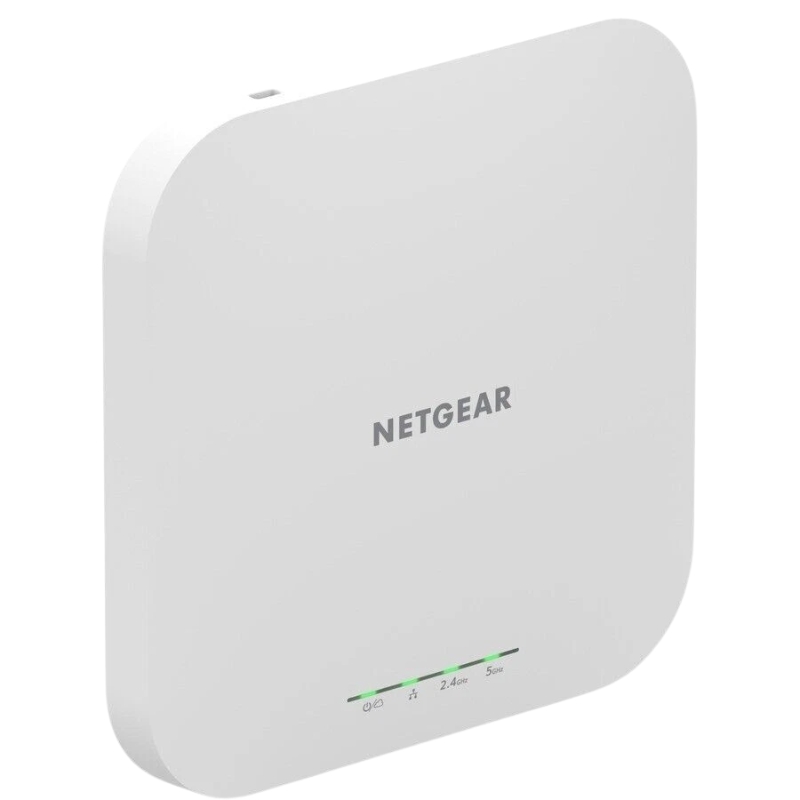
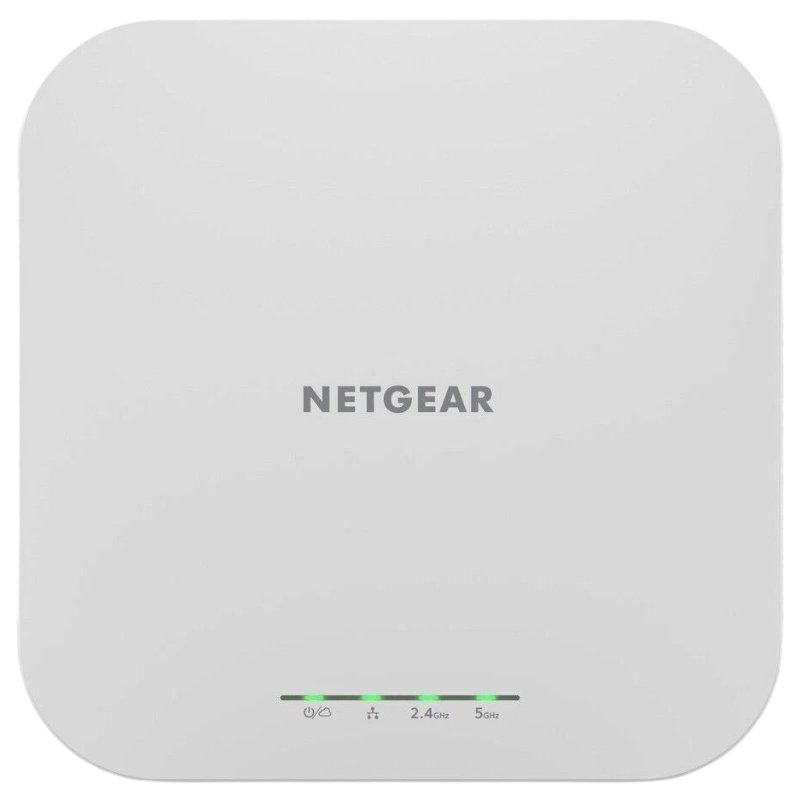
Netgear WAX610-100NAS Dual Band Wi-Fi 6 IEEE 802.11ax 5GHz 2.5GBPS PoE Internal Antenna Wireless Access Point. New Sealed with 1 Year Replacement Warranty
The Netgear WAX610-100NAS represents a pivotal evolution in wireless infrastructure, merging the rigorous demands of business environments with the breakthrough efficiency of the IEEE 802.11ax standard. As a dual‑band, internal‑antenna access point, it is engineered to deliver simultaneous high‑density connectivity on both the 2.4 GHz and 5 GHz radios, with a special emphasis on the 5 GHz spectrum where it achieves an aggregate data rate exceeding 2.5 Gbps.
The Netgear WAX610-100NAS Dual Band Wi-Fi 6 IEEE 802.11ax 5GHz 2.5Gbps PoE Internal Antenna Wireless Access Point belongs to a high-performance enterprise-class wireless networking category engineered for dense device environments, high throughput demands, and scalable infrastructure deployments. This category is defined by advanced wireless standards, multi-gigabit wired uplinks, efficient spectrum utilization, and secure centralized management capabilities designed for business-critical connectivity. Devices within this classification are engineered to deliver reliable wireless distribution across corporate offices, campuses, retail floors, hospitality deployments, and professional installations where stable bandwidth and seamless roaming are essential.
The WAX610-100NAS IEEE 802.11ax protocol implemented in this category represents a next-generation wireless transmission framework designed to optimize spectral efficiency, reduce latency, and enhance multi-device communication. The architecture enables simultaneous transmissions to multiple clients through orthogonal frequency division multiple access and uplink/downlink MU-MIMO technologies, allowing connected devices to share available bandwidth more intelligently. The protocol operates across dual-band frequencies, supporting both 2.4GHz and 5GHz spectrums for balanced coverage and speed distribution.
Wireless access points in this class incorporate dynamic frequency scheduling algorithms that allocate bandwidth resources based on device priority and traffic demand. These mechanisms ensure that latency-sensitive applications such as video conferencing, VoIP communications, and real-time data synchronization maintain stable performance even when numerous endpoints are connected simultaneously. Beamforming technology enhances signal directionality, strengthening transmission reliability while minimizing interference.
The hardware and firmware design of this product class supports dense client environments through intelligent airtime fairness logic and adaptive load balancing. These capabilities enable each connected device to receive optimized throughput allocation without degrading network stability. The result is a wireless infrastructure capable of maintaining consistent speeds in environments containing dozens or even hundreds of active wireless devices.
Dual band functionality allows simultaneous broadcasting across separate frequency ranges, enabling optimal device distribution and interference mitigation. The 2.4GHz band offers extended range and improved wall penetration characteristics, while the 5GHz band delivers higher throughput and reduced congestion. This architecture ensures devices are automatically directed to the most appropriate frequency, maximizing efficiency and maintaining signal integrity across varied usage scenarios.
Integrated band steering technology automatically detects compatible client capabilities and directs them to the optimal frequency spectrum. Devices capable of high-speed communication are routed to the 5GHz channel to maximize performance, while legacy or distant devices remain connected to 2.4GHz channels to preserve stability and coverage consistency. This intelligent distribution prevents spectrum saturation and improves overall network responsiveness.
This category is distinguished by multi-gigabit uplink support through a 2.5Gbps Ethernet interface. Unlike standard gigabit access points, the multi-gigabit interface eliminates wired bottlenecks when high throughput wireless traffic is aggregated from multiple clients. The interface ensures that the wired backbone can accommodate peak wireless speeds without limiting data flow, making it suitable for high-capacity enterprise networks and bandwidth-intensive deployments.
The WAX610-100NAS presence of a 2.5Gbps port enables seamless integration with multi-gig switches and advanced routing infrastructure. This allows administrators to deploy wireless access layers that match the speed capabilities of modern fiber or high-speed copper networks. The increased backhaul capacity supports high-resolution media streaming, cloud applications, and data-intensive operations without introducing congestion at the uplink stage.
Power over Ethernet support allows devices in this category to receive electrical power and network connectivity through a single Ethernet cable. This simplifies installation logistics, reduces infrastructure complexity, and enables flexible mounting in ceilings, walls, or other optimal coverage positions without requiring nearby electrical outlets. The PoE design also enhances reliability by allowing centralized power management from network switches.
With PoE architecture, network administrators can remotely control power cycling, monitor consumption, and implement energy-saving policies directly from managed switches. This centralized approach improves maintenance efficiency and reduces downtime by allowing remote and device resets without physical access.
The internal antenna configuration used in this product class is engineered for uniform signal propagation and professional aesthetic integration. Internal antenna arrays are strategically positioned within the enclosure to create balanced omnidirectional coverage patterns, ensuring consistent signal strength throughout deployment zones. This design eliminates external antenna protrusions, reducing physical vulnerability while maintaining high transmission performance.
The antenna layout is calibrated to produce overlapping coverage cells that minimize dead zones and ensure seamless roaming between access points in multi-unit installations. This configuration is especially effective in structured enterprise layouts where predictable signal distribution is required for uninterrupted mobility.
Wireless access points within this category integrate advanced security frameworks designed to protect data transmissions and prevent unauthorized network access. Encryption standards, authentication protocols, and intrusion detection systems work together to safeguard wireless communication channels. These mechanisms support enterprise authentication environments, ensuring only authorized users and devices can connect.
Authentication features support multiple credential validation methods, including secure key exchange and enterprise authentication servers. These capabilities enable administrators to enforce strict access policies and maintain network integrity across large user populations. Real-time monitoring tools allow suspicious activity to be detected and addressed promptly.
Devices in this classification support centralized configuration platforms that enable administrators to manage multiple access points from a single interface. Management systems provide visibility into network health, device status, client distribution, and performance analytics. This centralized architecture simplifies deployment scaling, firmware updates, and configuration adjustments.
Management flexibility is achieved through compatibility with both cloud-based and on-premises controller environments. Cloud management allows remote monitoring and configuration from any location, while local controllers provide direct oversight within internal network infrastructure. This dual compatibility ensures adaptability for organizations with varied security and operational requirements.
Advanced wireless optimization algorithms ensure efficient traffic handling and stable connectivity under varying load conditions. Quality of service prioritization mechanisms allow administrators to allocate bandwidth based on application type or device category. This ensures mission-critical communications maintain priority even during peak usage periods.
Dynamic load balancing distributes client connections across available access points to prevent congestion and maintain consistent performance. When a particular access point approaches capacity, additional clients are automatically directed to nearby units with available resources. This automated balancing ensures uninterrupted service quality across large deployments.
This category of wireless access point is engineered for flexible installation scenarios including ceiling mounts, wall mounts, and structured network enclosures. Compact form factors and professional industrial design allow discreet placement within commercial environments while maintaining optimal coverage. Durable chassis construction ensures reliable operation under continuous use conditions.
Scalability is a defining characteristic of this product class. Administrators can expand wireless coverage incrementally by adding additional access points without redesigning existing infrastructure. Automatic configuration synchronization allows newly deployed units to adopt network settings immediately, minimizing setup time and ensuring consistent performance standards across the deployment.
Thermal management is an essential design consideration in high-performance wireless hardware. Passive cooling systems and optimized internal component layouts ensure efficient heat dissipation without requiring active fans. This silent operation design increases reliability, reduces mechanical failure risk, and supports long-term continuous operation in professional environments.
Components used in this category are selected for endurance and stability, supporting extended uptime requirements typical of enterprise networks. Voltage regulation systems and protective circuitry safeguard against power fluctuations, ensuring consistent functionality and reducing maintenance frequency.
The Netgear WAX610-100NAS category is designed to integrate seamlessly with modern networking ecosystems. Compatibility with multi-gigabit switches, VLAN segmentation, advanced routing systems, and network monitoring platforms ensures that the device can function as part of a comprehensive infrastructure. This interoperability allows organizations to deploy advanced wireless capabilities without replacing existing network hardware.
Support for standard Ethernet cabling and PoE standards ensures straightforward integration into structured cabling installations. The device can operate within existing network topologies while providing enhanced wireless performance, making it suitable for infrastructure upgrades that prioritize efficiency and cost control.
Coverage optimization tools enable administrators to fine-tune signal strength, channel selection, and transmission power. These adjustments help eliminate interference from neighboring networks and ensure optimal performance across deployment areas. Automatic channel selection algorithms analyze the surrounding RF environment and adjust parameters dynamically to maintain stable connectivity.
Seamless roaming capabilities allow client devices to transition between multiple access points without connection interruption. This functionality is essential in environments where users move frequently throughout coverage zones, ensuring persistent connectivity for voice, video, and real-time applications.
The throughput capabilities of this category are engineered to accommodate modern bandwidth requirements generated by high-definition streaming, cloud computing, large file transfers, and collaborative platforms. Multi-stream transmission architecture increases aggregate data capacity while maintaining consistent connection quality for individual clients.
Simultaneous data streams allow multiple devices to communicate concurrently without waiting for sequential transmission cycles. This parallel communication approach significantly improves network efficiency and reduces latency, particularly in environments with numerous connected endpoints.


 Contact Us
 Information
 Catalog
 Solid State Drives (SSD)
 Network Switches
 Hard Disk Drives
 HBA & Controllers
 PC & Servers
 PC & Server Memory
 CPU & Processors
 Network Routers
 Power Supplies
 Tape Drives & Libraries
 Network Devices
 Computer & Network Cables