(7% discount is applied at checkout)
Cart is empty
Your go-to destination for cutting-edge server products
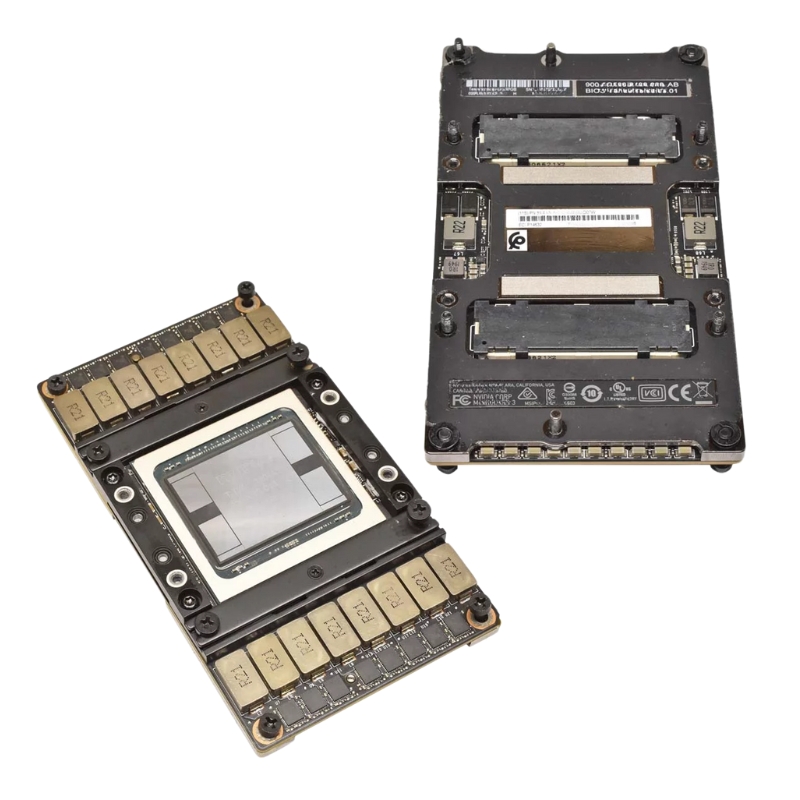


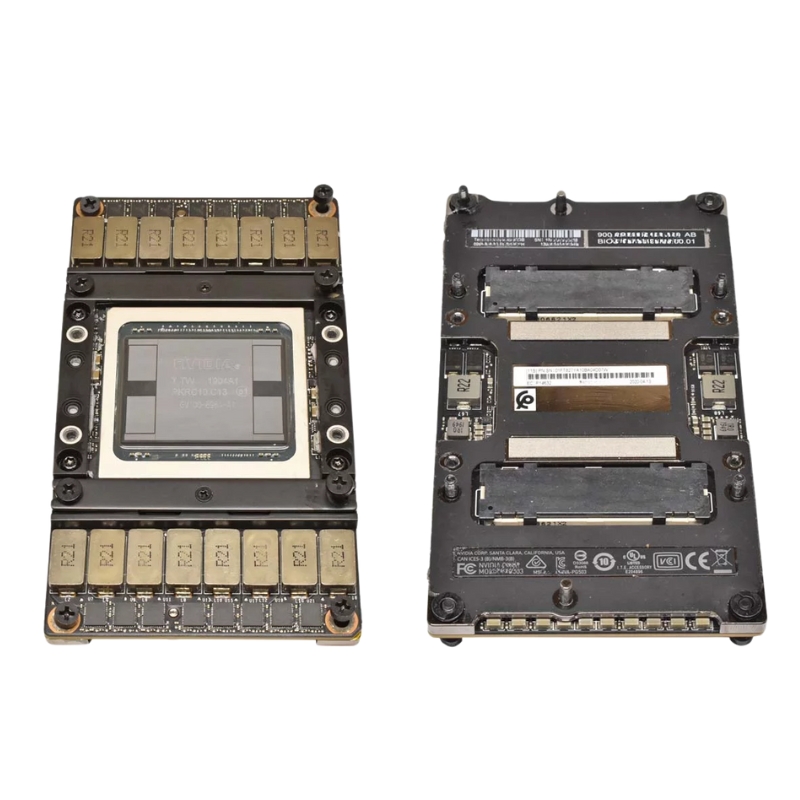
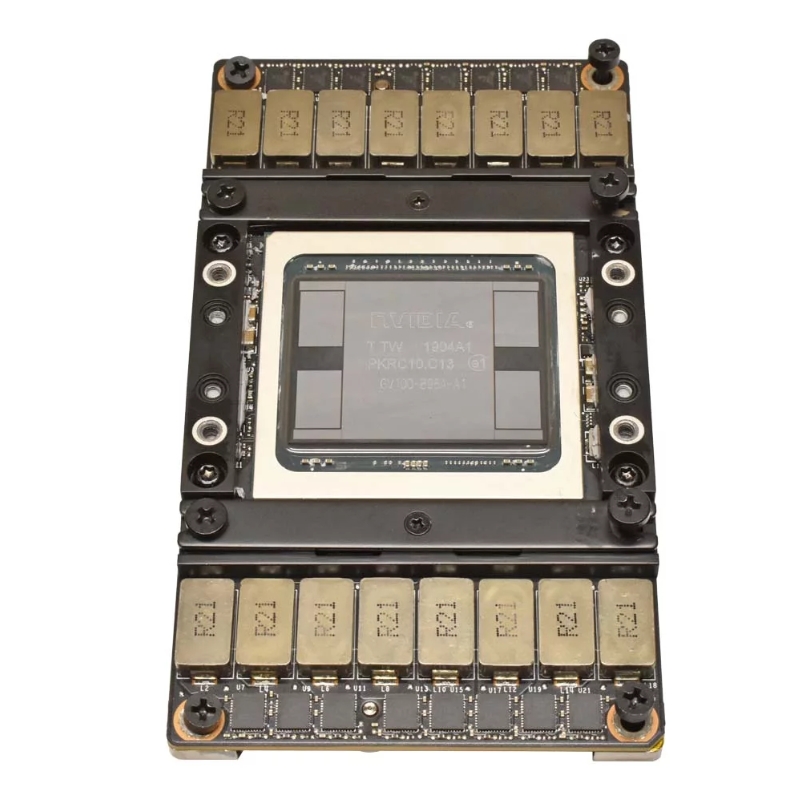
Nvidia 900-2G503-0430-000 Tesla V100 SXM2 32GB Passive Accelerator Card GPU. Excellent Refurbished with 1 year replacement warranty
The Nvidia 900-2G503-0430-000 Tesla V100 SXM2 32GB Passive Accelerator Card is engineered for high-performance computing, artificial intelligence, and data-intensive workloads. Designed with cutting-edge architecture, this GPU delivers exceptional parallel processing power and optimized memory bandwidth for enterprise-grade applications.
The Nvidia 900-2G503-0430-000 Tesla V100 SXM2 32GB Passive Accelerator Card GPU is a purpose-built, data-center grade compute accelerator designed for large-scale deep learning training, high performance computing (HPC), scientific simulation, and virtualized GPU workloads. Built on Nvidia’s Volta architecture and packaged in the SXM2 form factor, this passive-cooled Tesla V100 variant brings 32GB of HBM2 memory to workloads that demand high-bandwidth memory, dense tensor compute, and superior sustained throughput in rack-mounted servers with custom cooling solutions.
The SXM2 form factor prioritizes inter-GPU communication and power delivery. Unlike PCIe cards, SXM2 modules are designed to be mounted directly onto specialized server motherboards that support high-speed interconnects such as NVLink. The passive designation means the card itself lacks built-in fans; it relies on system-level airflow or chassis-specific cooling plates. This approach allows denser packing in high-performance rack systems and can reduce acoustic noise while enabling more efficient thermal solutions crafted for the server chassis.
One of the Tesla V100 SXM2’s most notable features is its 32GB HBM2 memory capacity. High Bandwidth Memory (HBM2) delivers much greater bandwidth per watt than traditional GDDR memory types, which matters for training large neural networks, running large-scale simulations, or processing huge datasets entirely on-GPU to minimize costly PCIe/host memory transfers. For ML engineers and researchers, this means the ability to train larger models without aggressive model partitioning or frequent gradient synchronization that slows iteration.
Passive cards are ideal for custom server environments with carefully designed airflow or liquid cooling systems. System integrators should ensure adequate front-to-back airflow, sufficient heat-sink contact, and validated thermal path design. Typical deployments include dense server nodes in data centers, GPU-accelerated compute racks, and specialized GPU enclosures where fans and airflow are managed system-wide rather than per-card.
The V100 family introduced dedicated Tensor Cores that accelerate matrix multiplications essential to modern deep learning. These cores enable high mixed-precision throughput (FP16/FP32) that substantially speeds up training and inference compared to older architectures. For teams focused on neural network training — from convolutional networks to transformer-based models — the Tesla V100 SXM2 32GB passive accelerator significantly reduces time-to-train when integrated into optimized, multi-GPU nodes.
Beyond deep learning, the Tesla V100 remains highly capable for double-precision (FP64) and single-precision (FP32) scientific workloads that require predictable, high throughput for linear algebra, molecular dynamics, computational fluid dynamics, and more. The 32GB memory buffer also enables larger simulations to run entirely on-device, cutting down on host-device communication overhead and improving iteration speed.
SXM2-compatible Tesla V100s typically make use of NVLink to provide high-bandwidth, low-latency interconnects between GPUs. NVLink enables faster model parallelism, distributed training, and data sharing between GPUs inside a node — critical when scaling to dozens of GPUs for enterprise-scale training jobs. For infrastructure planners, the NVLink topology and bandwidth per link are core considerations when designing balanced multi-GPU systems.
Research groups, AI labs, and enterprises commonly select the Nvidia 900-2G503-0430-000 Tesla V100 SXM2 32GB Passive Accelerator Card GPU for tasks such as natural language processing (NLP) model training, image and video analytics, recommendation systems, and reinforcement learning. The large on-board memory makes experimenting with larger batch sizes and model variants more practical, and the tensor acceleration reduces the calendar time required to converge complex models.
While many modern inference deployments use specialized inference accelerators, V100 cards remain a robust choice for high-throughput, low-latency inference when applications require high precision, multi-model hosting, or support for a broad stack (CUDA, TensorRT, ONNX). Their raw compute and memory allow inference pipelines to serve multiple models simultaneously or to support on-device preprocessing and postprocessing without falling back to CPU memory.
HPC centers and research institutions use V100 SXM2 cards for simulations where double precision and large memory footprints are necessary. The passive SXM2 cards fit well into custom-cooled HPC racks where energy efficiency and density are paramount, and where NVLink connectivity helps distributed solvers and multi-GPU domain decomposition scale efficiently.
Because the card is passive, it must be installed in servers engineered to provide proper airflow or thermal transfer. Common compatible platforms include blade-style servers, specialized GPU nodes, and manufacturer reference designs for SXM2 GPUs. When creating product listings or guidance, emphasize that buyers confirm chassis compatibility, thermal envelopes, and OEM validation for the specific server model and intended workload.
SXM2 modules draw power differently than PCIe cards. Integrators must verify power delivery rails, VRM capability on the host motherboard, and overall rack PDU capacity. Thermal and electrical planning are equally important: a passive V100 will operate reliably only within the validated power and thermal bounds. List recommended PSU sizing, rack-level power density best practices, and cabling considerations for prospective buyers.
The Tesla V100 family is compatible with Nvidia’s compute stack: CUDA, cuDNN, NCCL, TensorRT, and Nvidia drivers tailored for Tesla/VGPU workloads. For enterprise buyers, highlight driver branches that support the SXM2 Tesla cards and recommend LTS kernel/driver combinations for stable production environments. Also underline the importance of using the latest compatible CUDA toolkit to fully leverage Tensor Cores, NVLink bandwidth, and performance tuning libraries.
Ongoing health monitoring is vital for sustained operations. Recommend tools and practices for monitoring GPU temperature, memory errors, utilization, and NVLink topology health. Where applicable, remind readers to check for firmware updates from Nvidia or their server vendor to address performance fixes and compatibility patches — and to schedule these during maintenance windows to avoid disrupting running jobs.
To squeeze the most performance from multi-GPU setups, tune the distributed training framework to exploit NVLink. Use NCCL for collective operations, and consider data-parallel strategies that minimize costly PCIe transfers by keeping tensors resident on GPUs that are NVLink-connected. Provide sample tuning checkpoints: batch size scaling strategies, gradient accumulation, and mixed-precision training to improve throughput without sacrificing model fidelity.
With 32GB per GPU, teams have expanded room to experiment with larger architectures. However, memory fragmentation and temporary allocations still occur. Recommend memory pool allocators, careful profiling of peak allocation, and strategies like gradient checkpointing or activation offloading for extremely large models that still exceed on-device RAM.
For organizations running multi-tenant GPU clusters, highlight the need for GPU isolation (vGPU or container-based isolation), role-based access control for job submission systems, and encryption of sensitive datasets. The Tesla family has historically been used in virtualized environments; ensure purchasers know which hypervisors and software versions are validated for vGPU or passthrough modes.
Containers are the de facto deployment method for cloud-native AI. List best practices: use Nvidia Container Toolkit to expose GPUs inside containers, pin driver versions across the host and container image, and stage a consistent CI/CD pipeline with GPU-accelerated test runs to validate images before production rollout.
When building product landing pages, customers appreciate direct comparisons. Compare the Tesla V100 SXM2 32GB passive accelerator to other classes (e.g., PCIe V100 variants, later-generation Ampere or Hopper-based cards, and specialized inference accelerators). Emphasize the strengths of the V100: balanced double-precision performance, large HBM2 capacity, mature software stack, and proven deployment history in academic and enterprise clusters. Also call out trade-offs: newer architectures may provide higher raw TFLOPS or more advanced tensor formats, but V100 still offers consistent performance for many production and research workloads.
Use cases include transformer pretraining and fine-tuning, computer vision model training, speech recognition model development, and recommendation engine optimization. The 32GB memory footprint simplifies the prototyping and scaling phases by reducing the need for complex model parallelism for moderately sized state-of-the-art models.
Large models and large datasets are common in genomics and medical imaging. The extra memory enables multi-volume MRI/CT processing and large-scale genomics pipelines to stay resident on GPU memory, accelerating research and shortening time-to-insight.


 Contact Us
 Information
 Catalog
 Solid State Drives (SSD)
 Network Switches
 Hard Disk Drives
 HBA & Controllers
 PC & Servers
 PC & Server Memory
 CPU & Processors
 Network Routers
 Power Supplies
 Tape Drives & Libraries
 Network Devices
 Computer & Network Cables