(7% discount is applied at checkout)
Cart is empty
Your go-to destination for cutting-edge server products
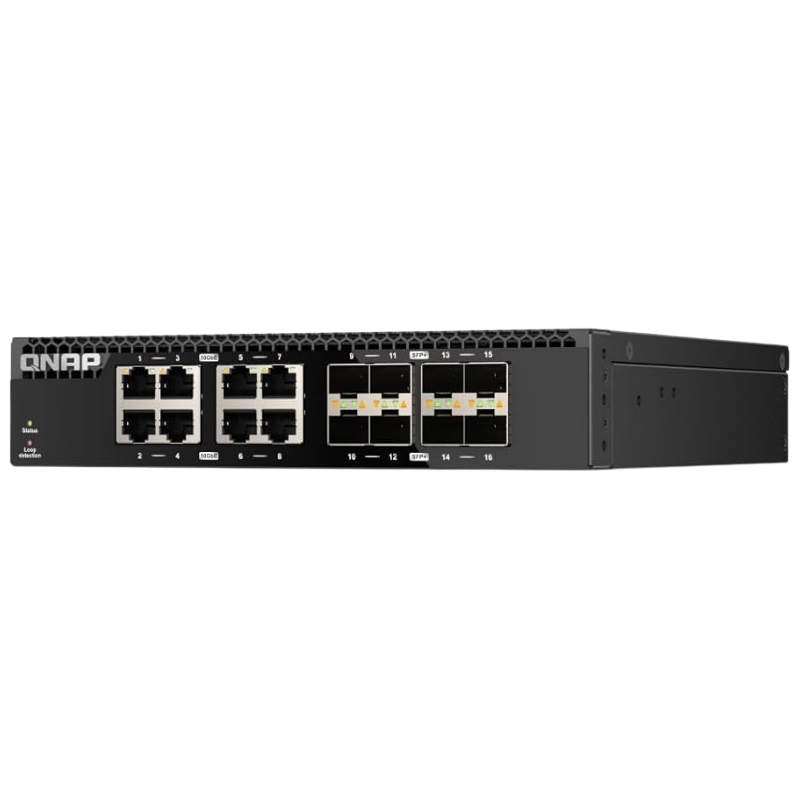


Qnap Systems QSW-3216R-8S8T-US 8 Ports Half Width Rackmount 16 Ports 10GbE Unmanaged Ethernet Switch. Factory-Sealed New in Original Box (FSB) with 3 Years Warranty
The Qnap Systems QSW-3216R-8S8T-US represents a significant advancement in high-speed, unmanaged network switching, specifically engineered for environments where space is at a premium but performance cannot be compromised. As a 16-port 10-Gigabit Ethernet (10GbE) switch housed in a compact, half-width rackmount form factor, this device delivers enterprise-level throughput without the complexity of management protocols.
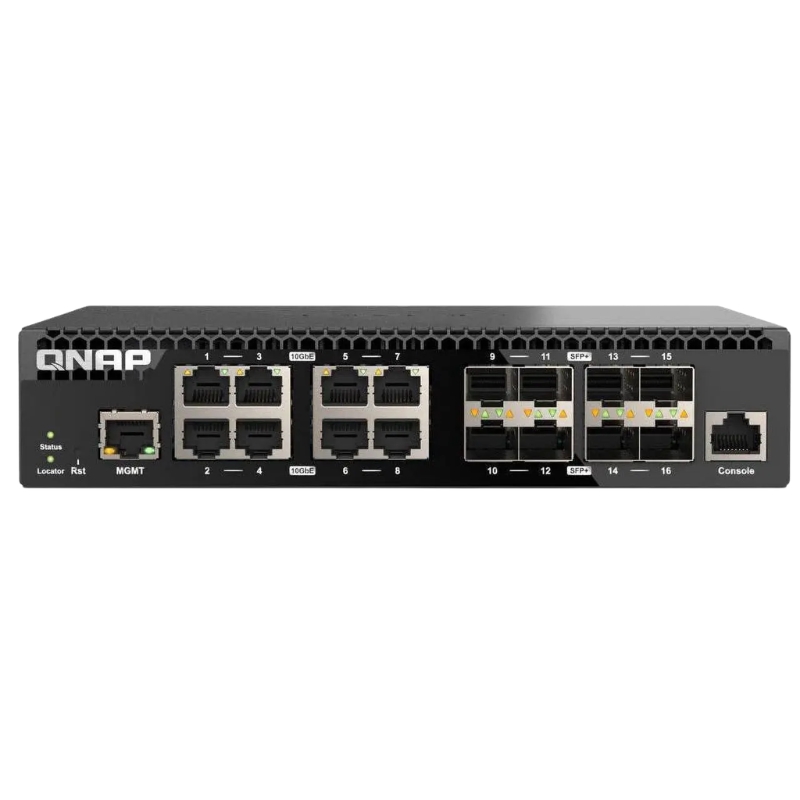
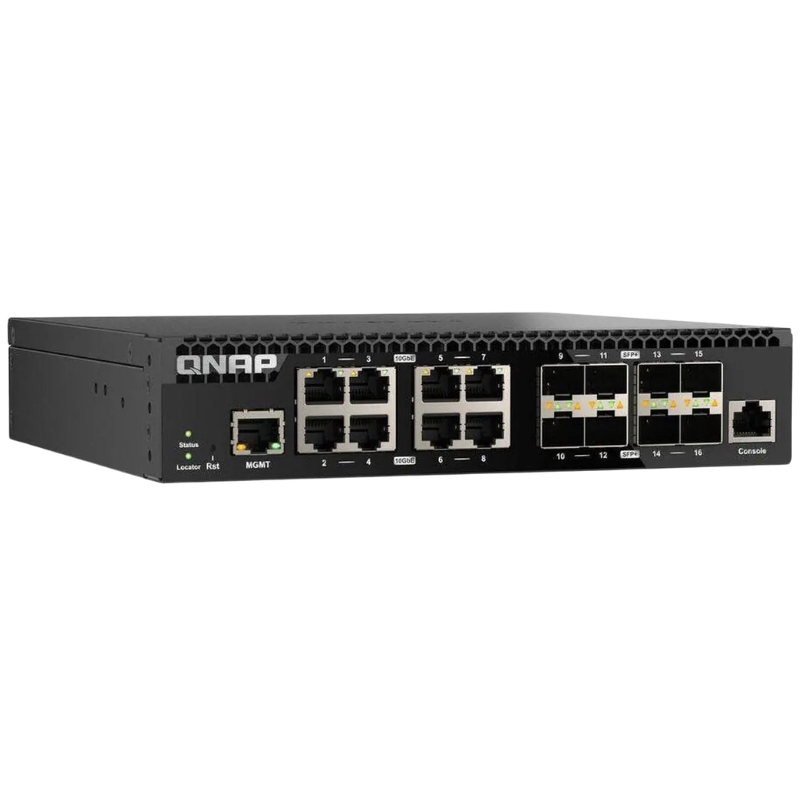
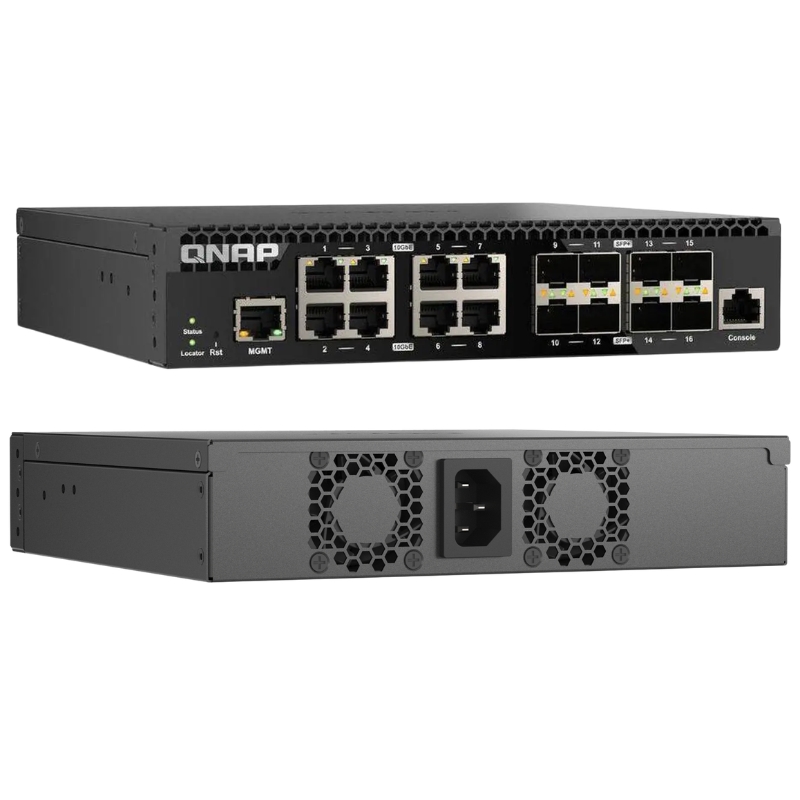
The QSW-3216R-8S8T-US from is engineered as a high-performance networking solution designed for enterprise edge deployments, professional AV environments, and high-density data transfer infrastructures that require reliable 10-Gigabit connectivity. Built in a half-width rackmount chassis, this switch optimizes rack space efficiency while delivering a full set of sixteen 10GbE ports configured in a hybrid arrangement of eight SFP+ fiber ports and eight 10GBASE-T copper ports. This architecture allows seamless integration into mixed-media network infrastructures where both optical fiber and copper Ethernet connections must coexist within a single switching platform.
The physical construction of the device focuses on space-efficient deployment in standard server racks. The half-width format enables administrators to mount two units side-by-side within a single rack unit using optional mounting accessories, allowing for scalable network expansion without consuming additional vertical rack space. The steel enclosure enhances durability while also supporting efficient heat dissipation through optimized airflow channels integrated into the chassis design.
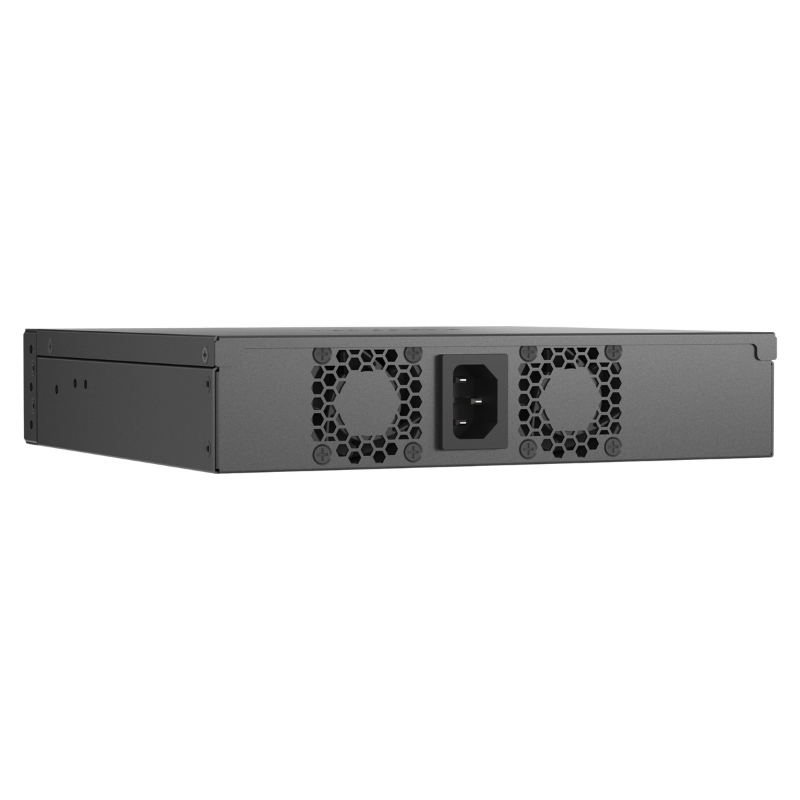
The QSW-3216R-8S8T-US chassis includes a precision-engineered thermal architecture that balances passive ventilation with active cooling. Strategically placed ventilation grills guide airflow across internal components such as the switching ASIC and power circuitry. The internal fan module dynamically adjusts rotation speed based on thermal load, maintaining stable operating temperatures during sustained high-bandwidth transfers. This ensures consistent performance under heavy traffic conditions typical of 10GbE workloads.
The QSW-3216R-8S8T-US 8 Ports switch integrates sixteen dedicated 10-Gigabit Ethernet interfaces divided into two distinct connectivity technologies. Eight ports utilize SFP+ cages supporting fiber transceivers for long-distance or interference-resistant communication, while eight ports use RJ45 connectors compatible with Cat6a or higher cabling for copper-based networking. This hybrid design supports deployment flexibility in environments transitioning from legacy copper infrastructure to modern fiber backbone networks.
The QSW-3216R-8S8T-US SFP+ ports support a wide range of optical transceiver modules designed for multimode or single-mode fiber connections. These interfaces enable extended transmission distances, improved electromagnetic immunity, and reduced latency for data-intensive applications such as storage replication, virtualization clusters, and high-resolution media streaming. The modular nature of SFP+ slots allows administrators to select transceivers that match distance, wavelength, and fiber type requirements.
The eight copper ports support 10GBASE-T Ethernet standards and maintain backward compatibility with 5GbE, 2.5GbE, 1GbE, and 100MbE speeds through automatic negotiation. This ensures interoperability with existing network devices while providing an upgrade path toward higher throughput without immediate infrastructure replacement. Advanced signal processing within the switch maintains link stability and signal integrity even across longer cable runs within specification limits.
Each port implements intelligent auto-negotiation algorithms that detect the highest supported speed and duplex mode of connected devices. This automation eliminates manual configuration and minimizes compatibility issues when integrating heterogeneous hardware into a single switching environment.
Designed to support full wire-speed switching, the device delivers non-blocking throughput across all ports simultaneously. Its switching fabric bandwidth ensures that each interface can operate at maximum 10Gbps without contention, even under full load. The internal packet forwarding engine uses store-and-forward architecture to verify frame integrity before transmission, reducing network errors and improving overall reliability.
The unmanaged architecture simplifies deployment by removing the need for manual configuration, firmware tuning, or command-line setup. Once powered on, the switch automatically begins forwarding packets using standard Layer 2 switching logic. This plug-and-play design is particularly beneficial in environments where reliability and rapid installation are prioritized over granular configuration control.
The system automatically detects connected devices, learns network topology, and establishes optimal forwarding paths without user intervention. This eliminates setup complexity and reduces the possibility of configuration errors that could disrupt network communication.
Built-in loop detection mechanisms monitor traffic patterns for anomalies caused by accidental cable loops. When detected, the switch isolates affected ports to maintain network stability and prevent broadcast storms that could degrade performance.
The hardware platform is engineered for continuous operation in professional environments requiring consistent connectivity. Internal circuitry includes surge protection and voltage regulation components that safeguard the switch against electrical fluctuations. The power subsystem maintains stable output to internal modules even during transient input variations.
The enclosure incorporates shielding elements that protect internal electronics from electromagnetic interference generated by adjacent equipment. This ensures signal accuracy and prevents data corruption in electrically noisy environments such as equipment racks filled with servers and storage arrays.
Integrated packet validation algorithms analyze incoming frames for structural integrity before forwarding. Frames containing errors are discarded, preserving network efficiency and preventing propagation of corrupted data across connected segments.
The switch is designed to function as a central aggregation point or high-speed distribution node in network topologies requiring large data throughput. Its hybrid port configuration allows it to bridge fiber backbone links with copper-connected endpoints, making it suitable for deployment in server rooms, creative studios, enterprise departments, and laboratory environments.
Because of its half-width design, administrators can mount the switch individually for compact installations or pair two units side-by-side for expanded port density. This flexibility simplifies network scaling strategies and enables incremental expansion without replacing existing hardware.
The switch adheres to IEEE Ethernet standards, ensuring interoperability with routers, servers, workstations, storage devices, and other switches from a wide range of manufacturers. This standards-based design guarantees seamless integration into established infrastructures without requiring proprietary protocols.
The device operates using a built-in power supply engineered for stable voltage conversion and efficient energy usage. Power management circuitry distributes current across internal subsystems in a balanced manner, preventing overload conditions. The power design also minimizes heat generation, contributing to the overall thermal stability of the system.
Advanced energy-efficient Ethernet logic dynamically adjusts power consumption based on link activity. Idle ports automatically reduce energy draw, helping to optimize operational efficiency while maintaining readiness for immediate data transmission when traffic resumes.
At the core of the device lies a dedicated switching ASIC optimized for high-speed packet forwarding. This chipset handles address learning, frame buffering, error detection, and traffic distribution at hardware level rather than relying on software processing. Hardware-accelerated switching significantly reduces latency and ensures consistent throughput regardless of traffic volume.
The switching engine is tuned for ultra-low forwarding delay, enabling near-instantaneous packet transmission between ports. This characteristic is essential for applications such as real-time data replication, synchronized computing environments, and high-frequency transaction processing.
Integrated buffering algorithms maintain steady packet flow even during sudden bursts of network activity. This prevents congestion and ensures that data streams remain uninterrupted under demanding workloads.
The switch is optimized for workloads that demand sustained high throughput. Its architecture supports simultaneous multi-port transfers at full 10-Gigabit speeds, enabling efficient handling of large data streams. This capability is essential for environments that manage high-resolution video editing workflows, large-scale database synchronization, or virtualization clusters.
The internal switching matrix allows multiple data flows to traverse the device concurrently without interference. Each port maintains dedicated bandwidth allocation, ensuring that heavy traffic on one connection does not degrade performance on another.
Even during continuous high-volume transmission, the hardware maintains stable latency and throughput characteristics. This stability is critical for professional environments that depend on predictable network performance.
The arrangement of ports on the front panel follows a logical grouping that separates fiber and copper connections. This layout simplifies cable management and helps technicians quickly identify interface types during installation or maintenance. The clear labeling and spacing between ports reduce the risk of accidental disconnection.
The spacing between connectors allows for organized routing of both fiber and copper cables. Adequate clearance ensures that transceiver modules can be inserted or removed without obstruction from adjacent cables.
All network interfaces and indicators are positioned on the front panel, enabling convenient access even when the device is mounted in a rack. This front-facing design simplifies installation, inspection, and maintenance tasks.


 Contact Us
 Information
 Catalog
 Solid State Drives (SSD)
 Network Switches
 Hard Disk Drives
 HBA & Controllers
 PC & Servers
 PC & Server Memory
 CPU & Processors
 Network Routers
 Power Supplies
 Tape Drives & Libraries
 Network Devices
 Computer & Network Cables