(7% discount is applied at checkout)
Cart is empty
Your go-to destination for cutting-edge server products
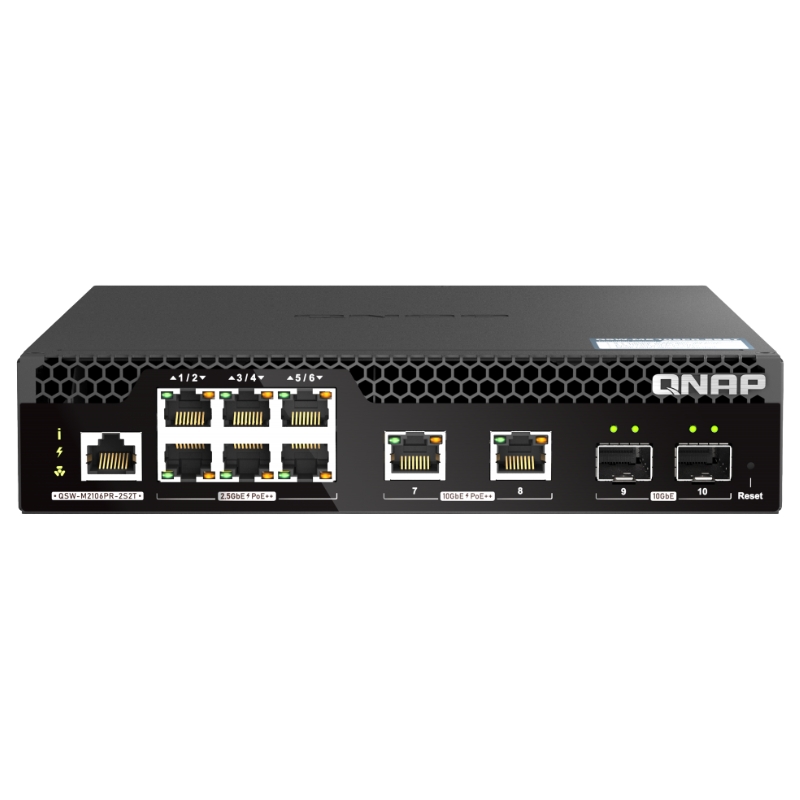


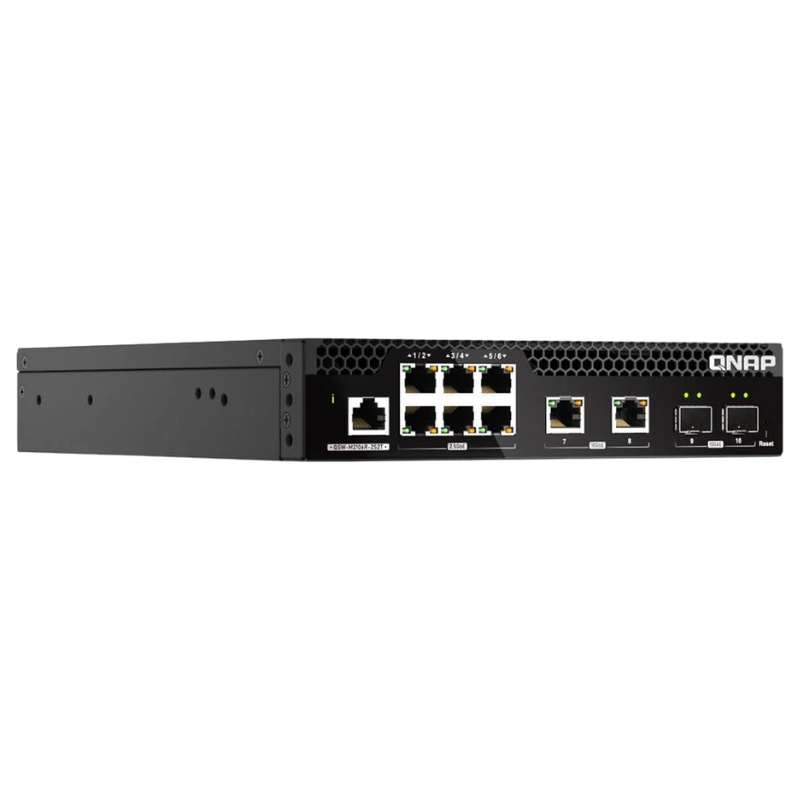
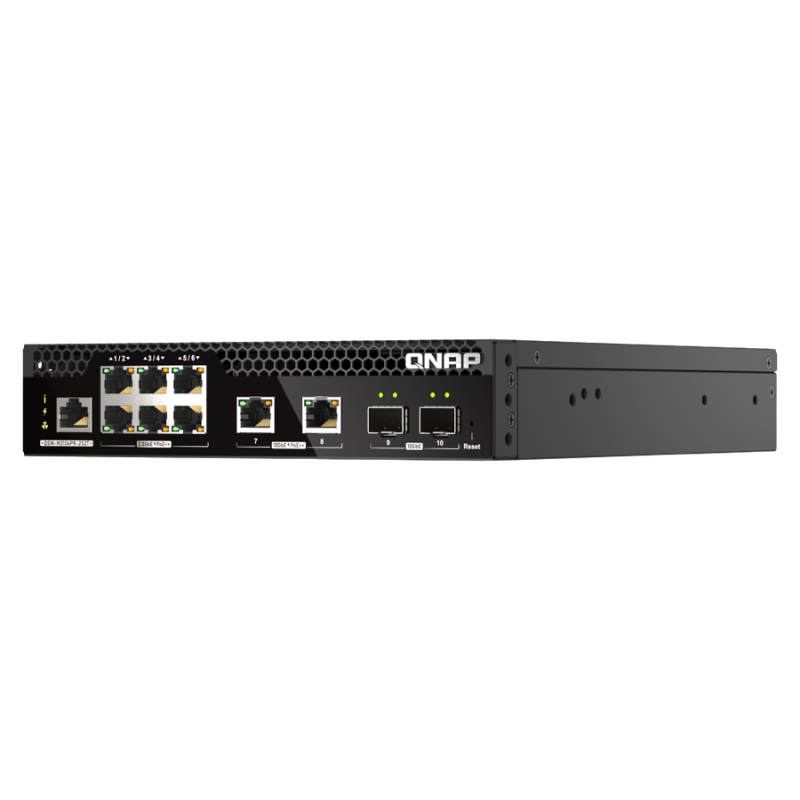
Qnap Systems QSW-M2106R-2S2T-US 6 Ports 10GbE and 2.5GbE SFP+ 1U Rack Mountable Layer 2 Managed Switch. Factory-Sealed New in Original Box (FSB) with 3 Years Warranty
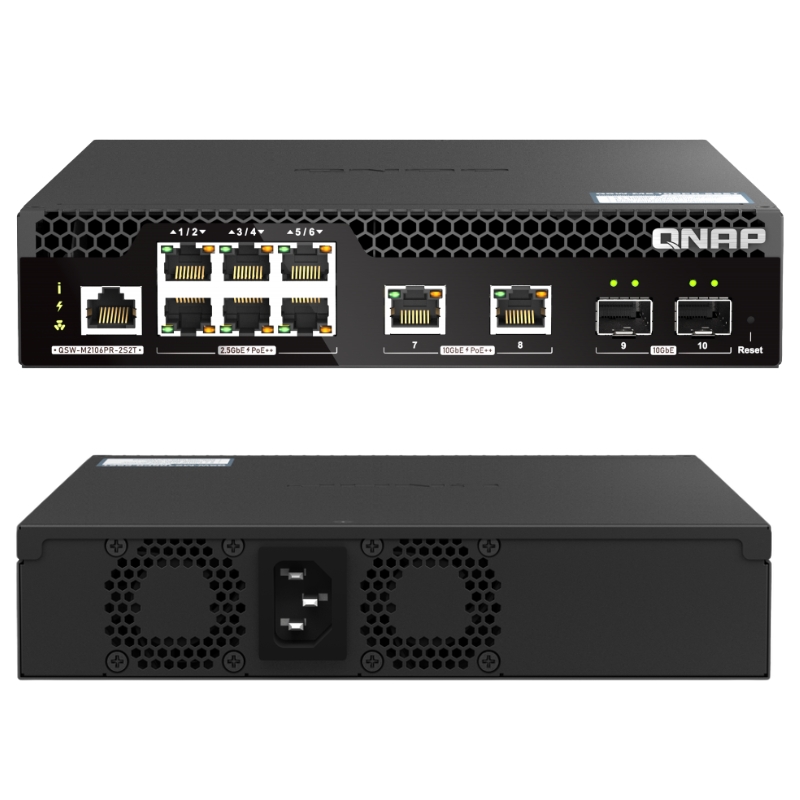
The Qnap Systems QSW-M2106R-2S2T-US represents a significant advancement in the category of compact, high-density Layer 2 managed switches. By combining six ports of 2.5GBASE-T, two ports of 10GBASE-T, and two dedicated 10GBASE-X SFP+ fiber uplinks, it delivers a versatile fabric capable of handling aggregated traffic from high-performance NAS devices, workstations, and surveillance systems without bottlenecking.
In modern network environments, the demand for high bandwidth and low latency is no longer limited to large data centers. Small and medium-sized businesses (SMBs), creative studios, and virtualized IT departments require robust infrastructure that can handle multi-gigabit traffic without complexity. The Qnap Systems QSW-M2106R-2S2T-US is a purpose-built network switch designed to bridge the gap between consumer-grade unmanaged switches and enterprise-level chassis systems. This 1U rack-mountable unit combines a flexible port configuration with a comprehensive Layer 2 management feature set, making it an ideal candidate for a cost-effective network spine. This category page delves into the intricate details of the QSW-M2106R-2S2T-US, exploring its hardware architecture, management capabilities, and the specific use cases it addresses within a high-speed network ecosystem.
The foundation of the QSW-M2106R-2S2T-US is built on a sturdy metal chassis designed for continuous operation in a 19-inch rack environment. Unlike desktop switches that sit on a shelf, the 1U height allows for efficient stacking in server rooms or network enclosures, optimizing space and airflow. The construction is passive or fan-cooled (depending on thermal load) with a smart fan design that minimizes acoustic noise while ensuring the internal components—including the switching ASIC and power supply—remain within operational thresholds. The front panel provides immediate visual feedback via LED indicators for link/activity and PoE status (though this specific model is not a PoE switch), allowing administrators to diagnose port connectivity at a glance.
The defining characteristic of the QSW-M2106R-2S2T-US is its diverse port ecosystem. It features a total of ten high-speed interfaces, categorized into three distinct types to support varying network segments:
The switch includes six ports operating at 2.5GBASE-T. These ports are backward compatible with 1000BASE-T (Gigabit) and 100BASE-TX, ensuring legacy devices can still connect. The 2.5G standard is particularly significant because it unlocks the full potential of Wi-Fi 6 access points and high-performance NAS units without requiring expensive CAT6a cabling; it operates efficiently over existing CAT5e infrastructure. This makes the switch exceptionally attractive for office upgrades where re-cabling is not feasible.
For high-bandwidth aggregation or connection to a core server, the switch provides two 10GBASE-T ports. These ports auto-negotiate between 10G, 5G, 2.5G, 1G, and 100M speeds. They serve as the primary uplink to a router or as direct connections to a 10G-capable file server or workstation. The inclusion of copper 10G ports ensures that users with existing CAT6a or CAT7 wiring can achieve 10G speeds without the need for fiber transceivers.
Complementing the copper interfaces are two 10GBASE-X SFP+ ports. These cages accept a variety of SFP+ modules, including 10GBASE-SR (multi-mode fiber), 10GBASE-LR (single-mode fiber), and Direct Attach Copper (DAC) cables. The SFP+ ports introduce fiber connectivity to the setup, enabling long-distance connections between buildings, or low-latency, low-power connections to other SFP+ devices using DAC cables. This hybrid approach (6x 2.5G + 2x 10G Copper + 2x 10G Fiber) provides unmatched topology flexibility in a fixed-configuration switch.
Transitioning from hardware to intelligence, the QSW-M2106R-2S2T-US is not merely a conduit for traffic; it is an active traffic manager. It operates as a fully managed Layer 2 switch, offering network administrators granular control over data flow. The management interface is accessible via a web-based GUI, Telnet, or SSH, supporting modern security protocols. The software stack is designed to optimize network performance, enhance security, and ensure redundancy.
One of the core features of managed switching is Virtual Local Area Network (VLAN) support. The QSW-M2106R-2S2T-US allows for the creation of up to 64 active VLANs. This enables network managers to segment traffic logically. For instance, in a small office setup, VoIP traffic can be isolated from guest Wi-Fi traffic, or a storage network can be segmented away from the user LAN. This not only improves security by containing broadcasts but also optimizes bandwidth utilization by preventing unnecessary traffic from crossing network segments. The switch supports port-based VLANs and 802.1Q tag-based VLANs, ensuring compatibility with a wide array of managed routers and access points.
To increase throughput beyond a single port's limitation or to provide link redundancy, the switch supports Link Aggregation. Administrators can combine multiple physical ports into a single logical trunk. For example, two of the 10G ports can be aggregated to create a 20G backbone between this switch and a core switch. The QSW-M2106R-2S2T-US supports various load-balancing algorithms (such as source-destination MAC/IP hash) to ensure traffic is distributed evenly across the aggregated links. This feature is critical for uplinks to servers or NAS devices where multiple clients are simultaneously accessing data.
Uptime is critical. The QSW-M2106R-2S2T-US integrates industry-standard protocols to ensure that network paths remain active even in the event of a cable break or device failure.
The switch supports multiple iterations of the Spanning Tree Protocol, including Rapid Spanning Tree Protocol (RSTP) and Multiple Spanning Tree Protocol (MSTP). RSTP provides faster convergence than the legacy STP, ensuring that backup links become active within seconds of a primary link failure. MSTP takes this further by allowing multiple VLANs to be mapped to a single spanning-tree instance, saving processing resources and enabling better load balancing across redundant links. This is essential for any network topology that includes physical loops for redundancy.
For environments that utilize IP surveillance cameras or IPTV, multicast traffic can be overwhelming. The switch features IGMP (Internet Group Management Protocol) Snooping (versions v1, v2, and v3). This feature intelligently monitors the IGMP traffic between hosts and routers, allowing the switch to forward multicast streams only to ports that have explicitly requested them. Without IGMP snooping, multicast traffic is flooded to all ports, wasting bandwidth. With it, the switch optimizes the delivery of video streams, ensuring that surveillance footage or streaming media does not saturate the network.
Beyond connectivity, securing the edge is a priority. The QSW-M2106R-2S2T-US incorporates Access Control Lists (ACL) based on Layer 2 and Layer 3 headers. ACLs provide packet filtering, allowing or denying specific traffic flows. For example, an administrator can create an ACL to block all traffic from a specific MAC address, or to prevent a specific IP subnet from accessing the management interface of the switch. This adds a layer of defense against unauthorized access and network attacks.
The switch includes features to protect against specific types of attacks. Port Security limits the number of MAC addresses that can be learned on a specific port, preventing MAC flooding attacks. DHCP Snooping acts as a firewall between untrusted hosts and trusted DHCP servers. It filters out DHCP messages from untrusted sources, mitigating the risk of rogue DHCP servers assigning malicious gateway addresses to clients. These features, while complex, are vital for maintaining a secure and trusted network infrastructure.
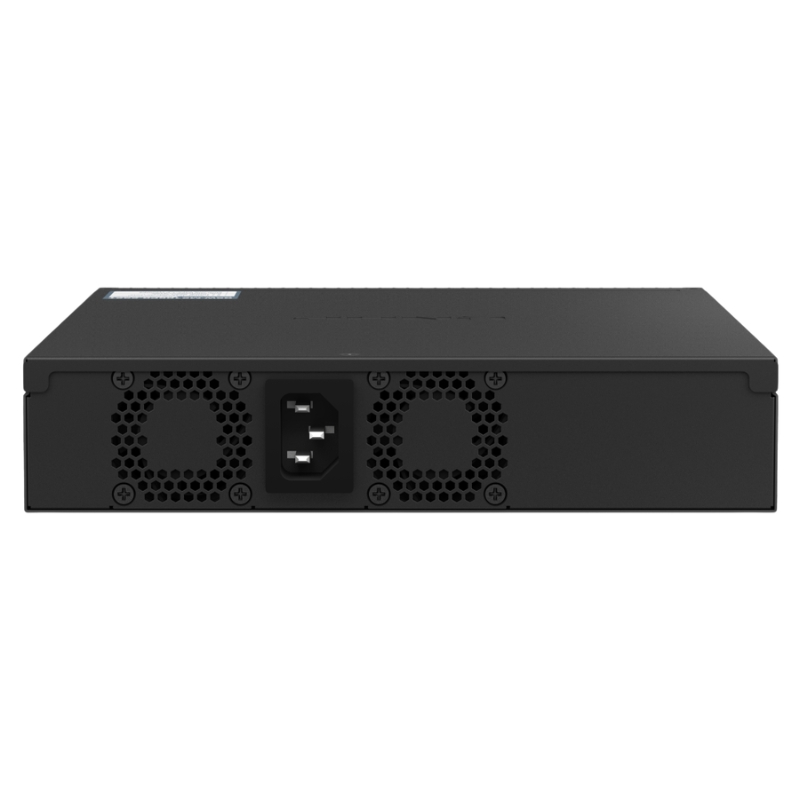
The QSW-M2106R-2S2T-US is engineered for the rack. The 1U form factor includes mounting ears for standard 19-inch racks. Power is supplied via an internal, auto-sensing power supply, supporting 100-240V AC, 50/60Hz. The power consumption is relatively efficient given the port density, typically operating below 30 watts under full load depending on transceiver usage. The cooling system utilizes smart fans that adjust speed based on the internal temperature sensor. In a typical office environment with moderate temperatures, the fans remain at low speeds, ensuring the switch is quiet enough to be located in an open-plan office or a small server room.
While the switch is branded QNAP, it is standards-compliant, meaning it operates seamlessly with any vendor's networking gear that adheres to IEEE standards. It is, however, optimized for use within a QNAP ecosystem. When connected to a QNAP NAS with 10G or 2.5G ports, the switch allows for the full utilization of the NAS bandwidth. It also supports the QNAP Qfinder Pro utility, which can discover the switch on the network, simplifying the initial setup process for users already familiar with QNAP's storage solutions.
Understanding the specifications is one thing; applying them to real-world scenarios highlights the switch's value. This device excels in specific deployment types due to its port variety and management features.
A video editing studio with multiple editors working off a central NAS requires high bandwidth. The 2.5G ports connect to editing workstations, providing double the speed of standard gigabit, significantly reducing file open/save times. The two 10G RJ-45 ports connect to the main storage NAS, providing a high-speed pipeline that can handle simultaneous streams from multiple editors. The SFP+ ports can be used to connect to a remote backup location using fiber, ensuring data redundancy off-site without electrical interference.
In a growing business with 30-50 users, this switch acts as the access layer core. The 2.5G ports connect to Wi-Fi 6 access points, providing the necessary backhaul for high-speed wireless. The 10G ports connect to the firewall/router and the central server. VLANs are configured to separate the guest Wi-Fi, corporate data, and VoIP phone traffic. RSTP ensures that if a cable is accidentally unplugged, the network reroutes traffic in seconds, minimizing downtime.
For IT professionals running a home lab with VMware or Proxmox, the combination of 2.5G for individual VM hosts and 10G for shared iSCSI or NFS storage is ideal. Link Aggregation can be configured between the switch and a multi-NIC server to increase throughput. The low latency of the SFP+ ports is perfect for connecting directly to storage arrays using DAC cables, providing a cost-effective, high-performance lab environment.


 Contact Us
 Information
 Catalog
 Solid State Drives (SSD)
 Network Switches
 Hard Disk Drives
 HBA & Controllers
 PC & Servers
 PC & Server Memory
 CPU & Processors
 Network Routers
 Power Supplies
 Tape Drives & Libraries
 Network Devices
 Computer & Network Cables