
(7% discount is applied at checkout)
Cart is empty
Your go-to destination for cutting-edge server products
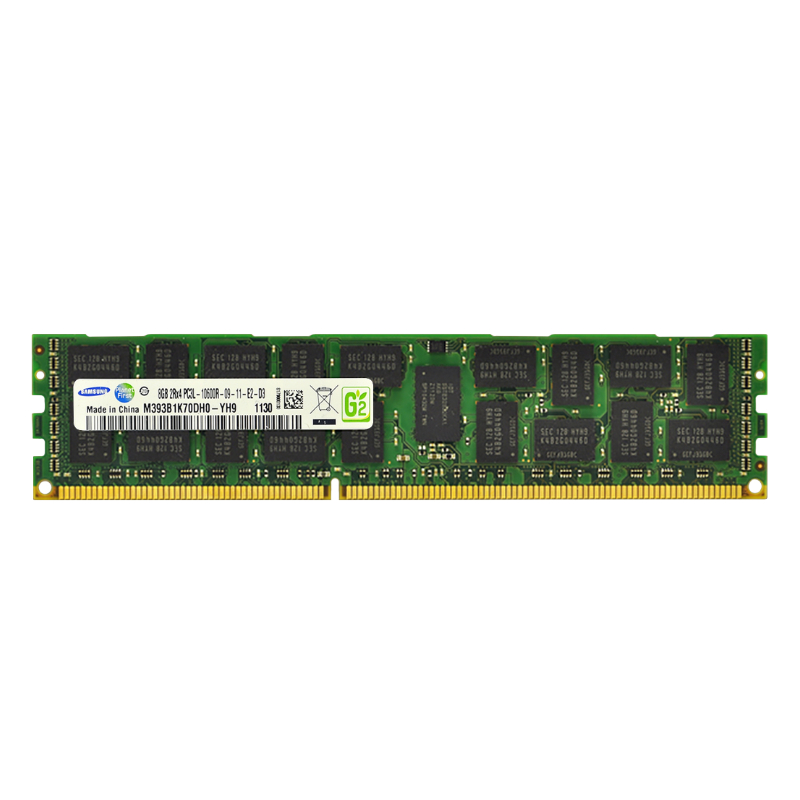
Samsung M393B1K70DH0YH9 8GB PC3-10600 1333MHZ DDR3 SDRAM Ecc Reg Ram. New (System) Pull with 1 year replacement warranty
| SKU/MPN | Warranty | Price | Condition | You save |
|---|---|---|---|---|
| M393B1K70DH0YH9 | 1 Year Warranty | Contact us for a price | Factory-Sealed New in Original Box (FSB) | |
| M393B1K70DH0YH9 | 1 Year Warranty | $49.00 | New (System) Pull | You save: $17.15 (26%) |
The Samsung M393B1K70DH0YH9 is a high-performance 8GB PC3-10600 DDR3-1333MT/s 2RX4 ECC Registered DIMM designed for enterprise-grade servers and workstations. This memory module ensures stability, reliability, and efficient multitasking for demanding computing environments.
The Samsung M393B1K70DH0YH9 8GB DDR3 ECC Registered memory module belongs to a specialized enterprise memory category designed for mission-critical server and workstation environments. This category focuses on stability, reliability, and predictable performance under sustained workloads rather than consumer-oriented speed optimizations. DDR3 ECC Registered DIMMs, commonly referred to as RDIMMs, are engineered to support error correction, higher memory densities, and electrical load reduction on the memory controller, making them suitable for data centers, virtualization platforms, database servers, and legacy enterprise systems that continue to rely on DDR3 architectures.
This memory category is widely deployed in environments where uptime, data integrity, and long-term compatibility are non-negotiable requirements. Samsung, as a tier-one semiconductor manufacturer, designs these modules to meet stringent validation standards required by OEM server platforms. The Samsung M393B1K70DH0YH9 exemplifies the characteristics expected from DDR3 ECC Registered memory, including dual rank architecture, x4 DRAM organization, conservative CAS latency, and low-voltage operation for improved power efficiency.
DDR3 SDRAM represents the third generation of double data rate synchronous dynamic random-access memory technology. Within enterprise memory categories, DDR3 remains relevant due to its mature ecosystem, proven reliability, and widespread support across legacy server platforms. DDR3 operates with improved prefetch architecture and reduced voltage compared to DDR2, enabling higher data transfer rates while maintaining thermal and electrical efficiency.
The Samsung M393B1K70DH0YH9 operates at 1333 megatransfers per second, aligning with the PC3-10600 specification. This data rate ensures consistent throughput for enterprise workloads such as file services, virtualization, transactional databases, and application hosting. In server environments, DDR3 memory modules like this one are often deployed in multi-channel configurations, where balanced memory population directly influences overall system bandwidth and latency behavior.
The PC3-10600 designation corresponds to a theoretical peak bandwidth of approximately 10.6 gigabytes per second per module. This bandwidth level is optimized for server chipsets that support DDR3-1333 memory frequencies. In enterprise platforms, sustained bandwidth consistency is more critical than peak burst performance, and PC3-10600 memory is well suited for workloads that require predictable memory access patterns.
Samsung’s engineering approach ensures signal integrity across the 240-pin RDIMM interface, minimizing timing skew and maintaining stability even when multiple modules are installed per memory channel. This is particularly important in registered memory configurations, where the register acts as a buffer between the DRAM and the memory controller.
Error Correcting Code, commonly abbreviated as ECC, is a defining feature of this memory category. ECC memory is designed to detect and correct single-bit memory errors and detect multi-bit errors, significantly reducing the risk of data corruption. In enterprise environments where large datasets are processed continuously, even minor memory errors can propagate into critical failures if left unchecked.
The Samsung M393B1K70DH0YH9 integrates ECC functionality at the hardware level, working in conjunction with compatible server chipsets and processors. This ensures that memory-related faults are handled transparently, maintaining application stability and system reliability without impacting performance in a noticeable way.
ECC memory is essential in systems that handle financial data, scientific computations, virtualization workloads, and enterprise applications. The presence of ECC significantly lowers the probability of system crashes caused by transient memory faults. This category of memory is therefore standard in rack servers, blade servers, and high-end workstations where reliability outweighs marginal cost differences.
Samsung’s ECC implementation follows JEDEC standards, ensuring compatibility with a wide range of server motherboards. This standardization allows system integrators and IT departments to deploy memory upgrades with confidence, knowing that the modules will behave predictably within supported platforms.
Registered DIMMs differ from unbuffered memory modules by incorporating a register between the DRAM chips and the memory controller. This register buffers command and address signals, reducing the electrical load presented to the memory controller. As a result, systems can support higher memory capacities and more populated DIMM slots without sacrificing stability.
The Samsung M393B1K70DH0YH9 is a registered DIMM designed specifically for enterprise platforms that require dense memory configurations. The use of RDIMM technology allows server architectures to scale memory capacity efficiently, supporting virtualization hosts and database servers that rely on large memory footprints.
By reducing signal load, registered memory enables more DIMMs per channel, which is critical for enterprise servers with multiple memory slots. This scalability allows organizations to expand memory capacity incrementally as workload demands grow. The registered design also contributes to improved signal integrity, which translates into fewer memory-related errors over time.
Samsung’s implementation of registered logic is optimized for DDR3 signaling characteristics, ensuring compatibility with Intel and AMD server platforms that support RDIMM configurations.
The dual rank design of the Samsung M393B1K70DH0YH9 divides the memory chips into two logical groups that can be accessed independently by the memory controller. Dual rank memory can improve performance in certain scenarios by allowing better interleaving of memory accesses, effectively increasing utilization of the memory bus.
In enterprise environments, dual rank modules strike a balance between capacity and performance. They are commonly used in servers where predictable throughput and compatibility are more important than achieving maximum possible frequency.
Rank interleaving enables the memory controller to alternate between ranks while one rank is refreshing or precharging. This behavior can reduce idle cycles and improve effective bandwidth. For workloads such as virtualization and database operations, this can translate into smoother performance under concurrent access conditions.
The Samsung dual rank architecture is validated to operate reliably at DDR3-1333 speeds with CAS latency 9, ensuring consistent timing behavior across a wide range of operating conditions.
The x4 DRAM organization used in this memory module refers to the data width of each individual DRAM chip. In x4 configurations, more chips are used to achieve the desired module capacity, which enhances fault tolerance in ECC implementations. This design is particularly favored in enterprise memory categories due to its improved error detection granularity.
Samsung’s x4 architecture aligns with server-class reliability standards, enabling more robust ECC correction compared to x8 configurations in certain failure scenarios. This makes the Samsung M393B1K70DH0YH9 suitable for environments with strict uptime requirements.
x4 memory layouts are commonly specified by OEM server manufacturers for platforms that prioritize reliability. The increased number of DRAM devices allows ECC mechanisms to function more effectively, contributing to higher overall system resilience.
This design choice reflects Samsung’s focus on enterprise-grade engineering rather than consumer-oriented cost optimization.
The CAS latency of CL9 defines the number of clock cycles between a read command and the availability of data. In server memory categories, conservative CAS latency values are preferred to ensure timing stability across varied workloads and thermal conditions. The CL9 specification of the Samsung M393B1K70DH0YH9 is well matched to its 1333 MT/s operating speed.
Rather than pursuing aggressive latency reductions, this memory category emphasizes consistent timing behavior. This approach reduces the likelihood of marginal timing errors that could compromise system stability during extended operation.
In multi-socket servers and virtualized environments, memory latency consistency is more critical than absolute minimum latency. Stable timing parameters contribute to predictable application performance, especially when multiple virtual machines or processes compete for memory resources.
Samsung validates its timing profiles to ensure compliance with JEDEC standards, simplifying deployment across diverse server platforms.
The 1.35-volt operating voltage of this DDR3 module classifies it as DDR3L, offering reduced power consumption compared to standard 1.5-volt DDR3 memory. Lower voltage operation is particularly beneficial in data center environments where energy efficiency directly impacts operational costs and thermal management.
Samsung’s low-voltage design allows enterprises to reduce overall system power draw without sacrificing stability or compatibility. This aligns with modern data center strategies focused on energy efficiency and sustainable operation.
Lower operating voltage results in reduced heat generation, which in turn can improve system reliability and extend component lifespan. In densely populated server racks, even small reductions in per-module power consumption can accumulate into significant energy savings.
The Samsung M393B1K70DH0YH9 is engineered to maintain stable operation at 1.35 volts across its full temperature range, ensuring dependable performance in controlled data center environments.
The 240-pin RDIMM form factor is standard for DDR3 server memory modules. This physical design ensures compatibility with enterprise server motherboards that support DDR3 registered memory. The pin layout and module dimensions adhere to JEDEC specifications, allowing seamless integration into supported systems.
Samsung’s manufacturing precision ensures consistent module thickness, contact alignment, and PCB quality, all of which contribute to reliable electrical connections and long-term durability.
Enterprise memory modules are designed for repeated installation and removal during system upgrades or maintenance. The robust PCB construction and high-quality edge connectors used in Samsung RDIMMs reduce wear and maintain signal integrity over time.
This physical reliability complements the electrical and logical robustness of the memory module, making it suitable for long deployment cycles.
The Samsung M393B1K70DH0YH9 is specifically designed for legacy enterprise platforms that support DDR3 ECC Registered memory. Many production environments continue to rely on proven server architectures due to software compatibility, certification requirements, or cost considerations.
This memory category plays a critical role in extending the usable life of existing server infrastructure. By providing reliable upgrade options, enterprises can maintain performance and stability without undertaking full system replacements.
Samsung memory modules are widely validated by major server OEMs, ensuring compatibility with platforms from vendors such as Dell, HP, IBM, and Lenovo that support DDR3 RDIMMs. This validation process includes extensive testing under various load and temperature conditions.
Such broad compatibility simplifies procurement and deployment for IT departments managing heterogeneous server environments.
This DDR3 ECC Registered memory category is commonly used in file servers, mail servers, virtualization hosts, database servers, and professional workstations. Its balanced specifications make it suitable for a wide range of workloads that demand reliability and stability rather than cutting-edge performance.
In virtualized environments, sufficient and reliable memory is critical for maintaining performance isolation between virtual machines. The Samsung M393B1K70DH0YH9 supports such environments by providing consistent memory behavior under concurrent access patterns.
Virtualization platforms benefit from ECC registered memory due to reduced error rates and improved scalability. Database systems similarly rely on stable memory to cache data and execute transactions efficiently.
This memory category continues to be relevant in enterprise deployments where DDR3 platforms remain in active service, supporting business-critical applications without disruption.


 Contact Us
 Information
 Catalog
 Solid State Drives (SSD)
 Network Switches
 Hard Disk Drives
 HBA & Controllers
 PC & Servers
 PC & Server Memory
 CPU & Processors
 Network Routers
 Power Supplies
 Tape Drives & Libraries
 Network Devices
 Computer & Network Cables