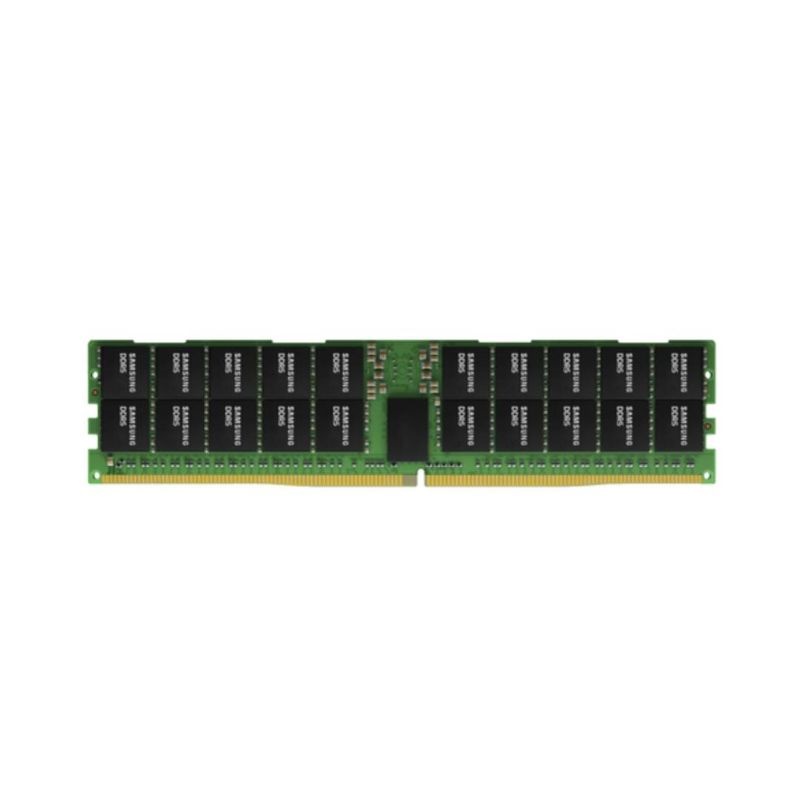
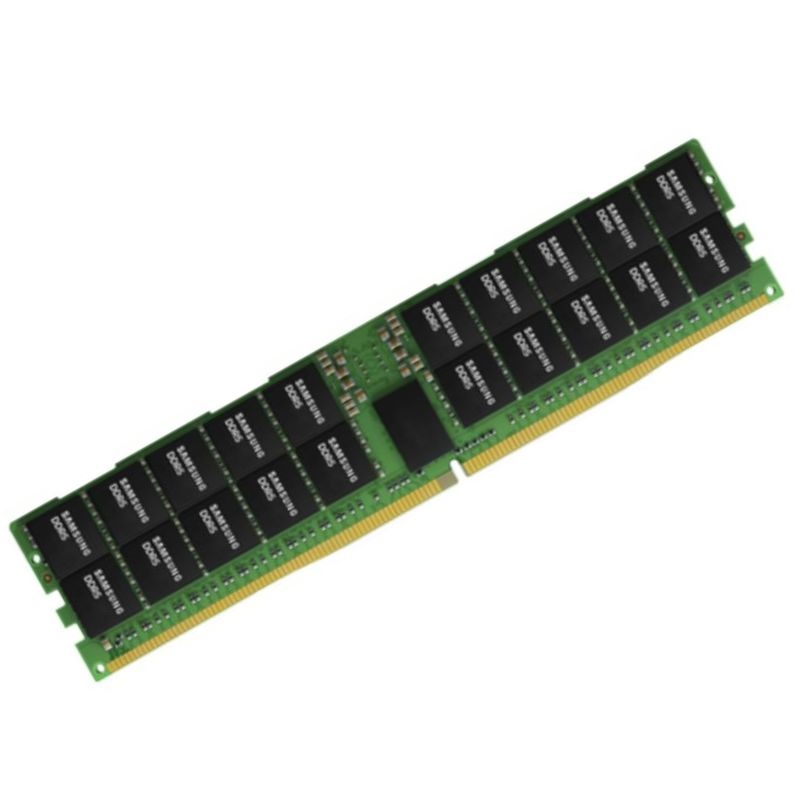
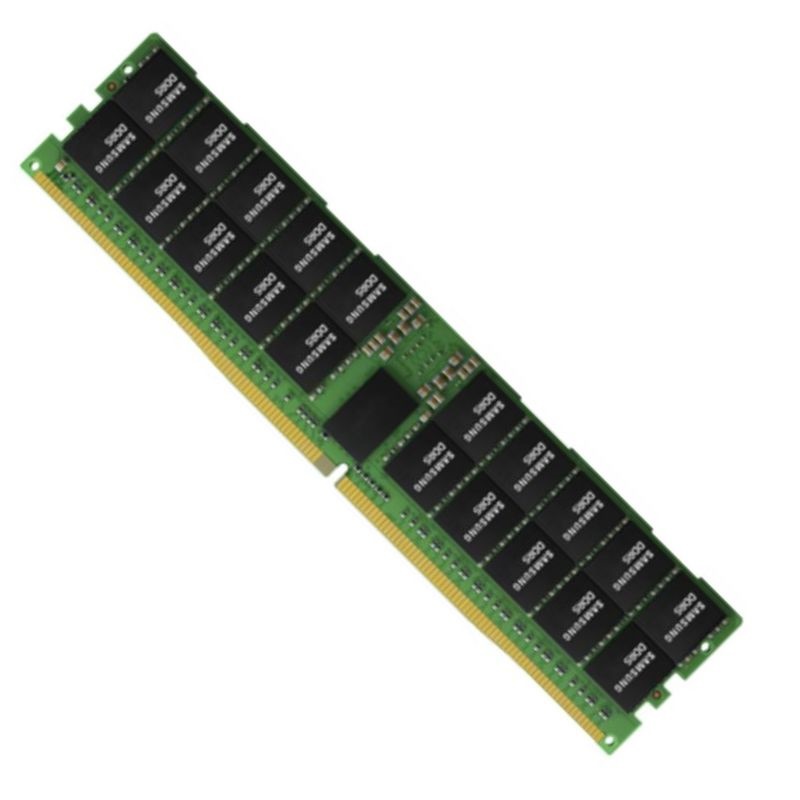
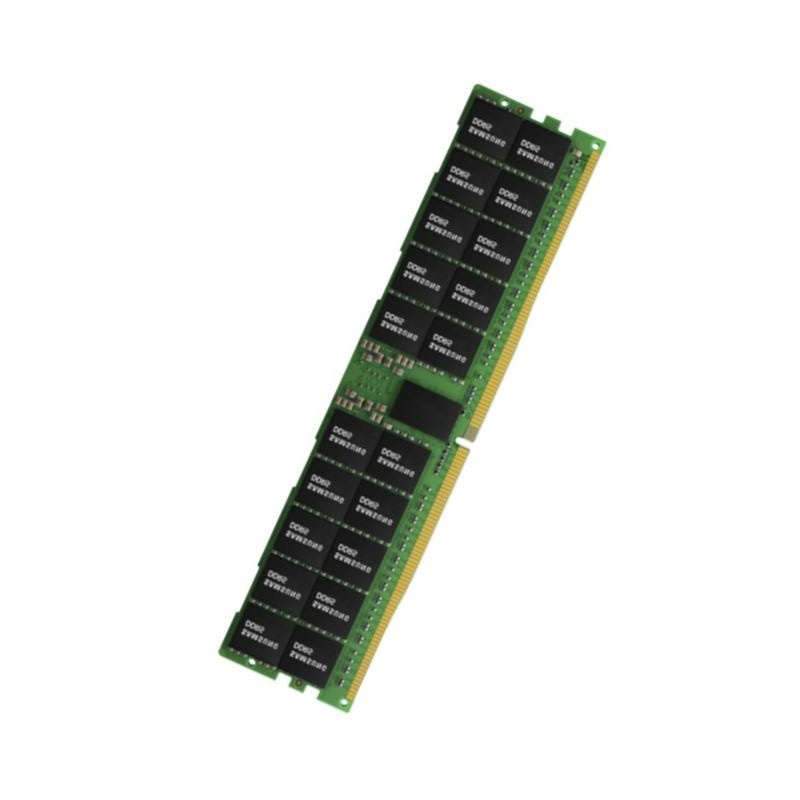
Samsung M321R2GA3BB0-CQK 16GB RDIMM PC5-38400R Server RAM
- — Free Ground Shipping
- — Min. 6-month Replacement Warranty
- — Genuine/Authentic Products
- — Easy Return and Exchange
- — Different Payment Methods
- — Best Price
- — We Guarantee Price Matching
- — Tax-Exempt Facilities
- — 24/7 Live Chat, Phone Support
- — Visa, MasterCard, Discover, and Amex
- — JCB, Diners Club, UnionPay
- — PayPal, ACH/Bank Transfer (11% Off)
- — Apple Pay, Amazon Pay, Google Pay
- — Buy Now, Pay Later - Affirm, Afterpay
- — GOV/EDU/Institutions PO's Accepted
- — Invoices
- — Deliver Anywhere
- — Express Delivery in the USA and Worldwide
- — Ship to -APO -FPO
- — For USA - Free Ground Shipping
- — Worldwide - from $30
Product Overview of Samsung DDR5 ECC Registered Memory
The SAMSUNG M321R2GA3BB0-CQK is a high-performance 16GB DDR5 SDRAM Registered ECC Memory Module, specifically engineered for servers and enterprise-class systems requiring stable, reliable, and accelerated data transfer. Designed with a 288-pin RDIMM form factor, this module ensures compatibility with advanced motherboards that support DDR5 technology.
Manufacturer Details
- Brand: Samsung
- Part Number: M321R2GA3BB0-CQK
- Product Type: DDR5 SDRAM RDIMM ECC Memory
Main Highlights
- High-density 16GB storage capacity for memory-intensive workloads.
- Latest DDR5 SDRAM architecture enabling faster data throughput.
- 4800 Mbps bus speed supporting PC5-38400 bandwidth.
- ECC (Error-Correcting Code) for improved data integrity and accuracy.
- Registered (Buffered) design enhancing system stability.
- Optimized latency with CL40 timings.
- Built with 1Rx8 rank configuration for efficiency.
Technical Specifications
Memory Performance
The Samsung DDR5 RDIMM delivers unmatched performance with its 4800 Mbps speed rating, ensuring accelerated data processing and reduced bottlenecks. Ideal for cloud computing, virtualization, and AI-driven workloads, this module supports consistent performance under demanding tasks.
Key Technical Features
- Capacity: 16GB
- Type: DDR5 SDRAM
- Speed: 4800 Mbps (DDR5-4800 / PC5-38400)
- Module Configuration: 1 x 16GB
- Data Integrity: ECC (Error Correction Code)
- Signal Type: Registered (Buffered)
- CAS Latency: CL40
- Rank: 1Rx8
Physical Attributes
Built with a 288-pin RDIMM design, this memory module ensures robust connectivity and reliable installation. Its compact size makes it well-suited for enterprise rack servers and high-performance computing systems.
Dimension & Weight Details
- Form Factor: 288-Pin RDIMM
- Height: 1.00 inch
- Depth: 6.75 inches
- Weight: 0.20 lb
Reason of choose of Samsung DDR5 ECC Registered Memory
Reliability & Stability
Thanks to its ECC technology, this module automatically detects and corrects data errors, significantly reducing downtime and preventing system crashes. Combined with its registered signal buffering, it ensures smoother system performance for mission-critical operations.
Future-Ready Technology
DDR5 memory represents the next leap in memory standards. With higher bandwidth and improved efficiency compared to DDR4, the Samsung M321R2GA3BB0-CQK is designed to support next-generation computing environments seamlessly.
Key Advantages at a Glance
- Supports enterprise-grade reliability with ECC.
- Registered memory enhances data transmission stability.
- DDR5 architecture ensures higher bandwidth and scalability.
- CL40 latency balances speed and responsiveness.
- Samsung manufacturing guarantees quality and longevity.
Ideal Applications
This Module Excels
- Enterprise-class servers requiring high stability.
- Datacenter deployments for large-scale memory capacity.
- Virtualization platforms that demand reliable performance.
- AI, HPC, and machine learning workloads with heavy memory requirements.
- Cloud-based infrastructure requiring faster throughput.
Summary of Benefits
The Samsung 16GB DDR5 ECC Registered RDIMM is a future-proof solution that combines cutting-edge speed, advanced error correction, and solid reliability. Whether for enterprise, datacenter, or high-performance computing, it ensures seamless operation, making it a valuable choice for professionals seeking uncompromised performance.
Purpose, Positioning, and Key Benefits of Samsung M321R2GA3BB0-CQK 16GB Server RAM
The Samsung M321R2GA3BB0-CQK is a 16 GB Registered DIMM (RDIMM) designed for enterprise-class servers and workstations that require exceptional reliability, predictable latency, and deterministic throughput. Classified as PC5-38400R, this module aligns with the JEDEC DDR5-4800 data rate class, offering high bandwidth while maintaining server-grade stability. As an RDIMM, it integrates a register (buffer) and an RCD (Registering Clock Driver) to offload electrical loading from the CPU’s memory controller, enabling higher module population per channel and more consistent signal integrity in multi-DIMM configurations. Typical deployments include virtualization hosts, database servers, hyper-converged nodes, container orchestration clusters, and edge compute appliances where uptime, data integrity, and performance consistency matter more than headline peak speeds.
- Capacity: 16 GB per module for balanced density and granular scaling.
- Generation: DDR5, PC5-38400 class for nominal 4800 MT/s data rate under JEDEC profiles.
- Type: RDIMM (Registered DIMM) with ECC support for server platforms.
- Voltage: DDR5 nominal 1.1 V operating level with on-module PMIC for stable power delivery.
- Use case: Enterprise servers, professional workstations, and mission-critical systems requiring ECC and buffering.
Understanding PC5-38400R and DDR5 Architecture in the Context of This Module
PC5-38400R identifies modules engineered for approximately 38.4 GB/s peak theoretical bandwidth per DIMM at the DDR5-4800 data rate (calculated from 4800 MT/s × 64-bit data bus ÷ 8). DDR5 advances the memory subsystem through higher signaling rates, dual independent 32-bit channels per DIMM (plus ECC bits), improved bank groups, and a power management architecture that moves certain regulation functions onto the module itself via the PMIC. The Samsung M321R2GA3BB0-CQK leverages these DDR5 attributes to deliver higher concurrency and more efficient parallelism than comparable DDR4 RDIMM solutions, especially under random and mixed workloads common in server environments.
Beyond raw throughput, DDR5 introduces on-die ECC within DRAM chips to improve internal cell reliability, while the module also supports traditional DIMM-level ECC for end-to-end data protection across the host memory controller, making the module well-suited for applications where silent data corruption must be minimized. Combined with the RCD, these electrical and logical improvements enable platform designers to scale memory footprints per socket while preserving signal margins across heavily populated memory channels.
Compatibility Scope and Platform Targeting
As an RDIMM with ECC, the Samsung M321R2GA3BB0-CQK targets server-class platforms whose memory controllers are validated for DDR5 RDIMMs (for example, modern server CPUs from leading vendors offering DDR5 channels). It is not intended for consumer desktop motherboards, which typically require UDIMM (unbuffered) or SODIMM memory and often do not implement RDIMM support. Professional workstations may support RDIMM if the board and CPU are certified for ECC RDIMM operation; always verify motherboard QVL lists and system OEM documentation to ensure compatibility with RDIMM type, data rate, and capacity per slot.
- Check that the board explicitly lists RDIMM support; UDIMM ECC and RDIMM are not interchangeable.
- Confirm DDR5 generation alignment; DDR4 and DDR5 modules are keyed differently and are not cross-compatible.
- Observe maximum DIMMs per channel (DPC) and ranks per channel recommended by the CPU vendor for stable operation.
- Match data rate expectations to the platform: with multiple DIMMs per channel, motherboards may down-clock to maintain stability according to JEDEC guidance.
Typical Workloads That Benefit Most
The 16 GB RDIMM capacity is a sweet spot for systems that prioritize channel interleaving and balanced population over sheer per-DIMM density. When slots are plentiful and administrators wish to maximize bandwidth via more populated channels, 16 GB RDIMMs help achieve uniform interleaving across sockets and memory channels. This approach benefits:
- Database servers using rowstore or columnar engines, where predictable memory latency aids query performance.
- Virtualization hosts (KVM, Hyper-V, VMware) seeking a balance between VM density and per-VM memory allocation granularity.
- Analytics nodes and in-memory caching tiers (Redis, Memcached) that value steady bandwidth.
- Build servers and CI/CD runners compiling large codebases with high concurrency.
- Edge compute and industrial control where ECC and uptime are mandatory.
Physical and Electrical Characteristics in Practical Terms
DDR5 RDIMMs incorporate a centralized PMIC that regulates module power rails, enabling finer-grained voltage control and improved signal integrity. The buffering and registering functions isolate the CPU memory controller from the electrical loading of multiple DRAM devices, improving timing margins and enabling higher system-level capacities per channel. This module adheres to standard server-height RDIMM form factor and includes thermal labeling to assist inventory management and serviceability in dense rack environments.
- Form factor: Standard DDR5 RDIMM.
- Operating voltage: Nominal 1.1 V input per DDR5 specification with on-module PMIC regulation.
- ECC: End-to-end ECC at the DIMM level; DDR5 DRAM die also implements on-die ECC mechanisms.
- Clocking: RCD for command/address signal registering to maintain timing fidelity under load.
- Thermal behavior: Designed for server airflow patterns; ensure front-to-back chassis flow and unobstructed baffles.
Latency and Timings Perspective
Server-grade modules ship with JEDEC-compliant SPD profiles designed for stability across broad environmental ranges. While precise CAS latency values vary by vendor binning and system configuration, the PC5-38400 class typically operates with standardized timing sets at the nominal data rate. When channels are heavily populated or mixed with different capacities, servers may negotiate lower effective data rates to maintain guard bands for stability; this is expected behavior and not a defect. Administrators planning for deterministic performance should size memory to minimize disparate DIMM types within a channel and prefer symmetric population across sockets.
Server Architecture Considerations: Channels, Ranks, and Interleaving
Modern server CPUs expose multiple memory channels per socket. Performance scales when those channels are populated symmetrically because interleaving distributes accesses and minimizes hot spots. The Samsung M321R2GA3BB0-CQK, at 16 GB, fits neatly into configurations aiming for uniform capacity per channel—e.g., 8 × 16 GB to yield 128 GB per socket in an 8-channel design. Administrators frequently prefer more modules of lower capacity to maximize parallelism, up to the point where thermal and power budgets or DPC limits begin to reduce achievable data rates.
Rank organization also affects concurrency. DDR5 modules can be organized internally in ways that let the memory controller juggle operations across rank boundaries to reduce perceived latency. Although rank specifics differ by module revision, the presence of multiple banks and enhanced bank groups in DDR5 improves opportunities for parallel access even within a single module, supporting higher effective utilization under mixed read/write server workloads.
Population Rules of Thumb
- Populate each channel evenly before adding a second DIMM per channel.
- Prioritize identical capacity and speed across a channel to minimize down-binning.
- When mixing vendors or bins, follow the platform’s recommended slot order and prefer identical modules per channel pair.
- Use motherboard QVL or server OEM memory configurators to verify supported DPC at the desired data rate.
Reliability, ECC, and Data Integrity Features
Enterprise environments demand long mean time between failures (MTBF) and robust protection against soft errors. The M321R2GA3BB0-CQK provides module-level ECC that detects and corrects single-bit errors and detects multi-bit errors, in conjunction with the system’s memory controller. DDR5’s on-die ECC further enhances resilience by correcting internal cell disturbances before they manifest externally. Combined, these capabilities reduce the incidence of silent data corruption, an essential factor for financial systems, scientific computing, medical imaging workloads, and any regulated workload requiring data coherency verification.
Administrators should also consider patrol scrubbing and demand scrubbing features in server BIOS/UEFI. These firmware routines periodically scan memory to detect and correct transient errors proactively. With high-density memory populations, enabling scrubbing helps maintain a clean memory state over long uptimes. Note that scrubbing can introduce a modest background bandwidth consumption; most servers expose scheduling or aggressiveness options to balance integrity and performance.
Thermal and Environmental Guidance
- Maintain chassis airflow in the vendor-specified direction (front-to-back in most rack servers).
- Ensure cable management and blanking panels do not impede memory airflow.
- Use environmental monitoring to track DIMM temperature sensors via IPMI or the vendor management stack.
- Plan for seasonal ambient changes in data centers without full environmental control, especially at the top of rack where heat pools.
Performance Tuning Strategies with 16 GB DDR5 RDIMMs
Performance hinges on channel utilization, NUMA awareness, and memory scheduling. Populate channels symmetrically first, then align NUMA node memory with the processes that consume it. For virtualization, pin high-bandwidth VMs to cores local to the memory channels hosting their working sets. For databases, allocate buffer caches to fit within a single NUMA node when possible to minimize cross-socket memory traffic, or intentionally stripe across nodes if the workload benefits from aggregate bandwidth more than locality.
Firmware settings can influence outcomes. Options such as “performance” vs. “balanced” power modes, memory interleaving policies, and scrubbing aggressiveness should be validated under your workload. Because the Samsung M321R2GA3BB0-CQK adheres to JEDEC standards, it behaves predictably across vendor platforms; nevertheless, profile your applications with representative data and concurrency settings to discover optimal BIOS and OS tunables for your environment.
Real-World Scenarios
- High-density VM farm: Use many 16 GB RDIMMs to maximize channels and keep host memory fragmentation low, enabling flexible VM sizing.
- Analytics/ETL tiers: Favor symmetric, multi-channel population to enhance shuffle and join performance in distributed processing frameworks.
- CI build clusters: Distribute 16 GB modules across nodes to improve parallel build throughput without over-provisioning per-node memory.
- Edge gateways: Combine ECC RDIMMs with ruggedized servers for on-site data pre-processing where backhaul bandwidth is limited.
Capacity Planning with 16 GB Modules
Choosing 16 GB RDIMMs provides fine-grained scaling. Rather than committing to fewer, high-capacity modules, many deployments prefer a larger count of 16 GB DIMMs to saturate channels, enhance interleaving, and maintain flexibility for future growth. This approach also eases stock management: spare pools need fewer unique SKUs when a standard 16 GB part can serve as a universal replacement in many hosts.
In cluster designs, administrators often target a per-node memory baseline that aligns with application reservation units—e.g., container memory limits or VM templates. The 16 GB step size maps cleanly to multiples used in practice (16, 32, 48, 64 GB per VM) and helps avoid stranding capacity due to awkward leftovers that don’t match deployment templates.
NUMA and Socket-Level Balancing
Memory should be distributed equally across sockets to reduce cross-socket traffic. If a dual-socket server supports eight channels per socket, a common starting configuration is to install eight 16 GB modules per socket (for 128 GB per socket), populating the preferred slot order indicated by the motherboard silk screen or manual. This ensures that OS NUMA domains report balanced memory per node, enabling schedulers to place tasks efficiently.
Comparisons: RDIMM vs. LRDIMM vs. UDIMM for Server Use
RDIMM modules like the M321R2GA3BB0-CQK include a register to reduce electrical loading, enabling stable multi-DIMM configurations at mainstream capacities and speeds. LRDIMM (Load-Reduced DIMM) takes buffering further with additional isolation, supporting even higher capacities per channel at the cost of slightly higher latency and complexity; LRDIMM is common where per-socket capacity is pushed to the limits. UDIMM ECC can be used in some workstation-class platforms but lacks the buffering needed for dense, multi-DIMM server configurations. For the majority of balanced, high-uptime servers, RDIMM strikes the ideal trade-off among capacity, performance, and cost.
Specifically 16 GB RDIMM
- Granular scaling: Adjust total memory in smaller increments to match workload needs precisely.
- Channel saturation: Populate more channels early to exploit interleaving benefits.
- Inventory flexibility: Simplify spares and reduce stranded stock across varied nodes.
- Cost efficiency: Lower per-DIMM cost compared with very high-density modules while preserving enterprise features.
Workload-Focused Recommendations
Virtualization and Cloud Hosts
For hypervisors, consistent latency and predictable ECC behavior matter more than maximal peak bandwidth. Populate channels symmetrically with 16 GB RDIMMs across sockets, then scale upward by adding the same modules in second DPC positions. Leverage host NUMA policies or orchestrator placement rules to keep VM memory local to the assigned CPUs. Reserve headroom for page-cache and live migration operations, especially during rolling upgrades.
Database and In-Memory Stores
Databases benefit when buffer caches fit fully in RAM. Build configurations around multiples of 16 GB to map cleanly to SGA/Buffer Pool sizing (e.g., 256 GB host memory translating to a 200 GB cache after OS overhead). Enable ECC logging and scrubbing. For write-heavy OLTP, favor balanced channels to minimize variance; for analytics, prioritize aggregate capacity with symmetry preserved.
Containers and Microservices
With Kubernetes or similar orchestrators, right-size node memory to the largest common container limit to reduce fragmentation. The 16 GB increment simplifies setting requests and limits and can be replicated uniformly across nodes for predictable scheduling. Employ node taints and labels to steer memory-hungry workloads to hosts with the most channels populated.
Content Delivery, Caching, and Edge AI
Edge nodes often operate in thermally constrained enclosures. The efficiency of DDR5 with on-module PMIC, combined with RDIMM buffering, assists with predictable power behavior. Use temperature telemetry to tune fan curves and ensure the module operates within its rated thermal envelope. For content caching, more channels at moderate capacity often outperform fewer channels with very large DIMMs due to better concurrency.
Technical Glossary for Quick Reference
- RDIMM: Registered DIMM with a buffer to ease electrical loading on the memory controller.
- ECC: Error-Correcting Code protecting against single-bit memory errors and detecting multi-bit faults.
- DDR5: Fifth-generation double data rate memory standard with higher bandwidth and on-module PMIC.
- PC5-38400R: Speed classification indicating DDR5-4800 RDIMM with ~38.4 GB/s theoretical bandwidth.
- PMIC: Power Management IC on the DIMM for stable voltage regulation.
- RCD: Registering Clock Driver that registers command/address signals for improved timing margins.
- DPC: DIMMs per channel; affects attainable data rates and training stability.
- NUMA: Non-Uniform Memory Access architecture in multi-socket systems affecting memory locality.
Config Examples Using Samsung M321R2GA3BB0-CQK 16 GB RDIMMs
Entry Dual-Socket Virtualization Host
- Goal: 256 GB total, balanced channels.
- Config: 2 sockets × 8 channels × 8 × 16 GB overall (64 GB per socket with first DPC, expanded later).
- Notes: Start with one DIMM per channel; add second DPC later maintaining identical modules.
Mid-Range Analytics Node
- Goal: 512 GB with strong interleaving.
- Config: 2 sockets with 8 channels each, 2 DPC using 16 GB modules for 16 modules per socket.
- Notes: Validate down-clock expectations at 2 DPC and ensure airflow margin.
Edge Datacenter Microserver
- Goal: 64–128 GB in thermally constrained chassis.
- Config: 4–8 pieces of 16 GB RDIMM based on slot count.
- Notes: Monitor DIMM temperatures and adjust fan curves via BMC.
Operational Tips for Stable 24×7 Service
- Schedule quarterly memory diagnostics during planned maintenance windows.
- Track ECC event rates per slot; replace DIMMs with rising trends before crossing thresholds.
- Keep a standardized spare pool of 16 GB RDIMMs to simplify swaps and reduce MTTR.
- Document population maps and firmware revisions alongside each host asset record.
Sustainability and Efficiency Notes
DDR5’s power architecture can reduce total energy per transferred bit relative to previous generations, particularly under balanced channel loads. Because many data centers operate within strict power envelopes, choosing 16 GB modules to saturate channels at moderate densities can provide a favorable balance between throughput and wattage. Monitoring actual memory utilization helps right-size capacity to avoid the hidden energy cost of idle headroom.
Thermal Design Implications
In high-density memory configurations, thermal gradients between inner and outer slots can be significant. Consider staggered population (following vendor guidance) if airflow is constrained, maintain clean air filters, and deploy temperature-aware fan profiles. The Samsung RDIMM construction supports typical enterprise airflow patterns; proper chassis design remains essential to prevent throttling or uncorrectable error spikes associated with heat.
Key Takeaways for Category Shoppers
- Samsung M321R2GA3BB0-CQK delivers DDR5-class bandwidth with RDIMM reliability and ECC protection.
- 16 GB capacity enables fine-grained scaling and optimal channel interleaving.
- Ideal for virtualization, databases, analytics, CI pipelines, and edge compute where deterministic performance is vital.
- Designed for platforms that explicitly support DDR5 RDIMM; not for consumer desktops.
- Backed by JEDEC-compliant SPD profiles for predictable cross-platform behavior.
Content-Ready Meta Points for Merchandisers
- “DDR5-4800 RDIMM with ECC for mission-critical servers”
- “16 GB capacity tuned for balanced channel interleaving and scalable performance”
- “On-module PMIC and RCD for stable power and clean signal margins”
- “Ideal for virtualization, database, and edge workloads requiring 24×7 reliability”
Deployment Patterns for Common Server Families
Across mainstream server families that support DDR5 RDIMM, a practical approach is to start with one DIMM per channel using 16 GB modules to ensure the highest data rate per vendor guidance, then expand to two DIMMs per channel as capacity needs grow. Maintain identical module SKUs per channel group to reduce training time and variability. When upgrading mixed fleets, validate firmware parity to prevent divergent training results across nodes.
This Category Entry Adds Value to Your Build
Choosing a well-specified, JEDEC-compliant 16 GB DDR5 RDIMM like the M321R2GA3BB0-CQK reduces operational surprises. It supports clear, repeatable capacity planning, aligns with best practices for channel population, and integrates cleanly with standard server management stacks that expose thermal and ECC telemetry. For teams managing many nodes, that predictability translates into faster deployments, simpler troubleshooting, and higher overall service quality.
Checklist Before You Click “Add to Cart”
- Verify DDR5 RDIMM support and maximum DPC on your exact motherboard and CPU.
- Plan symmetric channel population with 16 GB increments.
- Confirm rack airflow and power budgets for memory expansion.
- Prepare diagnostics media and update firmware prior to installation.
- Log part numbers and slot mappings for lifecycle tracking.
Extended Notes on Interoperability and Mixed Environments
Many enterprises run a blend of OEM-branded and channel memory. While mixing is feasible when all parts conform to JEDEC and platform rules, the lowest common denominator principle applies. Using the same Samsung 16 GB RDIMM across as many hosts as possible reduces edge cases. If mixing is unavoidable, maintain strict symmetry within a channel, keep speed grades identical, and ensure firmware is updated to the vendor release that includes the latest memory training improvements.
Serviceability in the Field
The clear labeling and standard geometry of the M321R2GA3BB0-CQK simplify identification in cramped racks. Tool-less retention in modern server sockets allows quick swaps. Pair spares with anti-static sleeves and include a printed quick-reference of slot population order to shorten maintenance windows and reduce human error.