(7% discount is applied at checkout)
Cart is empty
Your go-to destination for cutting-edge server products


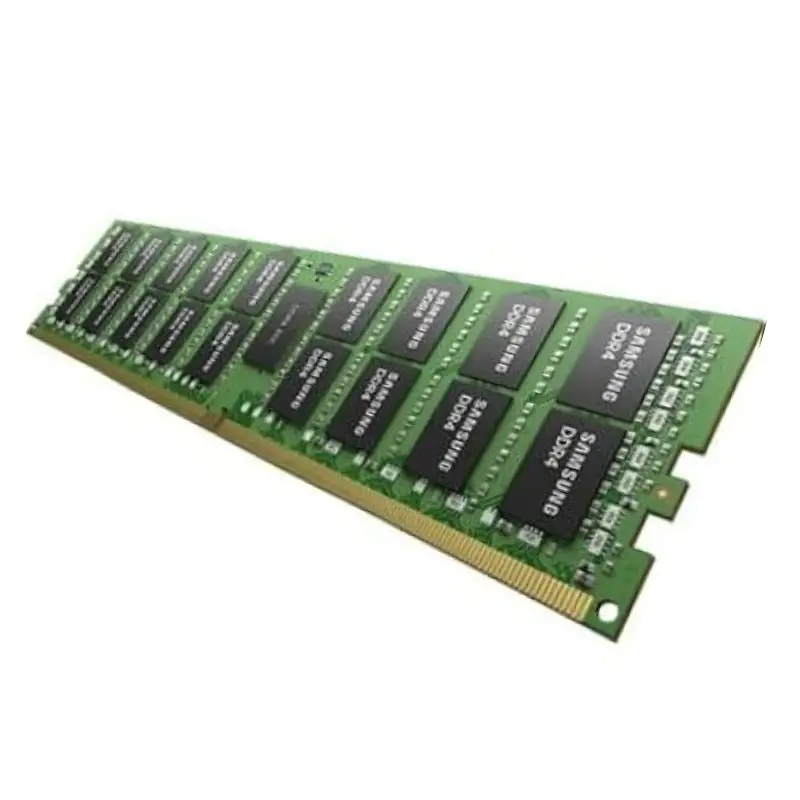
Samsung M393A4G43CB4-CWEBY 32GB 3200MBPS PC4-25600 CL22 Ecc Registered Dual Rank 1.2v DDR4 SDRAM 288-Pin RDIMM Memory Kit. New Sealed in Box (NIB) with 3 Year Warranty
The Samsung M393A4G43CB4-CWEBY is a high-performance 32GB DDR4 SDRAM memory module designed for enterprise servers and professional workstations. With ECC Registered technology and dual rank architecture, this RDIMM module delivers excellent reliability, stability, and speed for mission-critical applications.
The category of enterprise DDR4 Registered DIMM (RDIMM) memory modules represents a crucial backbone for modern data centers, cloud servers, virtualization platforms, and mission-critical computing systems. Products like the Samsung M393A4G43CB4-CWEBY 32GB PC4-25600 CL22 ECC Registered Dual Rank DDR4 SDRAM RDIMM memory kit exemplify this class by combining stability, high bandwidth, and error protection into a single professional-grade solution.
This category focuses on memory modules designed for servers and workstations rather than consumer desktops. Unlike standard unbuffered DIMMs (UDIMM), RDIMMs include a register between the memory controller and DRAM chips, allowing for improved signal integrity, better scalability, and greater capacity support in multi-DIMM configurations. These characteristics make RDIMM memory essential for enterprises that demand reliability under sustained heavy workloads.
DDR4 SDRAM is the fourth generation of Double Data Rate memory technology and remains widely used in enterprise platforms due to its balance between speed, power efficiency, capacity scalability, and cost. The PC4-25600 specification, equating to 3200 MT/s, places this category among the higher-performing DDR4 tiers, suitable for modern server CPUs from Intel Xeon and AMD EPYC families.
The Samsung M393A4G43CB4-CWEBY fits squarely into this high-performance DDR4 RDIMM subcategory, offering 32GB per module capacity combined with ECC, registered buffering, and dual-rank architecture. This makes it a prime candidate for scalable server builds that require predictable performance and consistent reliability.
The defining feature of RDIMM memory is the presence of a register (or buffer) that sits between the memory controller and the DRAM chips. This register reduces the electrical load on the memory controller by re-driving command and address signals, which significantly improves system stability when many memory modules are installed.
In enterprise servers, where memory channels are often populated with multiple DIMMs, unbuffered memory can struggle with signal degradation. RDIMM memory, like the Samsung M393A4G43CB4-CWEBY, solves this by enabling higher module counts per channel without sacrificing data integrity.
Dual rank memory modules organize their DRAM chips into two independent ranks that can be accessed separately by the memory controller. This design improves memory interleaving and can enhance performance by allowing one rank to be accessed while another prepares for the next operation.
The dual-rank layout in this category contributes to improved throughput in multi-threaded and memory-intensive workloads, making it suitable for virtualization, databases, and analytics platforms.
PC4-25600 denotes a theoretical peak bandwidth of 25.6 GB/s per module, corresponding to a transfer rate of 3200 mega-transfers per second. This high bandwidth is essential for modern server processors with many cores that depend on rapid access to system memory.
In environments such as cloud computing or virtualization, where dozens or hundreds of virtual machines may share system resources, the available memory bandwidth directly impacts overall system responsiveness and user experience.
CAS latency (CL22) may appear higher than typical consumer memory timings, but in server-class memory, stability and capacity take precedence over minimal latency. CL22 is well balanced for DDR4-3200 RDIMM, ensuring predictable performance across large memory arrays.
When combined with dual-rank architecture and ECC, this latency rating supports sustained workloads without compromising data integrity or system uptime.
In real-world server applications such as in-memory databases, ERP systems, or container orchestration platforms, consistent memory behavior is more important than peak benchmark scores. This category excels by delivering uniform performance under continuous load.
DDR4 memory operates at a lower voltage compared to its DDR3 predecessor, and the 1.2V operating voltage of Samsung’s RDIMM modules contributes to reduced power consumption and lower heat output. In large data centers, even small power savings per module translate into significant energy efficiency improvements.
Lower voltage also helps in minimizing thermal stress on system components, contributing to longer hardware lifespans and reduced cooling costs.
Server racks often operate in densely packed configurations where airflow is carefully managed. Memory modules in this category are engineered to function reliably under such conditions, with high-quality PCB design and carefully selected DRAM chips that tolerate extended operating temperatures.
The Samsung M393A4G43CB4-CWEBY module is designed for continuous operation in enterprise-grade thermal envelopes, ensuring stability even in high-density blade servers and rackmount systems.
This memory category is widely compatible with enterprise server platforms, particularly Intel Xeon Scalable and AMD EPYC processors. These CPUs are designed to leverage RDIMM memory for higher capacities and stable multi-channel performance.
System integrators and IT administrators choose RDIMM modules like the Samsung 32GB PC4-25600 to populate memory slots in dual-socket and quad-socket systems without compromising signal quality.
A 32GB per module capacity strikes an ideal balance between density and affordability in enterprise deployments. By using multiple 32GB RDIMM modules, administrators can configure systems with 128GB, 256GB, 512GB, or more, depending on the number of available memory slots.
This modular scalability allows data centers to start with moderate memory configurations and expand later as workload demands increase.
Registered memory enables the use of multiple DIMMs per channel (2DPC or 3DPC configurations) without destabilizing the memory bus. This is critical in servers where maximizing memory capacity per CPU socket is often a design goal.
Samsung RDIMM modules are validated for such configurations, ensuring predictable performance and compatibility across a wide range of server platforms.
Cloud service providers rely heavily on RDIMM memory to support thousands of virtual machines running simultaneously. High memory capacity, bandwidth, and reliability are essential for maintaining performance and service-level agreements.
Samsung 32GB RDIMM modules are well-suited for hypervisor-based environments such as VMware, Hyper-V, and KVM, where memory density and stability are critical.
Enterprise databases, especially in-memory platforms like SAP HANA or Redis Enterprise, depend on large, fast, and reliable memory pools. RDIMM memory ensures that these systems can operate at peak efficiency without risking data loss.
While UDIMM memory is common in desktops and entry-level servers, RDIMM memory offers superior scalability and stability. UDIMMs are limited in the number of modules per channel they can support, whereas RDIMMs excel in high-density configurations.
Load-Reduced DIMMs (LRDIMMs) allow even higher capacities but at a higher cost and with slightly increased latency. RDIMMs like the Samsung 32GB module provide a balanced middle ground between cost, capacity, and performance, making them the most commonly deployed memory type in enterprise servers.


 Contact Us
 Information
 Catalog
 Solid State Drives (SSD)
 Network Switches
 Hard Disk Drives
 HBA & Controllers
 PC & Servers
 PC & Server Memory
 CPU & Processors
 Network Routers
 Power Supplies
 Tape Drives & Libraries
 Network Devices
 Computer & Network Cables