(7% discount is applied at checkout)
Cart is empty
Your go-to destination for cutting-edge server products
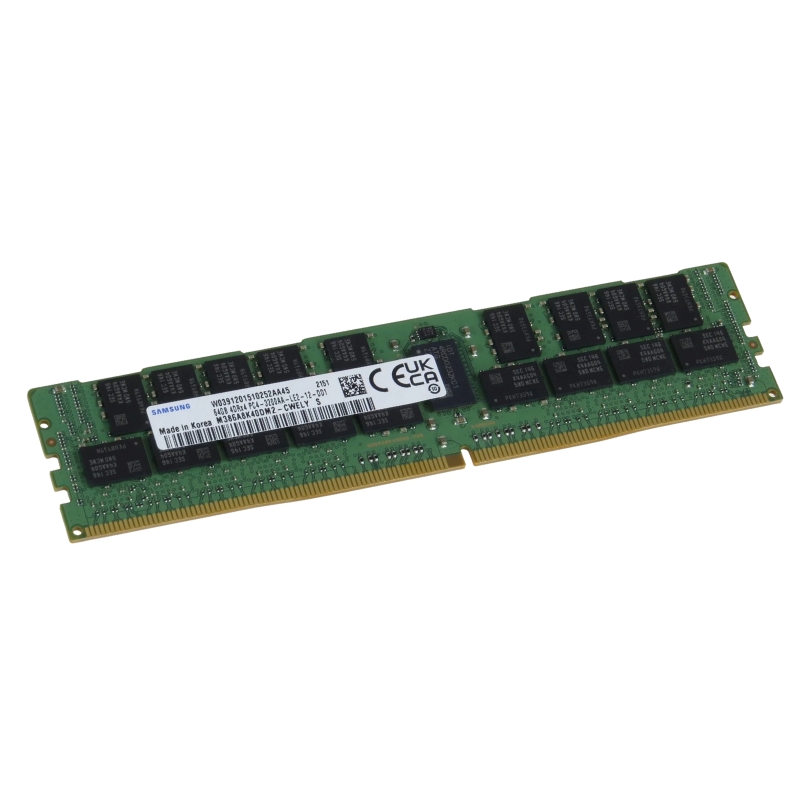


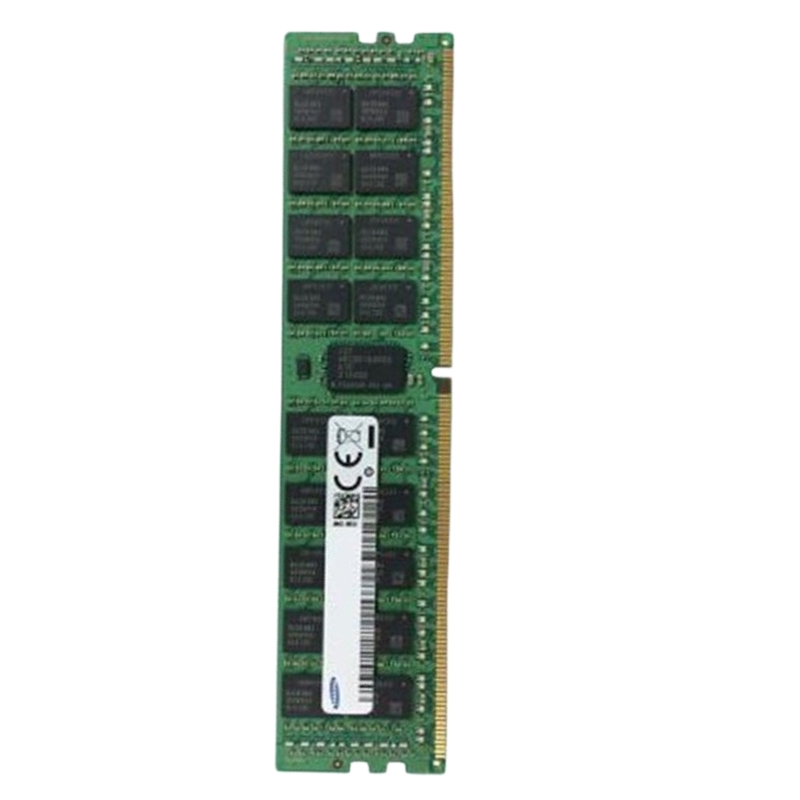
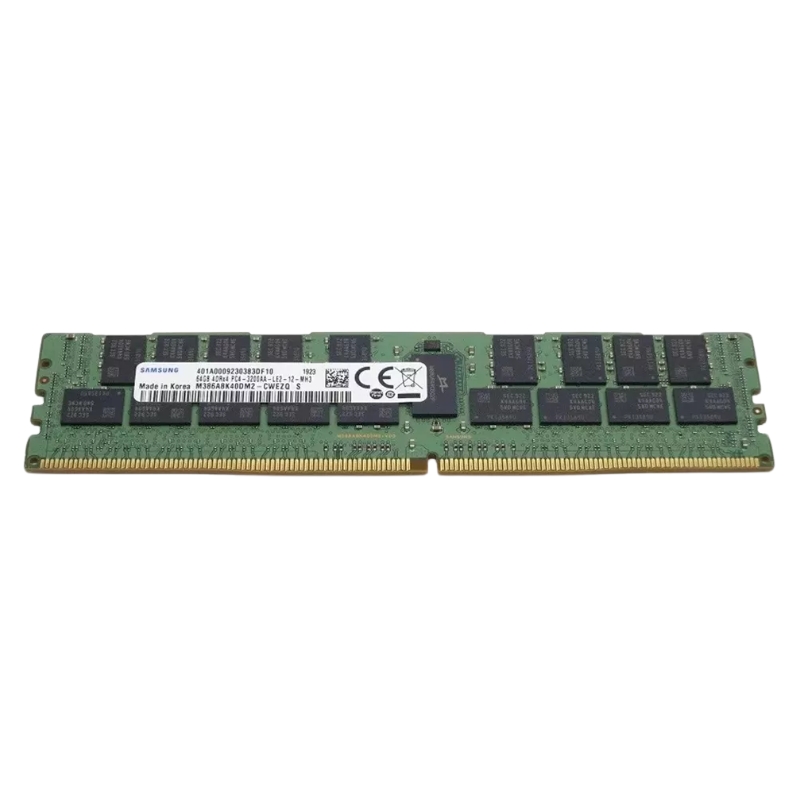
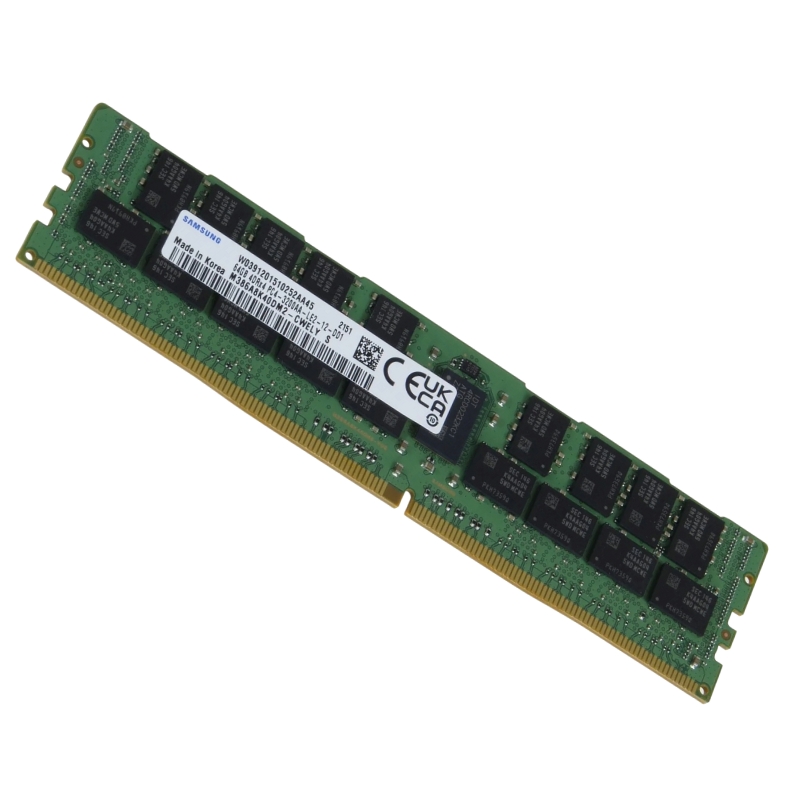
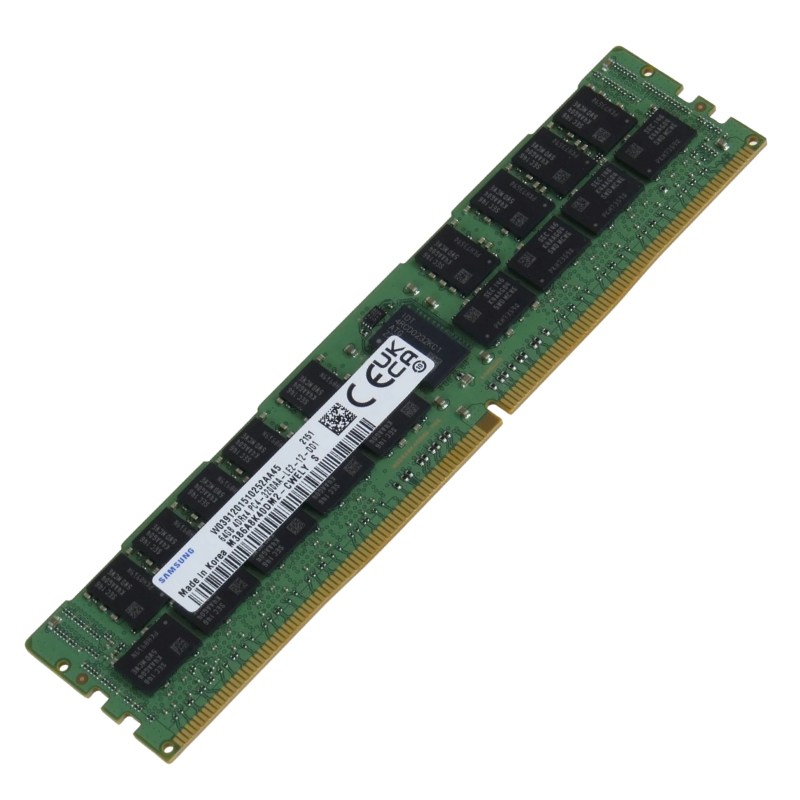
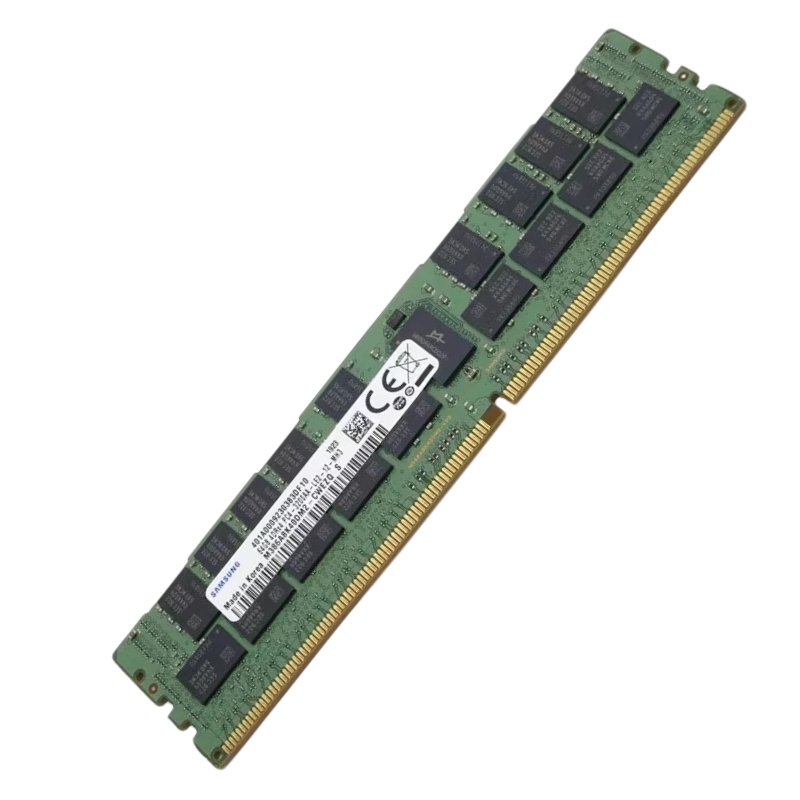
Samsung M393A8G40CB4-CWE 64GB RDIMM PC4-25600 Memory Module. New (System) Pull with 1 year replacement warranty
| SKU/MPN | Warranty | Price | Condition | You save |
|---|---|---|---|---|
| M393A8G40CB4-CWE | 1 Year Warranty | $1,198.00 | New (System) Pull | You save: $419.30 (26%) |
| M393A8G40CB4-CWE | 1 Year Warranty | $1,870.00 | New Sealed in Box (NIB) | You save: $654.50 (26%) |
The Samsung M393A8G40CB4-CWE RDIMM is an exceptional memory module that offers a remarkable capacity of 64GB. With such a high capacity, this RDIMM is perfect for users who require a significant amount of memory to handle demanding tasks and applications.
In the mission-critical environment of servers and data centers, memory reliability is paramount. This is where Error-Correcting Code (ECC) Registered DIMMs (RDIMMs) come into play. The Samsung M393A8G40CB4-CWE is a quintessential example of this specialized memory class, engineered to deliver not only high capacity and performance but also exceptional data integrity and system stability.
Samsung's model numbers are a detailed blueprint of the module's specifications. Breaking down "M393A8G40CB4-CWE" provides a complete technical profile without needing to look at a datasheet. The 'M3' signifies a DDR4 module. The '93' indicates it is a Registered DIMM (RDIMM) with ECC. The 'A8G40' reveals the component density and organization; here, it points to 8Gb components arranged in a specific configuration to achieve the total 64GB capacity. The 'C' denotes the revision of the module's PCB. The 'B4' often references the specific DRAM chip type and speed grade. Finally, the suffix '-CWE' is a critical commercial code where 'C' typically represents the standard commercial temperature range (0°C to 85°C) and 'WE' often signifies a general product family or marketing code. Understanding this nomenclature allows IT purchasers and system integrators to precisely identify compatible and suitable memory for their platforms.
This module embodies a set of precise technical characteristics that define its performance envelope and compatibility. Below is a comprehensive breakdown of its core specs.
The module offers a substantial 64GB (Gigabytes) of memory capacity in a single module. This is achieved using high-density 8-gigabit (Gb) DRAM chips. The "(1x64GB)" notation specifies that this is a single-module kit. The configuration "2Rx4" is crucial: it means the module is dual-ranked (2R) and has a x4 data width per DRAM chip. Dual-rank modules allow the memory controller to interleave accesses between the two ranks, potentially improving performance under certain workloads compared to a single-rank module of the same capacity. The x4 organization (as opposed to x8) is common in higher-capacity server modules and is fully supported by modern server platforms.
The 64GB density is ideal for maximizing total system memory in servers with a limited number of memory slots. For example, a dual-processor server with 16 slots per CPU could support up to 2 Terabytes of RAM using these modules. The 2R design balances performance and loading on the memory channel, ensuring stable operation in fully populated configurations.
The module is built with a specific number of 8Gb DDR4 SDRAM chips. The 2Rx4 configuration with ECC requires 18 chips per rank (16 for data and 2 for ECC) for a x72-bit wide module. With two ranks, this typically totals 36 DRAM chips on the PCB, alongside the vital registering clock driver (RCD) chip that buffers the command/address signals, a hallmark of RDIMMs.
Performance is defined by speed, latency, and data transfer rate, all of which are meticulously specified for this module.
The module operates at a data rate of 3200 Megatransfers per second (MT/s), commonly referred to as 3200 Mbps. This is the peak speed at which data can be transferred on the bus. In terms of industry classification, this speed corresponds to a PC4-25600 rating. The "PC4" denotes DDR4, and the "25600" represents the theoretical maximum bandwidth in megabytes per second (MB/s) for the module (3200 MT/s * 8 bytes = 25,600 MB/s).
The module's CAS Latency (CL) is 22 cycles at its rated speed of 3200 MT/s. Timings are often listed as a series of numbers (e.g., CL22-22-22). These represent critical delays (CAS Latency, Row Address to Column Address Delay, Row Precharge Time) measured in clock cycles. While higher speeds can sometimes lead to higher CL numbers, the overall absolute latency in nanoseconds is a key metric. At 3200 MT/s (cycle time of 0.625ns), a CL22 translates to an absolute latency of 13.75 nanoseconds. This balance of high bandwidth and managed latency is tailored for enterprise workloads.
The module operates at the standard DDR4 voltage of 1.2 volts, which is significantly lower than the 1.5V of older DDR3 technology. This reduction directly decreases power consumption and heat generation within the server chassis, contributing to lower and improved energy efficiency in data centers. The module supports various power-saving states as defined by the JEDEC specification.
The "ECC Registered" in the module's description highlights its two most important server-grade features, which differentiate it fundamentally from consumer memory.
ECC is a non-negotiable feature for data integrity in servers. It can detect and correct the most common type of memory errors—single-bit errors—on the fly, without any intervention from the operating system. When a single-bit error occurs, the ECC circuitry identifies the faulty bit and corrects it before the data is sent to the CPU. It can also detect, though not correct, multi-bit errors, alerting the system to a more serious problem. This functionality prevents silent data corruption, system crashes, and application faults that could result from cosmic rays, electrical interference, or component aging. The Samsung M393A8G40CB4-CWE includes an additional ECC chip on each rank to provide this essential protection.
For every 64-bit data word, the module stores an additional 8 bits of parity information, making it a 72-bit wide module. This allows the memory controller to use advanced algorithms (like Single Error Correction, Double Error Detection - SECDED) to verify data accuracy and make corrections in real-time, ensuring the integrity of database transactions, financial calculations, and scientific simulations.
The "Registered" or "Buffered" aspect is equally critical for system scalability. An RDIMM places a register, called the Registering Clock Driver (RCD), between the memory controller and the DRAM chips. This RCD buffers the command and address signals, reducing the electrical load on the memory controller.
By buffering these signals, the memory controller sees only one electrical load per RDIMM (the RCD) instead of the combined load of all the DRAM chips on the module. This dramatically improves signal integrity, allows for more memory modules to be installed per memory channel without timing degradation, and enables the support of higher capacities. It is the technology that makes populating a server with 64GB modules across multiple channels a stable and reliable proposition. The slight additional latency introduced by the RCD (typically one clock cycle) is a worthwhile trade-off for the immense gains in capacity and stability.
Proper physical and electrical compatibility is essential for a successful upgrade or system build.
The module uses the standard 288-pin interface defined for DDR4 RDIMMs. The pin layout and the position of the notch on the connector are specifically different from DDR3 modules and from DDR4 Unbuffered DIMMs (UDIMMs) to prevent accidental insertion into an incompatible socket. The RDIMM is typically longer than a standard UDIMM and is keyed differently. It is imperative to verify that the target server or motherboard supports DDR4 RDIMMs specifically.
The Samsung M393A8G40CB4-CWE is designed for servers and workstations based on Intel Xeon Scalable processors (e.g., Purley, Cascade Lake, Cooper Lake platforms) and compatible AMD EPYC platforms that support DDR4 3200 MT/s RDIMMs. It is not compatible with desktop platforms (which require UDIMMs) or with systems designed for Load-Reduced DIMMs (LRDIMMs). Always consult the system manufacturer's Qualified Vendor List (QVL) or memory compatibility tool to ensure this specific module has been validated for a particular server model.
The QVL is a list of memory modules (including specific part numbers like M393A8G40CB4-CWE) that the server OEM has rigorously tested in their system. Using a module from the QVL guarantees compatibility, performance, and the retention of system warranty. It confirms that the module's subtimings, firmware (SPD), and electrical characteristics are tuned for that specific platform.
This memory module is suited for demanding enterprise and data center workloads that require large, reliable memory pools.
In virtualized environments running VMware, Hyper-V, or KVM, physical memory is the critical resource that limits the number of virtual machines (VMs) a host can run. High-capacity 64GB RDIMMs allow administrators to build hosts with massive amounts of RAM, enabling higher VM density, improved performance, and more efficient consolidation of servers.
Technologies like SAP HANA, Oracle Database In-Memory, and Microsoft SQL Server In-Memory OLTP deliver extreme performance by storing and processing data primarily in RAM. These applications demand not only high capacity but also the absolute data integrity provided by ECC to ensure business-critical data is never corrupted.
Scientific simulations, financial modeling, and machine learning training often involve processing enormous datasets that must be held in memory. The high bandwidth of DDR4-3200 accelerates these computations, while ECC ensures the accuracy of the results, which is especially crucial in research and financial outcomes.


 Contact Us
 Information
 Catalog
 Solid State Drives (SSD)
 Network Switches
 Hard Disk Drives
 HBA & Controllers
 PC & Servers
 PC & Server Memory
 CPU & Processors
 Network Routers
 Power Supplies
 Tape Drives & Libraries
 Network Devices
 Computer & Network Cables