
(7% discount is applied at checkout)
Cart is empty
Your go-to destination for cutting-edge server products
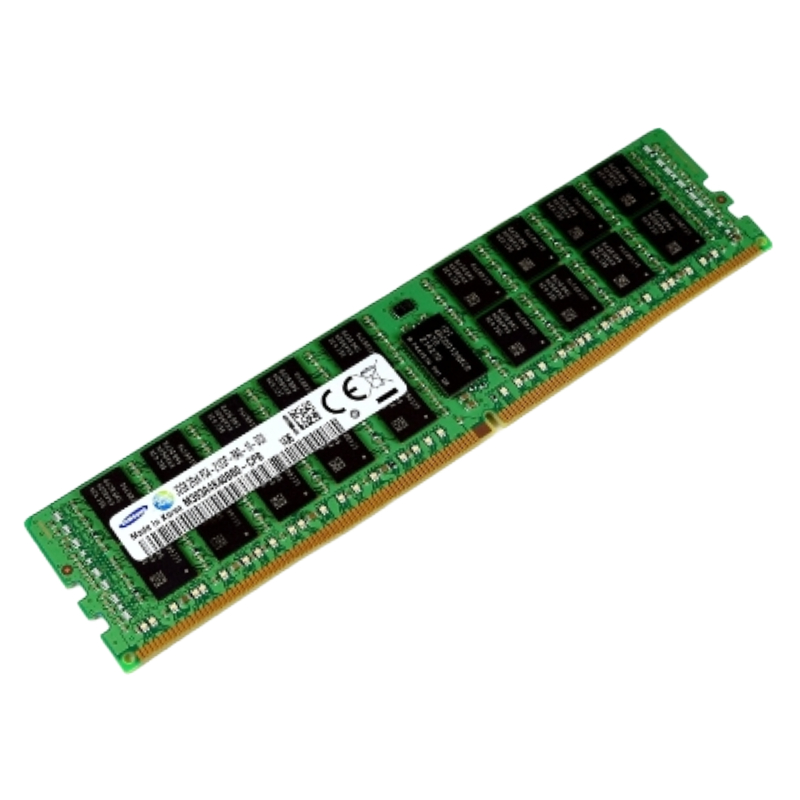
Samsung M393A8G40CB4-CWEBY 64GB RDIMM PC4-25600 Memory Module. New Sealed in Box (NIB) with 3 Years Warranty
In the realm of enterprise computing and data center management, memory is a critical component that directly influences system performance, stability, and capacity for workload handling. The Samsung M393A8G40CB4-CWEBY represents a pinnacle of server-grade memory technology, engineered to meet the rigorous demands of modern servers, high-performance computing (HPC), and sophisticated virtualization environments.
In the demanding landscape of enterprise computing and data center operations, memory is not merely a component; it is the lifeblood of system performance, stability, and scalability. The Samsung M393A8G40CB4-CWEBY 64GB DDR4 RDIMM represents a critical building block for modern servers, engineered to deliver uncompromising reliability, high bandwidth, and massive capacity in a single module. This memory module is meticulously designed for deployment in servers, high-performance workstations, and storage systems where error-free operation and data integrity are non-negotiable. As a registered, ECC-enabled RDIMM, it goes beyond standard memory to provide the advanced features necessary for mission-critical environments, ensuring that system uptime is maximized and data corruption is prevented.
At its heart, the M393A8G40CB4-CWEBY is a technological marvel built on Samsung's proven semiconductor expertise. Its specifications define a module suited for heavy, sustained workloads.
This module offers a substantial 64GB (Gigabytes) of memory in a single 288-pin package. The configuration is denoted as 1x64GB, meaning it is a single module providing 64GB of capacity. Its internal organization is 2Rx4, which stands for Dual Rank, x4 data width. A dual-rank module effectively allows the memory controller to access two sets of memory chips on the same module in an interleaved fashion, improving performance by reducing access latency and increasing bandwidth efficiency compared to single-rank modules in many server workloads.
In a server environment, memory is accessed continuously, and even minor cosmic rays or electrical interference can cause a memory cell to flip its bit (a "soft error"). ECC memory includes extra bits (e.g., 8 bits for every 64-bit word) to store an encrypted code. When data is read, the memory controller recalculates the code and compares it to the stored one. If a single-bit error is detected, it is corrected instantly and transparently to the system. For multi-bit errors, the system is alerted. This proactive correction maintains system stability and data accuracy, which is vital for financial databases, scientific computations, and cloud hosting infrastructure.
It is important to distinguish this RDIMM from LRDIMM (Load-Reduced DIMM) and UDIMM (Unbuffered DIMM). LRDIMMs use an additional buffer for data lines to further reduce load, enabling the very highest capacity systems. UDIMMs have no buffer, offering lower latency but severely limiting the number of modules that can be installed reliably; they are suited for desktops and entry-level servers. The Samsung M393A8G40CB4-CWEBY RDIMM strikes the ideal balance for mainstream enterprise servers, offering high capacity with robust signal integrity.
The module's speed of 3200 Megatransfers per second (MT/s) is often referred to as "DDR4-3200." This translates to a theoretical peak bandwidth of 25,600 Megabytes per second (MB/s), derived from the formula: (3200 MT/s * 64-bit data bus) / 8 bits per byte = 25,600 MB/s. The "PC4-25600" nomenclature is the module naming convention that reflects this 25,600 MB/s bandwidth. This high bandwidth is crucial for data-intensive tasks such as in-memory databases (like SAP HANA), large-scale virtualization, and real-time analytics, where the speed of data movement between CPU and RAM is a key bottleneck.
Samsung's part numbering system reveals key details. 'M393' indicates a registered DIMM. 'A' signifies that it is an 8Gb-based module (density of the individual DRAM chips). '8G40' breaks down into the capacity (8G for 64GB total, derived from 8Gb chips organized) and the data width (x4). 'CB4' refers to the specific revision and design of the component. The suffix 'CWEBY' denotes the speed grade (3200 Mbps), voltage (1.2V), and other product line specifics, aligning perfectly with its advertised performance metrics.
The module operates at a data rate of 3200 Megatransfers per second (MT/s), often marketed as 3200MHz. This translates to a peak bandwidth of 25,600 MB/s per module, which is why it is classified under the PC4-25600 designation (PC4 for DDR4, 25600 for the bandwidth in MB/s). The column address strobe latency (CL) is rated at CL22. While latency timings are important, in server environments, the combination of high bandwidth, massive capacity, and rock-solid stability often takes precedence over ultra-low latency, making this speed bin ideal for data-intensive applications.
What truly distinguishes server memory like the M393A8G40CB4-CWEBY from consumer-grade DIMMs are the advanced technologies implemented to ensure fault tolerance and system integrity.
ECC is a non-optional feature for any serious server deployment. This module includes dedicated extra bits to detect and, more importantly, correct the most common types of data corruption (single-bit errors) in real-time. Multi-bit error detection is also provided. This happens transparently to the operating system and applications, preventing silent data corruption that could lead to application crashes, computational errors, or database corruption. In 24/7 operational environments, ECC memory is the first line of defense against soft memory errors caused by cosmic rays, electrical interference, or other factors.
For every 64-bit data word, the module stores an additional 8 bits of ECC code. When data is written, a checksum is calculated and stored with it. Upon readback, the checksum is recalculated and compared. A mismatch triggers correction logic to fix the error before the data is sent to the CPU. This process ensures the integrity of every piece of data processed by the server.
The "Registered" in RDIMM refers to the presence of a register, or buffer, placed between the memory controller and the DRAM chips on the module. This register buffers the command, address, and control signals, reducing the electrical load on the memory controller.
By reducing the electrical load, an RDIMM allows a server system to support a significantly greater number of memory modules per channel (typically 2 or 3) and a higher total capacity of memory without signal degradation. This makes the M393A8G40CB4-CWEBY ideal for populating multi-socket servers with large memory quotas, enabling high-capacity configurations essential for virtualization, in-memory databases, and large-scale data analytics. It should be noted that the buffering adds a slight latency penalty (typically one clock cycle), but this is a worthwhile trade-off for the substantial gains in system capacity and stability.
Operating at a standard DDR4 voltage of 1.2V, this module balances performance with power efficiency. Lower voltage compared to previous-generation DDR3 means reduced power consumption and heat generation per module, a critical factor when deploying dozens or hundreds of modules in a data center rack. The module is designed with enterprise-grade thermal management in mind, ensuring stable operation within the extended temperature ranges typical of server chassis.
The Samsung M393A8G40CB4-CWEBY is not a universal memory module; it is engineered for specific enterprise platforms.
This RDIMM is designed for servers and workstations powered by Intel Xeon Scalable processors (from the Purley platform onwards, e.g., Cascade Lake, Ice Lake) and compatible AMD EPYC platforms that support registered DDR4 memory. It is crucial to verify compatibility with the specific server model and motherboard's Qualified Vendor List (QVL) before deployment. Using a module from the QVL guarantees it has been tested and validated by the system manufacturer for optimal performance and reliability.
For optimal performance, servers must follow strict guidelines for populating memory channels. These rules, detailed in the server's technical manual, dictate the order in which slots should be filled (often starting with the slot farthest from the CPU). Mixing this module with other capacities, speeds, or ranks in the same channel can force all modules to run at the lowest common speed and timings, or may cause the system to fail to boot. It is strongly recommended to use identical modules (same part number) across all slots in a system for best results.
The combination of high capacity, robust bandwidth, and ECC protection makes this module exceptionally well-suited for a wide array of demanding enterprise applications.
In virtualization hosts (using VMware vSphere, Microsoft Hyper-V, KVM, etc.), large memory pools are essential to host numerous virtual machines (VMs). A single server equipped with multiple 64GB RDIMMs can support hundreds of VMs, improving consolidation ratios and operational efficiency. The ECC protection is vital for the stability of the entire virtualized environment.
Platforms like SAP HANA, Oracle TimesTen, and various big-data analytics frameworks (e.g., Apache Spark) leverage vast amounts of system RAM to process data at unprecedented speeds. The 64GB capacity per module allows for the assembly of terabyte-scale in-memory databases, drastically reducing query times and accelerating business intelligence. The 3200MT/s bandwidth ensures data can flow rapidly between the CPU and memory.
Scientific computing, financial modeling, and engineering simulations require both high memory capacity and bandwidth to handle large datasets and complex calculations. The reliability offered by ECC is non-negotiable in these fields, as a single memory error could invalidate days of computation.


 Contact Us
 Information
 Catalog
 Solid State Drives (SSD)
 Network Switches
 Hard Disk Drives
 HBA & Controllers
 PC & Servers
 PC & Server Memory
 CPU & Processors
 Network Routers
 Power Supplies
 Tape Drives & Libraries
 Network Devices
 Computer & Network Cables